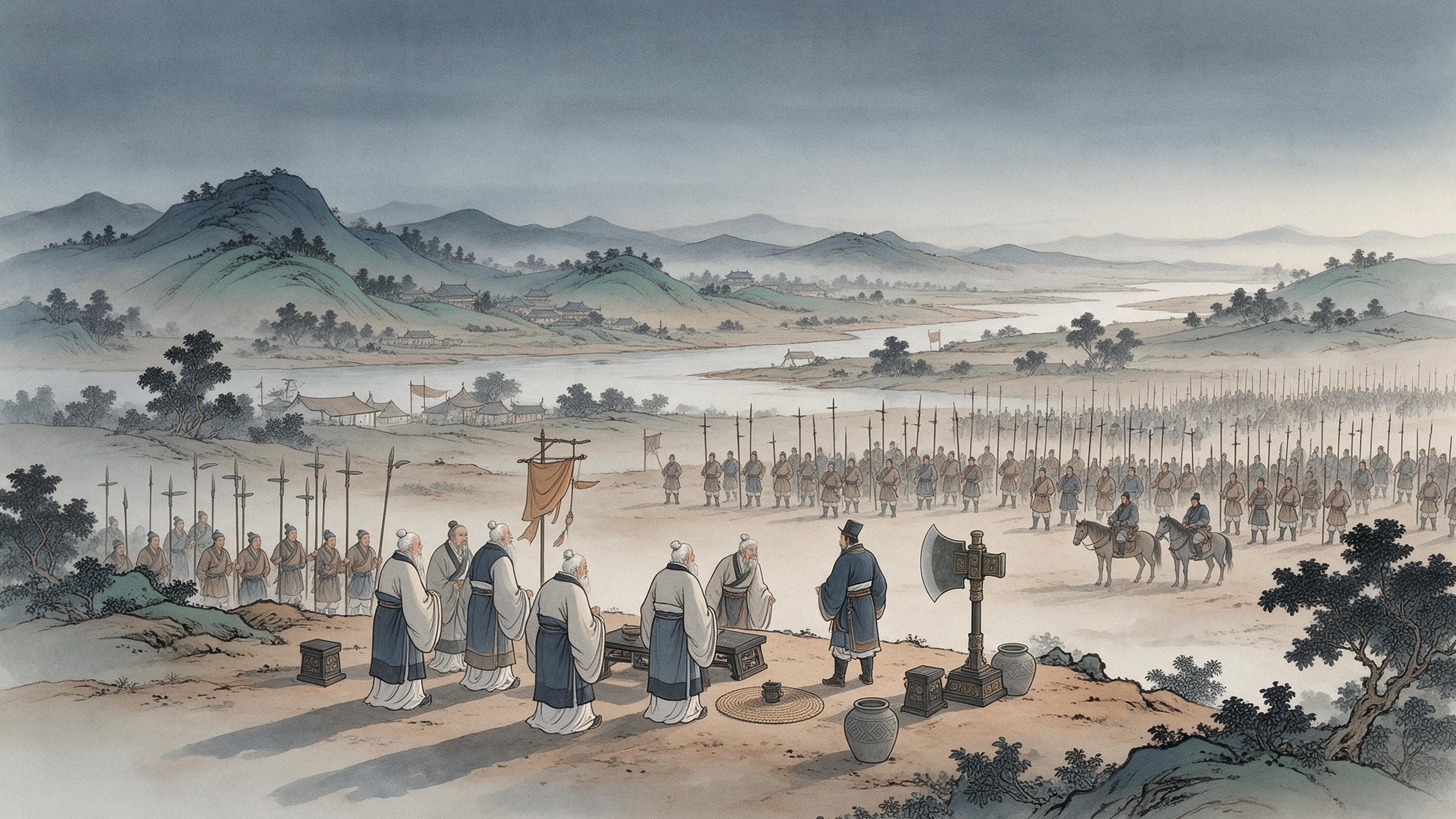
A Qin altar had a shopping list. The Han treatise on sacrifices gives one for the four altars at Yong: 'altar colts four; wooden dragons, one team; wooden carriages and horses, one team, each in the colour of its emperor; yellow calves and lambs four each; jades and silks in set numbers — all buried alive, with no stands or dishes for serving' (畤駒四匹……皆生瘞埋,無俎豆之具). Four real horses, four wooden dragons, four wooden carriages: buried, not eaten. Not a meal set before a god, but a payment put into the ground.
One: the zhi, once in three years
These altars are called zhi (畤). The page lays out how each was founded: Duke Xiang made the Western Zhi to the White Emperor; Duke Wen the Fu Zhi, 'with the three victims'; Duke Xuan the Mi Zhi south of the Wei, to the Blue Emperor; Duke Ling the Upper Zhi to the Yellow Emperor and the Lower Zhi to the Yan Emperor; Duke Xian, after it rained gold, the Wei Zhi to the White Emperor. One emperor to one altar, one altar to one place.
The schedule is plain: 'once in three years a suburban sacrifice' (三年一郊); and 'because Qin took the tenth month as the head of the year, they went up to the suburban meeting in the tenth month, passed the beacon fires, bowed beside Xianyang, and wore white' (秦以十月為歲首……而衣上白). Victims changed with the season — 'in spring and summer a red bull, in autumn and winter a bay' — and other sacrifices filled the year — the spring prayer when the ice breaks, the winter thank-offering, the tasting of colts in the fifth month. A textual note: the page prints 唯雍四時上帝為尊 where the same paragraph writes 畤, evidently a slip; quoted as printed and flagged.
Two: the word jiao
The word jiao is explained once, by officials to Emperor Wen: 'in antiquity the Son of Heaven sacrificed in person in summer, worshipping Shangdi in the suburbs, hence it is called jiao' (古者天子夏親郊,祀上帝於郊,故曰郊). Then an instance: 'in the fourth month of summer Emperor Wen first sacrificed in the suburbs to the five altars at Yong, and his robes were all red' (夏四月……衣皆上赤). He 'bowed in person at the junction of the Ba and Wei… the beacon fires were raised, as if a glow joined the sky'. The Han added a fifth god — a shrine to the Black Emperor — but 'the emperor did not go in person'.
Three: Ganquan and Fenyin
Emperor Wu moved the altars. Miao Ji of Bo told him: 'among the gods of Heaven the noblest is Taiyi, and Taiyi's assistant is the Five Emperors.' At Ganquan the altar was built 'three gai high, with the five emperors' altars ringed below it, each in its direction, the Yellow Emperor to the south-west'. Two words must be kept apart: the Tai altar (泰畤) is the altar, Taiyi (泰一) the god. The offerings: 'what is used is like one altar at Yong, with sweet wine, dates and dried meat added; one dark ox is killed to furnish the stands… the ox is white, a deer is placed inside it and a pig inside the deer. The sun is sacrificed to with an ox, the moon with a sheep and a pig.' The Taiyi priest 'wore purple and embroidery'.
The first imperial sacrifice is dated: 'on the winter solstice, the first day of the eleventh month, at first light, the Son of Heaven first sacrificed in the suburbs to Taiyi; in the morning he faced the sun, in the evening he faced the moon, and bowed' (十一月辛巳朔旦冬至……天子始郊拜泰一). The scene: 'the sacrifice had fires ranged all over the altar, with cooking vessels beside it.' For earth he went to Fenyin, on one line of reasoning: 'now Your Majesty sacrifices in person to Shangdi, but there is no sacrifice to Houtu, so the rite is not answered' (今上帝朕親郊,而后土無祀,則禮不答也). Five altars on a round mound in a marsh, one yellow calf each, all buried afterwards, attendants in yellow; a man of Fenyin 'saw a light like red silk beside the Fen'.
Four: five moves in thirty years
Under Emperor Cheng the altars came back. Chancellor Heng and the censor Tan argued: 'of the business of kings nothing is greater than receiving the order of Heaven, and of receiving it nothing is weightier than the suburban sacrifice'; and 'to sacrifice to Heaven in the southern suburb is to follow the yang; to bury to earth in the northern suburb is the image of yin' (祭天於南郊,就陽之義也;瘞地於北郊,即陰之象也). The old sites, they said, lay the wrong way: 'the suburban meeting with august Heaven is instead to the north, the dark yin, and the sacrifice to Houtu is instead to the east, the young yang'. They counted the road too: to Yunyang 'through valleys and gorges, narrow and a hundred li'; to Fenyin one crosses the great river, 'with wind, waves and the danger of boats'.
Then they moved back. 'Because there was as yet no imperial grandson', Ganquan and Hedong were restored; later, 'because in the end no blessing came', the Chang'an suburbs; then again Ganquan and Fenyin, for fear over an emperor's illness, 'and again no blessing came'. The treatise's summary is one line: 'in the space of some thirty years, the shrines of Heaven and Earth moved five times' (三十餘年間,天地之祠五徙焉). Nor did the emperor always go: under Emperor Yuan the pattern was 'every other year, in the first month, one visit to Ganquan for the suburban sacrifice to the Tai altar, then east to Hedong for Houtu, west to Yong for the five altars', five such services in all.
Five: Wang Mang fixes the solstices
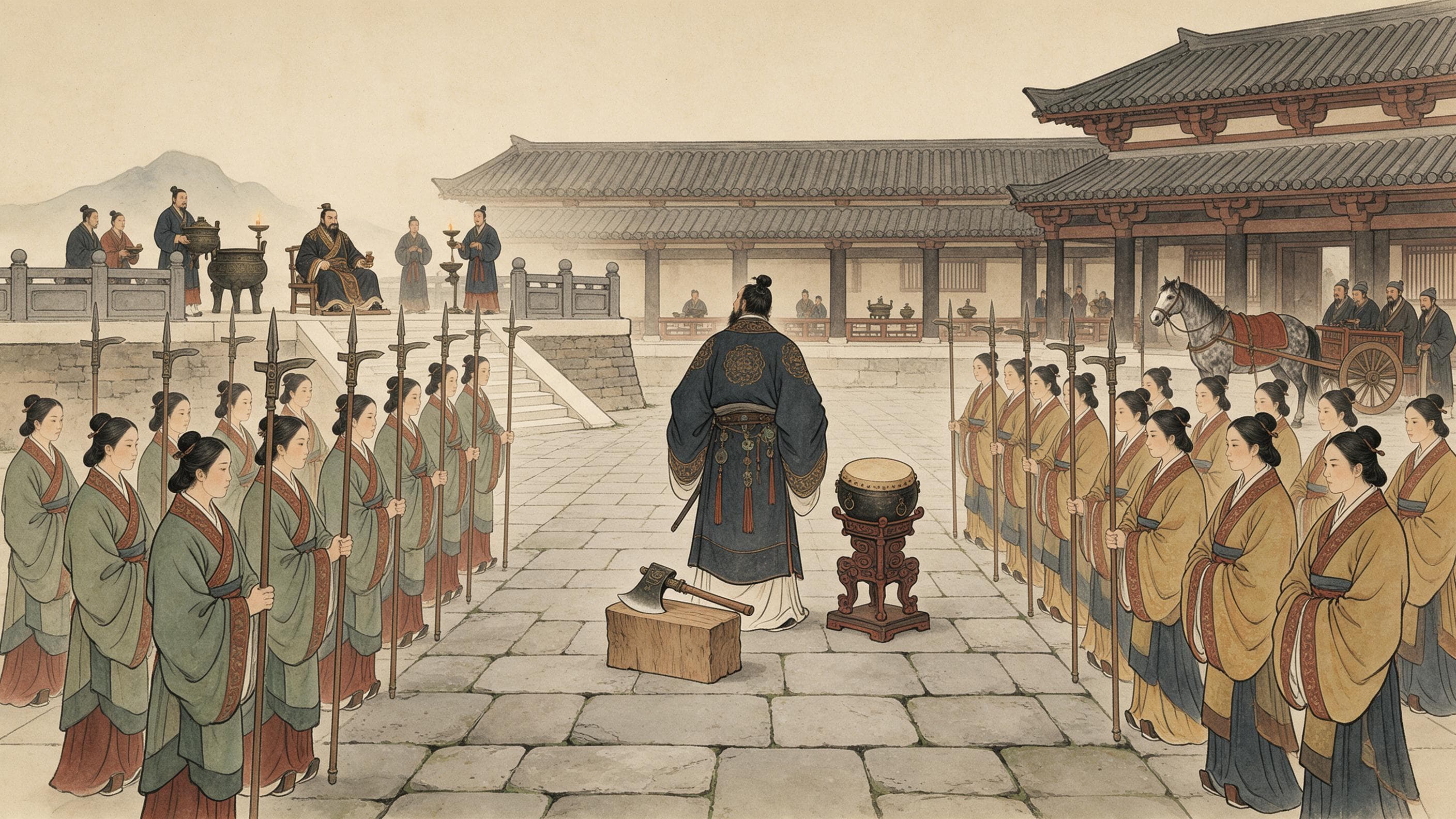
Under Emperor Ping, Wang Mang restored the two suburbs and fixed their dates: 'at the winter solstice let officials present the sacrifice in the southern suburb, with Emperor Gao as correlate, gazing toward the hosts of yang; at the summer solstice in the northern suburb, with Empress Gao, toward the hosts of yin.' The decisive sentence follows: 'at these seasons the empress does not inspect the regions, and so the Son of Heaven does not go in person but sends officials' (故天子不親而遣有司). The victims are counted: 'one calf for Heaven and Earth, one for the fire and the burial, one for Emperor Gao and Empress Gao'; 'the victim is a calf whose horns are like a cocoon or a chestnut' (牲用繭栗) — generally taken to mean a young beast, though the page does not gloss it.
Wang Mang also sorted the gods into five groups with their directions — Yellow at the centre, Blue in the eastern suburb, Red in the southern, White in the western, Black in the northern — after which 'the shrines and altars around Chang'an were very numerous'. His last years give the treatise its closing figure: 'one thousand seven hundred shrines, using more than three thousand kinds of victims, birds and beasts; later they could not supply them, and so used chickens for ducks and geese, and dogs for deer and elk' (以雞當鶩鴈,犬當麋鹿).
What the pages do not give: any size for an altar beyond the words 'three gai', any number of participants, any cost, any titles for the music — and no gloss on what a gai is (generally taken to mean a tier). This piece estimates no areas and converts no victims into modern weights or prices. One line must be drawn hard: the suburban sacrifice is a scheduled rite at the edge of a capital, while the same Han treatise carries a long section on the sacrifices at Mount Tai, a different, one-off subject not quoted here. So this piece keeps to place, date and offerings, and does not argue that the rite proved Heaven's mandate; neither page says that.
Related reading:Golden Elixir: What Ge Hong Cooked on Mount Luofu · Which Books Burned: The Qin Book Order, Item by Item · The Shang Colour: White, Noon, and a Carriage
Sources & further reading
- 《汉书》卷二十五〈郊祀志〉上、下(维基文库本,未与点校本复核) — The Han treatise, one page carrying both halves, from Qin to Wang Mang. It supplies the Qin altars and their victim list ('altar colts four; wooden dragons, one team of four; wooden carriages and horses, one team of four, each in the colour of its emperor… all buried alive; no stands or dishes' 畤駒四匹,木寓龍一駟……皆生瘞埋,無俎豆之具), the schedule ('once in three years a suburban sacrifice' 三年一郊; 'Qin took the tenth month as the head of the year… wore white' 秦以十月為歲首……而衣上白), Chancellor Heng's memorial under Emperor Cheng (祭天於南郊,就陽之義也;瘞地於北郊,即陰之象也), 'in some thirty years the shrines of heaven and earth moved five times' (三十餘年間,天地之祠五徙焉), Wang Mang's solstice arrangement with 'the Son of Heaven does not go in person but sends officials' (故天子不親而遣有司), and the closing figures of 1,700 shrines and chickens substituted for ducks. Page faults to note: the Qin passage prints 唯雍四時上帝為尊 where the same paragraph elsewhere writes 畤, evidently a slip for 畤; the sentence 文公薨黃蛇自天下屬地 does not parse and is not used here; the page writes 地 as 墬 throughout the Wang Mang section. No commentary is on the page.
- 《史记》卷二十八〈封禅书〉(维基文库本,未与点校本复核) — Used only for its Han section, and only for the suburban altars. It supplies the one gloss of the word jiao ('in antiquity the Son of Heaven sacrificed in person in summer, worshipping Shangdi in the suburbs, hence jiao' 古者天子夏親郊,祀上帝於郊,故曰郊), Emperor Wen's first suburban sacrifice in the fourth month dressed in red, Emperor Wu's Taiyi altar at Ganquan (壇三垓;五帝壇環居其下……其牛色白,鹿居其中,彘在鹿中;列火滿壇) and his Houtu altars at Fenyin. Two page faults: 天字始郊拜太一 stands for 天子始郊拜太一, and the ox is written 貍牛 where other texts read 氂牛; both are quoted as printed and flagged. The chapter also contains a long section on Mount Tai which this piece does not use. The 太史公曰 and 索隱述贊 at the end are comment, not record, and are not quoted.