The last item on the Jingzhou list in the Yugong is a turtle. The list gives feathers, hair, teeth and hides; three metals; several timbers; whetstones, drills and cinnabar; several bamboos — and then one line: 'the Nine Rivers send in a great turtle' (九江納〔入〕錫〔賜〕大龜). A tribute list from a Warring States text, one line from a list of nine provinces, and its final entry is a shell. The other page, the Shiji's chapter on shells and stalks, says how such a shell was used and kept — and that it was thrown away after use. Both pages are later texts; neither is a Shang record.
One tribute item: the turtle of the Nine Rivers
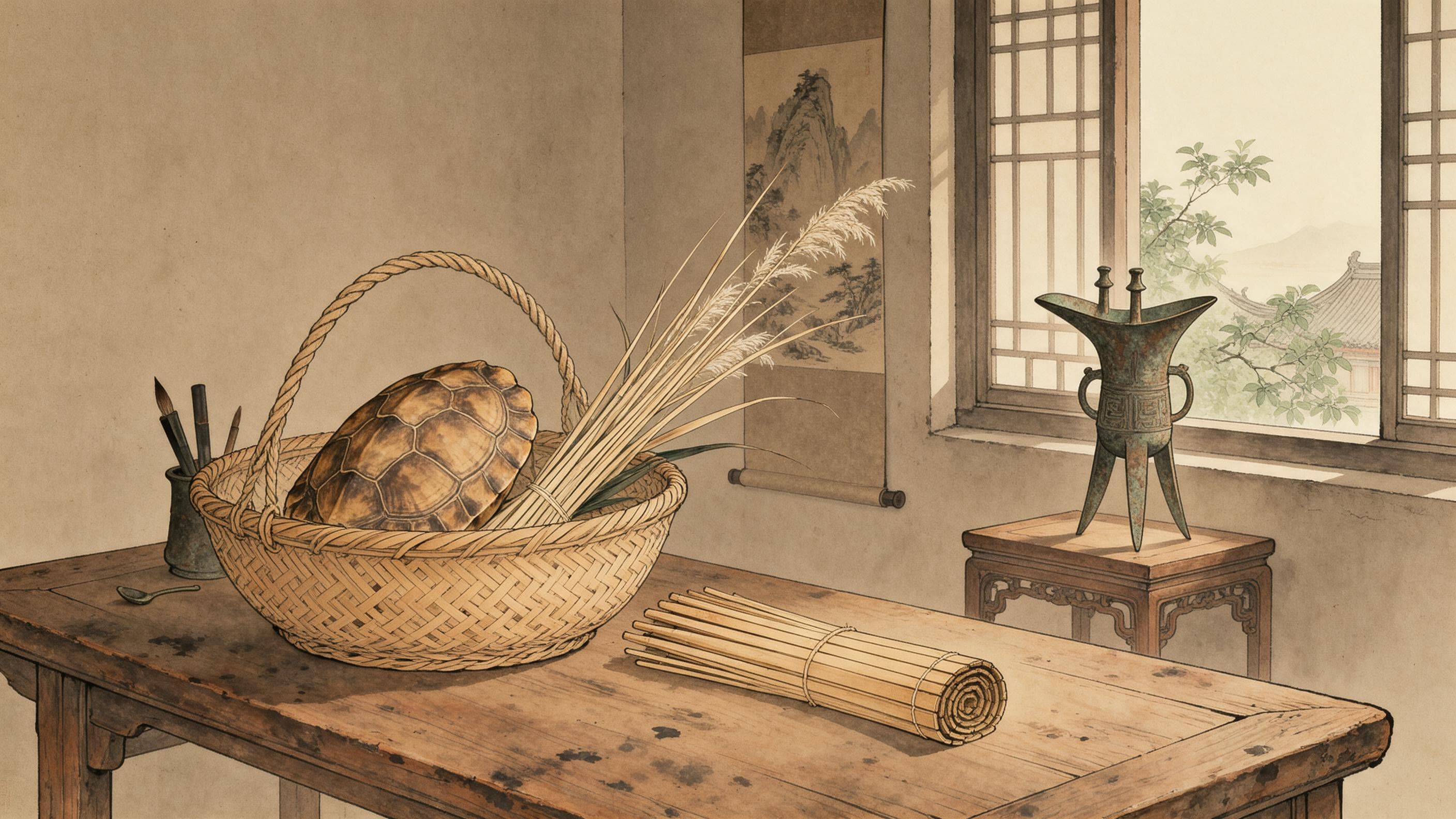
The chapter runs province by province, giving the mountains and rivers first and the tribute after. Here is the Jingzhou entry as written: 'its tribute: feathers, hair, teeth, hides; the three metals; the wood of the chun, gan, gua and cypress; whetstones, hones, arrowheads and cinnabar; the bamboo of several kinds, of which the three states send the named sorts. Wrapped and boxed, the fragrant mao grass; in baskets, dark and crimson silks and strings of pearls; the Nine Rivers send in a great turtle' (九江納〔入〕錫〔賜〕大龜). It is a list: it answers what came from where and nothing else. It does not describe divination, and it does not give the shell's size. Even the bamboo is itemised by name — 'the three states send up the named sorts' (三邦厎貢厥名). The same chapter's Yangzhou entry, with its 'basket of woven shell' (厥篚織貝), is the same kind of item.
One thing in that line needs saying. The page prints 納〔入〕錫〔賜〕 — the characters in brackets are variant readings added by the transcription, so that 納 can be read 入 and 錫 can be read 賜: 'send in a great turtle' against 'bestow a great turtle'. Both readings stand; this article copies the page and does not decide which was original. If the wording of a tribute list is already this unsettled, treating it as a direct record of Shang institutions needs more caution still.
The other page: how a shell was taken and kept
The Shiji chapter opens with a general rule: 'when a king decides doubtful matters he consults the milfoil and the shell, and cuts the knot with them — this is the unchanging way' (王者決定諸疑,參以卜筮,斷以蓍龜,不易之道也). That is a Han writer's statement of an institution, not a Shang document. The same opening concedes a limit — 'above Tang and Yu nothing can be recorded' (唐虞以上,不可記已) — and says the three dynasties each had their own omens (自三代之興,各據禎祥).
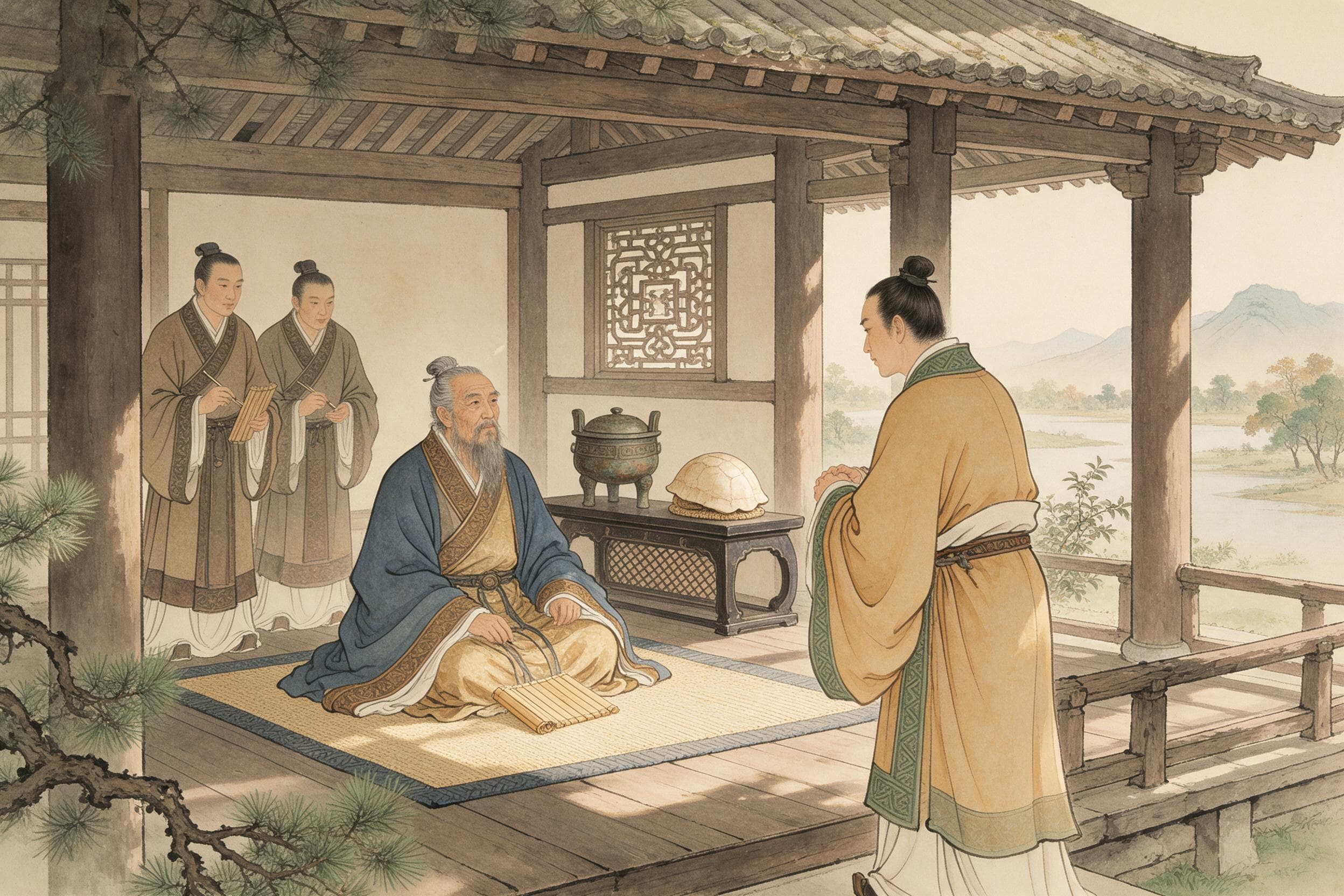
The sentence the article turns on is this: 'I have heard in outline that when the Xia and Yin wished to divine they took up the milfoil and the shell, and when done threw them away, holding that a shell kept in storage loses its numen and milfoil kept long loses its spirit. It was the diviners of the Zhou house who kept them as treasures' (略聞夏殷欲卜者,乃取蓍龜,已則棄去之,以為龜藏則不靈……至周室之卜官,常寶藏蓍龜). Notice the opening — 'heard in outline'. The author says himself that this is report, not archive.
Burning the shell to see the cracks
For the act itself one institutional sentence is enough: 'to arrange the stalks and fix the numbers, to burn the shell and observe the cracks — the changes are endless, and so the worthy are chosen to divine' (夫摓策定數,灼龜觀兆,變化無窮,是以擇賢而用占焉). It stops there. The same chapter goes on to eight famous shells, to invocations, to stories of answers coming true; none of that is taken here, because that is technique and anecdote, not institution. And the diviner is to be chosen from the worthy, not anyone who happens to hold a shell. The procedure and the words of the invocation are not laid out in this article.
Who wrote this chapter
The chapter's own history has to be told separately. It quotes the Grand Historian's preface: 'the three kings had different shells and the four directions different divinations, yet each decided good and ill by them; I have looked at the gist of it, and so made the Traditions of Shells and Stalks' (三王不同龜……故作龜策列傳). Immediately after comes Chu Shaosun: he could not find that text in Chang'an, 'so he went to the grand diviner's office, questioned the old clerks and men of letters who knew the precedents, and wrote down the shell-and-stalk divination matters, arranging them below' (寫取龜策卜事,編于下方). So the chapter as we have it contains a Han supplement, and the turtle-hunting, the named shells and the invocations come from that search. Every quotation here is marked 'the Shiji says' for that reason. So the chapter as it stands is two hands: the Grand Historian's argument at the front, and behind it a large block of divination matters taken down at the diviners' office.
The two pages can be dated in layers: the Yugong is the tribute lists of a Warring States text (this is generally held), and the Shiji chapter is a Han discussion with a Han supplement. Neither can serve as a Shang record, and this is the article's premise rather than a disclaimer: since the material is later, what can be written is the turtle in later texts, not the turtle of the Shang. The Nine Rivers in one line and the Xia and Yin in the other are both the backward looks of writers.
The line to neighbouring pieces, and the gaps
Two pieces already on the site deal with everyday oracle-bone queries and with ancestral sacrifice; those handle the content of the inscriptions and the rites. This one asks three things only: where the shell came from (tribute), how it was kept (storage), and how it was used (burning for cracks). The inscriptions themselves, what a Shang king asked, and whether an answer came true are not written here at all: no inscription and no ritual list is quoted in this article.
What neither page gives: an actual oracle bone or inscription (not in this material — there is none here, and that is stated), the real sources and sizes of Shang shells, how the tribute system actually worked, whether the Nine Rivers region really sent turtles in the Shang, and when the saying 'a shell kept loses its numen' began. The gaps are listed, not filled. Whether the 'great turtle' of the tribute list and the shells handled by the diviners are the same creature, neither page says. One line at the end of a tribute list and one reported sentence, several centuries apart, are two writers' two ways of speaking about a turtle; the space between them is what these pages cannot close.
Related reading:The Ten Stems in the Kings' Names: What the Shang Rulers Were Called · Three Pairs and a Master of Archery: How a Village Shoot Was Staged · Spring Sou, Summer Miao, Autumn Xian, Winter Shou: Four Hunts a Year
Sources & further reading
- 《尚书·禹贡》(维基文库本,未与点校本复核) — The tribute lists of the nine provinces, a Warring States text. Jingzhou's list runs: feathers, hair, teeth, hides; the three metals; several timbers; whetstones, drills and cinnabar; bamboo; then 'the Nine Rivers send in a great turtle' (九江納〔入〕錫〔賜〕大龜). The same chapter lists Yangzhou's goods, including 'a basket of woven shell' (厥篚織貝). The page prints variant readings in brackets — 納 read as 入, 錫 read as 賜 — and these are kept as the page gives them. These are lists of what came from where; they say nothing about how a shell was used or what size it had to be.
- 司马迁《史记》卷一百二十八〈龟策列传〉(维基文库本,未与点校本复核) — A Han text about divination. The Grand Historian opens: 'when a king decides doubtful matters he consults the milfoil and the shell, and cuts the knot with them — this is the unchanging way' (王者決定諸疑,參以卜筮,斷以蓍龜,不易之道也). Then the sentence this article centres on: 'I have heard in outline that when the Xia and Yin wished to divine they took up the milfoil and the shell, and when done threw them away, holding that a shell kept in storage loses its numen and milfoil kept long loses its spirit; it was the diviners of the Zhou house who kept them as treasures' (略聞夏殷欲卜者,乃取蓍龜,已則棄去之,以為龜藏則不靈……至周室之卜官,常寶藏蓍龜). On the act itself: 'to arrange the stalks and fix the numbers, to burn the shell and observe the cracks' (夫摓策定數,灼龜觀兆). The chapter also says how it was assembled: the Grand Historian's own note, quoted inside it, reads 'the three kings had different shells and the four directions different divinations… so I made the Traditions of Shells and Stalks'; and Chu Shaosun adds that he could not obtain that text in Chang'an, went to the grand diviner's office, questioned the old clerks, and 'wrote down the shell-and-stalk divination matters and arranged them below' (寫取龜策卜事,編于下方).