The Book of Documents' oath of Tang opens: 'The king said: Come, all you multitude, listen to my words' (王曰:格爾眾庶,悉聽朕言). The source layer first: the Tang shi is an oath in the Book of Documents, generally thought to have been transmitted through later editing, not written down by Tang himself; this article reads its reasons and its rewards and penalties item by item, and does not translate them into modern political arguments. Two comparisons are used: the same oath in another version in the Shiji, and one sentence of commentary in the Changes.
First Reason: Xia Has Many Crimes
Two earlier notices matter for the setting, both from the Shiji's narrative and not from the oath. Tang, 'campaigning against the lords', first attacked Ge because its earl did not sacrifice (湯征諸侯,葛伯不祀,湯始伐之); and there is the story of the net: seeing nets spread on four sides with the prayer that all things enter them, Tang removed three sides and prayed that what wished to go left might go left, what wished right might go right, and only the disobedient enter his net, at which the lords said his virtue reached even birds and beasts (湯德至矣,及禽獸). The oath knows nothing of Ge or of the net; it begins with the crimes of Xia.
The oath denies the charge first and then gives its reason: 'It is not that this petty man dares to raise rebellion; Xia has many crimes, and Heaven is striking it' (非台小子,敢行稱亂;有夏多罪,天命殛之). 'Heaven is striking it' is a line of the oath, a reason the speaker gives, not a narrator's judgement; it is printed as it stands and not read as historical necessity.
The second reason comes immediately: 'Now, all you multitude, you say: our lord does not pity us, he leaves our harvesting and cuts and corrects Xia. I have heard what you say; the Xia clan has crimes, and I fear God, and dare not fail to correct it' (今爾有眾,汝曰:我后不恤我眾……予畏上帝,不敢不正). The people's complaint is quoted first, then the speaker's own ground: fearing God, he dare not fail to 'correct' it; the page notes 正 as a variant of 征, printed with the note.
The third reason is the longest: 'Now you say: what are the crimes of Xia to us? The king of Xia exhausts the people's strength, he strips the towns of Xia, and the multitude is idle and uncooperative. They say: when will this sun perish? We will go down with you. Such is the virtue of Xia; now I must go' (夏王率遏眾力,率割夏邑,有眾率怠弗協。曰:時日曷喪?予及汝皆亡!夏德若茲,今朕必往). The speaker sets the three side by side and closes: such being Xia's virtue, he must go. The multitude's idleness and lack of accord (有眾率怠弗協) are part of the reason as he states it, not an aside.
The Oath's Rewards and Penalties
After the reasons come terms and consequences: 'If you will aid me, one man, and carry out Heaven's punishment, I will greatly reward you. Do not disbelieve me: I do not eat my words. If you do not follow the oath, I will slay your children, and there will be no pardon' (爾尚輔予一人,致天之罰,予其大賚汝……爾不從誓言,予則孥戮汝,罔有攸赦). The reward is 'greatly reward', the penalty is 'slay your children' with 'no pardon'; how much the reward is and how the penalty was carried out, the oath does not say and nothing is added here.
The Shiji's Version
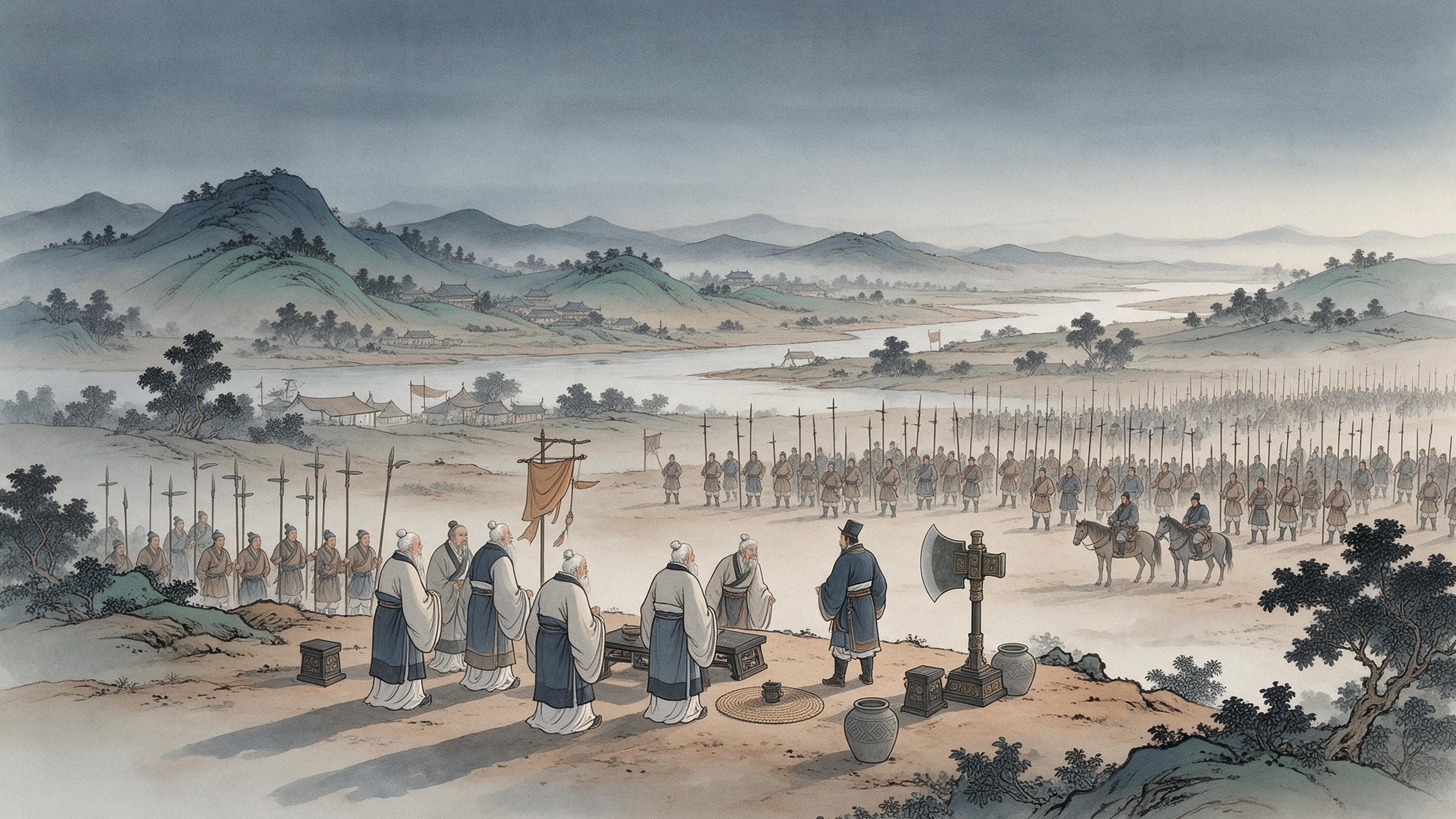
The Shiji's annals of Yin put the same oath inside a narrative: 'Tang then raised troops and led the lords; Yi Yin followed Tang; Tang took the axe himself, attacked Kunwu, and then attacked Jie. Tang said: Come, you multitude, come, all listen to my words…' (湯乃興師率諸侯,伊尹從湯,湯自把鉞以伐昆吾,遂伐桀). The troops, Yi Yin, the axe, Kunwu before Jie — then the oath. The wording differs point by point: 女 for 汝, 匪 for 非, 舉亂 for 稱亂, 維 for 惟, 嗇事 for 穡事, 'stops the people's strength and seizes the state of Xia' for 'exhausts and strips', 'greatly order you' for 'greatly reward you', 'enslave and slay you' for 'slay your children', and 'when will this sun perish' worded differently. Both versions are printed, neither corrected.
The Shiji also gives process and outcome: Jie 'was defeated at the mound of Yousong', 'fled to Mingtiao', 'the Xia army was routed'; Tang 'attacked Sanzong and captured its treasures'; 'when Tang had conquered Xia he wished to move its altar of soil, and could not'; 'then the lords all submitted, and Tang took the throne of heaven'; and at the end 'he corrected the first month, changed the colours of dress, honoured white, and held court by daylight' (改正朔,易服色,上白,朝會以晝). These are the history's narrative; the oath has none of them, and neither page gives battle detail or the size of either army.
Where 'Tang and Wu Changed the Mandate' Comes From
The phrase is not in the Tang shi. It is in the Changes, in the commentary on the Ge hexagram: 'Heaven and earth change and the four seasons complete; Tang and Wu changed the mandate, obeying Heaven and answering men; great indeed is the meaning of the time of change' (天地革而四時成,湯武革命,順乎天而應乎人). That is a line of the Changes, a later explanation of the hexagram, not the oath and not a narrative of the war. Its provenance is noted here, and it is not used to characterise the war.
What Neither Page Gives
Neither page gives a date, the place of the oath, who the multitude were (the oath says only 'you multitude'), the size of either army, battle detail or a line of march; nor any Xia-side account. How 'slay your children' was carried out, or what the great reward was, the oath does not say, and nothing is supplied. No 'he who is right has many helpers' style of comment is made, and 'Heaven's mandate' is not used as a historical explanation of the war.
One more layer: which version, Sima Qian's or the Book of Documents', is closer to the original, neither page says, and this article does not decide; the Changes commentary and the oath's reasons belong to different layers and are set apart, not merged.
What can be established is this: one oath, three reasons — Xia has many crimes and Heaven is striking it; I fear God and dare not fail to correct it; the king of Xia exhausts the people's strength and strips the towns, so the multitude is idle; and at the end reward and penalty, great reward and the slaying of children. The Shiji gives the mobilisation and the outcome; the Changes commentary gives one later verdict. The oath is an oath and the verdict is a verdict. The last of these is where the oath ends.
Related reading:One Hundred and Eighty Women: Sunzi Drills the Palace · The Yin Fields: Seventy Mu, a Public Field, and Millet · Golden Elixir: What Ge Hong Cooked on Mount Luofu
Sources & further reading
- 《尚书·汤誓》(维基文库本,页面白文无注;圆括号与〈〉内为录文所加异文校字,未与中华书局点校本复核) — The oath in full: the king calls the multitude to listen; he denies that a petty man would dare raise rebellion, and gives the first reason — 'Xia has many crimes, and Heaven is striking it'; he reports the people's complaint that their lord does not pity them and leaves their harvesting to 'cut and correct Xia'; then the second reason — 'the Xia clan has crimes, and I fear God, and dare not fail to correct it'; then the third — 'the king of Xia exhausts the people's strength and strips the towns of Xia, and the multitude is idle and uncooperative', with their saying 'when will this sun perish? We will go down with you'; and he closes with reward and penalty: those who help him will be greatly rewarded, and those who do not follow the oath will have their children slain, with no pardon.
- 《史记》卷三·殷本纪(西汉司马迁撰;维基文库本,页面白文无注,未与中华书局点校本复核) — The same oath inside a narrative: Tang raises troops with the lords, Yi Yin follows, Tang takes the axe himself, attacks Kunwu and then Jie, and speaks the oath with different characters — 'ye' for 'ru', 'not' for 'not', 'raise rebellion' for 'claim rebellion', 'reap the grain' for 'harvest', 'the king of Xia stops the people's strength and seizes the state of Xia' for 'exhausts and strips', 'greatly order you' for 'greatly reward you', and 'enslave and slay' for 'slay your children'. The chapter then records Jie's defeat at the mound of Yousong, his flight to Mingtiao, the rout of the Xia army, Tang's attack on Sanzong and capture of its treasures, the refusal to move the Xia altar, the submission of the lords, and Tang's accession, with the new calendar, colours and white dress.
- 《周易·革》彖传(维基文库本,页面白文无注,未与中华书局点校本复核) — The sentence containing the phrase 'Tang and Wu changed the mandate': 'Heaven and earth change and the four seasons complete; Tang and Wu changed the mandate, obeying Heaven and answering men; great indeed is the meaning of the time of change' (天地革而四時成,湯武革命,順乎天而應乎人). It is a line of the Ge commentary, quoted here for its provenance only, not as a characterisation of the war.