Three numbers in one sentence: 'the Xia gave fifty and took the tribute; the Yin gave seventy and took the aid; the Zhou gave a hundred mu and took the tithe — in fact all were one in ten' (夏后氏五十而貢,殷人七十而助,周人百畝而徹。其實皆什一也). Fifty, seventy, a hundred mu — and a tenth taken each time. The sentence is Mencius's, spoken when Duke Wen of Teng asked how a state should be governed. So the layer must be marked first: this is a Warring States account of three dynasties, not a Shang record. This piece keeps to the three things the page gives: the numbers, the public field, and the words for grain.
One: three sentences and a tenth
Two glosses follow: 'che means to take out; zhu means to borrow' (徹者徹也,助者藉也). That is the only definition on the page, and it is two characters long. The field sizes are copied as written — fifty, seventy, a hundred mu — and the rate as written: one in ten. How large a mu was, what seventy mu yielded, whether the tenth was taken from the crop or fixed in advance: the page does not say, and this piece neither converts mu into hectares nor computes a yield.
The word zhu is generally read as 'to borrow': the people lent their labour to a field whose crop was not theirs (generally so taken; the page carries no note). This piece goes no further, because the page goes no further — after 'zhu means to borrow' it does not explain how the thing worked. In the same passage Mencius quotes Longzi on the tribute: the tribute was 'fixed by averaging several years', so that in a good year it took too little and in a bad year it still took the full amount; that is a criticism of the tribute, not a description of Yin fields.
Two: the public field
The public field rests on one word and one line of verse. 'Only with zhu was there a public field' (惟助為有公田); and the Ode: 'rain on our public field, and then reach our private plots' (雨我公田,遂及我私). From these Mencius concludes: 'by this we see that even the Zhou had zhu' (雖周亦助也). The conclusion is his inference, the verse is the Odes' verse; the page says only 'the Odes' and names no poem, and does not say who sang it or when.
The most detailed field scheme on the page is not about the Yin at all. Asked about the well-fields by Bi Zhan, Mencius sets out what Teng should do: 'in the countryside, one in nine by zhu; in the capital, one in ten, self-assessed'; 'a square li makes a well; a well is nine hundred mu, with the public field in the middle; the eight households each hold a hundred mu privately and together tend the public field; only when the public work is finished dare they attend to private business' (方里而井……八家皆私百畝,同養公田). There are also 'gui fields of fifty mu' for officers below the ministers and 'twenty-five mu' for surplus men. Nine hundred, eighty, fifty, twenty-five. This is a plan for Teng offered in the fourth century; the page never says the Yin were organised so, and this piece keeps it in a paragraph of its own, marked as a proposal and not merged with the account of the three dynasties.
Three: farming in Pangang
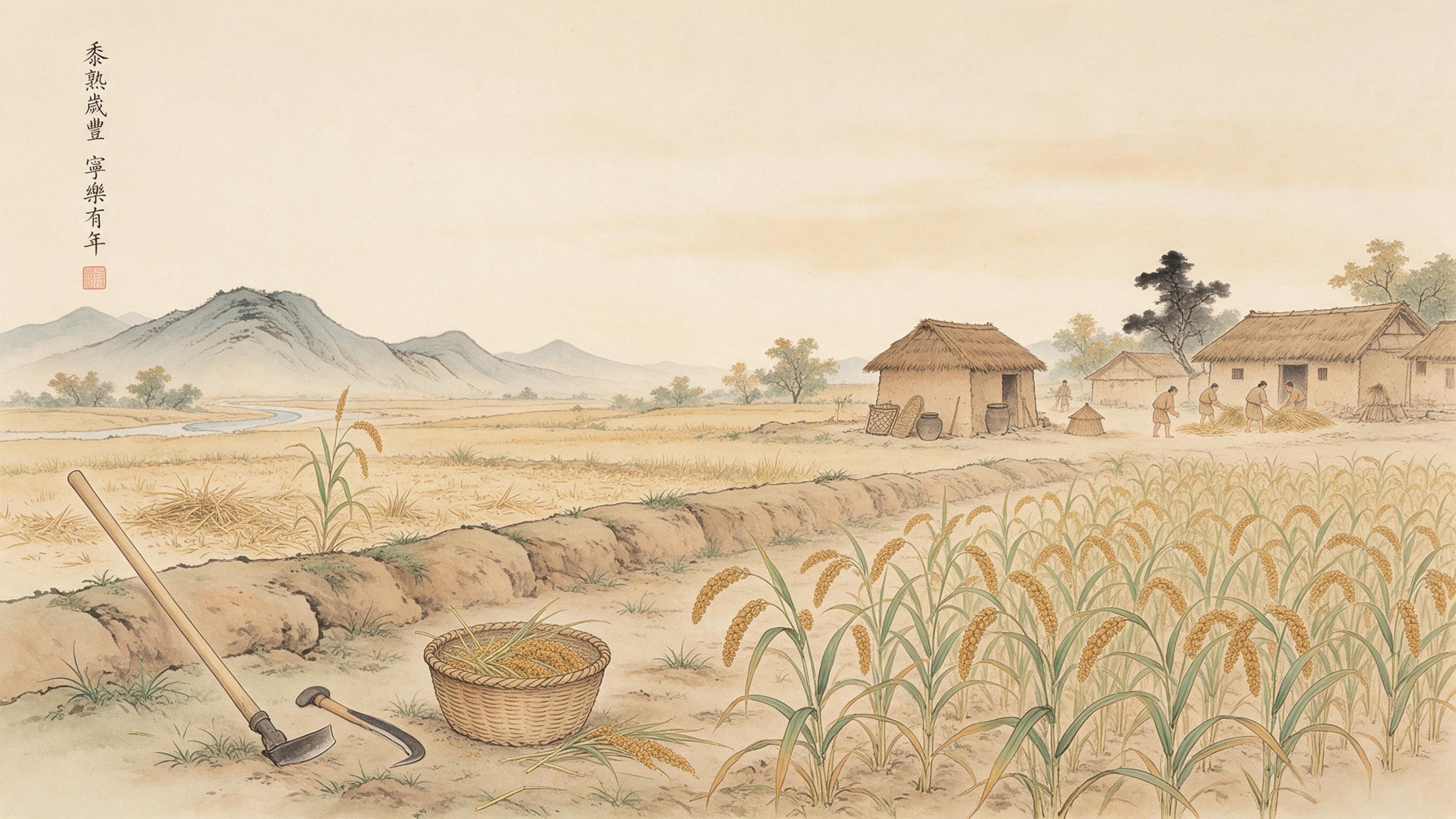
The other page is a Shang text, and its farming is simile. The Book of Documents opens: 'Pangang moved to Yin, and the people were not at ease where they lived' (盤庚遷于殷,民不適有居). The king summons them to the courtyard and speaks; twice he uses the farmer. 'As when the net is on its main rope, there are strands and no tangle; as when the farmer applies himself to the fields and works at the harvest, then indeed he has his autumn' (若網在綱,有條而不紊;若農服田力穡,乃亦(弈)有秋). And the reverse: 'the lazy farmer, at ease with himself, not straining at the work, not serving the fields — he will have no millet or panicled millet' (惰農自安,不昏(暋)作勞,不服田畝,越其罔有黍稷).
What the page gives is vocabulary, not figures: field, mu, harvest, millet, panicled millet, autumn — and the verbs 'serve the fields', 'work at the harvest', 'strain at the work'. No field sizes, no yield, no tool, no season. One more thing must be said about the page: it prints variant readings in brackets inside the text — 爰(易)宅, 如台(何), 不惕(施), 不昏(暋), 亦(弈) — those marks are the transcription's, and this piece quotes them as printed rather than treating them as part of the original.
Four: the gap between the pages
The two pages are not one layer of material. The Mencius passage is a Warring States account, generally taken to be a reconstruction from tradition and texts, arranging the three dynasties as fifty, seventy and a hundred mu. The Pangang is a transmitted Shang speech whose wording was fixed by later hands (generally so taken). So neither can prove the other: Mencius's 'seventy and zhu' cannot be used to establish the field system of Pangang's time, and Pangang's similes cannot be used to fill in Mencius's details. This piece sets them side by side and merges neither. One concrete example of why the later text cannot be reasoned backwards: the only farm tool mentioned anywhere on the Mencius page is iron ploughing — in the Xu Xing section the question is put, 'does Master Xu cook in a cauldron and steam, and plough with iron?' and the answer is yes; that is a fourth-century fact, and it cannot be used to say the Shang ploughed with iron.
The oracle bones should be the third layer, and they are not on these pages: no divination record, no inscription asking whether the harvest would be good, no bone at all. So this piece writes 'none', quotes no oracle text, and does not use later documents to reason backwards into Shang institutions — which is exactly the move this piece is meant to avoid.
Five: where the numbers stop
The numbers stay numbers: fifty, seventy, a hundred mu; one in ten; nine hundred mu in a well, a hundred per household, fifty for a gui field, twenty-five for a surplus man. How large a mu was, how much grain a mu produced, how the tenth was collected, whether the public field was one block or strips inside each household's holding — the pages do not say, and this piece does not compute it: no hectares, no yield, no total harvest.
One last boundary: this piece does not argue that the Shang was an agricultural society — neither page says anything of the kind. What they offer is a Warring States man's three sentences, one line of verse, two farming similes from a Shang speech, and a handful of grain words — plus one word, 'none', where the oracle bones would have been.
Related reading:One Hundred and Eighty Women: Sunzi Drills the Palace · Golden Elixir: What Ge Hong Cooked on Mount Luofu · Tribute Turtles: Where Divination Shells Were Said to Come From
Sources & further reading
- 《孟子·滕文公上》(维基文库本,未与点校本复核) — Three sentences of field history, spoken to Duke Wen of Teng: 'the Xia gave fifty and took the tribute; the Yin gave seventy and took the aid; the Zhou gave a hundred mu and took the tithe — in fact all were one in ten' (夏后氏五十而貢,殷人七十而助,周人百畝而徹。其實皆什一也), with the two glosses 'che means to take out; zhu means to borrow' (徹者徹也,助者藉也). The same page supplies the argument from the Odes — 'only with zhu was there a public field' (惟助為有公田) and the verse 'rain on our public field, and then reach our private plots' (雨我公田,遂及我私) — and, separately, the well-field scheme Mencius proposes for Teng ('a square li makes a well; a well is nine hundred mu, with the public field in the middle; the eight households each have a hundred mu privately' 方里而井……八家皆私百畝), with gui fields of fifty mu and twenty-five mu for surplus labourers. The page does not claim that any of this describes the Shang in practice; the well-field section is advice to a fourth-century state.
- 《尚书·盘庚上》(维基文库本,未与点校本复核) — The Shang speech, used only for its farming language. Pangang has moved the capital to Yin, the people are not at ease, and he summons them to the courtyard: 'as when the net is on its main rope, there are strands and no tangle; as when the farmer applies himself to the fields and works at the harvest, then indeed he has his autumn' (若網在綱,有條而不紊;若農服田力穡,乃亦(弈)有秋); and 'the lazy farmer, at ease with himself, not straining at the work, not serving the fields — he will have no millet or panicled millet' (惰農自安,不昬(暋)作勞,不服田畝,越其罔有黍稷). The page marks its variant readings in brackets — 爰(易)宅, 如台(何), 不惕(施), 昬(暋), 亦(弈) — and quotations follow the page as printed. The speech gives no acreage, no yield and no tools.