A man comes to a king with a book. The chapter opens with two sentences: 'Sunzi Wu was a man of Qi. He presented himself to King Helü of Wu by means of the art of war' (孫子武者,齊人也。以兵法見於吳王闔廬) — the page writes the honorific and the name together, Master Sun, Wu. Then a short exchange. 'Your thirteen chapters — I have seen them all. Could you make a small trial of handling troops?' 'I could.' 'Could the trial be made with women?' 'It could.' 'Thereupon he consented, and brought out the beauties of the palace, and got one hundred and eighty of them' (出宮中美女,得百八十人). This piece is about what happened to those hundred and eighty on that day.
One: two questions, one hundred and eighty women
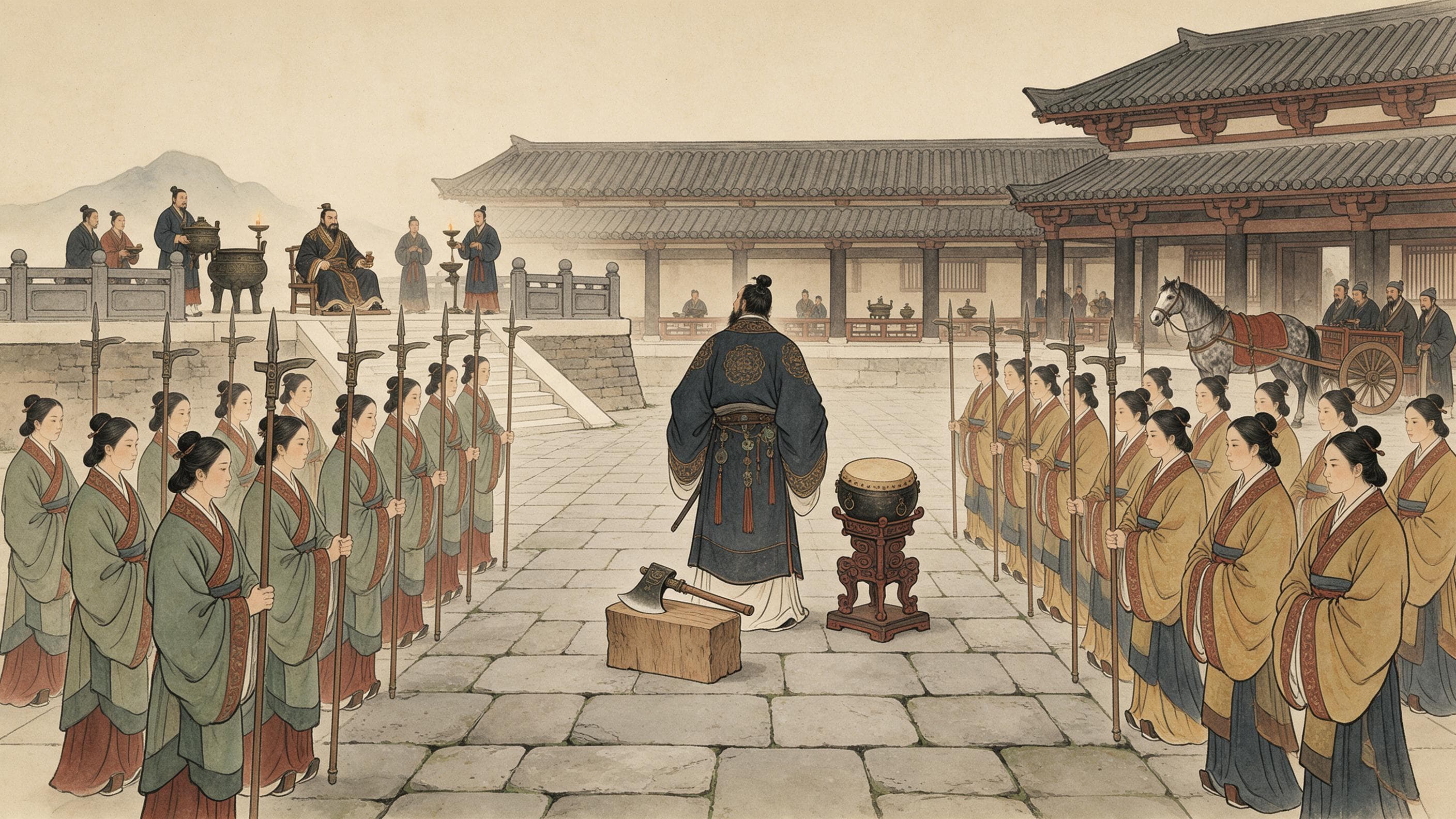
What follows is drill, written as drill: 'Sunzi divided them into two companies, and made the king's two favourite concubines captains of each, and ordered them all to take halberds' (孫子分為二隊,以王之寵姬二人各為隊長,皆令持戟). Then the order of the day: 'Do you know your heart, and your left and right hands, and your back?' The women said they did. 'Forward, look to the heart; left, to the left hand; right, to the right hand; rear, to the back' (前,則視心;左,視左手;右,視右手;後,即視背). Four directions, each given by a part of the body the women already had.
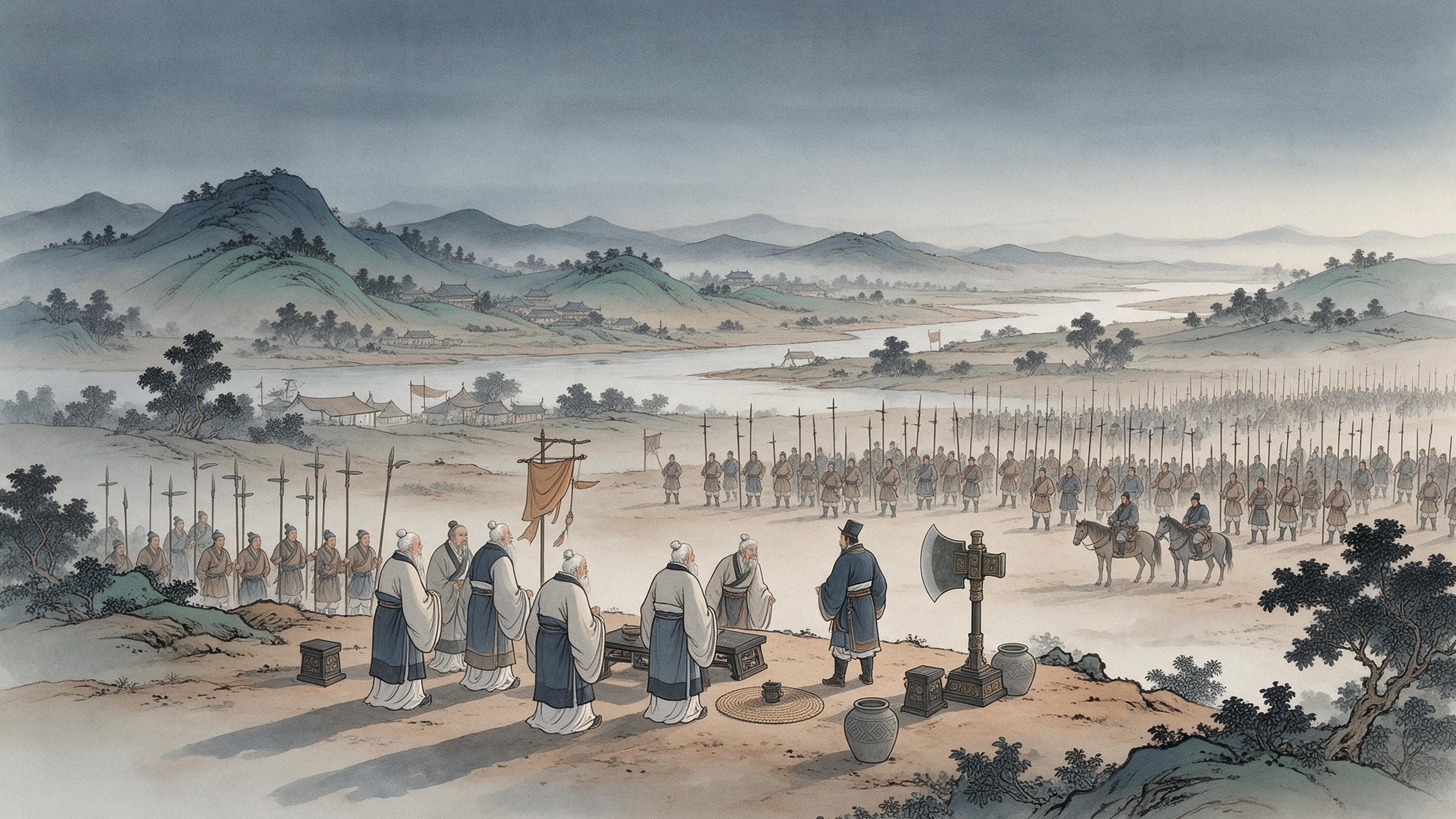
After that: 'the constraints having been published, he then set out the axe and the battle-axe, and thrice gave the orders and five times repeated them' (約束既布,乃設鈇鉞,即三令五申之). The axe is set out before the repetition, not after — a punishment instrument standing on the ground while the orders are read out. The page gives neither its size nor its form.
Two: drummed right, drummed left
The first drumming: 'he drummed them to the right, and the women laughed loudly' (鼓之右,婦人大笑). Sunzi's judgement: 'the constraints are not clear, the repeated orders are not familiar — that is the general's fault' (約束不明,申令不熟,將之罪也). So 'he again gave the orders three times and repeated them five times, and drummed them to the left, and the women laughed again' (復三令五申而鼓之左,婦人復大笑). Twice the count is repeated in full: three orders, five repetitions.
The second time he states both halves: 'the constraints are not clear, the repeated orders are not familiar — the general's fault; but now that they are clear and still they do not obey the law, that is the fault of the officers and men' (既已明而不如法者,吏士之罪也). 'He then wanted to behead the captains of the left and right' (乃欲斬左右隊長).
Three: the man on the terrace
The king has been watching: 'King Wu was looking on from the terrace; seeing that his favourite concubines were about to be beheaded, he was greatly alarmed. He hurriedly sent an envoy with an order: I already know that the general can command troops. Without these two concubines I find no flavour in my food; I beg you not to behead them' (吳王從臺上觀……願勿斬也).
The king watched from the terrace and sent a man down to plead. Sunzi's answer was a single sentence: 'Since I have already received the appointment as general, then when the general is with the army, there are orders of the sovereign he does not accept' (臣既已受命為將,將在軍,君命有所不受). So 'he had the two captains beheaded and paraded as a warning' (遂斬隊長二人以徇), and 'appointed the next in line as captains' (用其次為隊長). Then the drum was beaten again.
Four: one more drumming
'He drummed them again. Then the women went left and right, forward and back, knelt and rose, all hitting the square and the line, and none dared make a sound' (於是復鼓之。婦人左右前後跪起皆中規矩繩墨,無敢出聲). Square, compass, line and ink are a carpenter's tools; that is the usual reading of 規矩繩墨, and the page does not gloss it. He sent word to the king: 'the troops are now in order; the king may come down and inspect them; use them as he wishes — they would go through water and fire' (兵既整齊……雖赴水火猶可也).
The king declined: 'let the general rest and go to his quarters; I do not wish to come down and look.' And Sunzi: 'the king merely likes the words, and cannot use the substance' (王徒好其言,不能用其實). The chapter closes the story in one breath: 'thereupon Helü knew that Sunzi could command troops, and in the end made him general. In the west they broke mighty Chu and entered Ying; in the north they awed Qi and Jin; his name was famous among the feudal lords, and Sunzi had a part in it' (孫子與有力焉). The campaigns are a single clause here, and this piece does not expand them.
Five: Sunzi on another page
The same man has another record in the Hereditary House of Wu, and it is written in another form. That chapter keeps the years and the places: Helü's third year, an attack on Chu, Shu taken; the fourth year, Liu and Qian; the fifth, Yue defeated; the sixth, Chu beaten at Yuzhang; the ninth, the question of entering Ying. Word for word: 'the general Sun Wu said: the people are worn out; it cannot be done; wait' (將軍孫武曰:民勞,未可,待之), and in the ninth year the king asks Wu Zixu and Sun Wu together, and they answer about Chu's greedy commander and about Tang and Cai. So one page has a chronology and a working general; the other has no years at all and one story inside a palace. This piece sets the two side by side and fills neither out.
The chapter closes with the Grand Historian's comment, and that comment states the rule this piece follows: 'what the world says of armies all speaks of Sunzi's thirteen chapters… so I do not discuss them, but discuss what he did and what he set up' (世俗所稱師旅,皆道孫子十三篇……故弗論,論其行事所施設者). It is comment, not record, so it is quoted as the historian's own sentence — but it is also why no chapter of the thirteen is quoted here and no reading of the military text is offered. The gaps stay gaps: the women's ages or origins, the length or pattern of the halberds, where in the palace the drill was held, what was done with the two executed women, how long it took. Nor does this piece call the man a sage of war or the drill a model of discipline: the page leaves a few actions, a few sentences, and a hundred and eighty people holding halberds.
Related reading:Golden Elixir: What Ge Hong Cooked on Mount Luofu · Tribute Turtles: Where Divination Shells Were Said to Come From · Muye: The Order of Battle on the Jiazi Day
Sources & further reading
- 司马迁《史记》卷六十五〈孙子吴起列传〉(维基文库本,未与点校本复核) — The whole episode, in one paragraph: Sunzi of Qi presenting himself to King Helü of Wu 'by means of the art of war' (以兵法見於吳王闔廬); the two questions about a small trial, first with troops and then with women; 'brought out the beauties of the palace, and got one hundred and eighty of them' (出宮中美女,得百八十人); the two companies with the king's two favourite concubines as captains, all ordered to take halberds; the four directions (heart, left hand, right hand, back); 'thrice he gave the orders and five times repeated them' (三令五申之); the drumming right and left with laughter both times; the general's-fault/officers'-fault sentence; the king's order from the terrace; 'when the general is with the army, the king's command need not be accepted' (將在軍,君命有所不受); 'beheaded the two captains and paraded them' (遂斬隊長二人以徇); and the close, with the campaigns in the west and north and 'Sunzi had a part in it' (孫子與有力焉). The page gives no date, no place inside the palace, and no number besides 180.
- 司马迁《史记》卷三十一〈吴太伯世家〉(维基文库本,未与点校本复核) — Used for contrast only. Here Sunzi is a serving general and no more: in King Helü's third year, when the king wants to enter Ying, 'the general Sun Wu said: the people are worn out; it cannot be done; wait' (將軍孫武曰:民勞,未可,待之); in the ninth year the king puts the question to Wu Zixu and Sun Wu together, and the two answer about Chu's commander and about Tang and Cai. The chapter has no palace drill, no women, no drum — which is why the two pages are set side by side rather than merged.
- 《孙子兵法》十三篇(维基文库本,未与点校本复核) — Checked only to fix the boundary: the thirteen chapters are a separate text and a separate article's subject. In line with the brief, this piece quotes no chapter and offers no reading of the military text; the only reference is the列传's own sentence that the king had read 'your thirteen chapters' (子之十三篇,吾盡觀之矣).