An elixir could be costed. In the Golden Elixir chapter of the Baopuzi, Ge Hong does the sum: 'one catty of gold by the old scale is two catties by today's measure, and comes to no more than three hundred thousand or so'; with the other ingredients, 'four hundred thousand will get one batch, enough for eight men to become immortals' (古秤金一斤於今為二斤……都合可用四十萬而得一劑,可足八人仙也). In the same chapter he says he had held the recipe for over twenty years: 'I received it more than twenty years ago; my means are not worth a picul, I have nothing to make it with, and can only sigh' (余受之已二十餘年矣……但有長嘆耳). So: a recipe, a sum, and the man doing the arithmetic.
One: the price of a batch
He prices two elixirs against each other. The nine elixirs are 'the highest method of the immortal drugs', but they 'use a great many miscellaneous drugs' and need 'the fire lit for tens of days and nights, watching the flame's strength, never letting it lose its proper measure'. Liquid gold is easier: 'only the gold is hard to get'. Hence two figures: a catty of gold at 'three hundred thousand or so', a batch at 'four hundred thousand'. The page does not say whose money, or what that bought in ordinary life, and this piece converts nothing.
Two: an official post for cinnabar
The Jinshu explains why he left the capital: 'as he grew old he wished to refine elixir to pray for long life, and hearing that Jiaozhi produced cinnabar he asked for the post of Gouliu magistrate. The emperor thought his standing too high and refused. Hong said: It is not for honour; it is because there is cinnabar. The emperor let him go' (以年老,欲練丹以祈遐壽……非欲為榮,以有丹耳). He never reached Jiaozhi: 'at Guangzhou the governor Deng Yue would not let him go on, and Hong stayed on Mount Luofu to refine elixir' (洪乃止羅浮山煉丹). Deng Yue proposed him for Dongguan; he declined, and 'spent years on the mountain, at ease, writing without pause'.
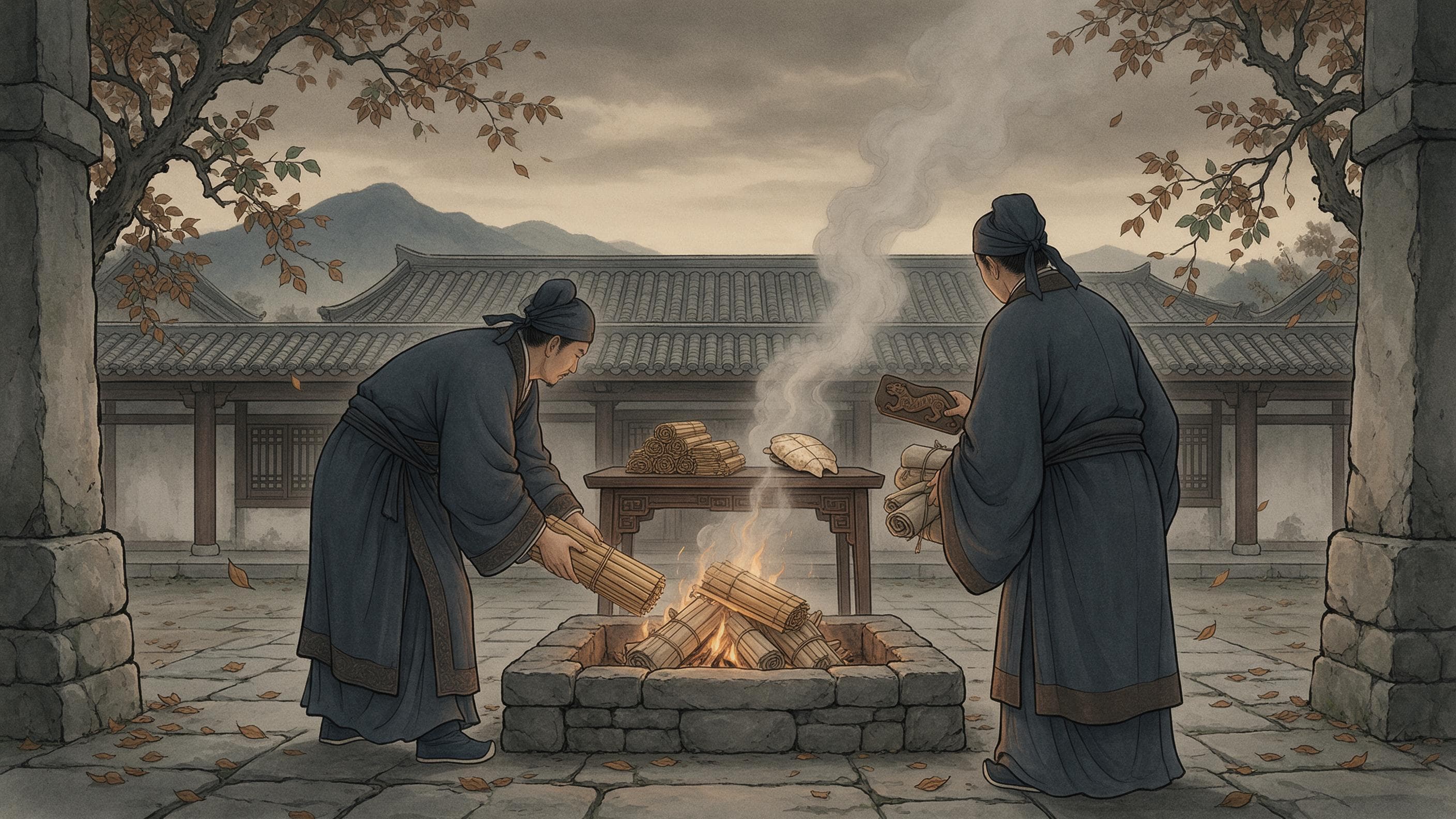
Luofu turns up neatly. The chapter ends with a list of mountains where 'one may concentrate and compound the immortal drugs', from Hua and Tai to Tiantai and Kuocang; Luofu is on it, and these mountains 'all have a true god within, and some have earthbound immortals'. The same chapter gives the rules: a famous mountain, a place without people, 'no more than three companions, fast for a hundred days first, bathe in five fragrant waters', away from filth, 'and do not let those who do not understand the Way know of it, for if they slander the divine drug, it will not form'. Then a sacrifice, portions by weight to Heaven, sun and moon, the Dipper, the River Lord and the doors, 'eighty-eight catties in all', the last twelve wrapped in leather and quietly set down in a crowded market.
Three: one recipe, the Flower of Cinnabar
The first elixir, 'Flower of Cinnabar': 'First make the dark yellow; take realgar water, alum water, salt from the salt lake, bittern salt, arsenolite, oyster shell, red halloysite, talc and white lead, several tens of catties of each, to make the six-one mud; fire it thirty-six days and it forms; take it seven days and you are immortal. Then form this elixir with dark paste and set it on a fierce fire: in a moment it becomes gold. Or take two hundred and forty zhu with a hundred catties of mercury and fire it: it becomes gold too. If the gold forms, the drug has formed; if not, seal it again and fire it the same number of days, and it will always form' (第一之丹名曰丹華……金成者藥成也). This piece quotes the names as they stand, explains none of the substances, and rules on nothing effective or poisonous — the page has no such layer.
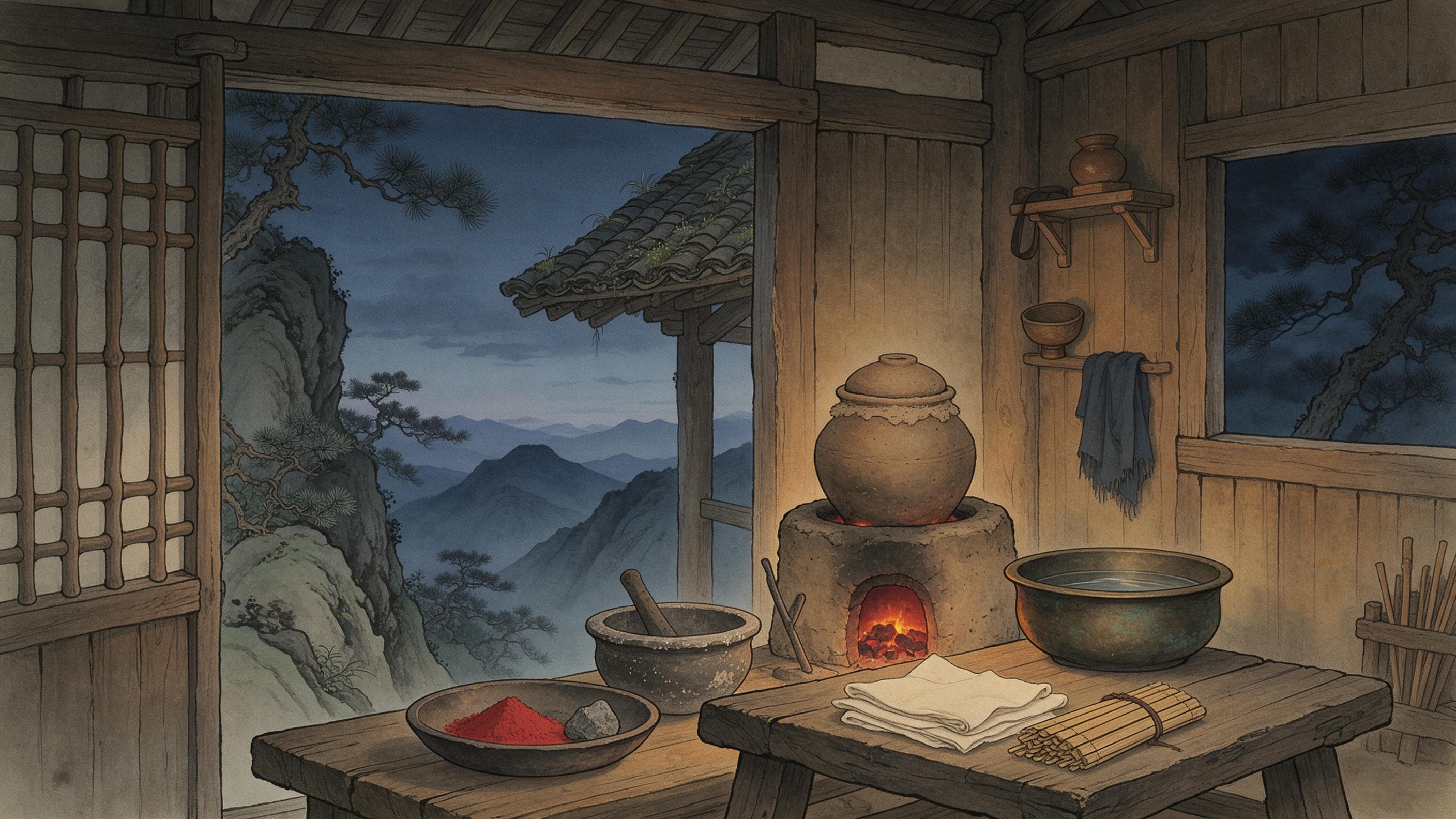
Firing has rules. The nine-times-turned elixir is 'sealed and coated in an earthen cauldron, with chaff fire, first gentle then fierce': one turn to nine, each with its days. Fewer turns means 'the drug's strength is insufficient', so 'it must be taken longer and immortality comes slowly' — a first-turn elixir three years, a ninth-turn one three days. Doses are in 'knife-tips', one or three; the measures are copied and converted into nothing, since the page never says how much a knife-tip is. Nor does either page describe the furnace, the cauldron or the compounding room.
Four: cinnabar, mercury, and why it lasts
Ge Hong's reason rests on an observation: 'all plants burn to ash, but cinnabar when burned becomes mercury, and as the changes accumulate it turns back into cinnabar' (凡草木燒之即燼,而丹砂燒之成水銀,積變又還成丹砂). And: 'the longer the golden elixir is burned the more marvellous its changes; gold in fire is not consumed by a hundred meltings, buried it does not decay for a whole heaven; take these two and they refine a man's body, so he does not age and does not die' (夫金丹之為物……故能令人不老不死). His reasoning is analogical: 'this is borrowing an outer thing to make oneself firm, like fat feeding a fire so it cannot go out, or bronze patina on the feet keeping them from rotting in water' (此蓋假求於外物以自堅固……借銅之勁以扞其肉也).
This layer must be labelled: it is Ge Hong speaking and reasoning. 'Cinnabar burned becomes mercury, and turns back into cinnabar' is an observation he states; 'so he does not age and does not die' is his inference from it. The page records no procedure, no test, no independent check. So this piece keeps observation and inference apart, treats 'immortal' as the text's word rather than a conclusion, and neither turns the recipes into modern chemistry nor rules on whether they work or poison.
Five: the man writing
The chapter opens with a self-account that sounds like a man hunting for books: 'In youth I loved the methods, and went on foot to ask questions, not shrinking from danger or distance; when I heard something strange I took it for joy, and though mocked I did not grieve' (余少好方術……雖見毀笑,不以為戚). He travelled through several provinces, saw 'several hundred wandering vulgar Daoists', and asked them about the divine elixir and liquid gold: 'not one knew'. He gives the transmission too: a spirit-man gave the scriptures to Zuo Yuanfang, who passed them to Ge Hong's grand-uncle Ge Xuan, who passed them to Zheng Yin, who passed them to Ge Hong — with an oath at an altar on Mount Maji and the oral instructions unwritten. 'The east of the river had no such books before.'
He states his purpose: 'I now sketch the general outline of the golden elixir to show those of like mind who come after' (余今略鈔金丹之都較). Why the mountain and the secrecy, he explains in Zheng Yin's words: a great drug requires sacrifice, and at it the highest gods come to inspect; done where vulgar people pass, the gods blame the maker, evil air enters, and the drug will not form. An analogy from medicine: physicians compounding a good ointment 'do not want fowls, dogs, children or women to see it; if anything offends it, it has no effect' (今之醫家……用便無驗). A drug seen loses its power; an elixir slandered will not form. Medical pieces elsewhere are about drugs and prescriptions; this page is about swallowing an elixir to become immortal — the word and the taboos are shared, the question is not.
The Jinshu ends him on Luofu: 'he sat until midday, motionless as if asleep, and died, aged eighty-one. His colour was as in life, his body soft, and the coffin was very light, like empty clothes; the world took it that he had escaped by dissolution and become an immortal' (世以為屍解得仙雲). That is a history writing down what people said, and this piece copies it marked as such. The gaps are plain: the furnace, the compounding room, whether the four hundred thousand was ever spent, whether he ever made the elixir — neither page says. So this piece neither calls him a pioneer of chemistry nor writes a debunking: the pages leave one man's conviction, a sum, and a few recipes.
Related reading:Which Books Burned: The Qin Book Order, Item by Item · The Shang Colour: White, Noon, and a Carriage · Fifty Get a Staff: Old Age in a Ritual Book and an Edict
Sources & further reading
- 葛洪《抱朴子内篇》卷四〈金丹〉(维基文库本,未与点校本复核) — The chapter that gives the recipes and the author's own account. Costs: 'one catty of gold by the old scale, which by today's measure is two catties, comes to no more than three hundred thousand or so… four hundred thousand will get one batch, enough for eight men to become immortals' (古秤金一斤於今為二斤,率不過直三十許萬……都合可用四十萬而得一劑,可足八人仙也). Self-account: 'I received it over twenty years ago; my means are not worth a picul, I have nothing to make it with, and can only sigh' (余受之已二十餘年矣,資無擔石,無以為之,但有長嘆耳). It carries the first elixir's recipe, the nine elixirs and their firing times, the cinnabar and mercury sentences, and the list of mountains fit for compounding, which includes Luofu (羅浮山). The page's characters are uneven — 餘/余 and 復/複 are mixed — and quotations here follow the page as printed.
- 房玄龄等《晋书》卷七十二〈葛洪传〉(维基文库本,未与点校本复核) — The biography: Ge Hong of Jurong in Danyang; taught by Zheng Yin, who had the alchemical secrets from Ge Hong's grand-uncle Ge Xuan; 'as he grew old he wished to refine elixir to pray for long life, and hearing that Jiaozhi produced cinnabar he asked for the post of Gouliu magistrate. The emperor thought his standing too high and refused. Hong said: It is not for honour; it is because there is cinnabar' (以年老,欲練丹以祈遐壽,聞交阯出丹,求為句漏令……洪曰:非欲為榮,以有丹耳). Then: 'at Guangzhou the governor Deng Yue kept him from going on, and Hong stayed on Mount Luofu to refine elixir' (洪乃止羅浮山煉丹). The chapter ends with his death at eighty-one and the judgement 'the world took it that he had escaped by dissolution and become an immortal' (世以為屍解得仙雲). It also lists his medical works (《金匱藥方》一百卷,《肘後要急方》四卷), which this piece does not use.
- 葛洪《抱朴子内篇》卷十一〈仙药〉(维基文库本,未与点校本复核) — Checked and used only to show that the habit of naming ingredients by weight runs through the book. This chapter has 小神方:'three catties of true cinnabar and one catty of white honey, mixed and sun-dried' (小神方,用真丹三斤,白蜜一斤,合和日曝煎之,令可丸), where the Golden Elixir chapter's 小神丹方 reads 白蜜六斤 for the same recipe. The two chapters differ by a character in the honey weight; this piece does not pick a correct reading and quotes neither in the body. The same chapter is where the Yu-step (禹步法:前舉左,右過左,左就右……如此三步,當滿二丈一尺,後有九跡) and the herbal recipes sit; this piece quotes none of the medical material.