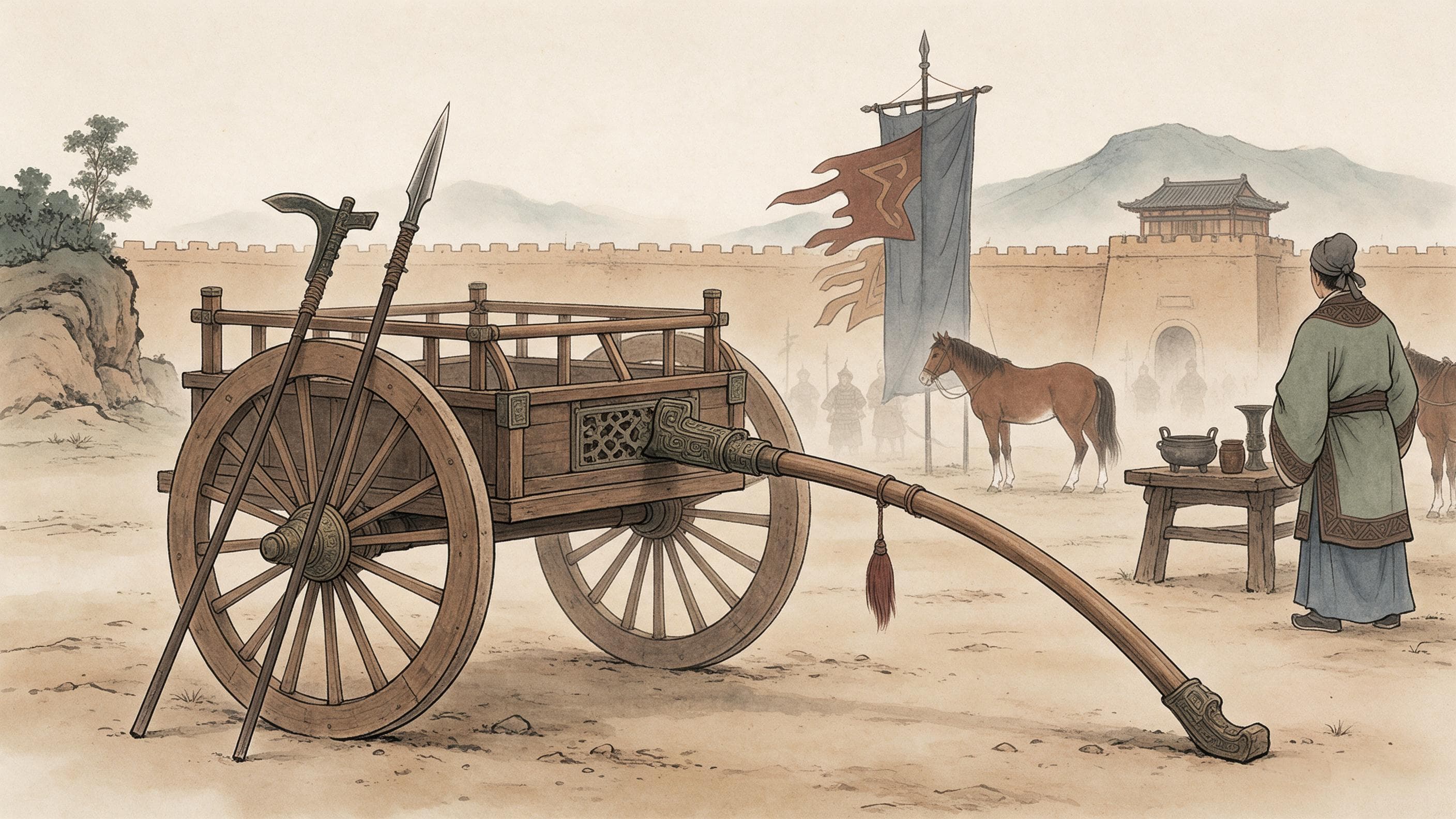
A wheel six chi and six cun across; its axle end standing three chi three cun above the ground; add the frame and the block and the floor of the carriage is four chi up; a man is eight chi tall. 'Getting in and out,' the Kaogongji says, 'is the measure.' Of all the tests a war chariot had to pass, the first was that a man could climb aboard.
Six Chi Six Cun
The Kaogongji, the section of the Zhou li that deals with manufacture, opens its chariot chapters by putting three vehicles side by side: 'the war chariot's wheel is six chi and six cun; the field chariot's wheel is six chi and three cun; the riding chariot's wheel is six chi and six cun' (兵車之輪六尺有六寸,田車之輪六尺有三寸,乘車之輪六尺有六寸). The war chariot and the riding chariot share the tall wheel; the field chariot, built for hunting and rough ground, sits three cun lower. The text does not say why. It records the dimensions, and this article keeps them in the book's own chi and cun rather than converting them.
Before any dimension, the chapter notices how many trades meet in one vehicle: 'in the making of a single object, it is the chariot that gathers the most crafts' (故一器而工聚焉者,車為多). Seven wood-working trades are named — wheelwrights, carriage makers, bow makers and four others — and the three chariot chapters are titled after the men themselves: lun ren, the wheelwright; yu ren, the carriage maker; zhou ren, the shaft maker. The wheelwright cuts his three materials in season, and when all three are ready a skilled man harmonizes them (斬三材必以其時,三材既具,巧者和之). His charge is three parts: the hub, 'for turning easily'; the spokes, 'for reaching straight'; the rim, 'for holding firm'. If the wheel wears out and none of the three has failed in its office, the text calls it complete (完).
The Triple Match and Six Degrees
The carriage maker's rules are all proportions. 'Wheel height, carriage width and yoke length, three as one: this is called the triple match' (輪崇,車廣,衡長,叄如一,謂之叄稱) — the old form 叄 is what the text uses. Everything after that is a fraction: divide the carriage width in three and take away one for the depth (隧); divide that depth again, one part in front and two behind, and bend the crossbar to it; the front crossbar (式) stands at half the width; the side rail (較) at half the depth. There is not a single absolute figure in the passage. The carriage is measured against itself.
Then the six degrees (六等之數). The carriage frame is four chi — the first. A dagger-axe on its six-chi-six-cun shaft, planted slanting, rises four chi above the frame — the second. A man eight chi tall rises four chi above the dagger-axe — the third. A spear a xun and four chi long rises four chi above the man — the fourth. A chariot halberd a chang long rises four chi above the spear — the fifth. A lance a chang and four chi long rises four chi above the halberd — the sixth. Every step is four chi. The page does not gloss xun or chang; what it fixes is a ladder of heights running from the carriage floor to the tip of the longest weapon.
How a Chariot Was Judged
'Examining a chariot begins with the wheel' (察車自輪始). Then the two failures that set the limits: 'if the wheel is too tall, a man cannot climb in; if it is too low, the horse is forever going uphill' (輪已崇,則人不能登也;輪已庳,則於馬終古登阤也). Then four tests, each with an instrument: 'round matches the compass, square matches the square, upright matches the plumb line, level matches the water' (圜者中規,方者中矩,立者中縣,衡者中水).
The shaft maker's chapter has the best line in the section: 'going forward it consults the horse; going back it consults the man' (進則與馬謀,退則與人謀). The shaft's depth is graded by the team: four chi seven cun for a state horse, four chi for a field horse, three chi three cun for a worn one. A chariot is not one object. It is a set of parts, each measured against what it has to deal with — the ground, the horse, the man.
Seven Hundred, Then Eight Hundred
In the second year of Duke Cheng of Lu (589 BCE), Sun Huanzi, beaten at Xinzhu, did not go home to Wei but went to Jin to beg for troops; Zang Xuanzhu went too, and both worked through Xi Xianzi. 'The Marquis of Jin promised him seven hundred sheng' (晉侯許之七百乘). Xi Ke refused the figure: 'This is the levy of Chengpu. Thanks to the former ruler's wisdom and the former officers' discipline, that battle was won; I could not do what they did. I ask for eight hundred sheng' (請八百乘). The marquis allowed it. Then the appointments: Xi Ke over the central army, Shi Xie over the upper, Luan Shu over the lower, Han Jue as marshal — to relieve Lu and Wei.
Read that passage closely and a sheng stops being a chariot. Seven hundred, eight hundred: these are figures of obligation, and the argument over them is conducted by comparison with an older campaign's assessment (城濮之賦). Later in the same year the lord of Qi calls his own forces 'my poor levy' (不腆敝賦), and a report comes that 'the chariots had come in great numbers' (且告車來甚眾) — where 車 is the vehicle and 賦 the levy. The two words are not interchangeable.
What These Pages Do Not Say
Neither page gives the size of a sheng. The Kaogongji measures a vehicle and says nothing about how many men stood in it; the Zuo zhuan counts an obligation and says nothing about how those chariots were arrayed or what they looked like on the road. Later handbooks do assign men to a chariot, but this article does not use their figures, because the two pages it rests on do not give them. There is no formation, no tactical diagram, no actual muster. The Kaogongji is a standard for making, not a roll-call; the Zuo zhuan is the record of a bargain over numbers.
What remains is a pair of measurements that never quite join. A chariot was judged by whether a man could step up into it, by four chi between the axle and the tip of a lance, by a wheel that ran true against a compass. An army was judged by an old assessment, argued over in units of seven and eight hundred, by men who had never seen the workshop's numbers. The craft book has the exact dimensions and no army; the chronicle has the army, and only a number to name it.
Related reading:How Big Should a City Be? The Nine Li of the Kaogong ji and the Hundred Zhi of the Zuo zhuan · Fifty Paces Wide and Eighteen Hundred Li Long: What Qin's Roads Look Like in the Sources · Moving the Capital: Five Capitals and Three Speeches
Sources & further reading
- 《周礼·冬官考工记》(齐国官书传统;维基文库本,未与点校本复核) — A craft manual, not an order of battle. It puts three chariots side by side — 'the war chariot's wheel is six chi and six cun, the field chariot's six chi and three cun, the riding chariot's six chi and six cun' — then gives the carriage maker's proportions ('wheel height, carriage width and yoke length, three as one, called the triple match', written with the old form 叄) and the 'six degrees', a ladder of heights rising four chi at a time from the four-chi carriage frame to the lance tip. It also gives the workshop's tests: 'examining a chariot begins with the wheel', 'round matches the compass, square the square, upright the plumb line, level the water', and the two failures that set the limits — a wheel too tall to climb into, too low and the horse is forever going uphill. Measurements are quoted in the text's own chi and cun here, never converted.
- 《春秋左氏传·成公》(成公二年,前 589;维基文库本,未与点校本复核) — Here sheng is a unit of military obligation, not a vehicle. Sun Huanzi, defeated at Xinzhu, goes to Jin to beg for troops together with Zang Xuanzhu, both through Xi Xianzi: 'the Marquis of Jin promised him seven hundred sheng.' Xi Ke objects, 'this is the levy of Chengpu — thanks to the former ruler's wisdom and the former officers' discipline that battle was won; I could not do what they did; I ask for eight hundred sheng,' and the marquis allows it. The same year has the lord of Qi call his own forces 'my poor levy' (不腆敝賦) and a report that 'the chariots had come in great numbers' (且告車來甚眾) — 賦 for the levy, 車 for the vehicles. The chapter gives no men per chariot, no formation and no count of what actually arrived.