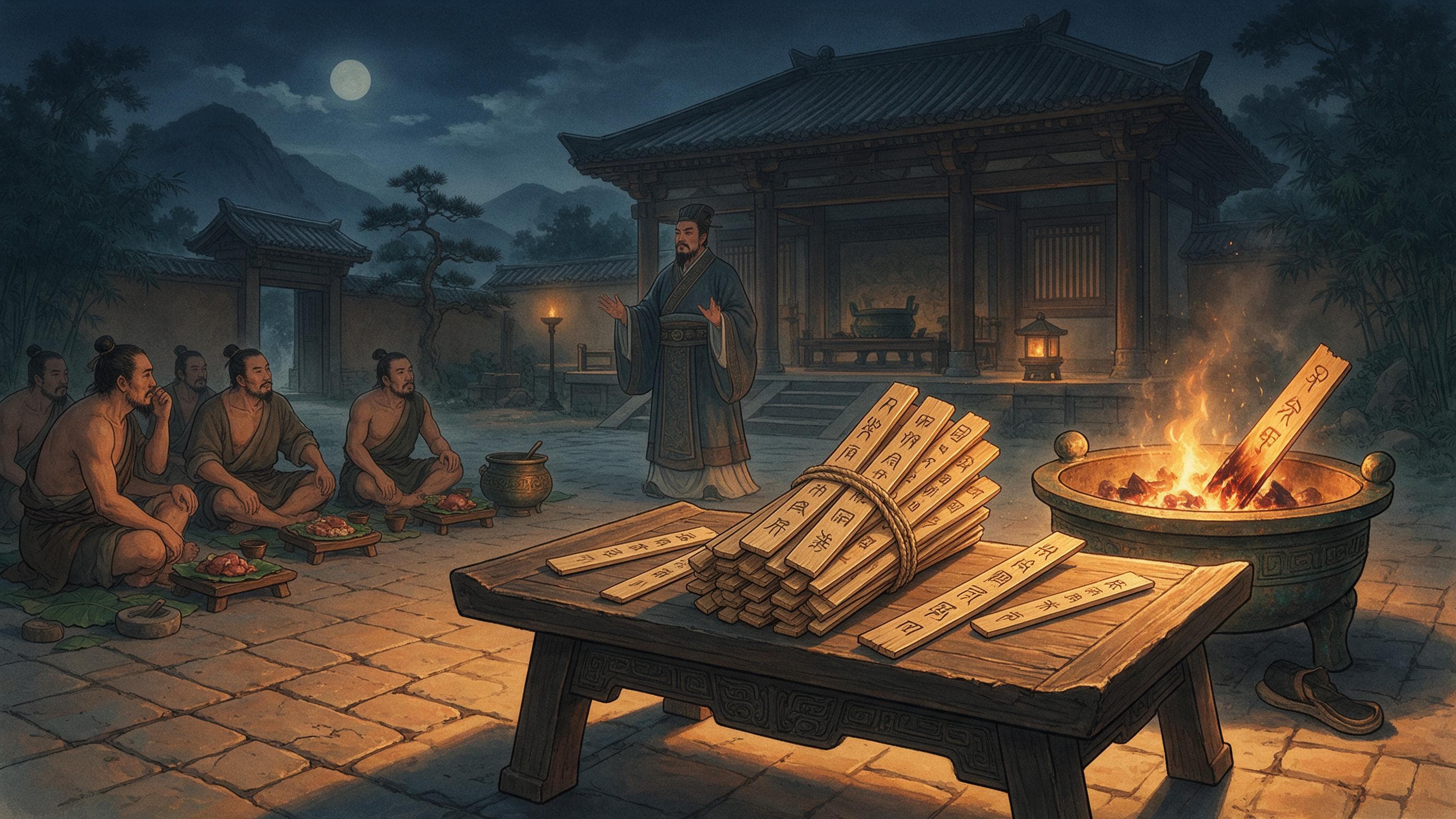
The scene is a banquet in Jin. The marriage has been arranged, Yanzi has received the rites, and Shu Xiang drinks with him and asks how Qi stands. Yanzi answers: 'this is a late age; I do not know — Qi will go to the Chen clan. The duke has cast off his people, and they have gone over to Chen' (此季世也,吾弗知。齊其為陳氏矣。公棄其民,而歸於陳氏). The reason he gives is not an army and not a palace plot. It is a set of measuring vessels.
Four measures: dou, qu, fu, zhong
Qi's old measures are four, and the passage lays them out in order: 'the old four measures of Qi: dou, qu, fu, zhong. Four sheng make a dou; each fourfold, up to the fu; ten fu make a zhong' (齊舊四量:豆、區、釜、鍾。四升為豆,各自其四,以登於釜,釜十則鍾). The chain is four, four, ten — two different steps run together in one series: dou to qu to fu by fours, then fu to zhong by ten. The page gives the names and the steps only. It never says how much a dou held, and this article does not supply it.
What the Chen clan did is one sentence: 'the three measures of the Chen clan were each raised one grade, and so their zhong was larger' (陳氏三量,皆登一焉,鍾乃大矣). It is generally thought that 'raised one grade' means one step up from the old unit in each case; the page carries no note, gives no capacity, and does not say how much larger the zhong became. No conversion and no multiplication is done here. The point of the sentence is not arithmetic but position: three vessels each enlarged, and the enlargement landing on the last link of the chain.
Lend by the family measure, collect by the public one
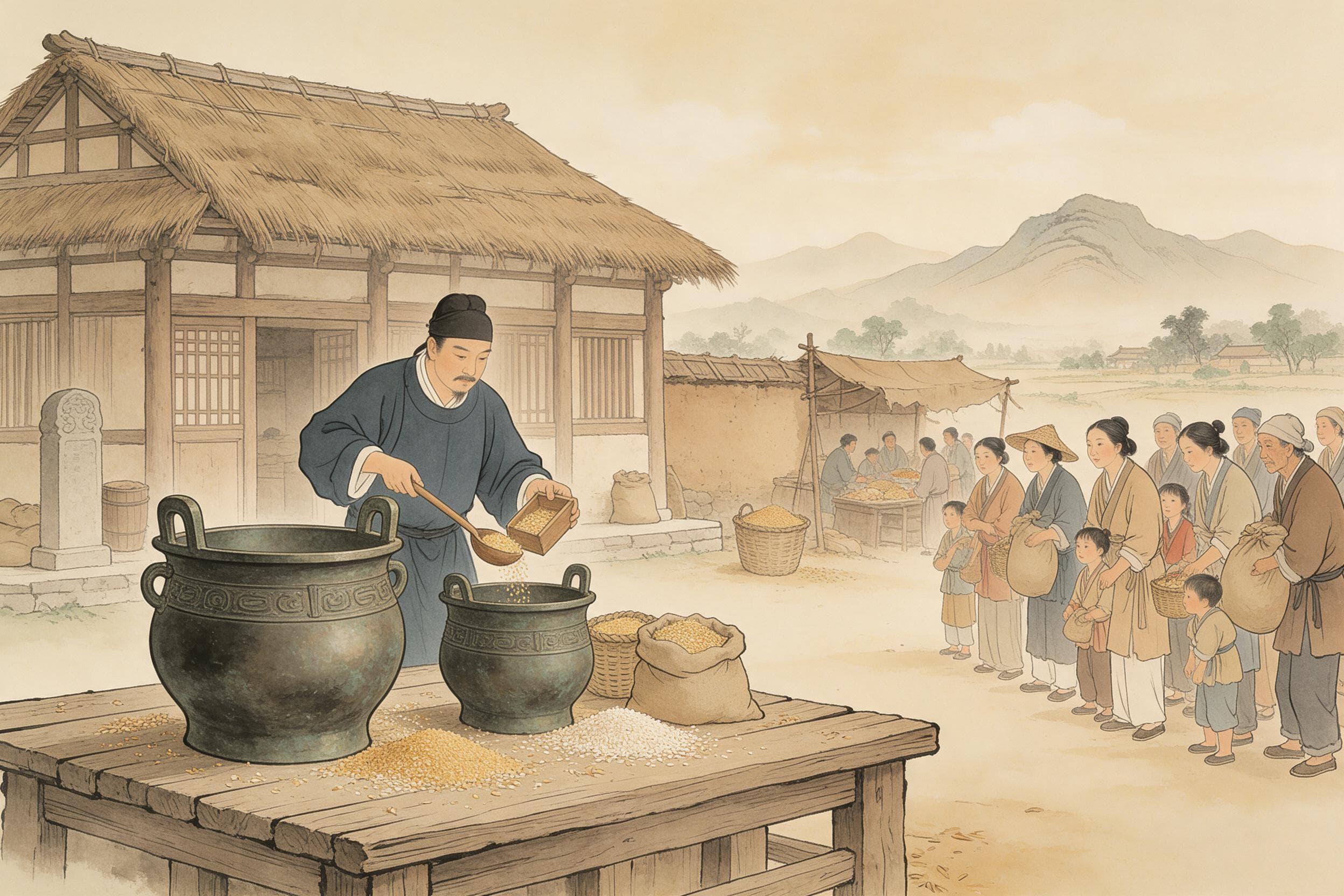
The core is this: 'they lend by the family measure and collect by the public one' (以家量貸,而以公量收之). It matters to say what it is not: it is not a tax cut. The levy stays the same; only the vessel used to measure it out and the vessel used to receive it back differ. Grain goes out by the Chen's own larger dou and comes back by the state's smaller one, so that the same nominal amount is a bigger gift going out and a smaller debt coming back. The page states the operation and stops; it gives no ratio, and neither does this article.
The Shiji tells the same thing with a different subject-name and the operation in the opposite word order: 'Tian Lizi Qi served Duke Jing of Qi as a great officer; when he collected taxes from the people he received them with a small dou, and when he gave out grain he did so with a large one, doing hidden kindness among the people, and Duke Jing did not forbid it. From this the Tian clan won the hearts of Qi; the clan grew stronger and the people thought of Tian' (其收賦稅於民以小斗受之,其(粟)[稟]予民以大斗……由此田氏得齊眾心). The page prints a correction here, 粟 against 稟, and the quotation keeps it visible.
The two accounts cannot be run into one sentence. The clan is 陳 in the Zuo and 田 in the Shiji — generally thought the same clan written two ways. The operation is described from opposite ends: lending by the family measure and collecting by the public one, against receiving by a small dou and giving by a large one. The occasion differs too — a banquet where the two men talk, against 'whispering privately' (私語). And the verdict differs in wording: 'Qi will be Chen's' against 'the government of Qi will end with the Tian clan' (齊國之政卒歸於田氏矣). Both stand; neither is preferred.
More than a bigger dou
The measures are one item in a longer list. Timber 'in the market is not raised above its price in the hills'; fish, salt, clams and shellfish 'are not raised above their price at the sea' (山木如市,弗加於山;魚鹽蜃蛤,弗加於海). The people's strength is counted in thirds: 'of the people's strength, two parts go to the duke and one part clothes and feeds them' (民參其力,二入於公,而衣食其一). Meanwhile 'what the duke has gathered rots and breeds worms, while the village elders freeze and starve' (公聚朽蠹,而三老凍餒). And the market tells its own story: 'in the markets of the state, shoes are cheap and false feet are dear' (屨賤踊貴). The 踊 are generally thought to be the artificial feet of men who had a foot cut off; one sentence is enough, and the history of punishment is not opened here.
The effect — and Jin's half of the talk
The result is the most quoted sentence in the passage: 'the people were in pain, and someone warmed and comforted them; they loved him as parents and went to him like water — try as you would to win no people, where could you escape it?' (民人痛疾,而或燠休之。其愛之如父母,而歸之如流水). The 'him' is the Chen clan, and the sentence is Yanzi's — a man of Qi speaking about his own state in front of a Jin minister. It is quoted here as his judgement, not as a historian's conclusion. He adds one more sentence about the clan's ancestors — 'Ji Bo, Zhi Bing, Yu Sui and Bo Xi, with Hu Gong and Da Ji, are already in Qi' (箕伯、直柄、虞遂、伯戲,其相胡公大姬,已在齊矣) — which is recorded here without opening the genealogy.
Shu Xiang does not argue; he says Jin is in the same late season. Six clauses: 'war-horses are not yoked; the ministers have no troops; the duke's carriages have no men; the ranks have no officers. The common people are worn out, and the palaces grow more extravagant. On the roads the dead are seen, and the women's families overflow with wealth. The people hear the duke's orders as they would flee an enemy' (戎馬不駕……民聞公命,如逃寇讎). Then a list of fallen clans — Luan, Xi, Xu, Yuan, Hu, Xu, Qing, Bo — 'brought down to servants' (降在皂隸), and the verdict: 'government is in the great families, and the people have nowhere to lean' (政在家門,民無所依).
Two texts, two layers, and the gaps
The two pages are two kinds of text: the Zuo's passage is a conversation in the third year of Duke Zhao of Lu, with two speakers and replies; the Shiji's is a later condensation, with the protagonist named Tian Lizi Qi. Their differences are set side by side above and not adjudicated. What neither gives: the vessels themselves or their capacities, the interest, term or recipients of the lending, the income of the Qi ducal house, and what came after — the page stops at the sentence 'Qi will be Chen's', and this article does not run past it. Nor is there a general lesson about winning hearts: Yanzi's words are a contemporary's judgement, not a historian's verdict. Go back to the banquet: no war, no edict, only a set of oversized bushels and one remark whispered to a neighbouring state's minister.
Related reading:Horses in the Lanes: Price, Prohibition and a Bronze Model · Asking the Cauldron's Weight: 'It Lies in Virtue, Not in the Vessel' · The Annual Account: How a Ledger Travelled from County to Court
Sources & further reading
- 《春秋左氏传·昭公》(昭公三年,维基文库本,未与点校本复核) — At a banquet in Jin, Shu Xiang asks Yanzi how Qi stands, and Yanzi answers that Qi will go to the Chen clan — the reason being measures, not armies: 'Qi's old four measures: dou, qu, fu, zhong. Four sheng make a dou; each fourfold, up to the fu; ten fu make a zhong. The three measures of the Chen clan were each raised one grade, so that their zhong was larger. They lend by the family measure and collect by the public one' (齊舊四量……陳氏三量,皆登一焉,鍾乃大矣。以家量貸,而以公量收之). The passage adds that timber is not raised above its hill price nor fish and salt above their sea price; that of the people's strength two parts go to the duke and one feeds them; that the duke's stores rot while the elders freeze; that in the markets 'shoes are cheap and false feet dear' (屨賤踊貴); and that 'they love him as parents and go to him like water' (其愛之如父母,而歸之如流水). Shu Xiang answers with Jin's own diagnosis — war-horses unyoked, ministers without troops, the roads full of dead, the people fleeing the duke's orders like an enemy, eight old clans reduced to servants, 'government in the great families' (政在家門).
- 《史记》卷四十六〈田敬仲完世家〉(维基文库本,未与点校本复核) — The Shiji's condensation, with the clan written Tian and the operation in the opposite word order: 'Tian Lizi Qi served Duke Jing of Qi as a great officer; when he collected taxes from the people he received them with a small dou, and when he gave out grain he did so with a large one, doing hidden kindness among the people, and Duke Jing did not forbid it. From this the Tian clan won the hearts of Qi, the clan grew stronger, and the people thought of Tian. Yanzi remonstrated several times and the duke did not listen. Later, sent to Jin, he whispered privately to Shu Xiang: the government of Qi will end with the Tian clan' (其收賦稅於民以小斗受之,其稟予民以大斗……齊國之政卒歸於田氏矣). The page prints a correction in its text here (粟 corrected to 稟), which is noted where quoted.