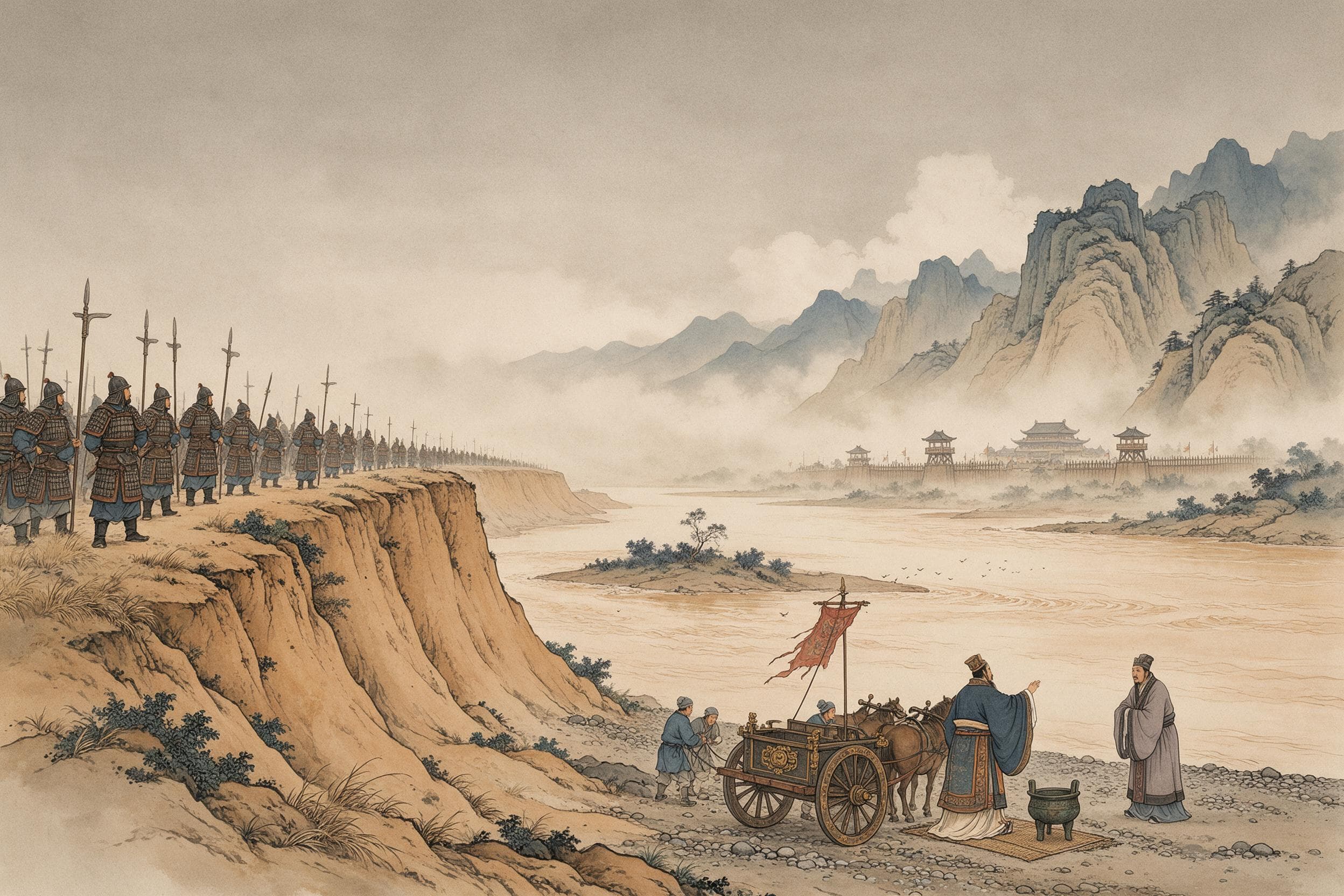
Begin with the name of a ledger. The Tang compilation Tongdian, describing Han commandery governors, reaches the end of the year: 'in the Han system, at the year's end each sends one accounting officer (上計掾史各一人), who sets out the various affairs of the commandery; it is called the ledger of accounts' (計偕簿). One clerk per commandery, once a year, carrying the year's business up in writing. The sentence sits inside the list of a governor's duties, between the spring tour of his counties and the autumn interrogations of prisoners. The three characters say it: 計 is the account, 偕 is 'together with' — generally thought to mean the ledger that travels with the officer, though the page does not gloss it. This must be flagged first: the Tongdian is a Tang compilation, a later systematic account of Han institutions, not a Han document.
One ledger: the ji xie bu
The route has two levels. For the county, the Tongdian's section on magistrates says: 'in autumn and winter they collect and assess, and report up to the commandery or kingdom they belong to' (秋冬集課,上計於屬郡國). For the commandery, the line already quoted: at the year's end it sends one accounting officer, who sets out the commandery's affairs. So the county reports to the commandery, and the commandery sends its clerk to the court. 'One each' means one per commandery or kingdom, not a total; how many there were altogether, neither page says, and this article does not multiply.
The timings differ and are copied as they stand: the county in 'autumn and winter', the commandery 'at the year's end', and the commandery's own clerks — Hu Guang says 'from the assistant and commandant down, they go to the commandery each year' (丞尉以下歲詣郡). The governor's year is full too: 'he tours the counties under him in spring, and in autumn and winter sends harmless clerks to interrogate prisoners, equalise their sentences, and settle the grading of first and last' (春行所主縣,秋冬遣無害吏按訊諸囚,平其罪法,論課殿最). The season of accounts and the season of inspection meet.
Four items on the ledger
What is written on it comes from Hu Guang, quoted in the Tongdian: 'at the year's end they count the county's households and cultivated fields, cash and grain in and out, and the number of bandits, and send up the assessment ledger' (各計縣戶口墾田,錢穀入出,盜賊多少,上集簿). Four items: households, fields, cash and grain, bandits. Four, as written; no fifth is added. Note the two layers of time: Hu Guang was a man of the Eastern Han, describing the system he knew, and the book quoting him is a Tang compilation. Both distances are kept visible.
One more textual point before the grading: the ledger carries two names on these two pages. The commandery passage calls it 計偕簿. Hu Guang, describing the county, says the county sends up 集簿 — 'they send up the assessment ledger' (上集簿). The pages never say whether 集簿 and 計偕簿 are one document, or whether one is the county's copy and the other the commandery's. Both names stand as written; this article does not decide that they are the same book.
With the account comes a grade. From the same passage: 'clerks from the assistant and commandant down go to the commandery each year, where their merit is assessed; those with much merit, especially the highest, are praised in the courtyard to encourage the rest; those with much deficit, especially the lowest, are called to account in the rear office to correct slackness' (功多尤為最者,於庭慰勞勉之……負多尤為殿者,於後曹對責). Merit is 最, deficit is 殿. It is generally thought that 最 is the first grade and 殿 the last; the page does not gloss them, and they are left as the text pairs them. The words travel: 殿最 also appears in the Hanshu edict, where 'the chancellor and censor grade them as first or last' (丞相御史課殿最以聞).
The ledger in the edict
The system above is one layer; the edict is another, and they are kept apart. Near the end of the Hanshu's Annals of Emperor Xuan comes an edict that begins with a question: 'the world has little business now, corvée is reduced, there is no war, yet the people are poor and bandits do not stop — where does the blame lie?' (方今天下少事,繇役省減,兵革不動,而民多貧,盜賊不止,其咎安在). Then it turns on the accounts: 'the annual accounts are paper only, and every effort goes into deceit, to dodge the assessment. If the three excellencies take no notice, whom am I to employ?' (上計簿,具文而已,務為欺謾,以避其課。三公不以為意,朕將何任). This is not a description of the system; it is the emperor's judgment on how it ran.
How to check an account
The same edict gives the remedy: 'let the censors examine the accounts, and impeach whatever is not real, so that true and false are not confused' (御史察計簿,疑非實者,按之,使真偽毋相亂). Not a new system — an added spot check. Another edict gives a different return, down to individual people: 'let the commanderies and kingdoms yearly report, for prisoners who died under beating or of cold and hunger, the name, county, rank and ward, and let the chancellor and censor grade them as first or last' (其令郡國歲上繫囚以掠笞若瘐死者所坐名、縣、爵、里). That is a separate return, not the commandery ledger, and the two are not merged here.
What each page does, and what neither gives
The two pages are not two witnesses to one fact but two kinds of text: the Hanshu gives an edict in the emperor's own voice, with the word 'accounts' and the fact of deceit but no procedure; the Tongdian gives the procedure and its items as a later synthesis, quoting an Eastern Han scholar. They supplement each other; they cannot corroborate each other, and the Tongdian is not a second independent primary source. Every quotation from it here is marked as the Tongdian's account or as Hu Guang's words. The page itself shows Hu Guang to be an Eastern Han man: elsewhere in the same chapter, in the section on the Later Han, he is listed among those who went out from the office of 尚書令 or 僕射 to be commandery governors (以尚書令、僕射出為郡守,鍾離意、黃香、桓榮、胡廣是也).
What neither page gives can be listed: the ledger's format — how many columns, what slips, how bound (nothing); the total number of accounting officers (only 'one each'); their travel and treatment; any actual figures for cash and grain (the item 'cash and grain in and out' has no numbers attached); whether Qin had such a return (both pages say only 'the Han system'); and the year of Emperor Xuan's edict (not marked on the page). None of it is supplied. The ledger travelled from county to court, but how far, what it looked like and how much was written on it — these pages give the rule and the emperor's complaint, not the ledger itself.
Related reading:Two Lives of the Rich: The Shiji's Merchants and the Hanshu's · Fifty Trees, Fires in Four Corners: Mulberry and Silkworm in the North · Jiaozi and Huizi: Two Notes, Two Systems of Issues
Sources & further reading
- 班固《汉书》卷八〈宣帝纪〉(维基文库本,未与点校本复核) — The emperor's edict near the end of the reign: 'the world has little business now, corvée is reduced, there is no war, yet the people are poor and bandits do not stop — where does the blame lie? The annual accounts are paper only, and every effort goes into deceit, to dodge the assessment. If the three excellencies take no notice, whom am I to employ? Let the censors examine the accounts, and impeach whatever is not real, so that true and false are not confused' (上計簿,具文而已,務為欺謾,以避其課……御史察計簿,疑非實者,按之). Another edict orders that commanderies report yearly, for prisoners who died under beating or of cold and hunger, 'the name, county, rank and ward, and let the chancellor and censor grade them as first or last' (其令郡國歲上繫囚……所坐名、縣、爵、里,丞相御史課殿最以聞).
- 杜佑《通典》卷三十三〈职官〉郡太守、县令条(维基文库本,未与点校本复核) — A Tang compilation's systematic account of Han institutions — a later description, not a second independent Han source. Under the commandery governor: 'in the Han system, at the year's end each sends one accounting officer (上計掾史各一人), who sets out the various affairs of the commandery, called the ledger of accounts (計偕簿)'; and the governor 'in spring tours the counties under him, in autumn and winter sends harmless clerks to interrogate prisoners, equalise their sentences, and discuss the grading of first and last' (論課殿最). Under the county magistrate: 'in autumn and winter they collect and assess, and report up to the commandery or kingdom they belong to' (秋冬集課,上計於屬郡國). Hu Guang is quoted: 'at the year's end they count the county's households and cultivated fields, cash and grain in and out, and the number of bandits, and send up the assessment ledger; clerks from the assistant and commandant down go to the commandery each year, where their merit is assessed; those with much merit, especially the highest, are praised in the courtyard; those with much deficit, especially the lowest, are called to account in the rear office' (功多尤為最者,於庭慰勞勉之……負多尤為殿者,於後曹對責).