In the twelfth month of the twenty-ninth year of the Dading reign — the winter of 1189 — the Jin court fixed the price of salt at thirty cash a jin. The chapter that records how it got there, "Food and Money IV: Salt" in the Jinshi, also lets the state's own figure slip out a few lines later: ten cash a jin. The two numbers sit side by side on the same page, and neither of them is a market price. This article rests on that one chapter — the salt section of the official history of the Jin, compiled under the Yuan — and where the page is silent I say so.
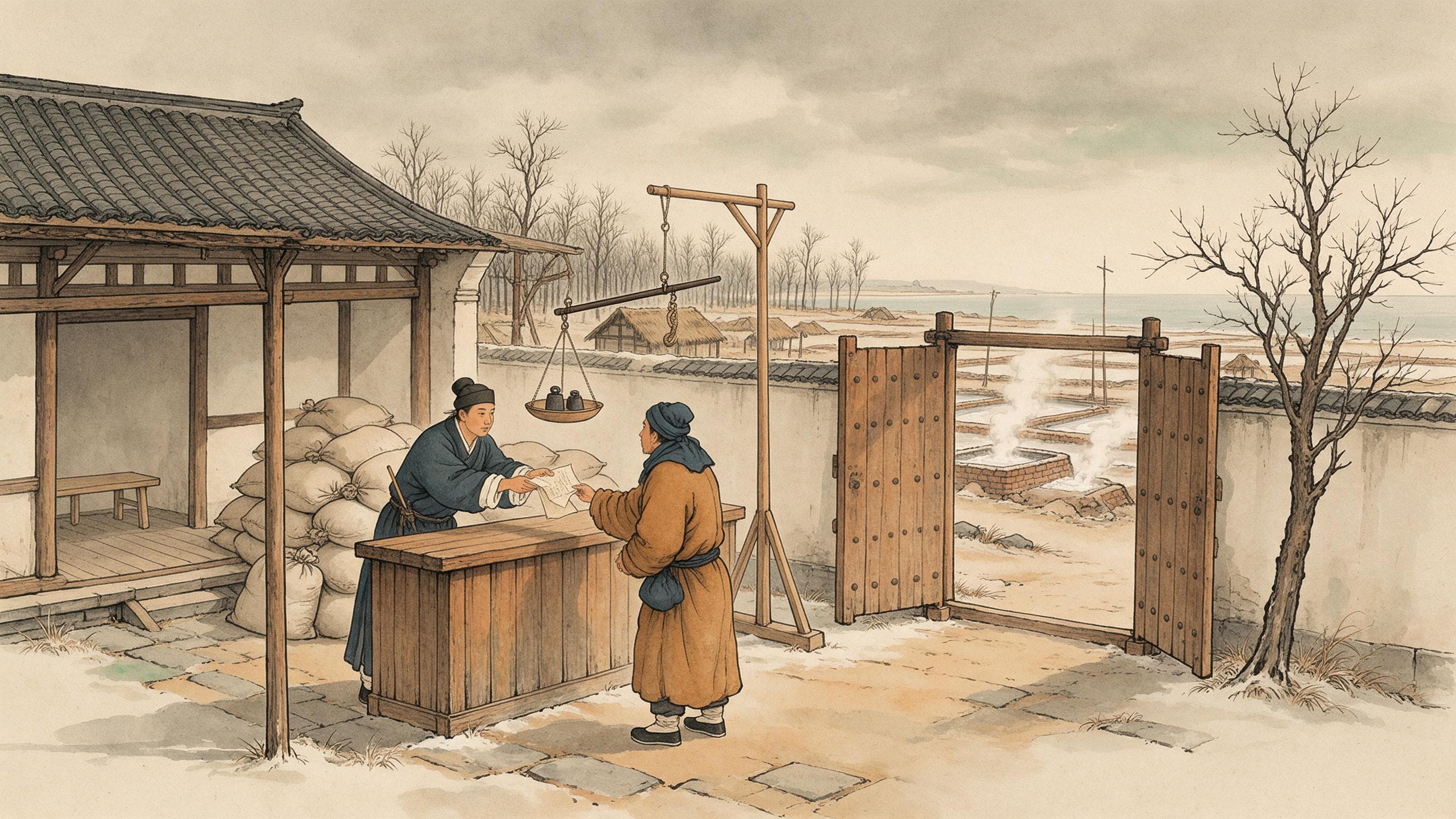
First, how the thing was sold. The Jin counted salt first among the ten goods it monopolised, and a sale needed three papers: "鈔、引、公據三者俱備然後聽鬻". What the first two did, the chapter explains elsewhere: "鈔,合鹽司簿之符" — the chao matched the salt office's register; "引,會司縣批繳之數" — the yin checked the numbers the county had counted and returned. The gongju is left unexplained. At Shandong, Cang and Baodi the unit was a bag of three hundred jin, twenty-five bags to a large set (大套), one chao to a set and "引如袋之數" — one warrant per bag. Jie salt was counted at 250 jin to a mat (席), five mats to a set; at the western capital, Beijing and Liaodong salt was reckoned by the shi of grain measure and converted into sets. The prices in the chapter are per jin; the trade ran in bags, mats and shi.
One: Thirty-eight, Twenty-five, Twenty
By the time the argument opened, the price had already come down once. The minister of revenue, Zheng Yan, reported that salt at Baodi, Shandong and Cang had lately been cut to thirty-eight cash a jin — "近已減寶坻、山東、滄鹽價斤為三十八文,乞更減去八文" — and asked for eight cash more off, which lands exactly on thirty. His reasoning was fiscal: official valuations stood too high, the poor preferred cheap private salt, and the state's salt revenue was shrinking ("緣官估高,貧民利私鹽之賤,致虧官課爾"). The cut, he said, would cost no more than 1.2 million guan a year, and the treasury's gold and silver, converted into cash, came to some hundred million guan — enough, he reckoned, for a hundred years.
Others went further. The minister of rites, Li Yan, wanted twenty-five: "莫若每斤減為二十五文,使公私價同,則私將自己" — bring the official price level with the private one and private selling will stop of itself. Wang Xiu wanted twenty. The ministers then put the cost on the table: "以每斤官本十文,若減作二十五文,似為得中" — the official cost is ten cash a jin, so twenty-five looks like the middle course. The edict took thirty: "遂命寶坻、山東、滄鹽每斤減為三十文,已發鈔引未支者准新價足之" — and warrants already issued but not yet drawn were to be topped up at the new price. Thirty was the revenue minister's own figure, five cash above the sum his colleagues had called the middle course.
Two: Ten Cash Was What It Cost the State
The ten cash survives only as one sentence inside a ministers' memorial. The chapter gives no ledger, no freight, no rate of loss in boiling or carting, no pay for the clerks who weighed it out. So the two numbers can be set beside each other and nothing more: an official price of thirty, an official cost of ten. Nor is there a retail price anywhere in the chapter — nobody in these pages buys salt by the jin across a counter, and a figure fixed per jin on a three-hundred-jin bag is not what a household paid for a handful.
The cost of the cut was reckoned only in the twelfth month of Mingchang 5 (1194), when the secretariat looked back: under the old law Shandong and Cang had charged forty-one cash a jin and Baodi forty-three, and the cut to thirty had given up "計減百八十五萬四千餘貫" — 1,854,000-odd guan of revenue. The next sentence turns the direction round: "後以國用不充,遂奏定每一斤複加三文為三十三文" — state expenditure was not covered, so three cash went back on, to thirty-three.
Three: Putting It Back — Forty-two and Forty-four
In the twelfth month of Chengan 3 (1198) the three offices of Shandong, Baodi and Cang were raised to forty-two cash a jin. The other districts were priced in their own units: at Jie a mat from five guan to six guan four hundred; in Liaodong and at Beijing a shi from nine hundred cash to one thousand five hundred; at the western capital boiled salt from two guan to two guan eight hundred a shi, and scooped salt from one thousand five hundred to two thousand. The same entry reports the seven salt offices' yearly revenue rising from 6,226,636 guan 566 cash to 10,774,512 guan 137 cash and 2 fen.
In the sixth month of Taihe 4 (1204) the seven offices' quotas were put on a seven-year cycle and the price went to forty-four cash a jin — the last price the chapter records. Collection did not follow smoothly: in the third month of Taihe 6 (1206) the court was told Shandong was short by more than 500,000 guan, "蓋以私煮盜販者成黨" — private boiling and smuggling had formed bands the salt offices could not catch.
Four: Warrant, Bag, Mat, Shi
The units were not uniform, and the chapter lists them as a practical matter: three hundred jin to a bag in Shandong, Cang and Baodi, twenty-five bags to a large set, with small sets of ten, five or one bag; 250 jin to a mat at Jie, five mats to a set; at the western capital five shi to a large set and three to a small one, at Beijing four, in Liaodong ten — "皆套一鈔,石一引", one chao to a set and one warrant to a shi. Salt also moved only inside assigned territories: the nine yards of Shandong and Cang supplied Shandong, Hebei, Daming, Henan and Nanjing; Jie salt went into Hedong and Shaanxi; the western capital and Liaodong sold only at home. The chapter introduces all this with one line — "行鹽之界,各視其地宜": each territory got whatever salt suited it.
Five: The People the Warrant Did Not Fit
In the tenth month of Dading 25 (1185) the emperor, back from Shangjing, put his finger on the gap in the system: "夫細民徐買食之,何由有引目" — a poor man buying a little at a time, how would he ever have a warrant? On that remark the salt offices of Beijing and Liaodong were abolished. Three years later he turned on the enforcement: salt officers going on tour, he said, had their patrol men carry official salt on them, demand bribes and food and drink along the way, and when refused "則以所懷誣以為私鹽" — accuse a man of private salt using the salt they were carrying. A separate patrol office was set up directly under the province and ministry, forbidden to search houses, and salt under one dou was not to be prosecuted.
One chapter, then, holds three changes of direction: a cut to thirty in 1189, three cash back on within a few years, then forty-two and forty-four; and beside the price a second scheme, to replace warrants with household quotas. In the tenth month of 1189 the emperor wanted commoners to boil their own salt, following the arrangement already used at Ping, Luan and Taiyuan; by Mingchang 1 (1190) the Hedong circuit's flat levy of 100,000 guan a year was reported as so heavy that people were running away; in Taihe 5 (1205) the Shandong and Cang offices went over to collecting by household, and Lai and Mi were said to find it heavy enough to fear flight. The chapter gives no retail price, no freight, no total output, and nothing on what thirty cash actually bought. It gives official prices, an official cost, official quotas, and the arguments of the men who set them. That is the whole of the evidence here.
Related reading:Horses in the Lanes: Price, Prohibition and a Bronze Model · Lending by the Family Measure: How One Clan Bought a State with Bushels · Asking the Cauldron's Weight: 'It Lies in Virtue, Not in the Vessel'
Sources & further reading
- 脱脱等《金史》卷四十九「食货四·盐」(元修;维基文库本,页面白文无注,未与中华书局点校本复核) — The salt price per jin as the court fixed it: thirty cash after the reduction of 1189, thirty-three once three cash went back on, forty-two in 1198 and forty-four in 1204 — with the ministers' own figure for the state's cost, ten cash a jin. Same juan, first passage; this article rests on this one chapter.
- 同上,《金史》卷四十九「食货四·盐」课额、计量与巡捕诸条(同卷后段,同一史源) — Same chapter, later passages: the bag of three hundred jin and the warrant count per 套, the rise of the seven offices' quota from 6.22 to 10.77 million guan, the emperor's remark that a poor man buying a little salt could not have a warrant, and the salt officers' men who carried official salt to accuse people of private trade. Two entries, one source — stated openly rather than padded with a second history.