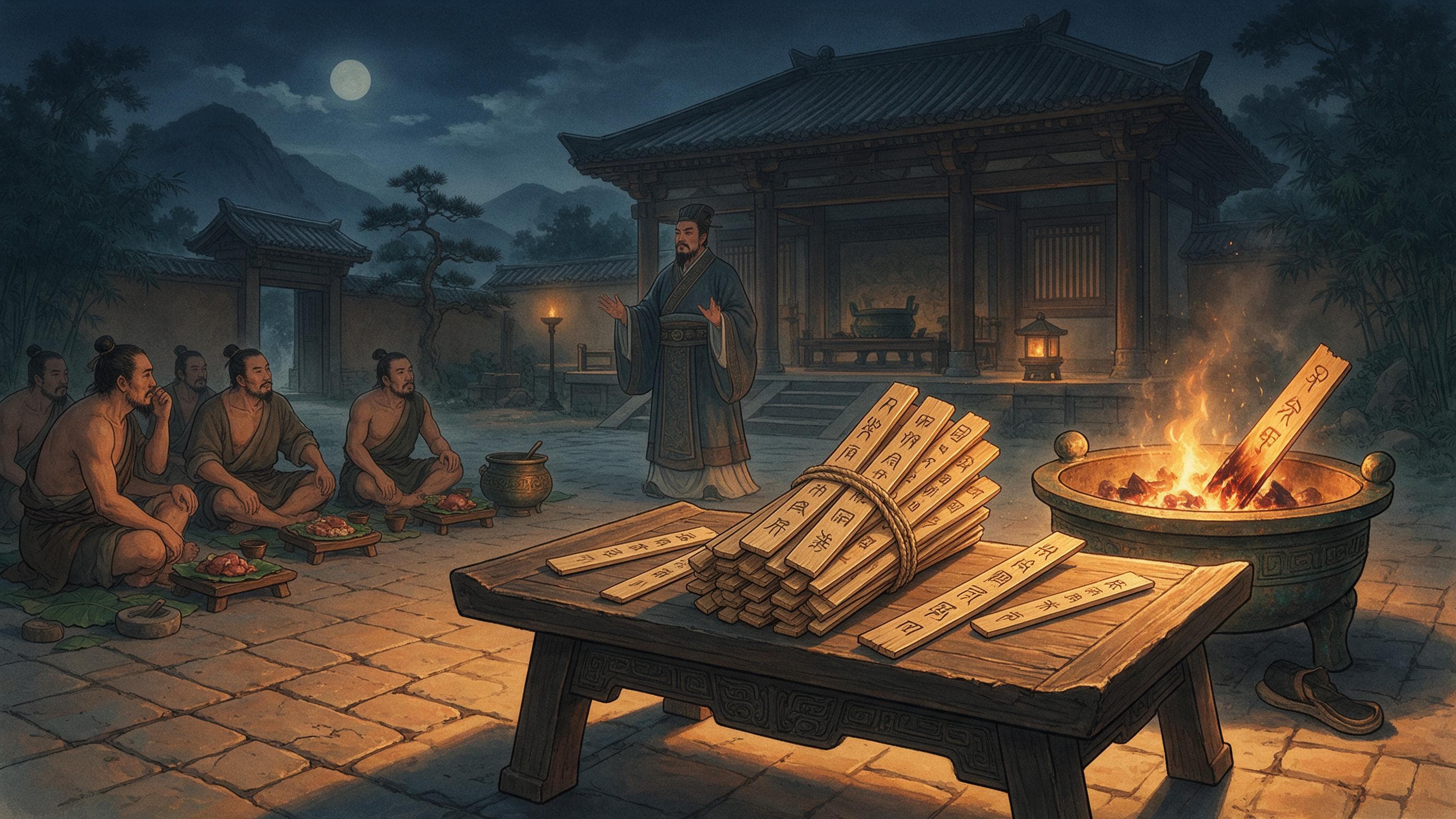
The Records of the Grand Historian, in the treatise on the balanced standard, gives the Han founding in one sentence: 'the founder came after the ruin of Qin; men went to the wars, the old and weak carried grain, the work was hard and wealth exhausted, so that the son of heaven could not match his four horses in colour, and some of the generals and chancellors rode ox-carts, and the common people had nothing left to store' (自天子不能具鈞駟,而將相或乘牛車,齊民無藏蓋). Two lines later comes the price: 'grain rose to ten thousand cash a shi, and a horse to a hundred jin' (米至石萬錢,馬一匹則百金). A hundred jin is printed as it stands and not converted; the usual reading takes it as the top of the early Han market, not a normal price.
The Lean Years
The coinage went bad before the horses became dear. The same passage says Qin cash was too heavy to use, so the people were allowed to cast their own and 'one jin of gold' was fixed as the standard, with the law relaxed; then 'unruly men chasing profit hoarded goods and held back the market, prices leapt, grain to ten thousand cash a shi and a horse to a hundred jin' (不軌逐利之民……物踴騰糶). This is a revenue treatise reaching the price list; the horse is one line of it.
Under Emperor Jing the same chapter has a smaller notice: when the land west of Shang commandery suffered drought, the sale of ranks was revived at a lower price to draw people, and convicts were allowed to pay grain to cancel their sentence; 'park horses were bred in greater numbers to broaden use, and palaces, terraces, carriages and horses were increasingly built and kept' (益造苑馬以廣用,而宮室列觀輿馬益增修矣). The sentence sits under Jing, not under Emperor Wu, though it is often put with the later boom. What 苑馬 exactly were — horses kept in the parks — is the usual reading; the page does not gloss it.
Horses in the Lanes
The boom comes one paragraph later, and it is a retrospect, not a ledger: 'down to the present emperor's first years, through more than seventy years of Han, the realm had no great affairs… the common people had horses in the lanes, and in herds between the field paths, while a man who rode a mare was shut out of gatherings' (眾庶街巷有馬,阡陌之閒成群,而乘字牝者儐而不得聚會). The writer looks back from the reign of Emperor Wu; the sentence is a description, not a count. 字牝 is read as a mare and 儐 as being kept out; the page glosses neither, and both are marked as the usual readings.
Set the two ends together and the chapter changes key: from four horses the emperor could not match in colour to horses in the lanes of ordinary people, with a social rule about which horse you rode to a gathering. What the chapter never gives is how many horses there were, in the realm or in the parks. One price and one scene are all it has, and this article does not turn them into a curve.
Gates, Park Horses and Feed
The Book of Han's annals of Emperor Jing are another kind of page, and keep the horses in single entries. In the fourth year of the middle era: 'the imperial secretary Wan proposed forbidding horses five chi nine cun and more in height, whose teeth are not yet worn level, to leave the passes' (禁馬高五尺九寸以上,齒未平,不得出關) — a height and a mouth, two conditions in one sentence. In the sixth year: 'the Xiongnu entered Yanmen, reached Wuquan, entered Shang commandery and took the park horses; officers and men killed in battle numbered two thousand' (匈奴入鴈門……取苑馬) — the park horses taken were on the Yanmen and Shang commandery side. In the second year of the final era: 'because the harvest failed, the inner commanderies were forbidden to feed grain to horses, and the grain was confiscated' (禁內郡食馬粟,沒入之).
One more entry sits in the deathbed edict: it 'gave the kings and marquises two teams of four horses each' (遺詔賜諸侯王列侯馬二駟). Prohibitions, seizures, losses, gifts — the annals carry them as they come, year by year, and the horses are never the subject of that page. There is no overview of a horse administration in these entries, and this article does not assemble one from them.
A Bronze Horse to Judge By
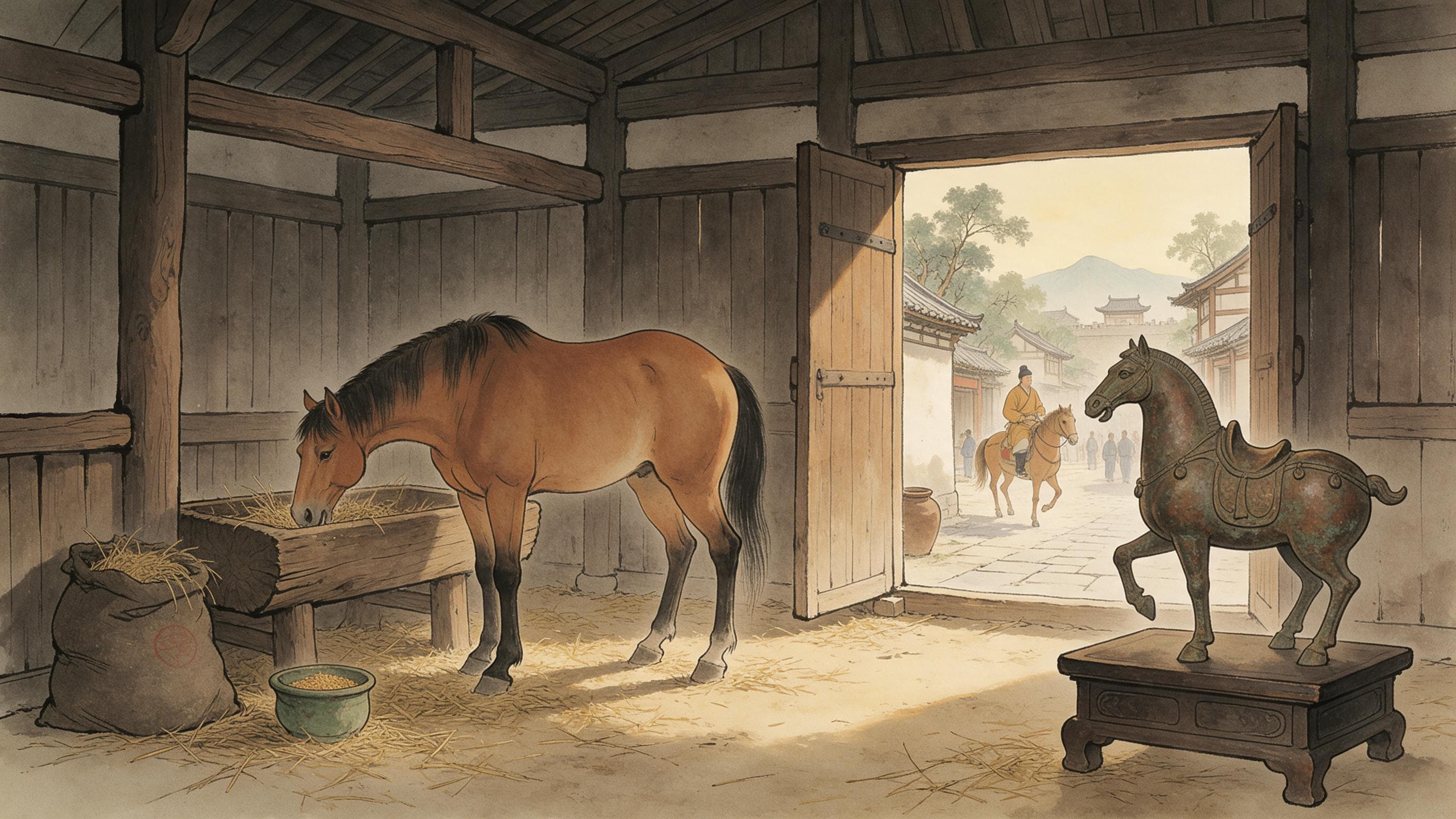
The Book of the Later Han, in the life of Ma Yuan, comes at horses from another side: 'Yuan loved to ride and was good at distinguishing famous horses; in Jiaozhi he obtained bronze drums of the Luo Yue and had them melted into a horse model, which he presented on his return' (援好騎,善別名馬,於交阯得駱越銅鼓,乃鑄爲馬式,還上之). With it went a memorial: 'In the sky nothing moves like the dragon, on earth nothing like the horse. The horse is the root of armour and weapons, the great use of the state: in peace it distinguishes the order of noble and base; in change it carries men far' (馬者甲兵之本。國之大用……). Those are Ma Yuan's words in one memorial, not a doctrine that any of the three pages attributes to the Han at large.
The memorial gives three things. A pedigree: 'in recent times there was Ziyu of Xihe, who also understood the method; Ziyu transmitted it to Yi Changru of Xihe, Changru to Ding Jundu of Maoling, and Jundu to Yang Zi'e of Chengji; I studied under Zi'e and received the bone method' (子輿傳西河儀長孺……臣援嘗師事子阿,受相馬骨法) — the page writes the third name once as 丁君都 and then as 君群, which is printed as it stands. An earlier bronze: under Emperor Wu the horse-judge Dongmen Jing 'cast a bronze horse method and presented it, and by edict it was set outside the Luban gate, which was thereupon renamed the Golden Horse Gate' (東門京鑄作銅馬法獻之……則更名魯班門曰金馬門). And his own model, set below the Xuande hall: 'the horse three chi five cun high, four chi five cun around' (馬高三尺五寸,圍四尺五寸). The sources he names are names only — 'Yi's bridle, the Bozhong family's mouth and teeth, Xie's lips and mane, Ding's body' (儀氏䩭,中帛氏口齒,謝氏唇鬐,丁氏身中) — with no bone method written out.
What the Pages Do Not Give
None of the three gives a total of horses, a number or size of parks, or a series of prices: there is one 'hundred jin' and nothing to compare it with. The model's measurements are printed as they stand and not converted. The judging method is a list of family names; no bone rule is supplied here. 'The horse is the root of armour and weapons' belongs to one memorial. No causal claim is made about horses and the wars with the Xiongnu, and the Northern Wei pastures are a separate article.
Three pages, three ways of writing. A revenue treatise gives one dear price and one remembered scene. An annals gives a gate size, a lost herd, a feed ban and a deathbed gift, one entry at a time. A biography gives a bronze horse with measurements and a list of teachers. Between the ox-carts of the founding and the horses in the lanes, the pages record that conditions changed; they never count the change, and they never describe an office that managed it.
Related reading:Forty Li of Purple Silk, Fifty of Brocade: Shi Chong and Wang Kai · Declare Your Goods: The Han Property Levy and the Rewards for Informers · Six Characters, Three Tables: Standard Measure in Qin and Han
Sources & further reading
- 《史记》卷三十·平准书(西汉司马迁撰;维基文库本,页面白文无注,未与中华书局点校本复核) — The two ends of Han horse wealth in one revenue treatise: at the founding, after the ruin of Qin, 'the son of heaven could not match his four horses in colour and some generals and chancellors rode ox-carts', with grain at ten thousand cash a shi and 'a horse at a hundred jin'; under Emperor Jing, drought west of Shang commandery, the sale of ranks at a lower price, convicts paying grain to cancel sentence, and 'park horses bred in greater numbers to broaden use'; then, looking back from the reign of Emperor Wu over seventy years, 'the common people had horses in the lanes, in herds between the field paths, and a man who rode a mare was shut out of gatherings'. No totals, no park numbers, no series of prices.
- 《后汉书》卷二十四·马援列传(南朝宋范晔撰;维基文库本,页面白文无注,未与中华书局点校本复核) — Ma Yuan, fond of riding and good at naming horses, melts bronze drums taken in Jiaozhi into a horse model and presents it with a memorial: 'in the sky nothing moves like the dragon, on earth nothing like the horse; the horse is the root of armour and weapons'; the transmission of the bone method from Ziyu of Xihe through Yi Changru, Ding Jundu and Yang Zi'e to himself; the earlier bronze of Dongmen Jing set outside the Luban gate, which was renamed the Golden Horse Gate; his own model three chi five cun high and four chi five cun around, set below the Xuande hall; and the families whose methods he followed, named only — Yi's bridle, Bozhong's mouth and teeth, Xie's lips and mane, Ding's body — with no bone rule written out.
- 《汉书》卷五·景帝纪(东汉班固撰;维基文库本,页面白文无注,未与中华书局点校本复核) — Single entries in the annals: in the fourth year of the middle era the imperial secretary Wan proposes forbidding horses five chi nine cun and more high, with teeth not yet worn level, to leave the passes; in the sixth year the Xiongnu enter Yanmen, reach Wuquan, enter Shang commandery and take the park horses, with two thousand officers and men killed; in the second year of the final era, the harvest failing, the inner commanderies are forbidden to feed grain to horses and the grain is confiscated; and the deathbed edict gives the kings and marquises two teams of four horses each.