In the third year of Duke Xuan of Lu, the lord of Chu attacked the Rong of Luhun, 'came to the Luo, and displayed his troops on the Zhou border' (遂至于雒,觀兵于周疆); King Ding of Zhou sent Wangsun Man to comfort him; and the lord of Chu asked 'the size and weight of the cauldrons' (問鼎之大小輕重焉). He asked how big and how heavy a bronze vessel was. Both pages record the conversation, and neither answers the question: there is not one word in either text about the cauldron's measurements or weight. The answer is four characters: 'It lies in virtue, not in the vessel' (在德不在鼎).
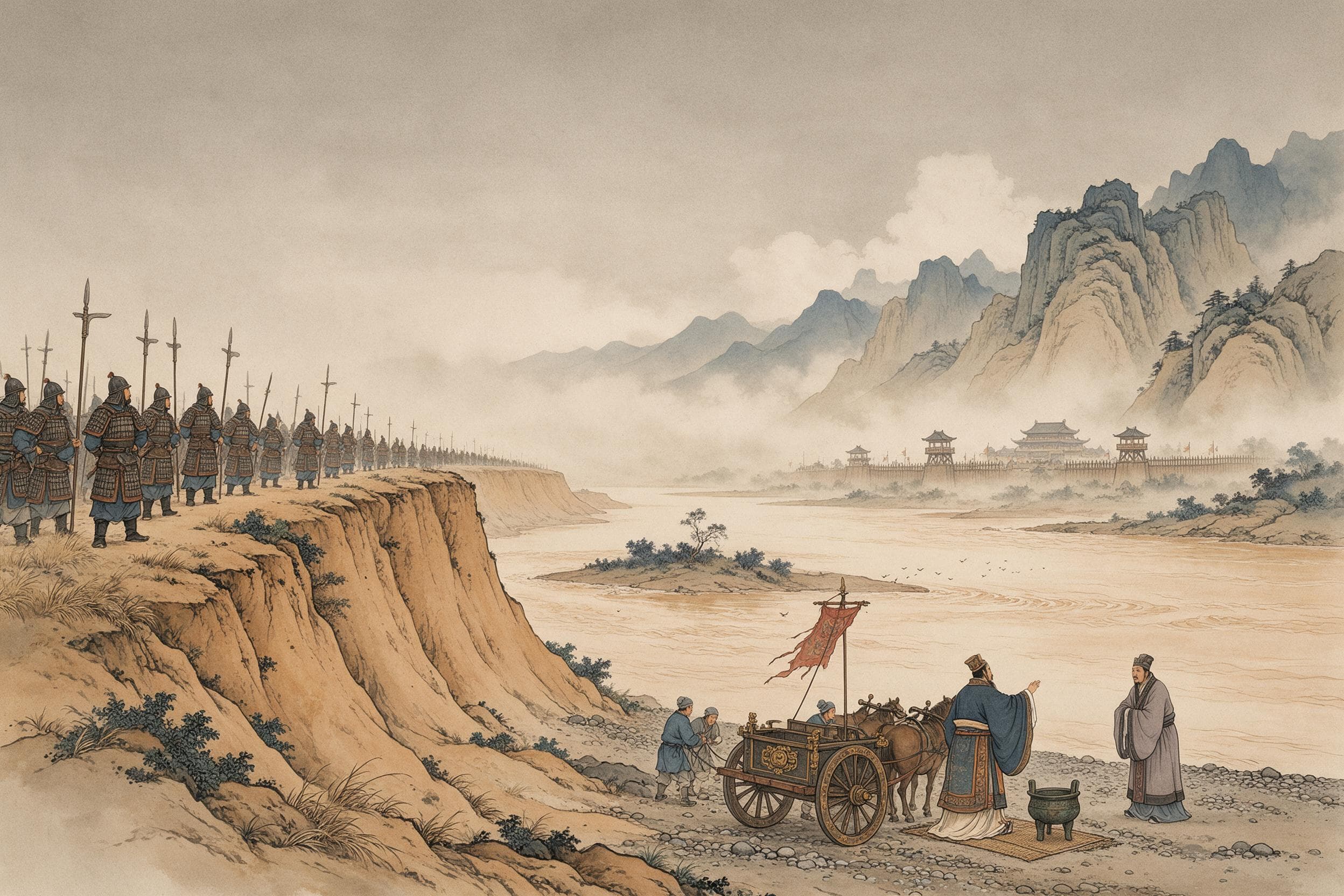
The Scene: Troops on the Zhou Border
The Zuozhuan begins: 'The lord of Chu attacked the Rong of Luhun, came to the Luo, and displayed his troops on the Zhou border. King Ding sent Wangsun Man to comfort the lord of Chu' (楚子伐陸渾之戎,遂至于雒,觀兵于周疆。定王使王孫滿勞楚子). The Shiji begins: 'In the eighth year he attacked the Rong of Luhun, came to the Luo, and displayed his troops on the Zhou outskirts. King Ding of Zhou sent Wangsun Man to comfort the king of Chu' (八年,伐陸渾戎,遂至洛,觀兵於周郊。周定王使王孫滿勞楚王). The history adds a year and a 'Zhou'; the man comforted is 'the lord' in one and 'the king' in the other. Both are printed. That 觀兵 means showing troops, a display of force, is the usual reading; the page does not gloss it, and it is marked here as the usual reading.
The question itself differs slightly in wording. Zuozhuan: 'the lord of Chu asked the size and weight of the cauldrons' (楚子問鼎之大小輕重焉). Shiji: 'the king of Chu asked the cauldrons' smallness and greatness, lightness and weight' (楚王問鼎小大輕重). Different order, same question: size and weight. That is the starting point of the whole affair — the question is a physical one, and the answer is not.
Four Characters, and a History of the Vessel
'He answered: "It lies in virtue, not in the vessel"' (對曰:在德不在鼎). How the two books place those four characters differs. In the Zuozhuan they open one continuous reply, which then runs to the end without interruption. In the Shiji they are given as the whole of the first answer; the king's retort is inserted (see the fourth section); and Wangsun Man begins again with 'Alas! Has your majesty forgotten it?' (嗚呼!君王其忘之乎?) before the long speech. One reply is a single block in one book and is cut in two in the other.
The casting of the cauldrons, in the Zuozhuan: 'In the time when Xia had virtue, the distant regions sent pictures of things, the nine herdsmen brought metal, and cauldrons were cast with images of things; every kind of thing was provided on them, so that the people should know the divine and the monstrous' (昔夏之方有德也,遠方圖物,貢金九牧,鑄鼎象物,百物而為之備,使民知神姦). Their use is given too: 'so when people went into the rivers, marshes, mountains and forests they met nothing unlucky; the spectres and sprites could not reach them, and thus they could harmonise above and below and receive Heaven's favour' (故民入川澤山林,不逢不若,螭魅罔兩,莫能逢之,用能協于上下,以承天休). The Shiji reads 'in the prime of Yu and Xia the distant regions all came' (昔虞夏之盛,遠方皆至) where the Zuozhuan has 'when Xia had virtue, the distant regions sent pictures of things'. In this passage the vessel is for knowing the divine and the monstrous, not for weighing.
The movements of the cauldrons are a small history, printed here in both readings: 'Jie had benighted virtue, and the cauldrons moved to Shang, with six hundred years of sacrifice' (桀有昏德,鼎遷于商,載祀六百) — the Shiji has 'Jie had chaotic virtue, and the cauldrons moved to Yin' (桀有亂德,鼎遷於殷), and then 'the tyrant Zhou of Shang, and the cauldrons moved to Zhou' (商紂暴虐,鼎遷于周), where the Shiji writes Yin for Shang. Benighted or chaotic, Shang or Yin: both are printed. 'Six hundred years of sacrifice' is left as the page leaves it, not converted into dates or drawn up as a chronology.
Heavy and Light: A Physical Question Replaced
The hardest sentence is a couplet: 'Where virtue is bright and fair, though the vessel be small, it is heavy; where it is crooked and benighted, though it be great, it is light' (德之休明,雖小,重也。其姦回昏亂,雖大,輕也). The Shiji has 'must be heavy' and 'must be light' (雖小必重……雖大必輕); both readings stand. The couplet turns 'how heavy is the cauldron' into 'how is the virtue': small can be heavy, great can be light. Which is why the measurement asked for is never given: Wangsun Man's answer is itself a refusal to weigh.
The Zuozhuan then adds a sentence the Shiji does not have — 'Heaven blesses bright virtue, and has its limits' (天祚明德,有所底止) — before 'King Cheng set the cauldrons at Jiaru, divining thirty generations and seven hundred years, which was what Heaven commanded' (成王定鼎于郟鄏,卜世三十,卜年七百,天所命也). The Shiji goes straight from 'must be light' to 'formerly King Cheng set the cauldrons at Jiaru' (昔成王定鼎于郟鄏). Jiaru is generally taken to be the later Wangcheng area; the page does not gloss it, and no modern place is named here. The two numbers are left as they stand, not turned into a span of years. Both books close the speech alike: 'Zhou's virtue may have declined, but Heaven's mandate has not changed. The weight of the cauldrons may not be asked' (周德雖衰,天命未改。鼎之輕重,未可問也).
Two Sentences Only in the Shiji
Only the Shiji gives the king's retort: 'Do not block my nine cauldrons! The broken barbs of Chu's halberds would suffice to cast them' (子無阻九鼎!楚國折鉤之喙,足以為九鼎). Its position differs with its book: in the Shiji it sits after the four characters and before the long speech, turning a question into a challenge; the Zuozhuan has no such line and runs the answer straight through. That 折鉤之喙 means the broken barbs of a halberd hook is the usual reading; the page has no note, and it is marked as the usual reading. The other sentence only the Shiji has is the ending: 'the king of Chu then went home' (楚王乃歸). Four characters, where the Zuozhuan stops at 'may not be asked' and does not say whether he went.
What Neither Page Gives
Neither page gives the cauldrons' measurements, weight, shape or number — that is exactly what was asked, and the texts decline to answer. Neither says what became of them; no later story of their sinking in the Si river or entering Qin is added here. Neither analyses the Zhou court's real strength, the king of Chu's next move, or the outcome of the exchange; the Shiji offers only 'then went home'. The Shiji page also carries the famous passage about the bird that does not fly for three years and then flies to the sky — another affair, and not folded into this one. The divination of thirty generations and seven hundred years is not converted into a chronology.
One last distinction. 'Asking the cauldron' (問鼎) later became a phrase for coveting the throne; that is a later use, and neither page says it. Both record one conversation: a man asks how heavy a vessel is, and is answered with virtue and the mandate of Heaven. What he asked for, neither book gives — not a measurement, not a weight.
Related reading:Two Lives of the Rich: The Shiji's Merchants and the Hanshu's · Fifty Trees, Fires in Four Corners: Mulberry and Silkworm in the North · Jiaozi and Huizi: Two Notes, Two Systems of Issues
Sources & further reading
- 《春秋左氏传·宣公三年》(维基文库本,页面白文无注,未与中华书局点校本复核) — The Zuozhuan's account: the lord of Chu campaigns against the Rong of Luhun, reaches the Luo and displays his troops on the Zhou border; King Ding sends Wangsun Man to comfort him; the Chu lord asks the size and weight of the cauldrons. Wangsun Man answers in one continuous speech: it lies in virtue, not in the vessel; when Xia had virtue the distant regions sent pictures and the nine herdsmen brought metal, and cauldrons were cast with images of things so that the people would know the divine and the monstrous; Jie's benighted virtue moved the cauldrons to Shang for six hundred years of sacrifice; the cruelty of Zhou of Shang moved them to Zhou; where virtue is bright, small means heavy, and where it is crooked, great means light; King Cheng set them at Jiaru with the divination of thirty generations and seven hundred years; Zhou's virtue may have declined but Heaven's mandate has not changed, so the weight of the cauldrons may not be asked.
- 《史记》卷四十·楚世家(西汉司马迁撰;维基文库本,页面白文无注,未与中华书局点校本复核) — The same affair in King Zhuang's eighth year, with a different shape: the king asks, the four characters 'it lies in virtue, not in the vessel' are given as the whole of the first answer, the king retorts 'do not block my nine cauldrons — the broken barbs of Chu's halberds would suffice to cast them', and only then does Wangsun Man deliver the long speech, opening 'Alas! Has your majesty forgotten it?' and speaking of 'Yu and Xia in their prime', Jie's 'chaotic virtue', the cauldrons moving to Yin, and 'must be heavy' for 'is heavy'. It also lacks the Zuozhuan's line about Heaven blessing bright virtue and having its limits, and ends with one sentence the Zuozhuan does not have: 'the king of Chu then went home.'