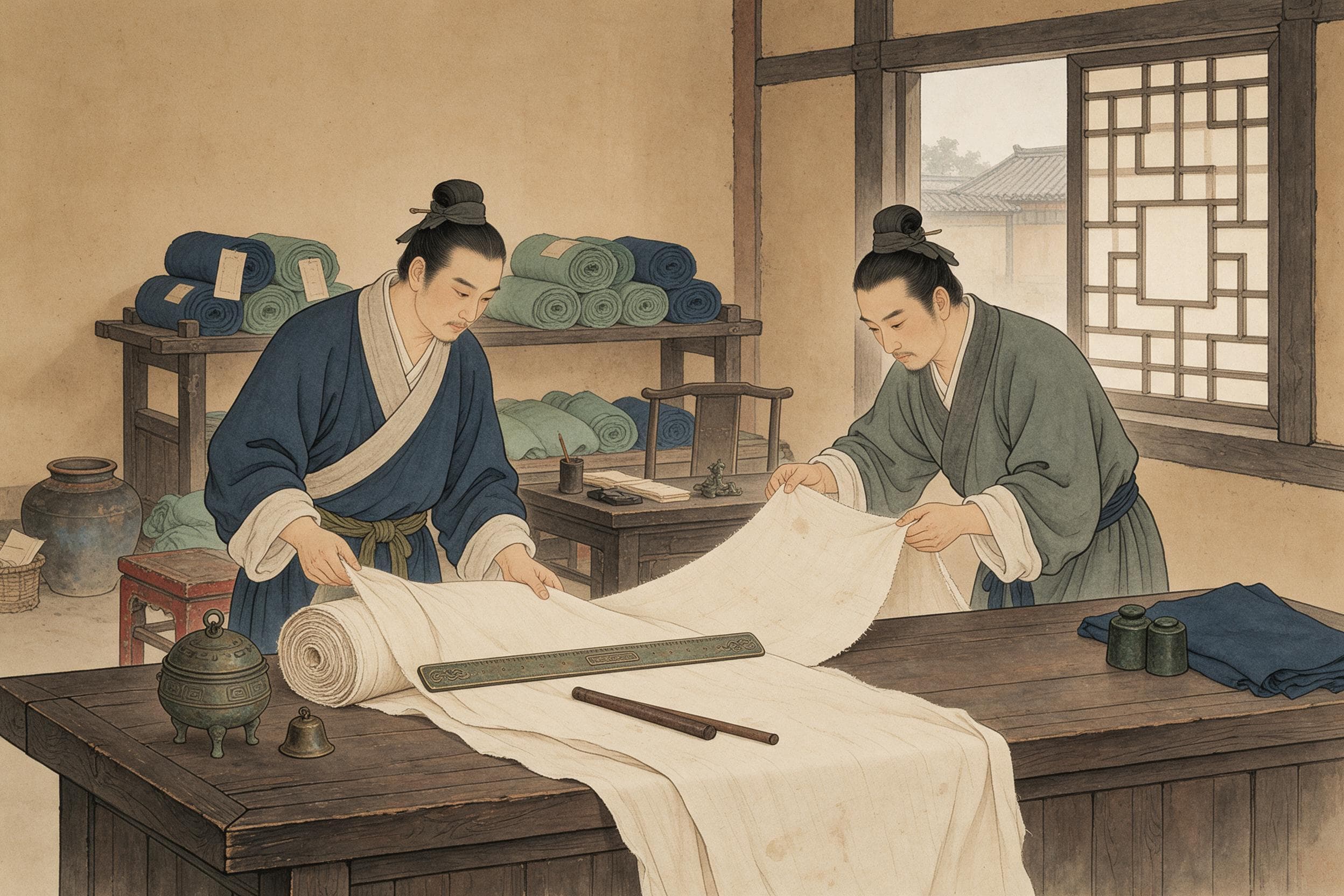
The size of a bolt of cloth is written down in the Hanshu's chapter on goods, in the middle of a passage about gold, knives, quan, cloth and silk: 'cloth and silk are two chi two cun wide as a sheet, and four zhang long as a bolt' (布帛廣二尺二寸為幅,長四丈為匹). Where it stands matters — not in a passage about weaving, but in one about the five kinds of 'goods'. Cloth here is not a textile; it is a form of goods.
One bolt: two chi two cun by four zhang
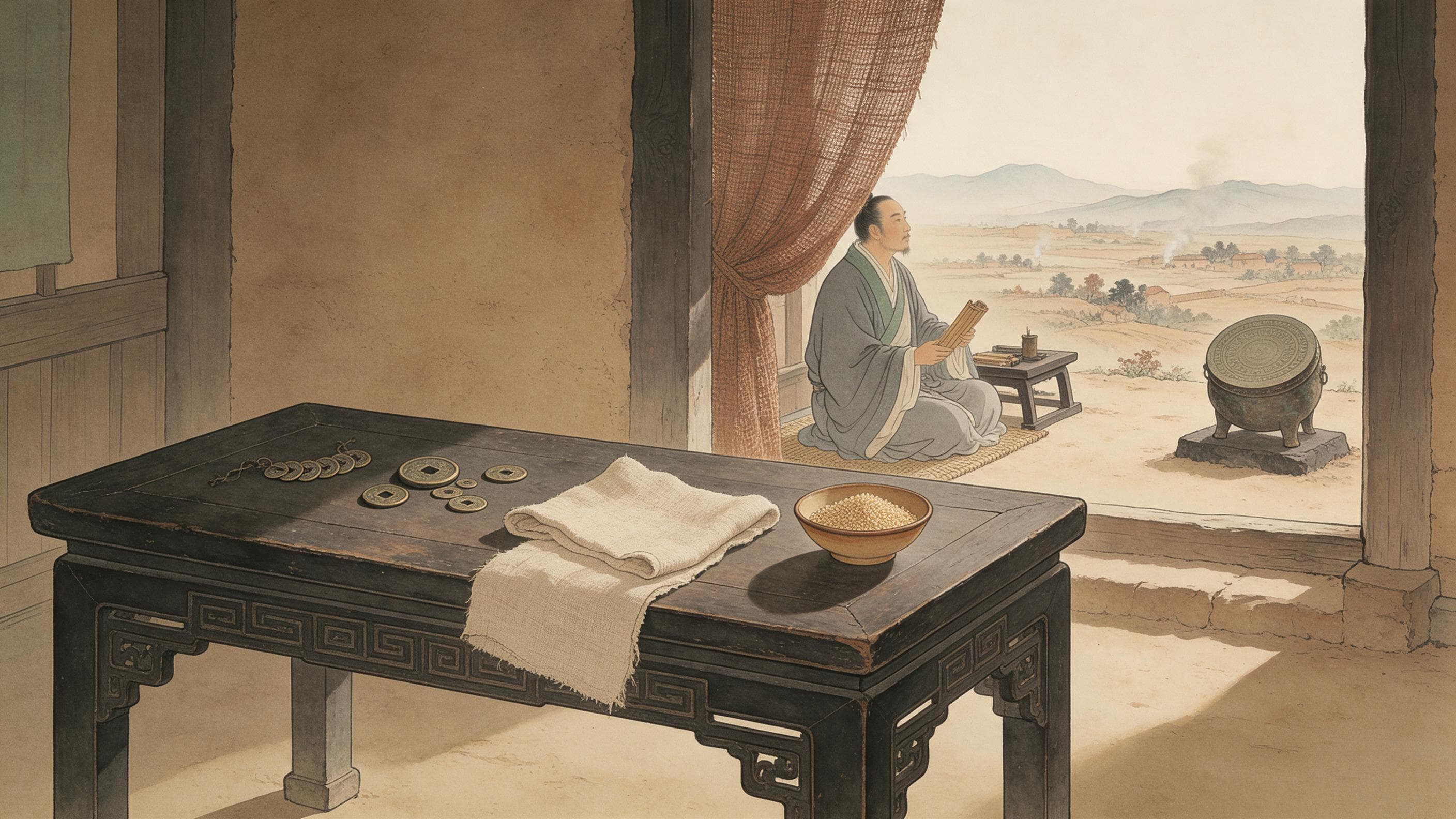
Here is the passage as written: 'as for goods — gold, cash, cloth and silk — before Xia and Yin the details are not recorded. The Grand Duke established for Zhou the nine-office round-cast system: gold one cun square and one jin in weight; coin round with a square hole, light and heavy reckoned in zhu; cloth and silk two chi two cun wide as a sheet, four zhang long as a bolt. Hence goods are treasured in gold, profited in knives, circulated in quan, spread in cloth, bound in silk' (故貨寶於金,利於刀,流於泉,布於布,束於帛). Three things are each given a specification: gold by the square cun and the jin, coin by round-and-square and by the zhu, cloth by sheet and bolt. The figures are copied as they stand; the units stay chi, cun and zhang, and this article converts nothing into centimetres.
It is worth saying what the page gives and what it does not. It gives two numbers: a sheet two chi two cun wide, a bolt four zhang long. It does not give the real length of a chi, who did the measuring, with what instrument, or what happened to a bolt that failed. Nor does it call this a weaving standard: it is the specification of a kind of goods, and cloth stands in it beside gold and coin.
The cloth that could not be sold
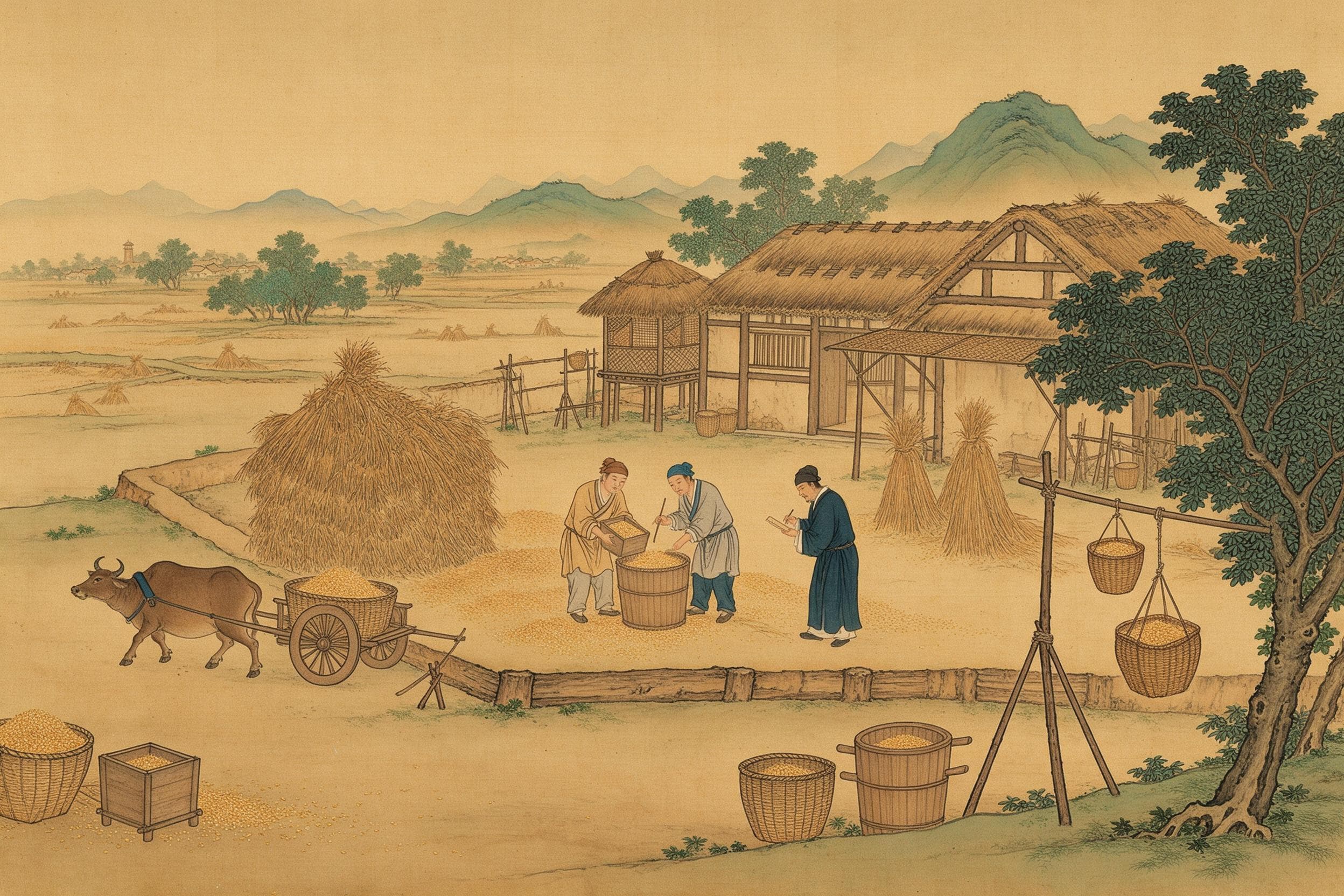
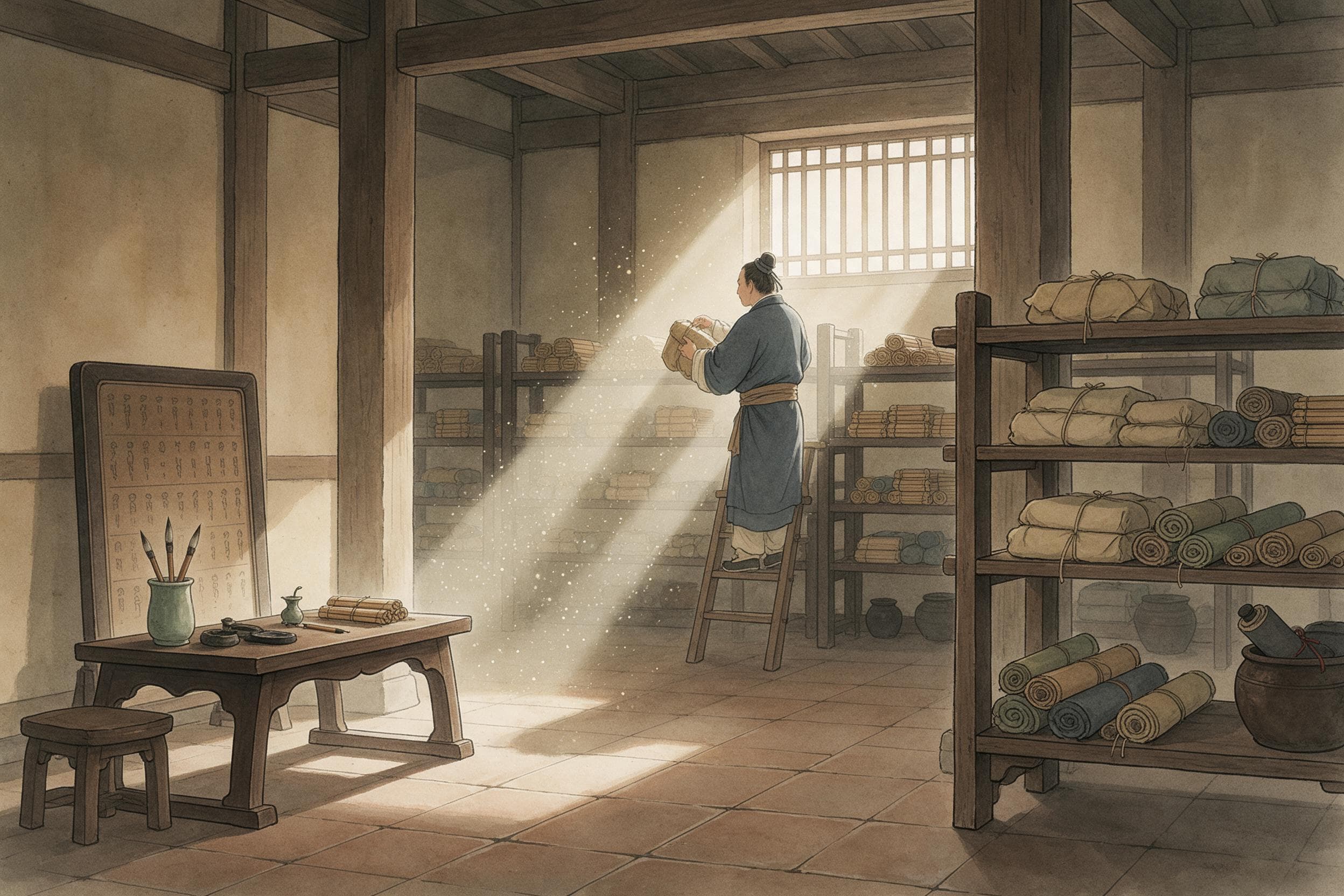
The other page, the Liji's chapter on royal regulations, offers something else: a list of goods that may not be sold. It opens with a principle — 'all who enforce prohibitions to keep the people uniform do not pardon offences' (凡執禁以齊衆,不赦過) — and then goes item by item: 'jade and gold tablets, not to be sold in the market; ceremonial dress and carriages, not to be sold; vessels of the ancestral temple, not to be sold; sacrificial animals, not to be sold; weapons, not to be sold; vessels not according to measure, not to be sold; war chariots not according to measure, not to be sold; cloth and silk whose fineness is not according to the count and whose sheet-width is not according to the measure, not to be sold; false colours confusing the true, not to be sold; worked brocade, pearls and jade, finished vessels, not to be sold; clothes and food, not to be sold; grain out of season and fruit unripe, not to be sold; timber not ready to be cut, not to be sold; birds and beasts and fish and turtles not ready to be killed, not to be sold' (不粥於市). The list ends with the pass officers: 'the passes enforce the prohibitions and inspect, banning strange dress and noting strange speech' (關執禁以譏). The word 粥 here is read 鬻, 'to sell'; this is generally held, and the page carries no note.
The layering is the point of this article. The cloth item — 'cloth and silk whose fineness is not according to the count and whose sheet-width is not according to the measure' — is one line in that list. Before it stand jade tablets, ceremonial dress, temple vessels, sacrificial animals and weapons; after it come false colours, brocade and pearls, clothes and food, grain out of season, unripe fruit, timber not ready and animals not ready. This is a market prohibition, not a textile standard: it governs what may enter a market, not how cloth should be woven.
The difference between the pages is now plain: the Hanshu gives the size of a bolt (a sheet two chi two cun, a bolt four zhang); the Liji gives a list of things not to be sold, one of which is cloth whose width and fineness miss the count. One gives figures, the other gives a ban; neither says how the two were joined up — who measured, whether a failed bolt was returned or confiscated, or how the market office and the pass officers divided the work. That layer is not filled in here.
How wide two chi two cun is
Read the figures as written: 'two chi two cun wide' is the width of a sheet, 'four zhang long' the length of a bolt; four zhang is forty chi, which is the text's own step. What ratio two chi two cun bears to four zhang is not computed here, and how many garments a bolt would make is another article's question — that is cutting and sewing. Two numbers are kept: two chi two cun across, four zhang long.
Why cloth counted as goods
The last sentence of the Hanshu passage ranks the five: 'goods are treasured in gold, profited in knives, circulated in quan, spread in cloth, bound in silk' (故貨寶於金,利於刀,流於泉,布於布,束於帛). Gold is treasure, knife-money is profit, quan circulates, cloth spreads, silk binds — cloth stands beside gold and coin as a circulating good. Fixing the sheet and the bolt happens in that setting: not to make cloth handsome, but to make it usable as goods. And that is as far as the page goes: it does not say how cloth was priced against coin, taxed, or valued in a market. Nor does this article touch the Qin rules that priced cloth in cash; that is another subject.
The gaps on both pages
What neither page gives: the real length of a Han chi (the pages do not say how long one was), the price of cloth, the method by which officials checked width, what was done with a bolt that failed, who enforced the Wangzhi list or how far enforcement went. These are gaps, listed and not filled. Nor is there any general lesson about standardisation promoting trade: the two pages give one measurement and one prohibition, not a conclusion in economic history.
Back to the two sentences: one says how wide and how long a bolt should be, the other says the cloth that misses the standard may not be sold. The first stands in a Hanshu passage about goods, the second in a Liji passage about prohibitions; between the two sentences lies a whole apparatus of inspection that was never written down. This article only sets the two sentences side by side, and leaves the space between them empty.
Related reading:Horses in the Lanes: Price, Prohibition and a Bronze Model · Lending by the Family Measure: How One Clan Bought a State with Bushels · Asking the Cauldron's Weight: 'It Lies in Virtue, Not in the Vessel'
Sources & further reading
- 班固《汉书》卷二十四下〈食货志下〉(维基文库本,未与点校本复核) — In the passage on 'goods', the bolt of cloth is given a standard in the same breath as gold and coin: 'as for goods — gold, cash, cloth and silk — before Xia and Yin the details are not recorded. The Grand Duke established for Zhou the nine-office round-cast system: gold one cun square and one jin in weight; coin round with a square hole, light and heavy reckoned in zhu; cloth and silk two chi two cun wide as a sheet, four zhang long as a bolt. Hence goods are treasured in gold, profited in knives, circulated in quan, spread in cloth, bound in silk' (布帛廣二尺二寸為幅,長四丈為匹。故貨寶於金,利於刀,流於泉,布於布,束於帛). The chapter sets sizes; it says nothing about who measured them.
- 《礼记·王制》(维基文库本,未与点校本复核) — A long list of things that may not be sold in the market, after the sentence 'all who enforce prohibitions to keep the people uniform do not pardon offences' (凡執禁以齊衆,不赦過): jade and gold tablets, ceremonial dress and carriages, temple vessels, sacrificial animals, weapons, 'vessels not according to measure', 'war chariots not according to measure', 'cloth and silk whose fineness is not according to the count and whose sheet-width is not according to the measure' (布帛精麤不中數,幅廣狹不中量), false colours confusing the true, worked brocade and pearls, clothes and food, grain out of season, fruit unripe, timber not ready to cut, animals not ready to kill — each followed by 不粥於市, 'not to be sold in the market'. The list closes with the pass officials who police it (關執禁以譏).