Spring sou, summer miao, autumn xian, winter shou (春蒐、夏苗、秋獮、冬狩): the four names come out of a remonstrance, not a regulation. In the fifth year of Duke Yin of Lu, 'the duke was about to go to Tang to watch the fishermen' (公將如棠觀魚者), and Zang Xibo argued against it. Inside the argument stands the sentence that carried the names: 'thus spring sou, summer miao, autumn xian, winter shou, all in the slack of farm work, for the practising of affairs' (故春蒐、夏苗、秋獮、冬狩,皆於農隙以講事也). This article reads that remonstrance and, separately, the Zhouli's duty text for the grand marshal; the two are not joined into one system.
The Day at Tang
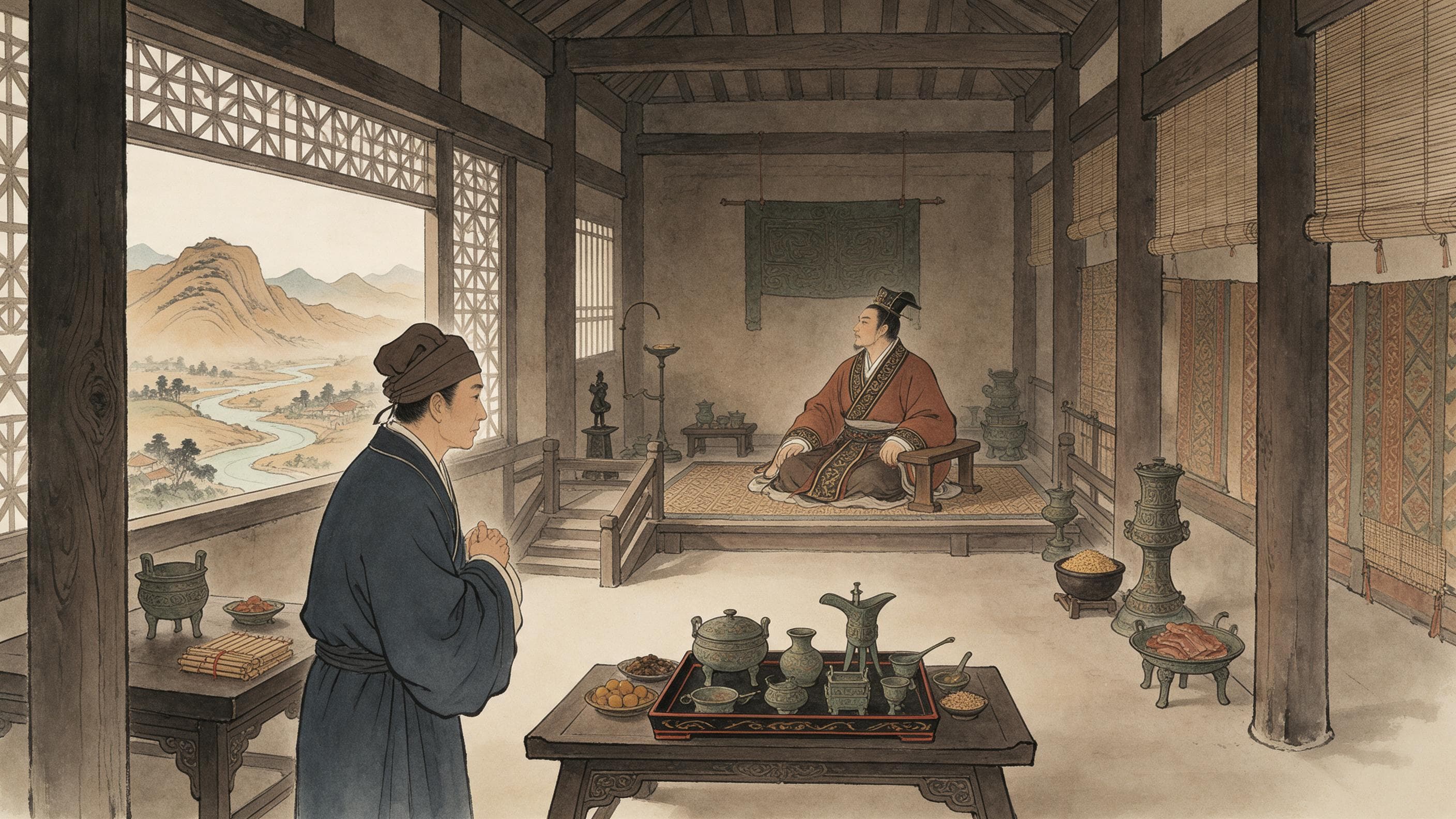
The Zuozhuan records the day as an event. The duke was going to Tang to look at the fishing; Zang Xibo began with a principle — 'whatever thing is not fit to be discussed in the great affairs, and whose material is not fit for vessels and equipment, the ruler does not take it up' (凡物不足以講大事,其材不足以備器用,則君不舉焉) — and ended with a division of labour: 'the produce of hills and marshes, the stuff of equipment, are the business of servants and the charge of officials, not what the ruler reaches' (山林川澤之實,器用之資,皁隸之事,官司之守,非君所及也). 'The duke said, "I am going to survey the land," and went. He had the fish set out and watched them. Xibo pleaded illness and did not go. The text writes: "the duke displayed fish at Tang" — not according to ritual, and it says the place was far' (公矢魚于棠,非禮也,且言遠地也). That 矢 here means 'set out' is the usual reading; the page does not gloss it.
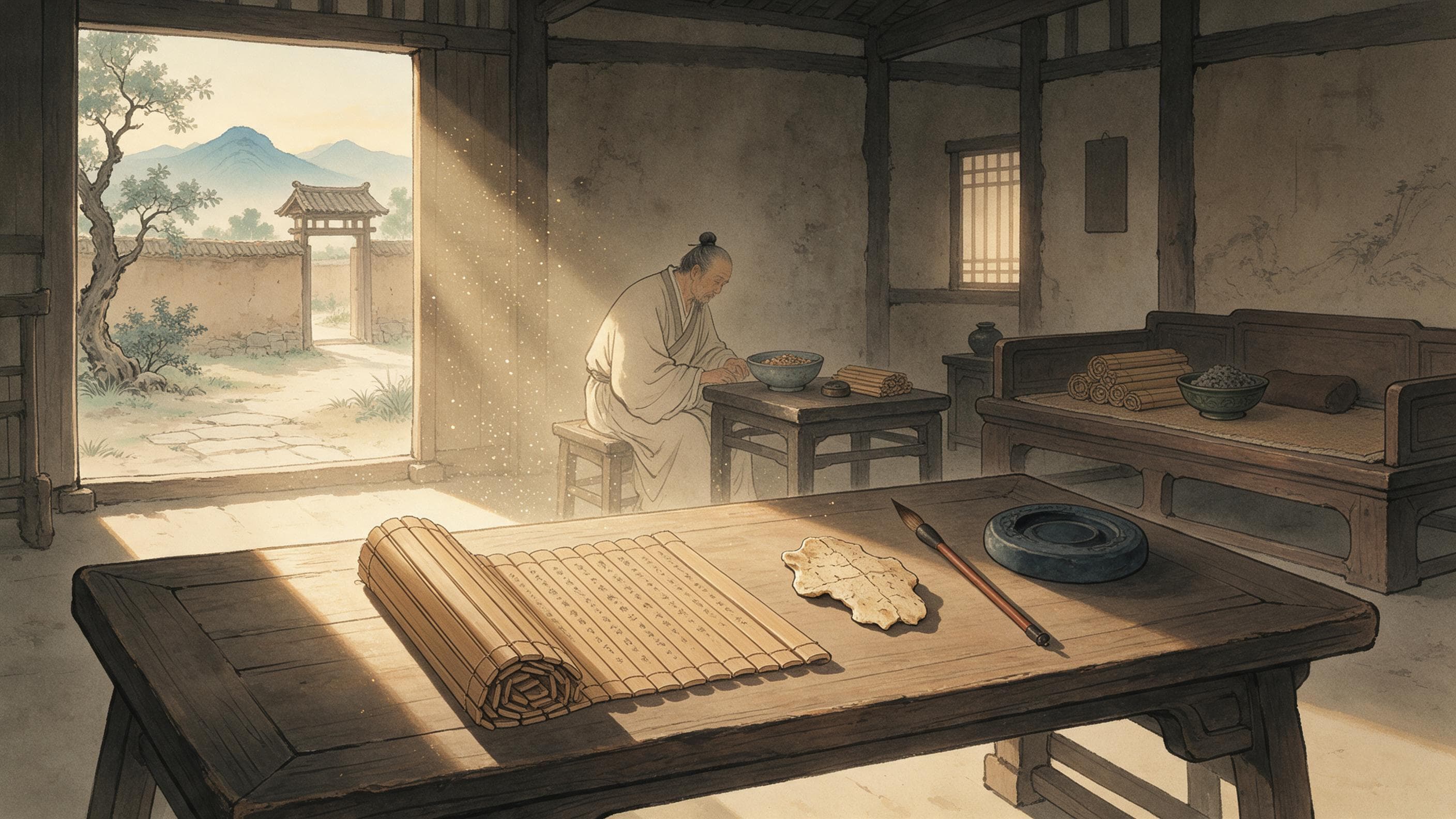
The four seasons come in the middle of this argument, as part of what a ruler is supposed to do instead. 'Thus spring sou, summer miao, autumn xian, winter shou, all in the slack of farm work, for the practising of affairs; every three years the troops are exercised; entering, they set the ranks in order; returning, they drink the arrival cup; and the military tallies are counted. Bright are the patterns, clear the noble and base, distinguished the ranks, ordered young and old, practised the awe and dignity' (三年而治兵,入而振旅,歸而飲至,以數軍實。昭文章,明貴賤,辨等列,順少長,習威儀也). This is a remonstrance: an argument about where a ruler should and should not go. It is not an instruction sheet, and the page gives none.
Four Names
The four names are all the Zuozhuan gives: sou in spring, miao in summer, xian in autumn, shou in winter, each tied to the slack of farm work. What was hunted, how many men went, what was done with the catch, how the ground was chosen — none of it is here. The names are printed as the page prints them, and no gloss is added: the text does not explain what each word means, and this article does not supply a meaning either.
The same remonstrance gives the reason a ruler may not shoot everything: 'if the flesh of birds and beasts does not reach the sacrificial stand, and hide, horn, bone, tooth, hair and feather do not reach the vessels, then the duke does not shoot — this was the rule of old' (鳥獸之肉不登於俎,皮革齒牙、骨角毛羽不登於器,則公不射,古之制也). That sentence is still the remonstrance's, spoken about one duke's outing; it is not a statute with a date and an office behind it.
The Zhouli's Four Reviews
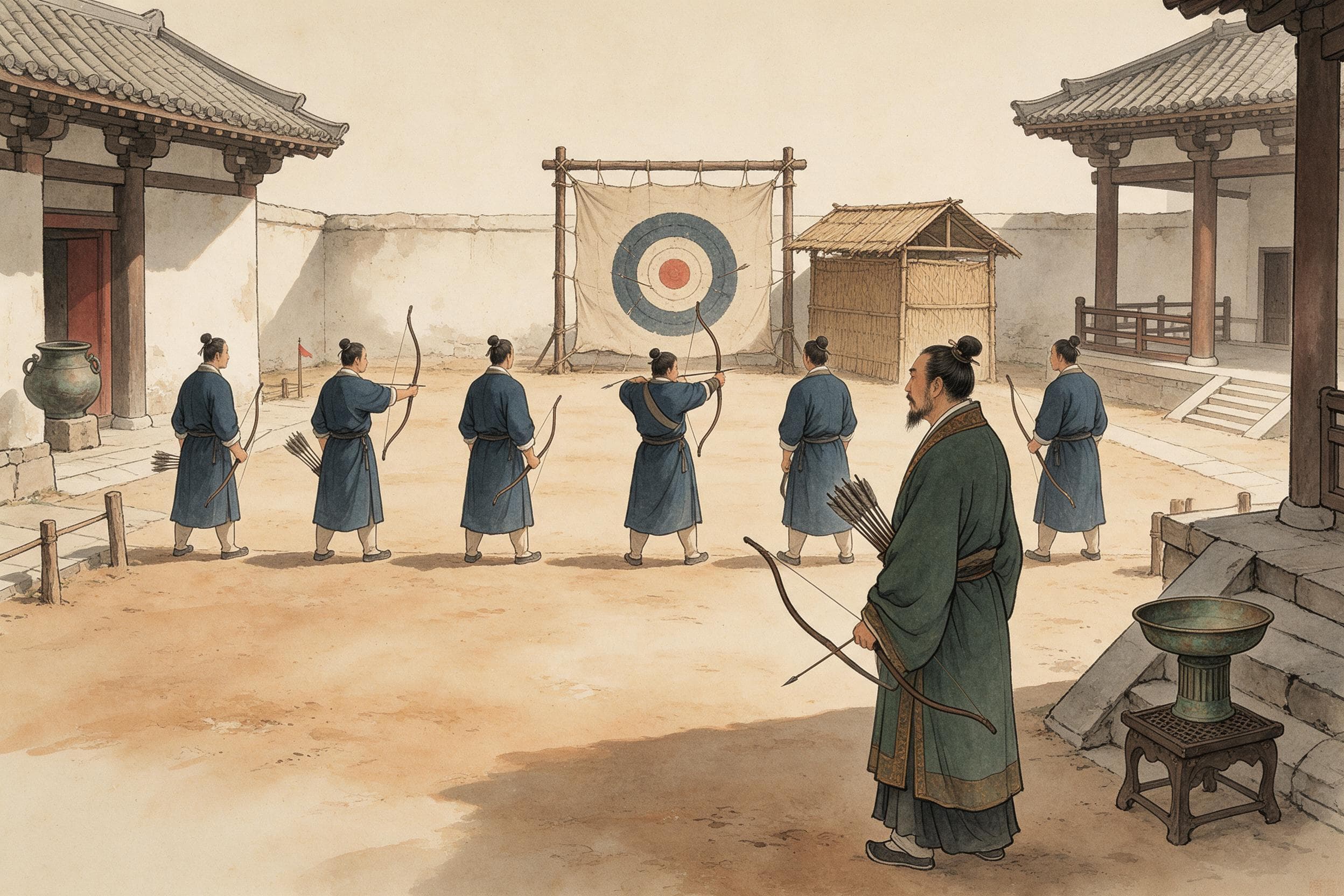
The Rituals of Zhou, in the office of the grand marshal of the summer ministry, is a different machine. It first sets the army's frame — 'in regulating the army, 12,500 men make an army; the king has six, a great state three, the next two, a small state one' (凡制軍,萬有二千五百人為軍。王六軍,大國三軍,次國二軍,小國一軍), down through the shi, lü, zu, liang and wu — and then gives the four seasonal reviews. In mid-spring, 'teach the marshalling of troops': drums, bells, gongs and hand-bells are assigned by rank, and the men are taught 'the times of sitting and rising, advancing and retiring, quick and slow, loose and close' (以教坐作、進退、疾徐、疏數之節). 'Then with the sou hunt' (遂以搜田): the officers make the sacrifice, swear the people in, the drum sounds, the beat closes, and 'the birds are presented in sacrifice to the earth' (獻禽以祭社).
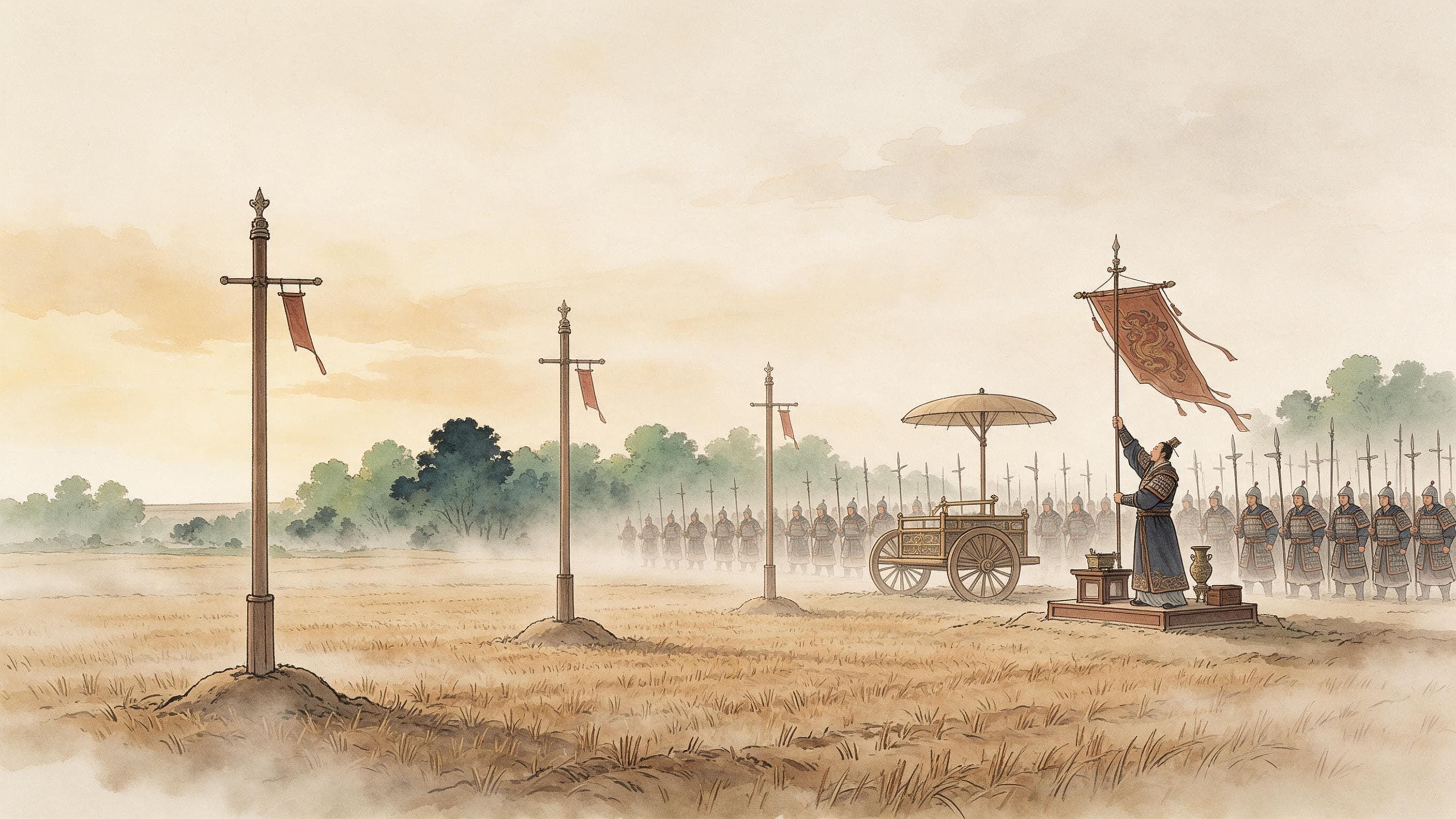
Mid-summer teaches the camping (茇舍) and the names for night work, 'then with the miao hunt as by the method of the sou', with the summer offering. Mid-autumn teaches the handling of troops and the distinguishing of banners — the king's great standard, the princes' flags, the officers' — 'then with the xian hunt as by the method of the sou', with the fang offering. Mid-winter is the great review: the forest officers clear the field and set markers 'one every hundred paces, three markers, and again one every fifty paces' (百步則一,為三表,又五十步為一表); at first light the flags come down, latecomers are executed, the chariots and foot are drawn up as for battle and made to sit, the oath is taken, an animal is killed, and the order is carried round the ranks — 'those who do not obey the command are beheaded' (不用命者斬之); then come the drum and bell signals, the advance to each marker, three shots of the chariots and three thrusts of the foot. 'Then with the shou hunt' (遂以狩田) the field is enclosed between gate-flags, and 'great beasts go to the public, small birds to the private; the taker keeps the left ear' (大獸公之,小禽私之,獲者取左耳); the kill is presented at the winter sacrifice.
Who Says What
Kept apart, the two pages speak in different voices. The Zuozhuan puts four names into a protest, ties them to the slack season, and adds a list of what the exercise is meant to show; it names no office, no season's drill, no method. The Rituals of Zhou gives a duty text: four seasons, four technical subjects (marshalling, camping, troop-handling, great review), four hunt names hung on them, an offering after each. The first is an argument addressed to a ruler; the second is a job description. Neither proves that the other's arrangement was carried out, and this article does not fuse them into a single Zhou hunting system.
Their wording does not match either. The Zuozhuan writes 蒐, 苗, 獮, 狩; the Rituals of Zhou page writes 搜田, 苗田, 獼田, 狩田 — 搜 for 蒐, 獼 for 獮 — and puts each hunt after a drill instead of listing four names. Both are printed as they stand; no character is normalised, and no claim is made about which is older.
What Neither Page Gives
Neither page gives a list of animals, a count, or an account of who got what. The Rituals of Zhou has one principle of division — great beasts to the public, small birds to the private, the taker keeps the left ear — and that is a principle, not a ledger. Nor is there a number for any single hunt: 12,500 to an army is the frame of the army, not the size of a hunting party. How the four seasons were fixed in practice, which months were the slack season, and what became of meat and hides afterwards are not said. The fish at Tang are not identified either.
Put together, one page has four names inside a sentence of advice; the other has four drills with four hunts hung on them. A duke's outing to watch fishermen produced the sentence that kept the names; a manual of offices produced the drills. Neither book says the system ran anywhere, and neither explains what a hunt was for — not training, not conservation; this article adds neither. The pages give names, ranks, markers, offerings, and one left ear. The rest is not there.
Related reading:Fifty Get a Staff: Old Age in a Ritual Book and an Edict · Three Years: One Rule, Several Calculations · Facing East: Four Seats at the Hongmen Banquet
Sources & further reading
- 《春秋左氏传·隐公五年》(维基文库本,页面白文无注,未与中华书局点校本复核) — The remonstrance in which the four hunts are named: the duke of Lu about to go to Tang to watch the fishing, Zang Xibo arguing that a ruler should not take up what cannot serve the great affairs or furnish equipment, and in the middle of the argument the sentence 'thus spring sou, summer miao, autumn xian, winter shou, all in the slack of farm work, for the practising of affairs', followed by the three-year exercise of troops, the setting of ranks on return, the arrival cup, the counting of military tallies, and the display of patterns, noble and base, ranks, young and old, awe and dignity. The remonstrance also says that if flesh, hide, horn, bone, tooth, hair and feather do not reach stand or vessel the ruler does not shoot, and closes with the division of labour between ruler and officials; the duke goes anyway, has the fish set out, and the record notes 'the duke displayed fish at Tang' as contrary to ritual and far from home.
- 《周礼·夏官司馬》大司马职(维基文库本,页面白文无注,未与中华书局点校本复核) — The grand marshal's duty text: the army frame of 12,500 men to a army, six armies for the king and three, two or one for states of different sizes, with the shi, lü, zu, liang and wu down to five men; then the four seasonal reviews — mid-spring marshalling with drums, bells, gongs and hand-bells assigned by rank and drill in sitting, rising, advancing, retiring, quick and slow, loose and close, followed by the sou hunt; mid-summer camping and night names, followed by the miao hunt on the same method; mid-autumn troop-handling and banners, followed by the xian hunt; mid-winter the great review with markers at a hundred paces and again at fifty, latecomers executed, the oath and the beheading of the disobedient, and the shou hunt enclosing the field between gate-flags, where great beasts go to the public, small birds to the private, and the taker keeps the left ear, ending with sacrifice. The page writes 搜 and 獼 for 蒐 and 獮.