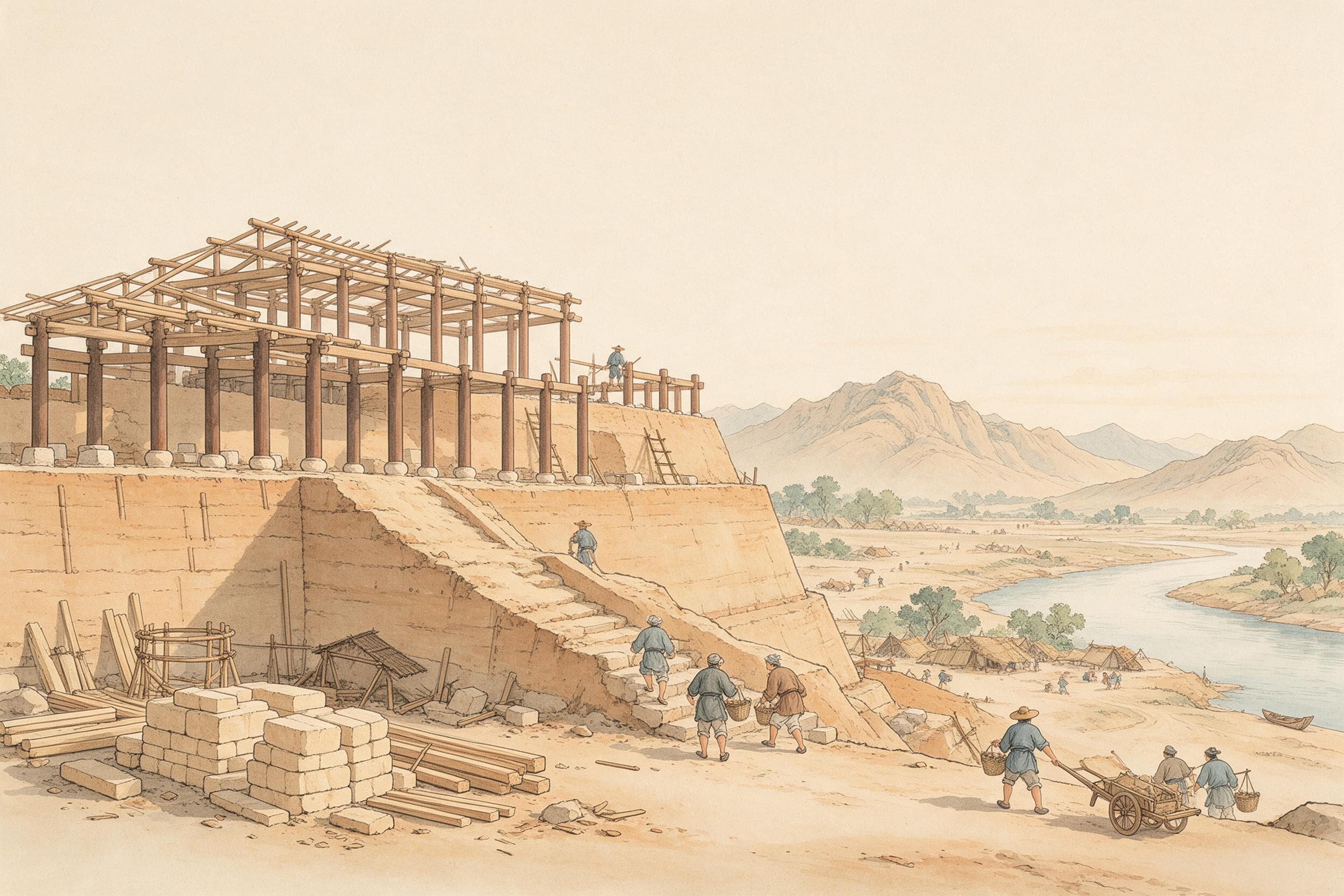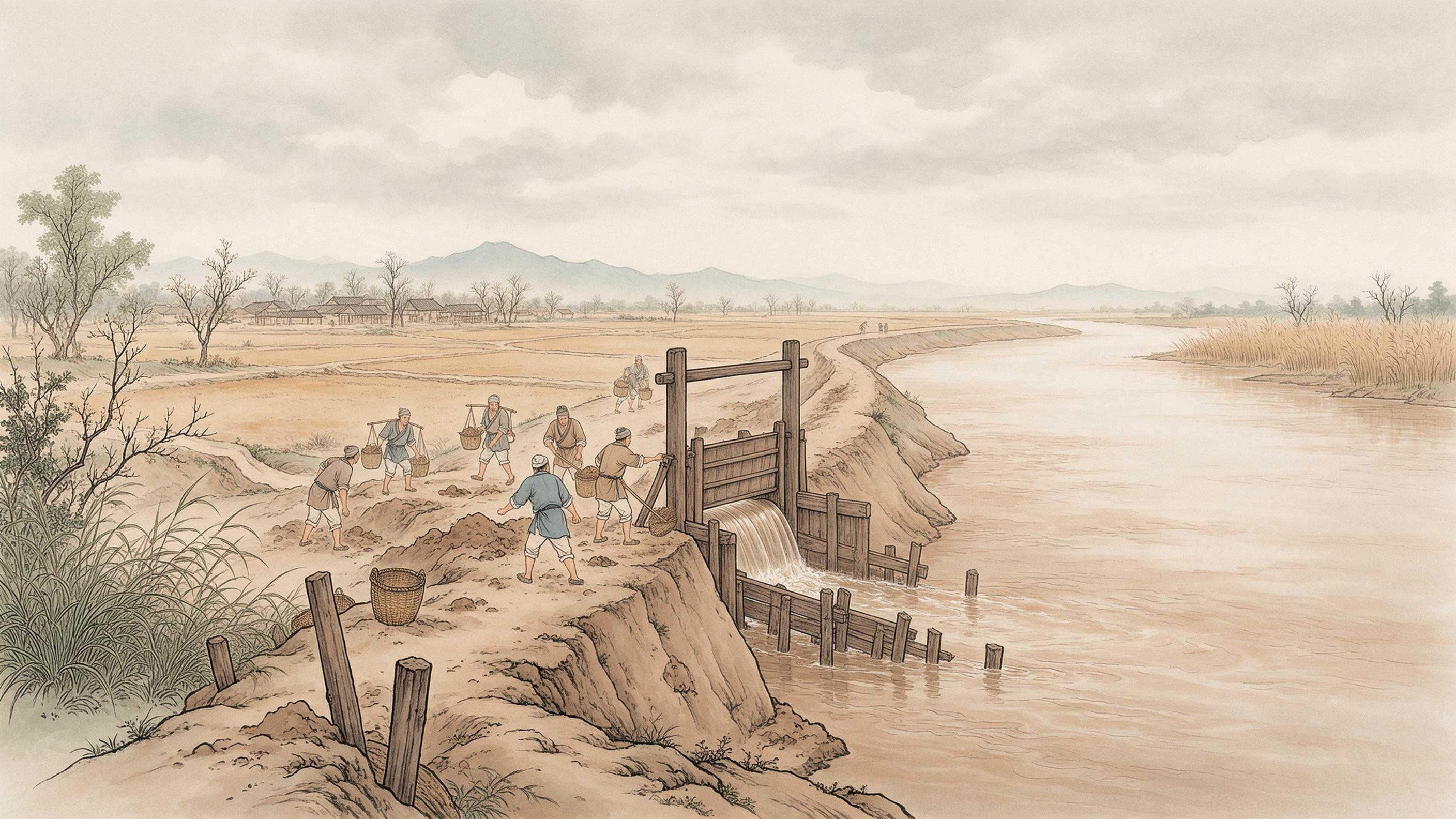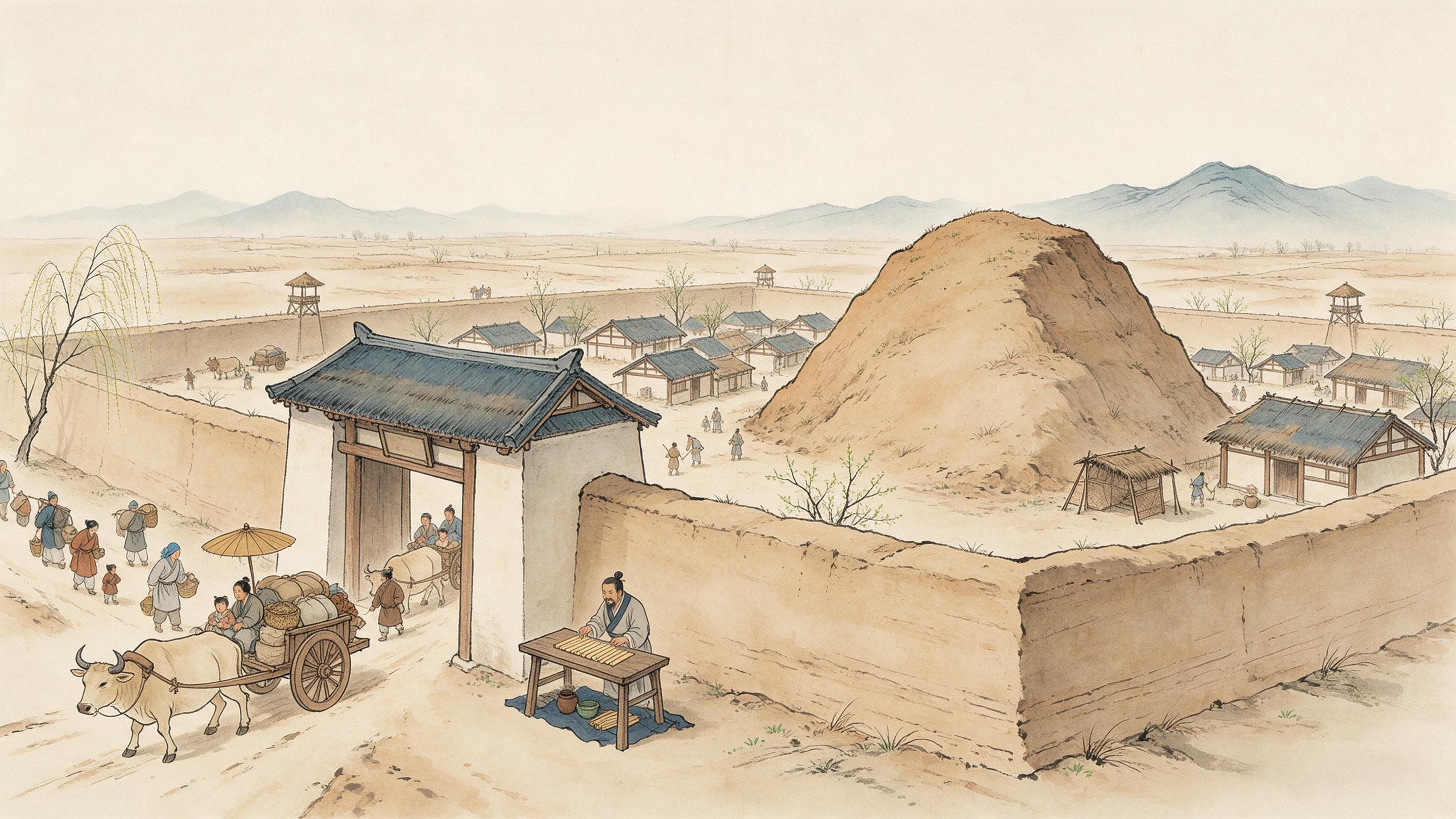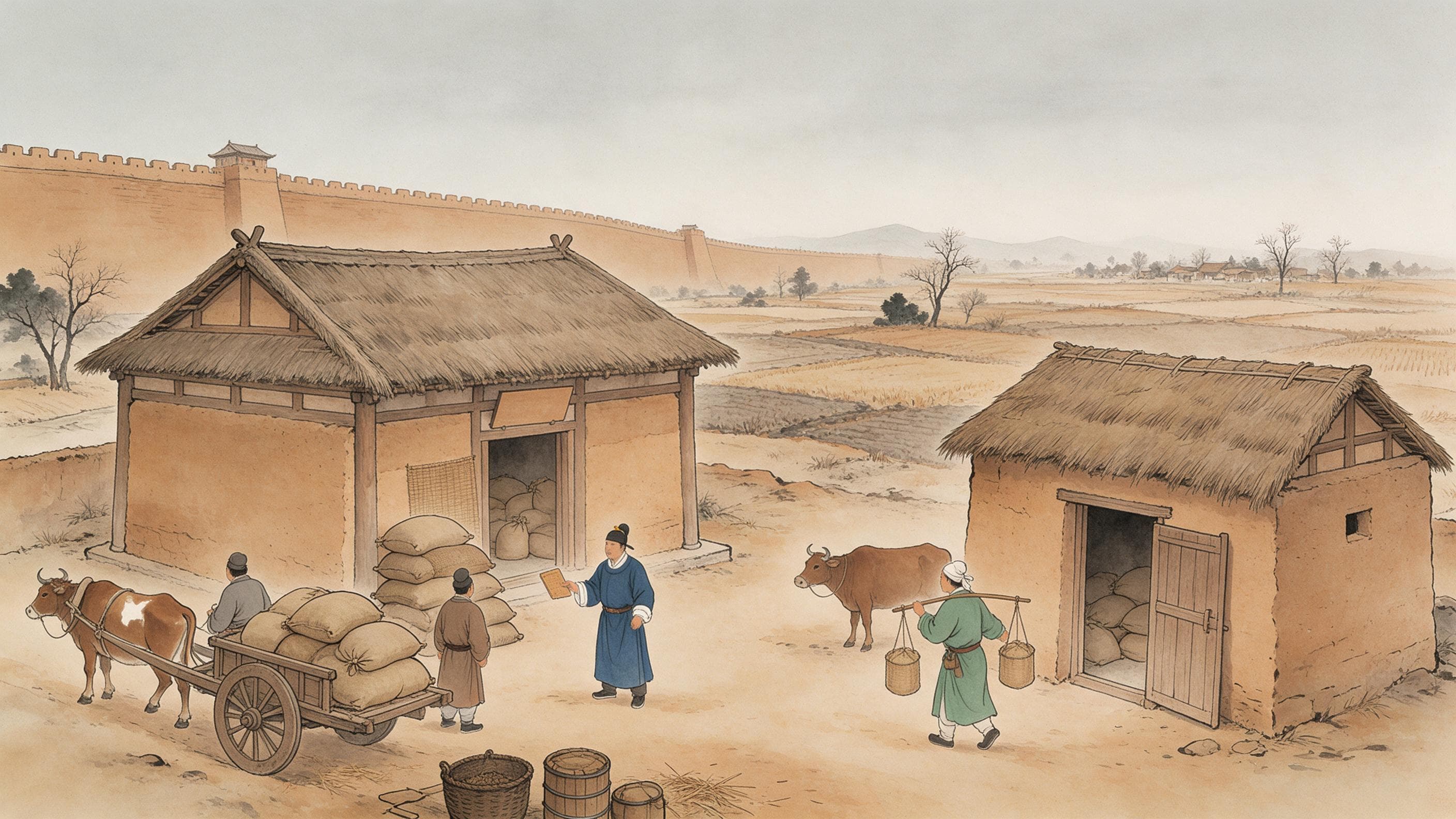
The most famous granary sentence in the Han shu is this: 'The grain of the Grand Granary lay layer on layer, brimming over and piled outdoors, rotting and unfit to eat' (太倉之粟陳陳相因,充溢露積於外,腐敗不可食). It is often quoted to show how much grain Han China had. It does stand in the passage on 'the first seventy years down to Emperor Wu', as a retrospective on plenty — not as a stock record of one storehouse in one year.
The Grand Granary and the Ever-Normal Barn
The Grand Granary stood in the capital and received grain shipped from east of the mountains for the capital's use. In the same chapter, on Sang Hongyang's transport reforms: 'the grain shipped from east of the mountains rose to six million shi a year, and in one year the Grand Granary and the Ganquan Granary were full' (山東漕益歲六百萬石……太倉、甘泉倉滿). Six million shi is a quantity shipped, not a granary's capacity; neither page gives Han capacities, numbers of granaries or staff. What can be said is the use: the Grand Granary was the state's principal store, and it managed flow — how much came in, how much went out.
The Ever-Normal Granary was a different thing. It was not in the capital but in the frontier commanderies; it did not count flow but price: it bought at a raised price when grain was cheap and sold at a reduced price when grain was dear. One store manages where grain goes; the other manages where the price goes. This article is about the second, from its founding to its abolition.
Five Cash a Shi
The motive was a price. After Emperor Xuan came to the throne, 'officials were mostly chosen for worth, the people were settled on the land, the years were repeatedly abundant, grain fell to five cash a shi, and the farmers profited little' (歲數豐穰,穀至石五錢,農人少利). Too cheap a grain hurts the grower; that is what an ever-normal barn was for — the opposite of a shortage.
The man who proposed it was Geng Shouchang, assistant to the grand director of agriculture, 'good at calculation and able to reckon profit', who memorialised in the Wufeng years. He began with a transport sum: 'By precedent, four million hu of grain are shipped from east of the mountains each year to supply the capital, using sixty thousand troops. It would be well to buy grain from the metropolitan district, Hongnong, Hedong, Shangdang and Taiyuan to supply the capital, which could save more than half of the eastern transport troops' (歲漕關東穀四百萬斛……可以省關東漕卒過半). First the account, then the institution.
Buy Cheap, Sell Dear
Then the sentence that matters: 'Shouchang accordingly proposed that every frontier commandery build granaries, buying at a raised price when grain was cheap to help the farmer, and selling at a reduced price when grain was dear, calling it the Ever-Normal Granary; the people found it convenient' (邊郡皆築倉,以穀賤時增其賈而糴,以利農,穀貴時減賈而糶,名曰常平倉。民便之). The place is the frontier commanderies, not the whole realm; the result is three characters, 'the people found it convenient' — the text's own verdict, not a statistical result. The emperor 'issued a decree granting Shouchang the rank of marquis within the passes'.
Xiao Wangzhi Objects
It was not passed unanimously. The imperial secretary Xiao Wangzhi memorialised with a different sum: 'Now Shouchang wishes to buy grain nearby and ship it within the passes, to build granaries and make boats, at a cost of more than twenty million, with the labour of moving crowds; I fear this will breed a drought and bring disaster on the people' (費直二萬萬餘,有動眾之功). And on the man: 'Shouchang is versed in calculating profit by fractions of a cash; his deep plans and far considerations are truly not to be relied on; it would be well to leave things as they are' (習於商功分銖之事……宜且如故). The emperor 'did not listen'. In the same passage Xiao also fought a rise in the sea-fishery tax, saying that when the tax was raised in past years the fish stopped coming. The two arguments stand next to each other in the text but are not one sentence; what is certain is only this: the finance officer proposed a barn, the supervising officer objected on cost and on 'moving crowds', and the emperor chose the former.
Emperor Yuan Abolishes It
The barn lasted until the throne changed hands. On Emperor Yuan's accession, 'great floods covered the realm, and eleven commanderies east of the mountains were especially bad'; in the second year, 'Qi suffered famine, grain reached three hundred odd cash a shi, many starved, and in Langya commandery people ate one another'. Immediately after this the text says: 'The Confucians at court said often that the salt and iron offices, the Beijia field office and the Ever-Normal Granary could be abolished, as they contended with the people for profit. The emperor followed their advice and abolished them all' (在位諸儒多言……毋與民爭利。上從其議,皆罷之). At the moment when grain had gone from five cash to three hundred, the barn was classed with the salt and iron offices as a competitor of the people. One line follows: 'Afterwards, when revenue fell short, only the salt and iron offices were restored' (其後用度不足,獨復鹽鐵官). The Ever-Normal Granary did not come back. That is the end of the line: founded, operated, opposed, abolished — all four steps on this one page of the Han shu, with no later story about two thousand years of continuance.
Du You's Tongdian, juan 12, tells the same story, but it is a Tang encyclopaedia copying the Han shu almost word for word: it can be read alongside, not counted as a second independent witness. It adds one line each for the Later Han ('in the fifth year of Yongping, the Ever-Normal Granary was made') and the Jin ('in the fourth year of Taishi an Ever-Normal Granary was established, buying in abundance and selling in scarcity'), and no more. The same juan also lists Tang figures for the eighth year of Tianbao, including 'the Grand Granary, 71,270 shi' — a Tang account under a name the Han also used; the number cannot be pushed back into the Han, and is not used here. Nor is this the same subject as the site's Sui-Tang granary piece: that one follows the work inside a granary, this one asks why the state built them at all.
The gaps are plain: neither page gives Han granary capacity or numbers, staff, the barns' locations, or any measure of whether the barns steadied prices; 'the people found it convenient' is the text's verdict. Prices are quoted as written (five cash a shi, three hundred odd), with no conversion to modern purchasing power, no capacity estimates, no architecture. The state built granaries not only to store grain; the Ever-Normal Granary meant to manage the price — but this page gives it a beginning and an end, and little in between.
Related reading:The Hangu Pass: One Gate in Three Kinds of Text · Two Graves in Detail: M102 and M110 at Shaojiapeng · Anyang's Other Shang City: Huanbei
Sources & further reading
- 《汉书》卷二十四·食货志(东汉;维基文库本,未与点校本复核) — Two kinds of store and one policy. The imperial granary in the capital: 'the grain of the Grand Granary lay layer on layer, brimming over and piled outdoors, rotting and unfit to eat' (太倉之粟陳陳相因,充溢露積於外,腐敗不可食) — a retrospective of the first seventy years, not a storehouse statistic; and under Sang Hongyang's transport reforms, 'the grain shipped from east of the mountains rose to six million shi a year, and in one year the Grand Granary and the Ganquan Granary were full' (山東漕益歲六百萬石……太倉、甘泉倉滿). The Ever-Normal Granary: under Emperor Xuan, 'years were repeatedly abundant and grain fell to five cash a shi, so farmers profited little' (歲數豐穰,穀至石五錢,農人少利); the grand director of agriculture's assistant Geng Shouchang, 'good at calculation and able to reckon profit', proposed in the Wufeng years to buy grain from the metropolitan and neighbouring commanderies to supply the capital and 'save more than half' of the 60,000 transport troops; then 'ordered every frontier commandery to build granaries, buying at a raised price when grain was cheap to help the farmer, selling at a reduced price when it was dear, and calling it the Ever-Normal Granary; the people found it convenient' (邊郡皆築倉……名曰常平倉。民便之), and the emperor granted him the rank of marquis within the passes. The imperial secretary Xiao Wangzhi objected, putting the cost at 'more than twenty million' and calling Geng 'versed in calculating profits by fractions of a cash; his deep plans are not to be relied on' (習於商功分銖之事……宜且如故); the emperor did not listen. On Emperor Yuan's accession, after great floods and a famine in Qi where 'grain reached three hundred cash a shi', the Confucians said the salt and iron offices, the Beijia field office and the Ever-Normal Granary 'contended with the people for profit' and all were abolished; later, when funds ran short, 'only the salt and iron offices were restored' (獨復鹽鐵官) — the barns were not.
- 《通典》卷十二·食货十二·轻重(唐杜佑;维基文库本,未与点校本复核) — A Tang encyclopaedia, used only as a parallel and explicitly not as an independent Han source: it retells the Han story almost word for word (漢宣帝時,歲數豐穰……名曰常平倉,人便之……元帝即位,罷之), then gives one line each for the Later Han (明帝永平五年,作常平倉) and the Jin (泰始四年,立常平倉,豐則糴,儉則糶). The same chapter also lists Tang storehouse totals for the eighth year of Tianbao — including 'the Grand Granary, 71,270 shi' — which are Tang figures under a Han-sounding name and are not used in this article.