一件鼎,编号 M102∶6,通高 19.8、口径 15.6 厘米,重 1718 克;腹上部一周三组目纹带,腹内还留着动物骨骼。一件器物记到克与厘米——这就是「详报」的意思。
27 座墓,只详报两座
邵家棚在殷墟宫殿宗庙区西北约 2.4 公里,2020—2021 年发掘约 6700 平方米,清理商周建筑基址 18 处、墓葬 27 座、车马坑 4 座、灰坑 127 个、水井 3 口。27 座商墓里,除 1 座「中」字形大墓,其余 26 座是中小型竖穴土坑墓;正文只详述 M102、M110 两座。
其余 25 座只在概述里给数(这组计数是对 27 座整体说的,M102、M110 自己也有二层台与腰坑):13 座有二层台、15 座有腰坑、17 座有随葬品、5 座出青铜容器、7 座出陶器;多数被盗,人骨保存差。这些是概述里的计数,不是逐墓登记,不能拿来算比例。简报没有器物登记表,尺寸与重量散在行文里,器物编号按「M102∶n」的格式,本篇照录。
M102
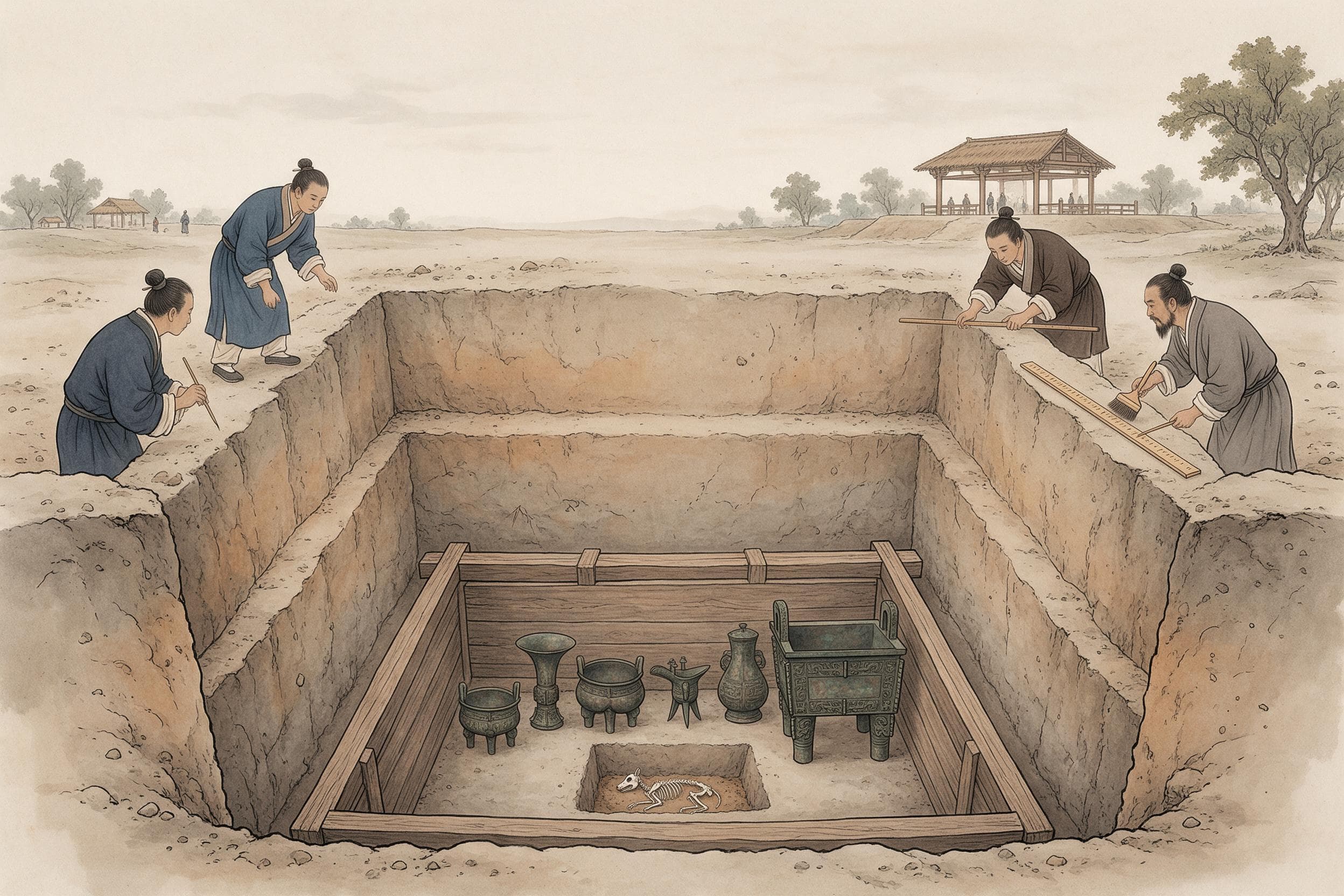
M102 是长方形竖穴土坑墓,方向 8 度,口小底大;墓口长 280、北宽 130、南宽 145 厘米,底距墓口 410 厘米;熟土二层台宽 22—40、高 70 厘米;腰坑长 75、宽 34、深 30 厘米。葬具一棺一椁,椁板髹黄漆,棺已朽、底部见朱砂与黑漆。东西二层台各殉一人,俯身直肢、头北,性别年龄不详;椁上置牛腿与羊腿;腰坑内殉狗一条。墓主骨架腐朽,据牙齿推断头朝北、老年,葬式与性别不详。
铜器 10 件(组):鼎 M102∶6(1718 克)、簋 M102∶7(重 1242 克,内底有铭文)、觚一对 M102∶9 与 M102∶10、爵一对 M102∶11 与 M102∶12、提梁卣 M102∶8(重 3194 克,锈蚀较重,盖不能开)、铃 M102∶1 与 M102∶13;另有铜器残片 M102∶20,可辨出部分为铜矛。
陶器 4 件,其中三件残破过甚无法修复;玉器 2 件(玉兔 M102∶14、玉鸟 M102∶15);另有磨石 M102∶2(出于殉人腰部)与三组螺,分别 43、29、56 枚。
M110
M110 方向 205 度;墓口长 230、北宽 95、南宽 105 厘米,底距墓口 340 厘米,墓底与墓口同大;熟土二层台宽 8—12、高 80 厘米;腰坑长 60、宽 45、深 30 厘米;葬具仅一棺,有红漆、黑漆痕迹;墓主头朝南,性别年龄未记;腰坑内一狗架。
铜器 4 件:铃 2(M110∶18 通高 8.1 厘米,M110∶19 通高 8 厘米)、镞 2(M110∶15-1、M110∶15-2)。陶器 11 件(组):甗 1(仅存口部与鬲部)、爵 2、觯 1、罐 4、盘 1、簋圈足 1、碎片 1 组。另有磨石、石器、骨镞 2、文蛤 13、海贝 9。随葬品多在墓室南端,墓主头下有骨锥与石器,腰坑中贝壳 9 枚。
两座墓怎么读
年代是简报的判断:M102 定为殷墟四期、M110 为四期偏晚阶段,依据是同类器物的类比,不是科学测年。两墓的差别可以直接描述:方向一北一南,一棺一椁对仅一棺,铜器 10 件对 4 件,礼器对兵器与响器;但这些只是两座墓的描述,不是等级序列。
边界写死:两座墓不能代表 27 座,更不能代表殷墟;25 座的概述数字不能补成逐墓统计;简报没记的性别、年龄不补。同一座都城的另一片——大司空村东南地 49 座商墓附墓葬登记表——只作一句背景:一个有表、一个是两墓细描,器物数不能拉平比,那是另一篇。本文不写身份、分层与人口。
材料没有的
缺口:没有器物登记表,没有逐件总表;M102 葬式与性别不详,两个殉人的性别年龄不详,M110 墓主年龄性别未记,「老年」是据牙齿的推断;墓主身份简报有推断,本文不展开;27 座墓也没有逐项统计。
所以这两座墓给的账细到克与厘米,范围却只有两座:8 度、280、410,一棺一椁,二层台各一人,腰坑一狗,10 件铜器;205 度、230、340,一棺,4 件铜器,铃与镞。账越细,越要记住:这是两座墓,不是一片墓地,更不是一个时代。
延伸阅读:277 平方米:一座商代制骨作坊的账 · 宫城以北的市:辽南京的城坊与户口 · 骊山陵:七十万人与一条水银的河
参考来源与延伸阅读
- 安阳市文物考古研究院、中国社会科学院考古研究所、北京联合大学《河南安阳殷墟邵家棚遗址 M102、M110 发掘简报》,《中原文物》2026 年第 4 期(总第 250 期)「夏商文明探研」专栏,11 页 PDF(一手发掘简报;维基文库无录文,未与纸本复核) — The primary brief. At Shaojiapeng (about 2.4 km north-west of the palace-temple area) the 2020-2021 excavation covered about 6,700 square metres and cleared 18 building foundations, 27 burials, 4 chariot pits, 127 ash pits and 3 wells. Of the 27 Shang burials — one 'middle'-shaped tomb and 26 small or medium shaft graves — only M102 and M110 are described in detail; the rest appear only in summary counts (13 with second-tier ledges, 15 with waist pits, 17 with grave goods, 5 with bronze vessels, 7 with pottery), and most were robbed. The brief has no register of objects: dimensions and weights are given piece by piece in the text, with object numbers of the form M102∶n quoted as they stand. M102: 8 degrees, mouth 280 cm long, 130-145 cm wide, 410 cm deep, one coffin and one chamber, a human victim on each of the east and west ledges, a dog in the waist pit, ten bronzes (ding M102∶6, 1,718 g; gui M102∶7, 1,242 g; a pair of gu M102∶9-10; a pair of jue M102∶11-12; a you M102∶8, 3,194 g; bells M102∶1 and 13; fragments M102∶20), four pottery vessels, two jades, a whetstone and three groups of shells. M110: 205 degrees, mouth 230 cm long, 95-105 cm wide, 340 cm deep, a single coffin, four bronzes (two bells M110∶18-19, two arrowheads M110∶15-1 and 15-2) and eleven pottery items. The brief dates M102 to Yinxu period IV and M110 to late period IV by comparison of vessels — the author's judgement, not a scientific date.
- 中国社会科学院考古研究所安阳工作队《河南安阳殷墟大司空村东南地 2016—2017 年发掘报告》,《考古学报》2026 年第 3 期,48 页 PDF(一手发掘报告;本稿仅作背景一句) — A primary report from the same capital, used in this article for a single background sentence only: the 2016-2017 excavation at Dasikong village's south-east area, over 3,800 square metres, cleared 49 Shang burials besides 11 house foundations, 2 roads, 2 wells and more than 230 ash pits, and appends a burial register with columns for position, layer relation, orientation, form, chamber size, waist pit, ledge, coffin and chamber, posture, human victims and offerings, grave goods, period and disturbance. Its houses and register belong to a separate article; here it serves only to mark that one site has a register and the other has two graves described in prose, so the two cannot be levelled.