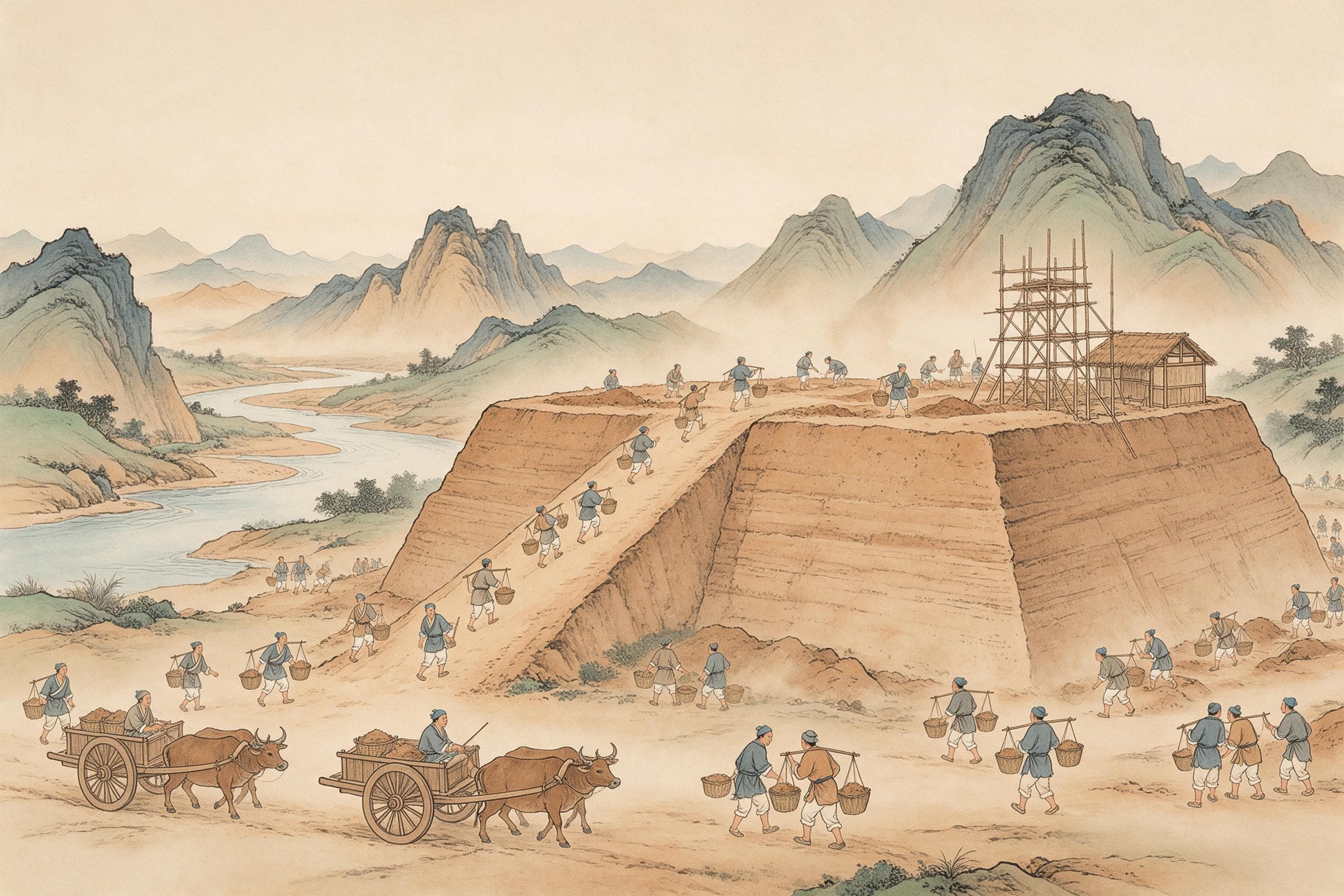
一句话里有两样东西:七十余万人,和一条水银做的河。《史记·秦始皇本纪》写葬始皇:「始皇初即位,穿治骊山;及并天下,天下徒送诣七十余万人,穿三泉,下铜而致椁,宫观百官奇器珍怪徙臧满之。令匠作机弩矢,有所穿近者辄射之。以水银为百川江河大海,机相灌输,上具天文,下具地理。以人鱼膏为烛,度不灭者久之。」
本纪里的骊山
这段之后还有两句:二世说「先帝后宫非有子者,出焉不宜」,于是「皆令从死,死者甚众」;葬事完毕,怕工匠泄漏机关,「尽闭工匠臧者,无复出者」;最后「树草木以象山」——把土丘种成山的样子。这些都在本纪的叙事里,与年表、巡游、刻石并列。没有高度、没有周回、没有「三泉」的深度。
「七十余万」在本纪里出现两处,要连起来看。三十五年:「隐宫徒刑者七十余万人,乃分作阿房宫,或作丽山。」——这批人分成两处,一处在阿房宫,一处在骊山。葬时又说「天下徒送诣七十余万人」。所以这个数字一是累计(「始皇初即位,穿治骊山」,从即位就开始),二是共用(至少三十五年时还分作两处)。不能读成「七十万人同时在这座墓里施工」。
刘向的引用
《汉书·楚元王传》里,刘向为谏汉成帝营建昌陵而上疏,先举秦为戒:「秦始皇帝葬于骊山之阿,下锢三泉,上崇山坟,其高五十余丈,周回五里有余;石椁为游馆,人膏为灯烛,水银为江海,黄金为凫雁。珍宝之臧,机械之变,棺椁之丽,宫馆之盛,不可胜原。又多杀宫人,生薶工匠,计以万数。天下苦其役而反之,骊山之作未成,而周章百万之师至其下矣。」后面还接项籍焚其宫室、牧儿亡羊失火烧其臧椁。
这段要读出它的用途。刘向不是在报告考古发现,他在劝谏:结论是「德弥厚者葬弥薄,知愈深者葬愈微。无德寡知,其葬愈厚,丘陇弥高,宫庙甚丽,发掘必速」;紧接着就转到「陛下即位,躬亲节俭……及徙昌陵,增埤为高,积土为山」。他把秦陵说得越盛,越能证明厚葬必遭发掘,从而劝成帝停工。所以引这几句,必须带上「刘向在对成帝说话」这一层。
数字与描述
两个数字不在一个层级上。「七十余万」是本纪说的服役者,累计、且分作两处;「计以万数」是刘向说的被杀宫人与生埋工匠,性质是死亡人数,而且是估量。两者不能相加,也不能用「万数」去反推「七十万」,更不能推出「同时有多少人在场」——两页都没有工期与出勤记录。
水银那句也一样。「以水银为百川江河大海,机相灌输」是本纪的叙述,刘向则写作「水银为江海」,都是文字描述,不是实物记录。至于地宫里究竟有没有这样一条水银的河,两页都不给证据;本文不写「已证实」。「高五十余丈,周回五里有余」同样是刘向的估计,不是测量数据。
两页的性质
一篇是本纪,纪年叙事;一篇是奏疏,修辞劝谏。本纪里有传说性的细节(人鱼膏做的蜡烛、「机弩矢」射穿近者),奏疏里有对比与结论(厚葬必发)。引文必须带说话人与目的:一句是史官在记,一句是刘向在对皇帝说。混在一起读,就会把「劝谏里的夸张」当成「记载里的尺寸」。
能写的是:这两部书怎样描述骊山。不能写的是:考古已经证实了水银江河;七十万人同时施工;地宫就像本纪写的那样。前一句是把文字当物证,后两句是把数字当出勤表。
材料没有的
缺口:陵园布局、地宫尺寸、工匠名册、死亡统计、修陵工期,两页都没有;水银、人鱼膏、机弩矢都没有实物记录;「从死」的宫人也没有确切数目;也没有说始皇死后这工程是否停工。所以这篇文章写的是「两部书怎么讲一座陵」,不是一座陵的考古报告。
骊山在这两页里是两样东西:在本纪里,它是一座「上具天文,下具地理」的地下世界,用来安置一个刚刚统一天下的人;在谏书里,它是一座「厚葬必发」的现成教训,用来劝另一个皇帝别学。同一座土丘,两种写法;读它先问:这是谁在说,说给谁听。
延伸阅读:六尺六寸:一辆战车的尺寸,与「乘」的两种算法 · 三十六郡:一个数字,没有名单 · 宫城以北的市:辽南京的城坊与户口
参考来源与延伸阅读
- 司马迁《史记》卷六·秦始皇本纪(西汉;维基文库本,未与点校本复核) — The chronicle's account of the tomb. In the thirty-fifth year it says that 'more than seven hundred thousand convicts were set to work on the Afang Palace or at Lishan' (隱宮徒刑者七十餘萬人,乃分作阿房宮,或作麗山); at the burial it says that 'from the beginning of his reign the First Emperor had cut and governed Lishan, and when he had united the world, convicts were sent there from all under heaven, more than seven hundred thousand of them' (天下徒送詣七十餘萬人), who 'cut through three springs, poured bronze and set the coffin', filled the palace halls and offices with wonders, set crossbow triggers to shoot at anyone who approached, 'made rivers, the Yangtze, the Yellow River and the great seas out of quicksilver, mechanically circulated', 'above they set the heavens, below the earth', and used 'fish-oil for candles'. It adds that the Second Emperor had the childless women of the palace follow the dead, 'and many died', and that the artisans who knew the machinery were shut inside the tomb 'and none came out again', the mound then planted to look like a hill. It gives no plan, no dimensions and no duration of the work.
- 班固《汉书》卷三十六·楚元王传(刘向传,东汉;维基文库本,未与点校本复核) — A memorial, not a survey. Under Emperor Cheng the court was building the Changling tomb, and Liu Xiang submitted a remonstrance against the extravagance; to argue it he holds up Qin: 'the First Emperor of Qin was buried in the fold of Lishan: below he sealed the three springs, above he raised a mountain mound more than fifty zhang high and more than five li around; stone coffins made a travelling palace, human fat the lamps, quicksilver the rivers and seas, gold the wild ducks and geese. Of the treasures hidden, the machinery's ingenuity, the beauty of coffin and outer coffin, the splendour of palaces and halls, one cannot finish the account. He also killed many palace women and buried artisans alive, reckoned by the ten thousand. All under heaven suffered his corvée and turned against him; the work at Lishan was not finished when Zhou Zhang's army of a million reached its foot' (驪山之作未成,而周章百萬之師至其下矣). Liu Xiang then traces the desecrations — Xiang Yu burning the buildings, a shepherd's fire in the tomb — and draws the moral that 'the thicker the virtue, the thinner the burial', using Qin to argue that Emperor Cheng should stop building Changling. The figures are his, given in the course of an argument.