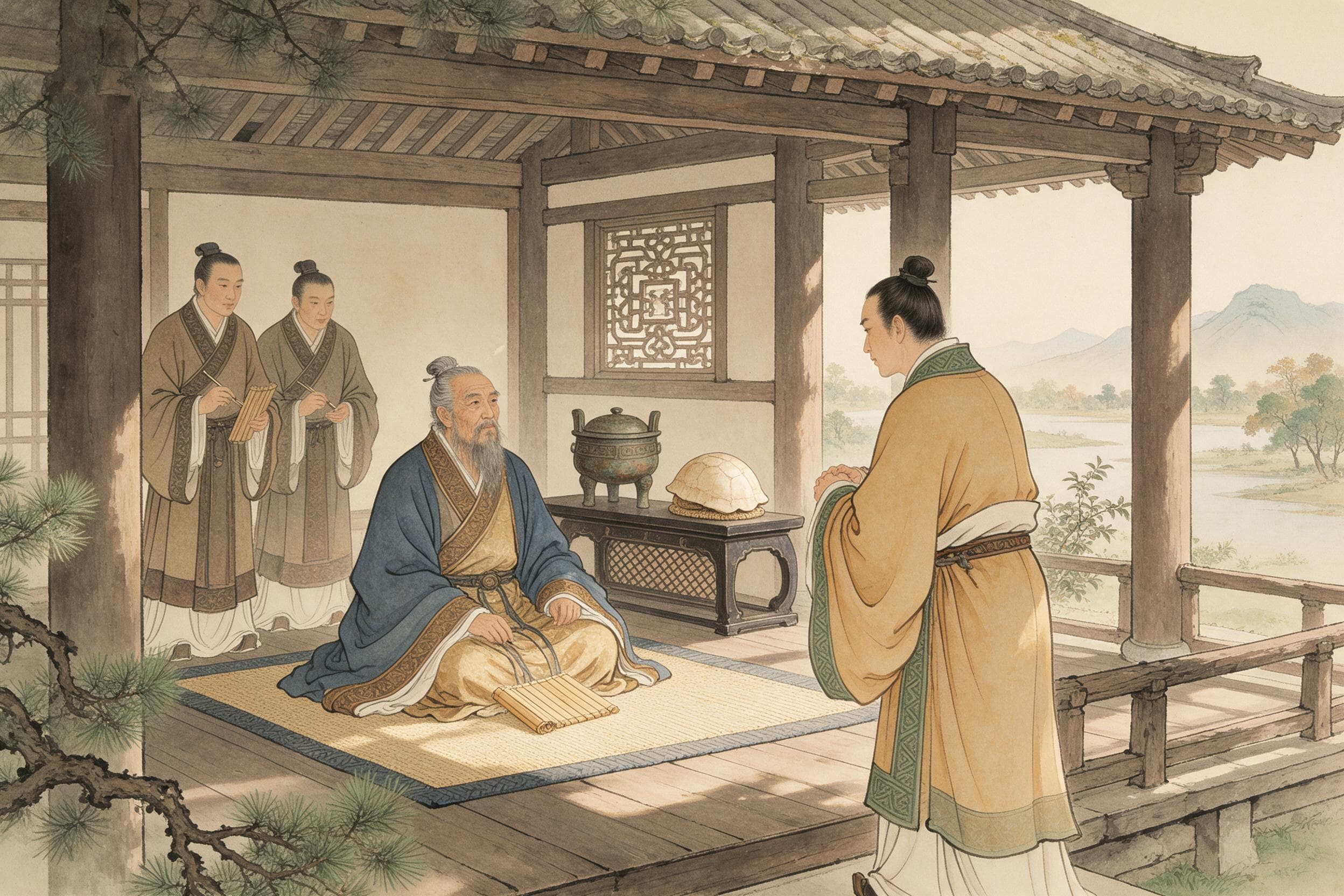
In the eighth year of Duke Yin of Lu, 'Wuhai died. Yufu asked for a posthumous name and a lineage. The duke asked Zhongzhong about the lineage' (無駭卒。羽父請謚與族。公問族於眾仲) — a funeral that produced a short treatise on surname, lineage and clan. When Zhongzhong had answered, the duke 'commanded that his courtesy name be the Zhan lineage' (公命以字為展氏). Two layers should be kept apart from the start: the Zuozhuan passage is a set of rules, while the Book of Rites' 'Great Treatise' sets out the organization of a clan. Both speak of surname and lineage, but they are not one document, and they are read separately here rather than fused into a Zhou system of surnames.
Wuhai's Lineage
The case itself is short: Wuhai dies; Yufu asks for a posthumous name and a lineage name; the duke takes the question of the lineage to Zhongzhong; Zhongzhong gives four sources; and the duke makes his courtesy name into the Zhan lineage. The page says only 'by his courtesy name, the Zhan lineage', and does not say what Wuhai's courtesy name was; this article does not supply it. What can be said is that Zhan is a lineage name, and that it comes from a courtesy name.
The four rules, as printed: 'The Son of Heaven establishes virtue, grants a surname according to birth, and enfeoffs land to give a lineage name. The nobles take a courtesy name as posthumous name and thence make a lineage. An office with hereditary merit has an office lineage; a town is the same' (天子建德,因生以賜姓,胙之土而命之氏。諸侯以字為謚,因以為族。官有世功,則有官族,邑亦如之). The surname is given 'according to birth'; the lineage is given 'by enfeoffing land'; at the level of the nobles, a courtesy name becomes a posthumous name and thence a lineage; hereditary office gives an office lineage; and a town works the same way. Three words — 姓, 氏, 族 — appear in one sentence, each with its own source. The page reads 以字為謚, not 以字為氏; it is printed as it stands, with no character corrected and no emendation supplied.
Surname and Lineage Are Two Systems
Surname and lineage cannot be run together as one word. 'Granting a surname according to birth' ties the surname to birth; it is granted by the Son of Heaven, and everyone under one surname shares it. The Great Treatise says 'those of the same surname follow the lineage and are gathered into the kin group' (同姓從宗,合族屬), and 'the surname is bound so as not to divide, they are fed together so as not to be set apart, and though a hundred generations pass marriage between them is not permitted — that is the Zhou way' (繫之以姓而弗別,綴之以食而弗殊,雖百世而昏姻不通者,周道然也). Here the surname does two things: it holds a body of people together, and it draws the line at marriage.
A lineage, by contrast, can divide and can change. It comes from land (land enfeoffed to give a lineage name), from a courtesy name (the nobles' courtesy name becoming a posthumous name and thence a lineage; Wuhai's courtesy name becoming the Zhan lineage), from office (hereditary merit giving an office lineage), and from a town (a town being the same). Four sources: land, name, office, town. Neither page gives a table matching a surname to a lineage, and neither says what surname the Zhan lineage bore; nothing is supplied here.
The Great Treatise: Same Surname, One Clan
The Book of Rites passage is a constitution for a clan, not a form for granting names. Its first pair of sentences separates the two categories: 'Those of the same surname follow the lineage and are gathered into the kin group; those of other surnames are ordered by name and title at meetings, and when name is clear male and female are distinguished' (同姓從宗,合族屬。異姓主名,治際會,名著而男女有別). Then comes the surname and marriage: bound so as not to divide, fed together so as not to be set apart, and after a hundred generations still no marriage between them — that is the Zhou way.
Then the rules of the clan: 'a son by a secondary wife does not sacrifice, to make his lineage clear' (庶子不祭,明其宗也); 'a branch son becomes an ancestor, the heir of the branch becomes the lineage, the heir of the father is the small lineage; there is a lineage not moved for a hundred generations and a lineage moved every five' (別子為祖,繼別為宗,繼禰者為小宗。有百世不遷之宗,有五世則遷之宗); and the close: 'revering the ancestor, therefore respecting the lineage; respecting the lineage is the meaning of revering the ancestor' (尊祖故敬宗,敬宗,尊祖之義也). The whole passage is about sacrifice, the gathering of the kin and the division of lineages; the four rules on granting names are not in it.
Who Says What
The Zuozhuan gives rules and one case of their use: surname from birth, lineage from land, name, office or town, and Wuhai's courtesy name made into the Zhan lineage. The Great Treatise gives clan rules: same surname following the lineage, other surnames ordered by name, the surname bound so as not to divide, the secondary son not sacrificing, the branch son as ancestor. Neither proves the other: the Zuozhuan has none of the clan organization, and the Great Treatise has none of the four sources of names. To join them is to invent a Zhou surname system that neither page contains; this article does not join them.
The vocabulary should also be read page by page. The Zuozhuan uses three words together — grant a surname (賜姓), give a lineage name (命之氏), make a clan (為族). The Great Treatise uses 姓, 宗 and 族, and 氏 is not its leading term. Even 族 does not mean exactly the same thing on both pages; the usages are printed as each page has them, and no terminology is harmonised here.
What Neither Page Gives
Neither page gives a table matching real families' surnames to their lineages, the ceremony, officiant or occasion of granting a name, a general rule that the lineage changes while the surname does not (only the direction given by 'a surname according to birth'), the later genealogy of the Zhan lineage, or where the surname itself came from. This article does not reach back to high antiquity, does not write a history of Chinese surnames, and does not fill the gap from later surname books.
What can be established is this: one funeral, four rules, one set of clan regulations. Surname from birth; lineage from land, name, office or town; the same surname follows the lineage, other surnames are ordered by name; the surname holds people together and draws the marriage line, while the lineage serves sacrifice and the gathering of kin. Two pages, two layers, and no bridge between them — which this article does not build.
Related reading:Men of Shang and Their Elephants: Three Sentences, Three Books · Tribute Turtles: Where Divination Shells Were Said to Come From · Weizi's Question: To Stay or to Leave, on the Eve of Shang's Fall
Sources & further reading
- 《春秋左氏传·隐公八年》(维基文库本,页面白文无注,未与中华书局点校本复核) — The case that carries the rules: Wuhai dies; Yufu asks for a posthumous name and a lineage; the duke asks Zhongzhong about the lineage, and Zhongzhong answers that the Son of Heaven establishes virtue, grants a surname according to birth and a lineage name by enfeoffing land; that the nobles take a courtesy name as posthumous name and thence a lineage; that an office with hereditary merit gives an office lineage; and that a town works the same way. The duke then 'commanded that his courtesy name be the Zhan lineage'. The page reads 以字為謚, not 氏, and no character is corrected here.
- 《礼记·大传》(维基文库本,页面白文无注,未与中华书局点校本复核) — The Great Treatise's rules for clan organization, not for granting names: those of the same surname follow the senior line and are gathered into the kin group, those of other surnames are ordered by name and title at meetings, so that name is clear and male and female are distinguished; the surname is bound so as not to divide and fed together so as not to be set apart, and though a hundred generations pass marriage between them is not permitted — that is the Zhou way; a son by a secondary wife does not sacrifice, to make clear his senior line; and the rules of separate branches as ancestors, of the inheriting branch as the lineage, with a hundred-generation and a five-generation line.