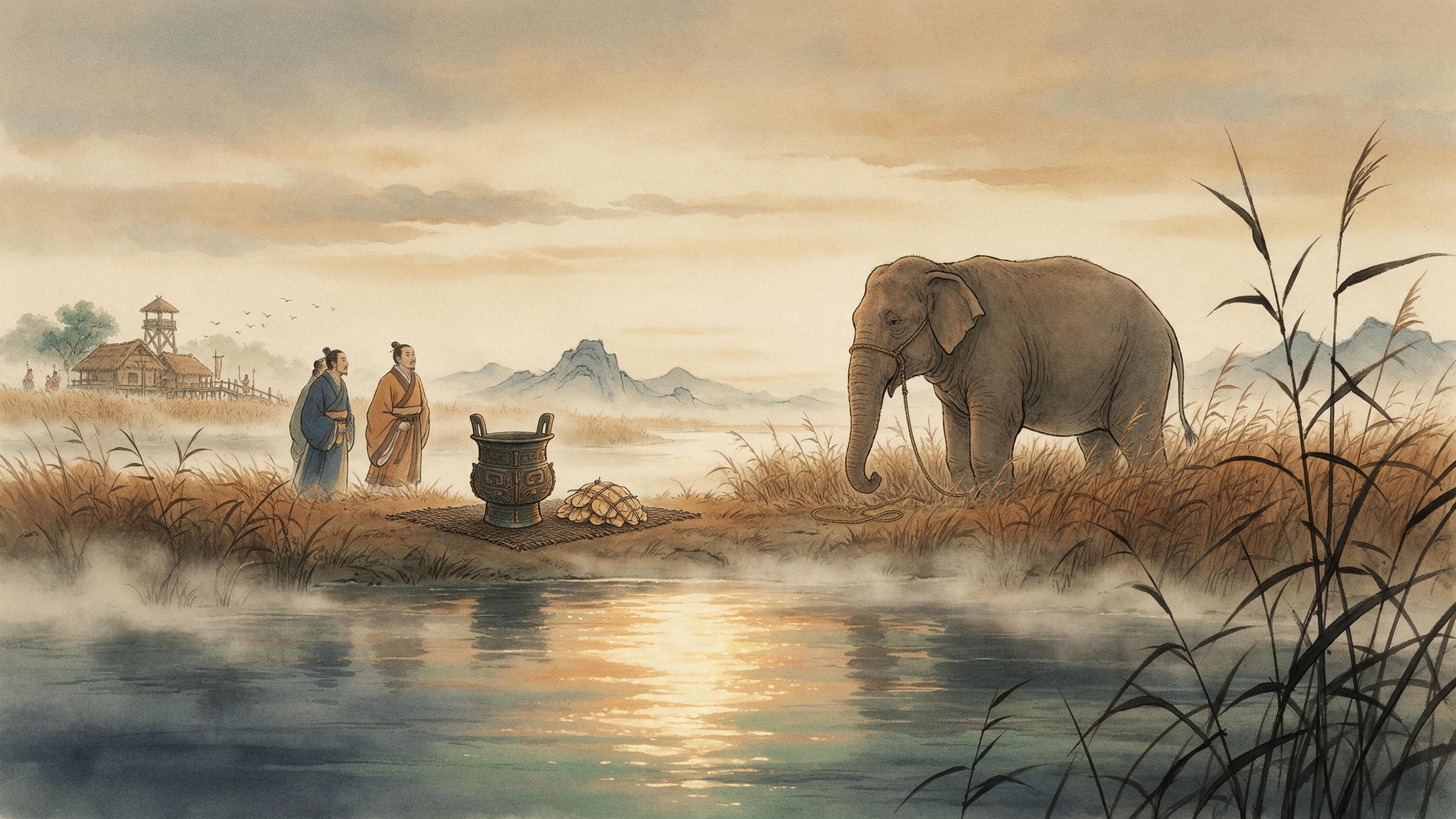
'The men of Shang worked elephants, and did cruelty against the eastern Yi' (商人服象,為虐于東夷) — eight characters, from the Lüshi chunqiu, juan 5, in the chapter on ancient music. The source layer first: the sentence is a Warring States retrospect on the early Zhou, not a Shang record, and it stands in a passage that assigns a piece of music to each reign, not in a chronicle of campaigns. This article keeps to the words of the three ancient sentences; on taming and on battle the sentences say nothing, and nothing is added here.
Finding an Origin for a Dance
The passage runs reign by reign: when Yu came to power he had Gao Yao make the Xia Yue in nine movements; when Tang took the throne he had Yi Yin make the Da Hu; King Wen at Qi had the Duke of Zhou write a poem; King Wu had the Duke of Zhou make the Da Wu; and then 'when King Cheng came to the throne the Yin people rebelled, and the king ordered the Duke of Zhou to attack them. The men of Shang worked elephants and did cruelty against the eastern Yi; the Duke of Zhou then drove them with an army as far as the south of the river, and made the San Xiang to praise his virtue' (成王立,殷民反……乃為《三象》,以嘉其德). Each king gets a piece; Cheng gets the San Xiang. The elephant sentence explains where that dance came from; it is not a separate dispatch.
Taken apart: King Cheng takes the throne, the Yin people rebel, the king orders the Duke of Zhou to attack; the men of Shang 'work elephants' and do cruelty against the eastern Yi; the Duke drives them with an army as far as Jiangnan; and the San Xiang is made. Here 'the men of Shang' are the Yin remnant, not traders — that is the usual reading, since the same sentence begins with 'the Yin people rebelled'. 服象 is two characters only: to work, harness or use, and elephant; how an elephant was tamed, how it was used, how many there were, the page does not say. One more thing may be pointed out: 象 occurs twice in the sentence, once in 服象 and once in the title 三象; the text does not connect the two, and this article does not speculate on the etymology.
Mencius: Driving the Beasts Away
The Mencius, in the Teng Wen Gong chapter, has a passage in a very different setting. Gongduzi asks why outsiders call the Master fond of disputing, and Mencius answers that he cannot help it: the world has always gone one while ordered and one while in chaos. He lists the ages: in Yao's time the flood, and Yu dug channels to the sea and 'drove the snakes and dragons into the marshes'; then 'the Duke of Zhou assisted King Wu, punished Zhou, attacked Yan, took their ruler in three years, drove Feilian to the corner of the sea and killed him, destroyed fifty states, and drove tigers, leopards, rhinoceroses and elephants far away; the world was greatly pleased' (驅虎豹犀象而遠之). The elephant is one item in a list of beasts driven off, inside an argument about order and chaos, not a record of a campaign.
Set the two side by side: in one the men of Shang 'work' elephants, and the elephant is used by people; in the other the Duke of Zhou drives tigers, leopards, rhinos and elephants away, and the elephant is one of the things driven. Use and expulsion — both are printed here, neither is chosen, and neither page turns them into 'the Zhou breaking a Shang elephant corps'. There is no elephant corps on either page, and no account of a clash.
A Third Sentence: Ivory as Tribute
The third sentence is in the Book of Songs, the Lu praise ode 'Pan Shui'. The lord of Lu drinks at the Pan palace; his warriors 'present the ears of the slain at the Pan' and 'present the prisoners at the Pan'; then 'he has conquered the Huai Yi, who are good and do not resist'; and the last stanza: 'How splendid those Huai Yi, coming to present their treasures: great turtles and ivory, and much southern metal' (憬彼淮夷,來獻其琛。元龜象齒,大賂南金). Ivory is one item on a tribute list, beside great turtle shell. The poem is a praise ode, generally read as praising Duke Xi of Lu, not a document. Ivory and a live elephant are two different things, and this article does not read the line as the Huai Yi presenting elephants.
Three Sentences, Three Layers
The three books come from different shelves: the Lüshi chunqiu from the late Warring States, generally thought to have been compiled by the clients of Lü Buwei; the Mencius from the middle Warring States; the Lu ode from the Spring and Autumn court of Lu, generally read as praising Duke Xi. None is a Shang document. Contemporary Shang material — oracle-bone inscriptions, bronze inscriptions, excavated objects — is not on these pages and is not drawn on here, so all three sentences can only be quoted as ancient text.
The elephant stands in three different places. In the Lüshi chunqiu it is 服, worked or harnessed by the Yin remnant. In the Mencius it is 驅, driven away with tigers and rhinos as one of the achievements of good order. In the ode it is 獻, presented as ivory. Used, expelled, offered: three positions that cannot be assembled into a history of Shang elephants.
What None of the Three Gives
None gives a method of taming — no feed, no enclosure, no keeper. None gives battle detail — how many, in what order, who drove them, how the army withdrew; not a word. Nor where the Yin remnant went, how the fighting against the eastern Yi was done, or in what year of King Cheng this happened. This article adds no elephant tactics, draws no map of migration, and does not supply a description of the San Xiang dance, which the page does not describe.
There is no evidence layer either: whether 'the men of Shang worked elephants' has any counterpart in oracle bones, bronze inscriptions or excavation, these three pages do not say, and this article does not go outside them to find one. No general history of war elephants is written here, no distribution of the animal, no word-study of 象 in other compounds, and no units are converted.
Three sentences, three places: one left by a late Warring States writer explaining where a dance came from, one an example in a Mencian argument about disputation, one an item on a tribute list in a praise ode. All three can only be quoted as ancient text. How the men of Shang themselves kept elephants or used them, these pages do not answer; what can be said is that the three sentences put the elephant in three different places, and none of them describes how an elephant was tamed.
Related reading:Tribute Turtles: Where Divination Shells Were Said to Come From · Weizi's Question: To Stay or to Leave, on the Eve of Shang's Fall · The Ten Stems in the Kings' Names: What the Shang Rulers Were Called
Sources & further reading
- 《吕氏春秋》卷五·仲夏纪·古乐(维基文库本,页面白文无注,未与中华书局点校本复核;一般认为成书于战国末) — The sentence in a passage on the origins of music and dance: after Yu and the Xia Yue, Tang and the Da Hu, Wen and Wu and the Da Wu — 'when King Cheng came to the throne the Yin people rebelled, and the king ordered the Duke of Zhou to attack them. The men of Shang worked elephants and did cruelty against the eastern Yi; the Duke of Zhou then drove them with an army as far as Jiangnan, and made the San Xiang to praise his virtue.' The elephant appears in a list of rulers and the pieces made for them, as part of the origin of one dance.
- 《孟子·滕文公下》(维基文库本,页面白文无注,未与中华书局点校本复核) — In the answer to Gongduzi's question why the Master is fond of disputing: the world has always gone one while ordered and one while in chaos; after the flood Yu drove the snakes and dragons into the marshes, and after the tyrant Zhou, 'the Duke of Zhou assisted King Wu, punished Zhou, attacked Yan, took their ruler in three years, drove Feilian to the corner of the sea and killed him, destroyed fifty states, and drove tigers, leopards, rhinoceroses and elephants far away, and the world was greatly pleased.' The elephant is one item in a list of beasts driven off, inside an argument.
- 《诗经·鲁颂·泮水》(维基文库本,页面白文无注,未与中华书局点校本复核;一般认为颂鲁僖公) — A praise ode for the lord of Lu at the Pan palace: the Huai Yi submit, the warriors present the ears of the slain and the prisoners at the water, and the last stanza has the Huai Yi coming with tribute — 'How splendid those Huai Yi, coming to present their treasures: great turtles and ivory, and much southern metal.' Ivory is one item on a tribute list; no live elephant appears in the poem.