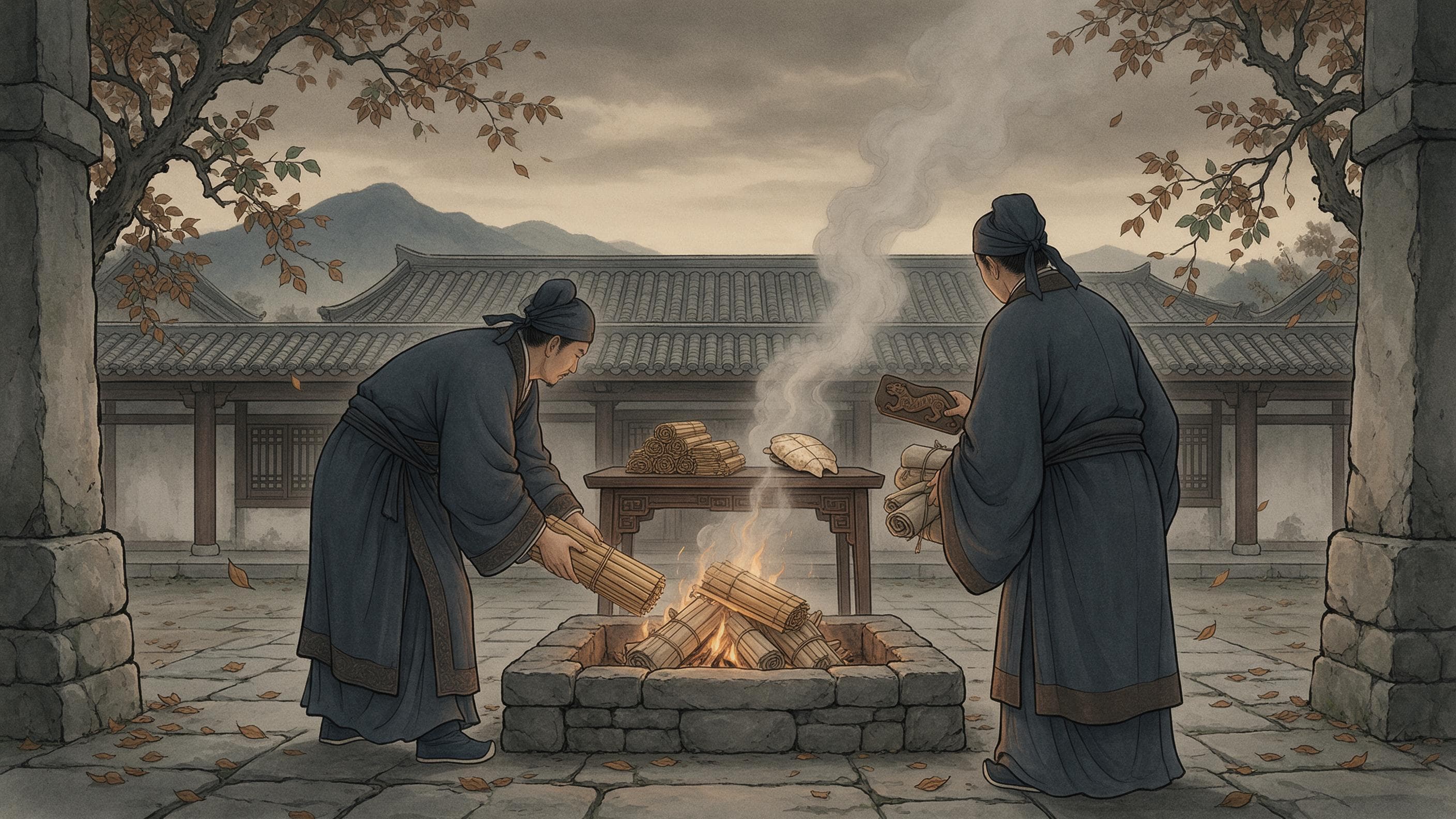
In the Liji's chapter on mourning there is a passage that follows straight on from coffins: 'the men of Yu used tile coffins; the Xia made the brick enclosure; the Yin used coffin and outer coffin; the Zhou added the wall and the feather screen' (有虞氏瓦棺,夏后氏堲周,殷人棺椁,周人牆置翣). After a note on burying the young in earlier dynasties' coffins come three parallel sentences: 'the Xia honoured black: for the great business they laid out the dead at dusk, for war they rode black horses, and their victims were dark. The Yin honoured white: for the great business they laid out the dead at noon, for war they rode white horses, and their victims were white. The Zhou honoured red: for the great business they laid out the dead at sunrise, for war they rode red horses, and their victims were red' (夏后氏尚黑……殷人尚白……周人尚赤……).
Three dynasties, three sentences
The three sentences are quoted above, and they are built alike: each gives three things — the hour for the 'great business' of laying out the dead, the horses for war, and the colour of the victims. Xia, Yin and Zhou take one sentence each, and the colours differ: black, white, red. The passage before them is about coffins, so the 'great business' is generally thought to mean mourning, and 斂 the laying out of the dead. That is only the sense of the words; the page carries no note. The manner is worth noticing too: the sentence just before, on coffins, is arranged the same way — one item of equipment, three dynasties, one clause each — and the three colour sentences follow that pattern.
What matters is that the three sentences are set side by side, not derived. Why Xia is black, Yin white and Zhou red; why white goes with noon, black with dusk, red with sunrise — the page explains none of it, and this article does not bring in the later Five Phases theory to fill the gap. When that theory arose, and whether it can be applied to these sentences, is beyond both pages and beyond this article.
The hours: dusk, noon, sunrise
The first of the three items is the hour, copied as written: Xia 'at dusk' (昬), Yin 'at noon' (日中), Zhou 'at sunrise' (日出). The three hours have their places in a day, but whether they form a sequence, and whether the sequence of dynasties answers to the sequence of hours, the page does not say. They lie far apart — one at sunset, one at midday, one at first light — and are copied without being arranged in order.
The pairing of hour and colour is copied too: black with dusk, white with noon, red with sunrise. 'The Yin honoured white: for the great business they laid out the dead at noon' — white and midday stand in one sentence. That is the text's juxtaposition, not this article's inference. Why white should go with noon, or whether noon light is white, or anything else, the page does not say; the juxtaposition is simply set out here.
Horses and victims
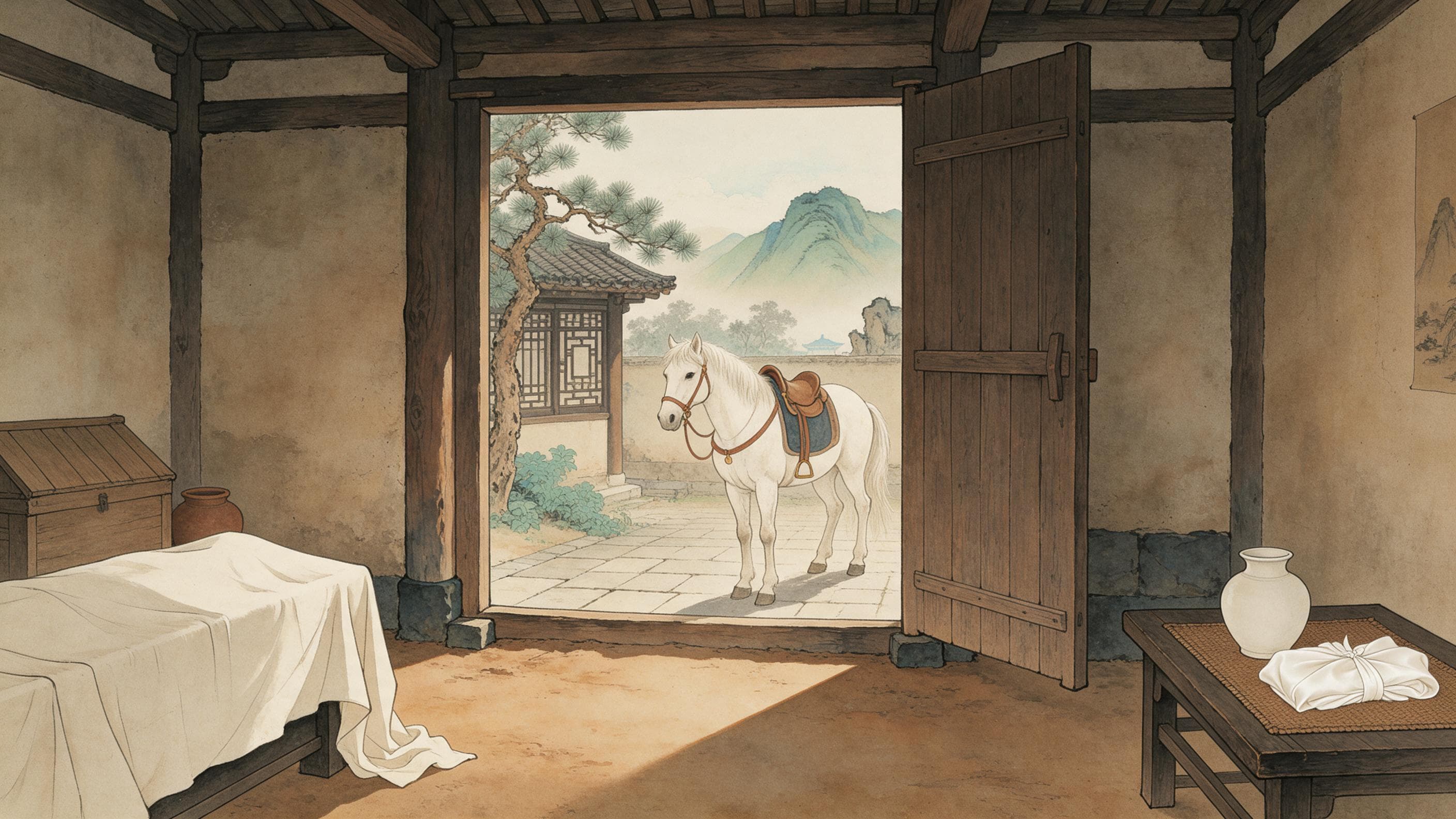
The second and third items are the horses and the victims. For war each sentence gives a horse: Xia 'rode black' (驪), Yin 'rode white' (翰), Zhou 'rode red' (騵). It is generally thought that 驪 is a black horse, 翰 a white one and 騵 a red one, but the page carries no note, and this article copies the three characters only. 乘 means to drive or ride; how one carriage was fitted out, how many wheels, how wide — the page does not say, and this article does not supply it. That is a question of carriage construction, not of this page.
The victims have their colours too: Xia 'dark' (玄), Yin 'white' (白), Zhou 'red' (騂); 玄 is generally taken as a dark colour and 騂 as a reddish one. Taken together, the three dynasties' colours are not a bare word 'honoured' but a set of actions: when to lay out the dead, what horse to drive, what victim to offer. A correspondence can be counted out — black horse for black, white for white, red for red — but why it is so paired the page does not explain.
The one sentence in the Shiji
The other page has a single sentence. At the end of the Grand Historian's verdict in the Basic Annals of Yin: 'Confucius said: the Yin road-carriage was good, and their colour was white in honour' (孔子曰,殷路車為善,而色尚白). Two things in one line: the carriage was good, and the colour was white. Note the frame — 'Confucius said'. The historian is quoting Confucius, not passing his own judgement, and this is the only record of colour in the whole chapter. Its position is worth a word: it is the very last sentence of the verdict, after a passage on the descendants of Qi and their surnames — a quotation tucked in at the end, almost as an afterthought.
What a 'road-carriage' was — its construction, wheels, timber, lacquer — the page does not say, and this article does not supply it. What is certain is only this: the sentence puts 'carriage' and 'colour' together, while the Liji's three sentences put carriage, horse, victim and hour together. On the same 'honouring white', one page gives a quoted line, the other three parallel clauses.
Which layer these pages are
Both pages are later texts. The Liji's mourning chapter is a Han compilation of ritual (this is generally held), and what it records of the three dynasties is the kind of thing 'the Zhou recalling the Yin rites' — not an archive of the Shang period. The Shiji is a Han work, and even this sentence quotes Confucius. So 'the Yin honoured white' can only be quoted as the words of an old book — marked as from the Liji's mourning chapter, or from the Shiji quoting Confucius — and not as the state of Shang. That must be said plainly, or three parallel sentences are easily read as an archaeological conclusion.
What neither page gives: colour evidence from Shang objects (lacquer, textiles, the colours in chariot-and-horse pits), any correspondence between such finds and these three sentences, the date when the Five Phases theory arose, or what else the 'great business' may have covered. The gaps are listed, not filled. Three parallel sentences and one quoted line give a set of correspondences — black with dusk, white with noon, red with sunrise — but those are correspondences in a text, not a scene from the Shang; the colours are written in books, and the soil has not yet been dug to that depth.
Related reading:Weizi's Question: To Stay or to Leave, on the Eve of Shang's Fall · Square Fields and Millet: Everyday Problems in a Han Reckoning Book · Surname and Lineage: How a Spring and Autumn Man Was Named
Sources & further reading
- 《礼记·檀弓上》(维基文库本,未与点校本复核) — The three-dynasty comparison, set right after a passage on coffins: 'the men of Yu used tile coffins; the Xia made the brick enclosure; the Yin used coffin and outer coffin; the Zhou added the wall and the feather screen… The Xia honoured black: for the great business they laid out the dead at dusk, for war they rode black horses, and their victims were dark. The Yin honoured white: for the great business they laid out the dead at noon, for war they rode white horses, and their victims were white. The Zhou honoured red: for the great business they laid out the dead at sunrise, for war they rode red horses, and their victims were red' (夏后氏尚黑,大事斂用昬,戎事乘驪,牲用玄。殷人尚白,大事斂用日中,戎事乘翰,牲用白。周人尚赤,大事斂用日出,戎事乘騵,牲用騂). The page carries no note explaining any of the correspondences.
- 司马迁《史记》卷三〈殷本纪〉(维基文库本,未与点校本复核) — At the very end of the Grand Historian's verdict on the Shang: 'Confucius said: the Yin road-carriage was good, and their colour was white in honour' (孔子曰,殷路車為善,而色尚白). One quoted line, attributed to Confucius, not the historian's own judgement, and the only sentence on the subject in the chapter. The chapter gives no colour rules, no hours, no horses, and no sacrificial victims.