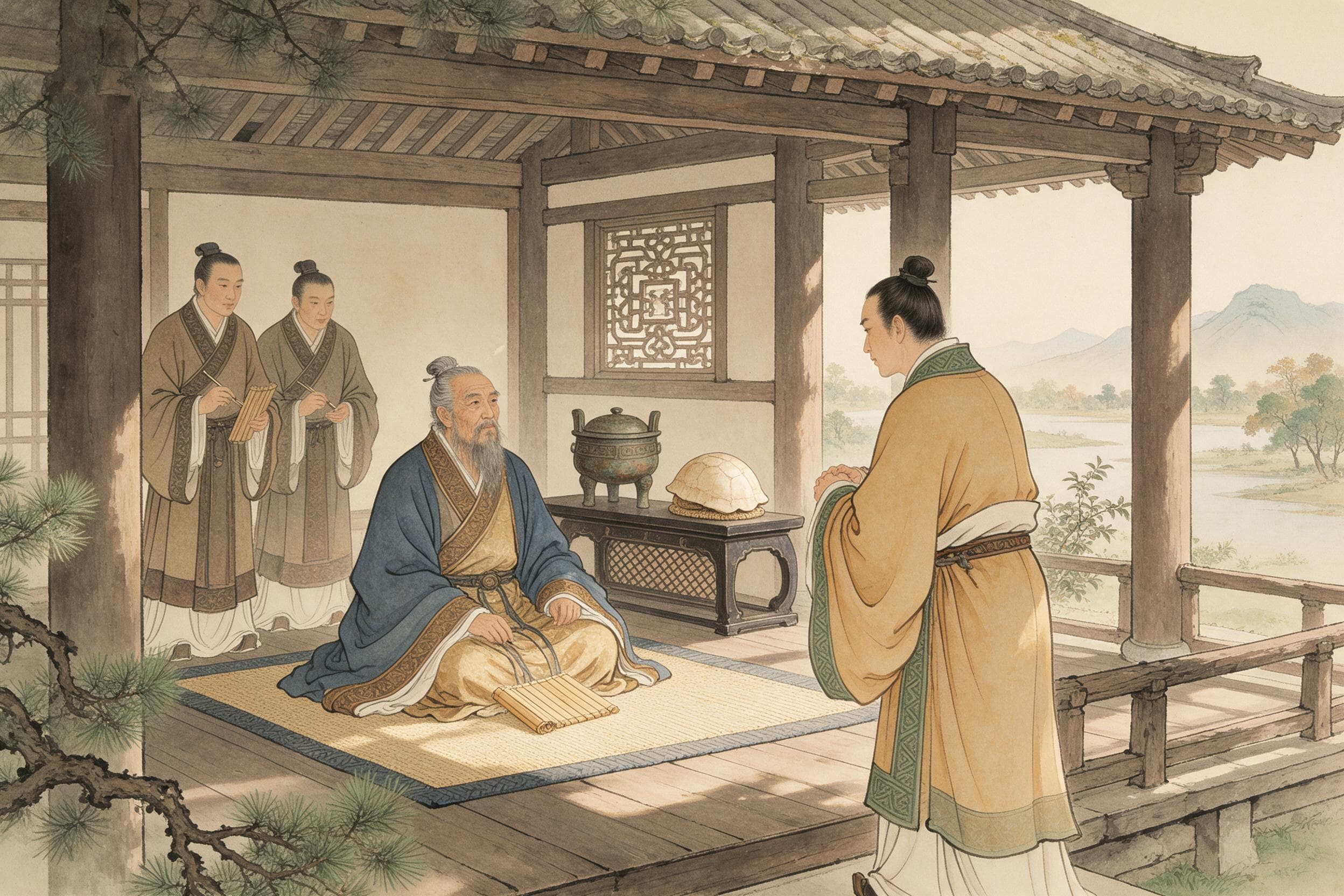
The Book of Documents' chapter 'Weizi' is short enough to read on a single page: one conversation, two speakers, Weizi asking and the Father-Master answering. The source layer should be stated first. The Book of Documents is a text transmitted and edited from Zhou times onward, and this chapter is generally thought to have been compiled by later hands, not written down by Weizi himself; the speakers and the shape of question and answer are printed here, but the page is not treated as a contemporary record. The Records of the Grand Historian, juan 38, rewrites the same scene; both are read here, and neither is blended into the other.
First, a List of What Has Gone Wrong
Weizi does not begin with an argument: 'Weizi spoke thus: "Father-Master, Junior-Master, Yin cannot order the four quarters. Our ancestors set forth their display above, and we are sunk in drink, and so ruin his virtue below"' (微子若曰:父師、少師,殷其弗或亂正四方……我用沈酗于酒,用亂敗厥德于下). Then the list: great and small alike 'delight in grass-hidden theft and villainy' (好草竊姦宄); 'the officers and leaders take no model, and of those who have guilt none is consistently caught' (卿士師師非度,凡有辜罪,乃罔恒獲); 'the common people rise together and become each other's enemies' (小民方興,相為敵讎). It closes on one image: 'now Yin is perishing, like crossing a great river with no bank in sight. Yin is going to ruin, and it has come to this day' (今殷其淪喪,若涉大水,其無津涯). The page prints variant characters in round brackets; they are kept as printed.
The first person matters: 'we are sunk in drink' has Weizi speaking for Yin, and it is a statement about the court, not a survey of everyone's drinking. This article does not turn it into 'the Shang all drank', and offers no theory of why Yin fell: the chapter gives words spoken by people, not a conclusion.
The Second Question: Go, or Stay
The question is a run of questions: 'Shall I set out and go? Or shall the old of our house withdraw into the wilds? If you do not point the way for me, I shall fall — what is to be done?' (我其發出狂?吾家耄遜于荒?今爾無指告,予顛隮,若之何其). The page notes 狂 as a variant of 往. The Shiji has the same sentence differently: 'shall I set out and go? Shall our house be preserved in its ruin? Now you give me no cause for guidance — I am stumbling, what is to be done?' (我其發出往?吾家保于喪?今女无故告予,顛躋,如之何其). 'Withdraw into the wilds' and 'be preserved in ruin' are two readings of one clause; both are printed here and neither is chosen.
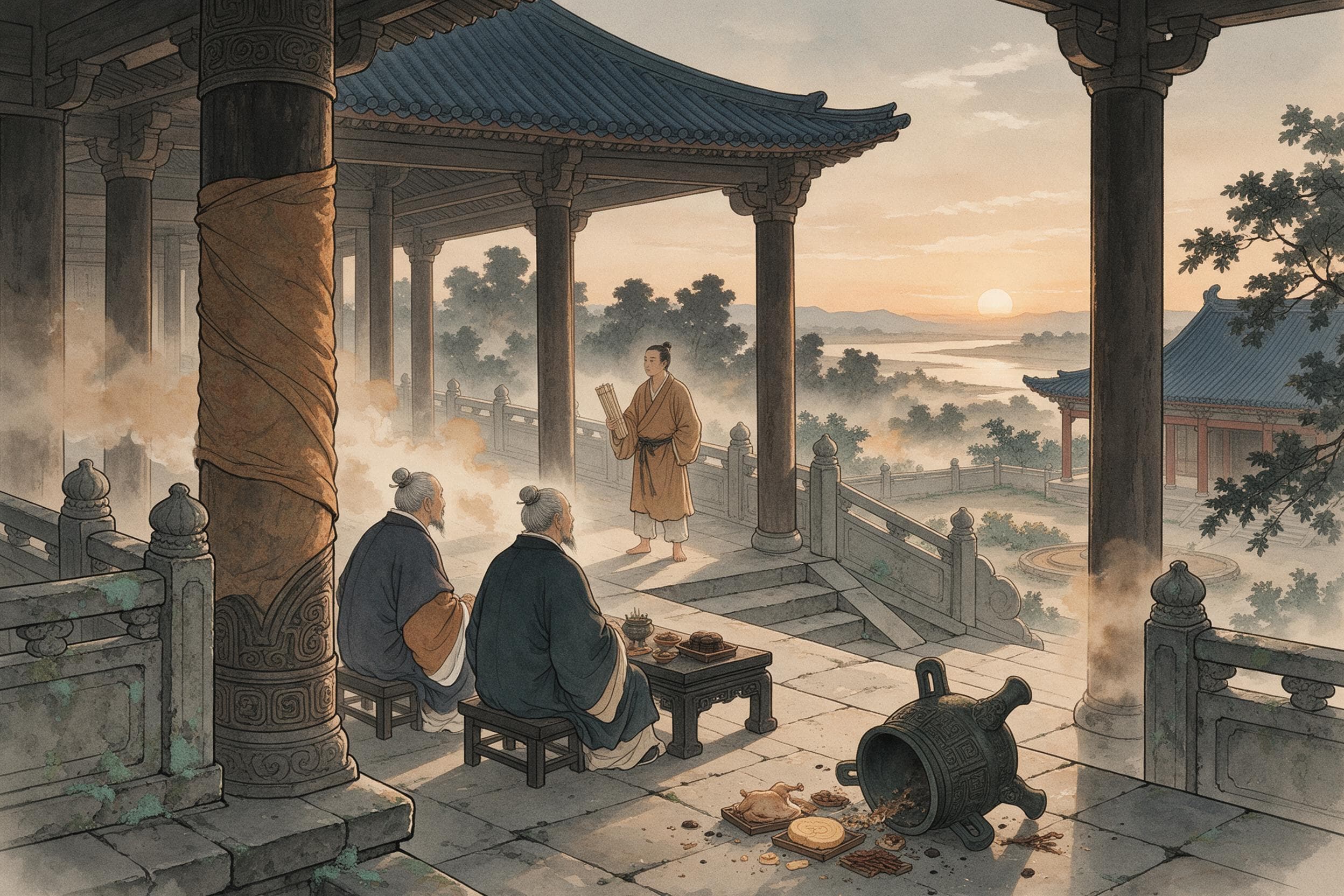
The Father-Master answers by naming the prince first, then the calamity: 'Heaven sends down calamity to lay waste the state of Yin; we are rising up in drink and stand in awe of nothing, and we set aside our elders and those long in place' (天毒降災荒殷邦,方興沈酗于酒,乃罔畏畏,咈其耇長、舊有位人) — 毒 is noted on the page as a variant of 篤. Then the sharpest item: 'now the people of Yin steal the sacrificial victims of the gods and spirits, to eat them at their ease, and no harm comes' (今殷民乃攘竊神祇之犧牷牲用,以容將食,無災). Then: 'I will share in its ruin; when Shang falls I will not be a servant of the new house' (商今其有災,我興受其敗。商其淪喪,我罔爲臣僕).
The close draws the line: 'I bid the prince go out; if the prince does not go out, we shall fall. Settle yourselves; each man offers himself to the former kings — I will not turn and flee' (詔王子出……王子弗出,我乃顛隮。自靖,人自獻于先王,我不顧行遯). He tells the prince to leave and says he will not leave himself. That is the hardest sentence in the chapter.
The Shiji's Rewriting of the Same Dialogue
The Shiji first supplies background the chapter does not have: 'Weizi Kai — the note says the character was changed to avoid the taboo on Emperor Jing's name — was the eldest son of Di Yi and the elder half-brother of the tyrant Zhou. When Zhou came to the throne he was unenlightened and disorderly in government, and Weizi remonstrated several times without being heard.' Then an episode absent from the Book of Documents: Zu Yi, because the Western Earl Chang of Zhou cultivated virtue and destroyed the state of Li, feared disaster and told the king; the king said, 'Am I not possessed of the mandate of Heaven? What can he do?' (我生不有命在天乎?是何能爲). The Shiji also writes the drinking as the king's — 'Zhou was sunk in wine and followed the counsel of women' (沈湎於酒,婦人是用).
The dialogue itself is reshaped. Weizi 'judged that the king could never be remonstrated with; he wished to die, and then to leave, and could not decide for himself' (欲死之,及去,未能自決), so he asked the Grand-Master and Junior-Master. Their exchange is printed here: 'Heaven sends down ruin on the state of Yin; they stand in awe of nothing and do not use the old and senior' (天篤下菑亡殷國……不用老長); 'now the people of Yin profane the sacrifices of the gods' (今殷民乃陋淫神祇之祀); 'if governing could be achieved, and the state were governed, I would not regret death; but to die and still not achieve government — better to go' (今誠得治國,國治身死不恨。爲死,終不得治,不如去). Then three characters: 'and so he fled' (遂亡).
The two pages end in opposite directions. In the Book of Documents the Father-Master says 'I will not turn and flee' and stays; in the Shiji the Grand-Master says 'better to go', and Weizi goes. Even the titles differ (Father-Master and Grand-Master), and so do the words — 沈酗 and 沈湎 for drinking, 天毒 and 天篤 for Heaven's sending, 'stealing the sacrificial victims' against 'profaning the sacrifices', one concrete and one general. All of it is printed side by side and none of it is adjudicated; that 父師 and 太師 are two names for one office is the usual reading.
Three Ways: Go, Stay, Feign Madness
The same juan gives two more men, and with them the other two ways. Jizi, a kinsman of the king, remonstrated and was not heard; 'someone said, "You may leave now." Jizi said: "To remonstrate as a minister, not be heard, and then leave, is to display the ruler's fault and win the people's praise for oneself — I cannot bear to do it." He then let down his hair, feigned madness and became a slave' (乃被髡詳狂而爲奴). Prince Bigan, also a kinsman, seeing Jizi reduced to slavery, said, 'If a ruler has a fault and one does not contend to the death, what blame do the common people bear?' and remonstrated outright; the king said, 'I have heard the heart of a sage has seven openings — is it true?' and had Bigan killed and his heart cut out to see. Go, stay, die: all three are on this page. The Book of Documents' chapter has only Weizi with the Father-Master and Junior-Master, and neither of these men. This article sets the three ways out as the texts set them and ranks none of them.
What Neither Page Gives
Neither page gives a date, the time or destination of Weizi's departure, the identity of the two masters, or any answer by the king — 'am I not possessed of the mandate of Heaven' comes before the conversation, in the Zu Yi episode. That Weizi, Jizi and Bigan are counted together is a later summary: the juan closes with the Grand Historian quoting Confucius, 'Yin had three benevolent men', a historian's quotation, not the chapter's words. One page is question and answer; the other rewrites it with background, the king's sentence, 'better to go' and 'and so he fled'. One affair, two endings; neither page says which is closer, and this article does not decide.
Related reading:The Ten Stems in the Kings' Names: What the Shang Rulers Were Called · Three Pairs and a Master of Archery: How a Village Shoot Was Staged · Spring Sou, Summer Miao, Autumn Xian, Winter Shou: Four Hunts a Year
Sources & further reading
- 《尚书·微子》(维基文库本,页面白文无注;圆括号内为录文所加异文校字,未与中华书局点校本复核) — The whole short chapter: Weizi speaks to the Father-Master and Junior-Master — Yin cannot order the four quarters; 'we are sunk in drink and so ruin his virtue below'; great and small delight in theft and villainy; the officers take no model; the common people rise and become each other's enemies; the state is 'like crossing a great river with no bank in sight'. He asks whether to go or stay; the Father-Master answers that Heaven sends down calamity, that the people steal the sacrificial victims of the gods and eat them with impunity, that when Shang falls he will not be a servant of the new house, that the prince should go, and that he himself will not flee. The page's parenthetical variant characters are printed as they stand.
- 《史记》卷三十八·宋微子世家(西汉司马迁撰;维基文库本,页面白文,〈〉内为录文夹注,未与点校本复核) — The Shiji's rewriting of the same scene: Weizi Kai (the note says the character was changed to avoid the taboo on Emperor Jing's name), eldest son of Di Yi and elder half-brother of the tyrant; the king will not listen to remonstrance; Zu Yi warns him after the Western Earl's rise and the fall of Li, and the king answers 'am I not possessed of the mandate of Heaven? What can he do?'; Weizi, unable to decide between dying and leaving, questions the Grand-Master and Junior-Master; the Grand-Master says the people now profane the sacrifices, that if governing were possible death would not be regretted, but since it is not, 'better to go' — and Weizi departs. The same juan also has Jizi feigning madness and becoming a slave, and Bigan killed for remonstrating, and closes with the Grand Historian quoting Confucius on the three benevolent men of Yin.