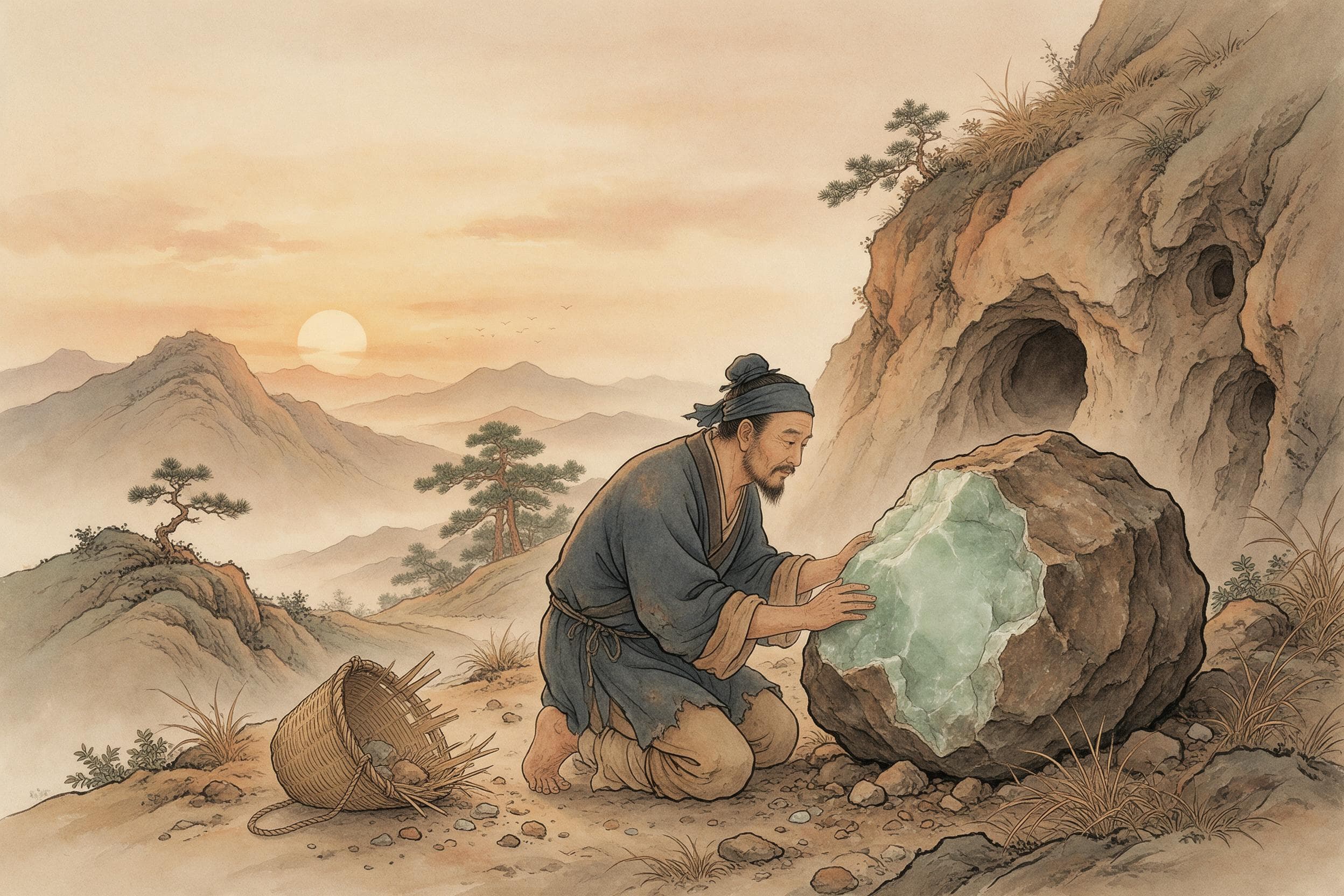
Its first appearance is three words: 'It is a stone.' The story opens: 'A man of Chu, He, got a jade in the rough in the Chu mountains and presented it to King Li. King Li had the jade-cutter look at it. The jade-cutter said: It is a stone. The king took He for a deceiver and cut off his left foot' (楚人和氏得玉璞楚山中……而刖其左足). One unopened stone, one craftsman's verdict, one left foot. This piece follows the jade through three appearances in texts; each has its source, and none of them may be strung into one line.
One: Bian He loses both feet
Two presentations, two amputations, in almost identical sentences: 'When King Li died and King Wu came to the throne, He again presented his rough jade to King Wu. King Wu had the jade-cutter look at it; again he said: It is a stone; and the king again took He for a deceiver and cut off his right foot' (又曰:石也。王又以和為誑,而刖其右足). The same verdict, the same treatment, left foot then right. The page does not say who the jade-cutter was, how he judged, or on what ground he said stone, and this piece adds none of it.
The third time is the weeping. 'When King Wu died and King Wen came to the throne, He clasped his rough jade and wept at the foot of the Chu mountains for three days and three nights, until his tears dried and blood came after them' (三日三夜,淚盡而繼之以血). The king heard and sent to ask why he wept so bitterly, since many in the world had been mutilated. He answered: 'I do not grieve for the cutting. I grieve that a precious jade should be labelled a stone, and a true man be named a deceiver' (悲夫寶玉而題之以石,貞士而名之以誑). So the king had the jade-cutter cut and polish the stone, got the treasure, and named it the He family jade (遂命曰和氏之璧).
Two: in Han Feizi it is an argument
This layer must be fixed: in the Han Feizi the story is not a Chu record but the opening of an argument. The moment it ends, Han Fei turns: 'pearls and jade are what a ruler urgently wants… yet even so two feet were cut before the treasure was judged — so hard is the judging of a treasure' (論寶若此其難也). Then he applies it: 'the man who holds the Way is not murdered only because the emperor's rough jade has not yet been presented', citing Wu Qi torn apart in Chu and Lord Shang torn by chariots in Qin. So the Bian He passage is quoted here as a story, and Han Fei's argument is marked as argument, not as Chu history.
Between 'it was named the He family jade' and its appearance in Zhao there is nothing. The Han Feizi page turns to argument and never mentions the jade again; the Shiji has one sentence: 'in the time of King Huiwen of Zhao they got the He family jade of Chu' (趙惠文王時,得楚和氏璧) — one verb, 'got', with no road attached. How it went from Chu to Zhao, through whose hands, or whether it was the same stone Bian He wept over, neither page says. This piece writes: not known, and not supplied.
Three: the debate at the Zhao court
'King Zhao of Qin heard of it and sent a letter offering fifteen cities in exchange for the jade' (原以十五城請易璧). The King of Zhao took counsel with General Lian Po and the great officers: give it and they feared Qin's cities would never come; refuse and they feared Qin's army. The eunuch director Miao Xian recommended Lin Xiangru, whose reading was that Qin was strong and Zhao weak, so it could not be refused; and when the king asked what if Qin took the jade and gave no cities, Xiangru answered that then the fault would be Qin's. Then the undertaking: 'If the king has no one else, I ask to carry the jade as envoy. If the cities enter Zhao, the jade stays in Qin; if not, I ask to return the jade whole to Zhao' (城入趙而璧留秦;城不入,臣請完璧歸趙).
Four: at the Zhang terrace
The presentation is all movement: 'King Zhao of Qin sat at the Zhang terrace to receive Xiangru; Xiangru presented the jade. The king was delighted, passed it to the beauties and those about him, and they all shouted ten thousand years.' Seeing that Qin had no intention of paying, Xiangru stepped forward: 'The jade has a flaw; let me point it out.' The king handed it over; Xiangru 'held the jade, stepped back and stood leaning against a pillar, his hair bristling with anger under his cap', and said that the King of Zhao had fasted five days and sent the jade with respect, while Qin received him with scant courtesy and passed the jade to beauties to make sport of him — 'I saw that Your Majesty had no mind to repay Zhao's cities, and so I took the jade back. If Your Majesty presses me, my head will be smashed with the jade against this pillar' (臣頭今與璧倶碎於柱矣). Then 'he held the jade and eyed the pillar, as if to strike it'.
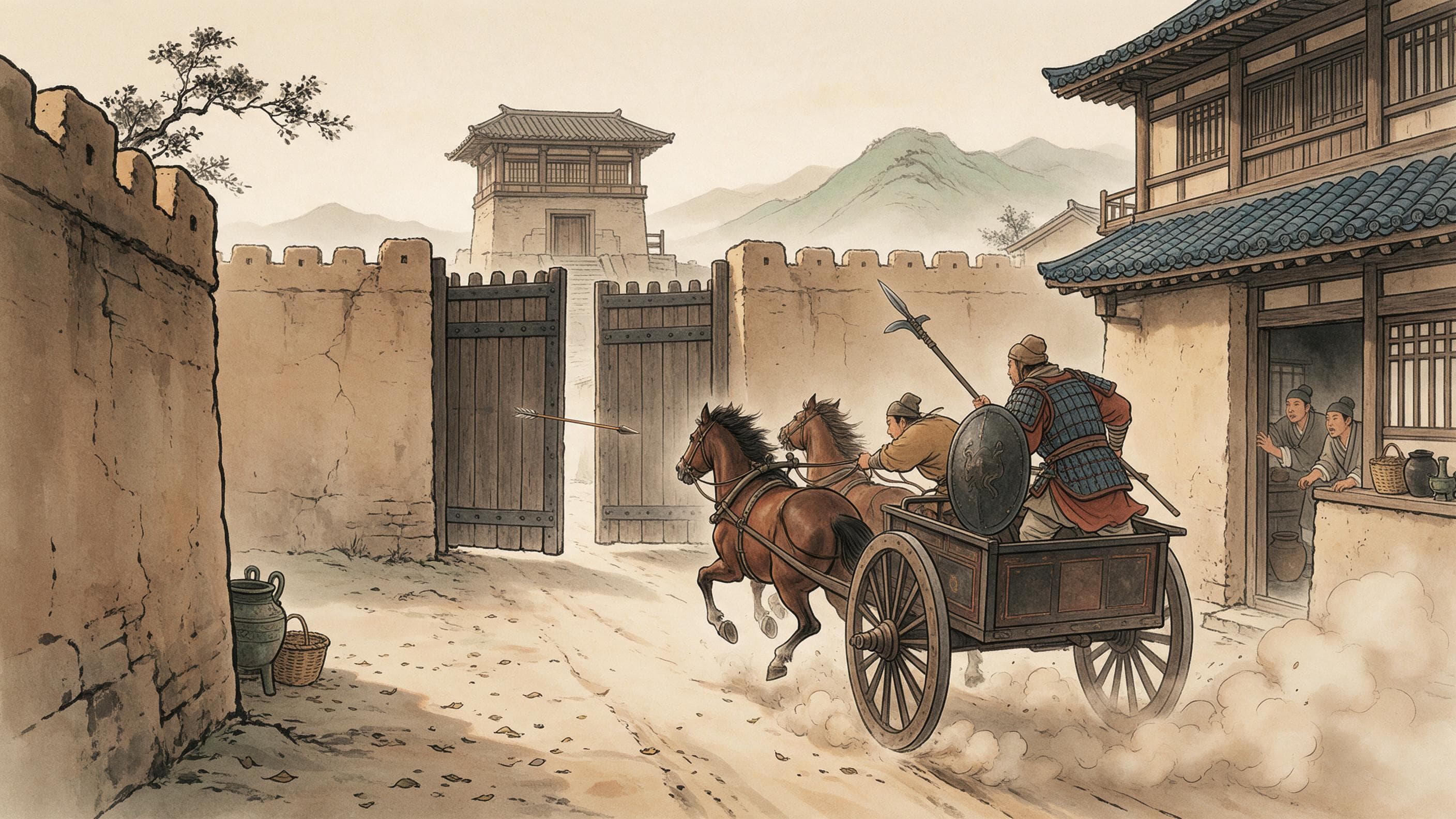
Qin's king, afraid the jade would break, apologized and pressed him, called the officials to bring the map, and 'pointed out that from here onward fifteen cities were granted to Zhao'. Xiangru judged it a sham, and set a condition: the jade is 'a treasure handed down by all under Heaven', and since the King of Zhao fasted five days, 'let Your Majesty also fast five days and set out nine guests in the court, and then I shall dare to present it'. The king agreed and lodged him at the Guangcheng hostel; Xiangru 'sent his follower in coarse clothes to carry the jade in his breast, and it went out by a side road and returned the jade to Zhao' (懷其璧,從徑道亡,歸璧於趙).
The ending is copied too: after the five days and the nine guests, Xiangru said that 'from Duke Mu of Qin onward, through more than twenty rulers, none has kept a firm and clear covenant', that the jade was already back in Zhao, and 'I ask to be sent to the boiling cauldron'. The king and his ministers 'looked at one another and laughed'; the king said killing him would not get the jade, so 'in the end he received him in court, completed the ceremonies and sent him home'. The last line gives the outcome: 'Qin never gave the cities to Zhao, and Zhao never gave the jade to Qin' (秦亦不以城予趙,趙亦終不予秦璧).
Five: three appearances, not one history
The two pages are not one thing. The Han Feizi chapter is a Warring States argument that opens with a parable: Bian He's presentations, mutilations, weeping, and the cutting of the stone all serve to prove how hard it is to judge a treasure. The Shiji chapter is a Han history's narrative: Qin and Zhao contend over a jade called the He jade, and Lin Xiangru sends it home. What the pages share is a name and the word Chu — the Shiji says Zhao 'got the He jade of Chu', not that it was the stone Bian He wept over. So this piece keeps three layers apart: Bian He's story (Han Feizi), one sentence about Zhao getting a jade (Shiji), and the contest over fifteen cities (Shiji) — not merged into a history of one stone's travels.
What the pages do not give is listed too: the jade's size, quality and weight — none of it; the fifteen cities are Qin's asking price in an exchange, not a valuation, and this piece converts nothing; the later phrase 'worth a string of cities' is not traced; and no moral is drawn about good faith or diplomatic cleverness. The jade-pendant pieces here are about the etiquette worn on the body, the cauldron piece about bronze — this one is only about what a stone is called in a few texts: first 'a stone', then 'a treasure handed down by all under Heaven', and at the end 'Qin never gave the cities to Zhao, and Zhao never gave the jade to Qin'.
Related reading:The Steward: A Great House's Private Court Turns on Its Lord · The Music Bureau: A Staff List of 829, and 441 Dismissals · Tiger Tallies: Half in the King's Hand, Half in the General's
Sources & further reading
- 《韩非子·和氏》(维基文库本,未与点校本复核) — The whole of the Bian He story in one paragraph: 'a man of Chu, He, got a jade in the rough in the Chu mountains and presented it to King Li. King Li had the jade-cutter look at it; the jade-cutter said: It is a stone. The king took He for a deceiver and cut off his left foot. When King Li died and King Wu came to the throne, He again presented the rough jade; the jade-cutter again said: It is a stone; and his right foot was cut off. When King Wu died and King Wen came to the throne, He clasped the rough jade and wept at the foot of the Chu mountains for three days and three nights, until his tears dried and blood came after them' (楚人和氏得玉璞楚山中……泣盡而繼之以血); the king's question and He's answer ('I do not grieve for the cutting — I grieve that a precious jade is labelled a stone, and a true man is called a deceiver'); and the ending, 'the king had the jade-cutter cut and polish the rough stone and got the treasure from it, and it was named the He family jade' (王乃使玉人理其璞而得寶焉,遂命曰和氏之璧). The rest of the chapter is Han Fei's argument — that a treasure is only judged after two feet are cut, and that men of law and method fare likewise, with Wu Qi and Lord Shang as examples — and that argument is marked as argument here, not as Chu history.
- 《史记》卷八十一〈廉颇蔺相如列传〉(维基文库本,未与点校本复核) — The Qin-Zhao episode, used as a separate layer: 'in the time of King Huiwen of Zhao they got the He family jade of Chu. King Zhao of Qin heard of it and sent a letter offering fifteen cities in exchange' (趙惠文王時,得楚和氏璧……原以十五城請易璧); Lin Xiangru's undertaking, 'if the cities enter Zhao the jade stays in Qin; if not, I ask to return the jade whole to Zhao' (城入趙而璧留秦;城不入,臣請完璧歸趙); the audience at the Zhang terrace, the jade passed round to the beauties, 'the jade has a flaw — let me point it out to Your Majesty', the retreat to the pillar with hair bristling, 'my head will be smashed with the jade against this pillar' (臣頭今與璧倶碎於柱矣), the demand for five days' fasting and nine guests in the court, the servant in coarse clothes carrying the jade home by a side road (使其從者衣褐,懷其璧,從徑道亡,歸璧於趙), and the close, 'Qin never gave the cities to Zhao, and Zhao never gave the jade to Qin' (秦亦不以城予趙,趙亦終不予秦璧). The page marks variant characters with editorial -{…}- brackets (於, 舍, 復, 髮), which are transcription marks and are not quoted.