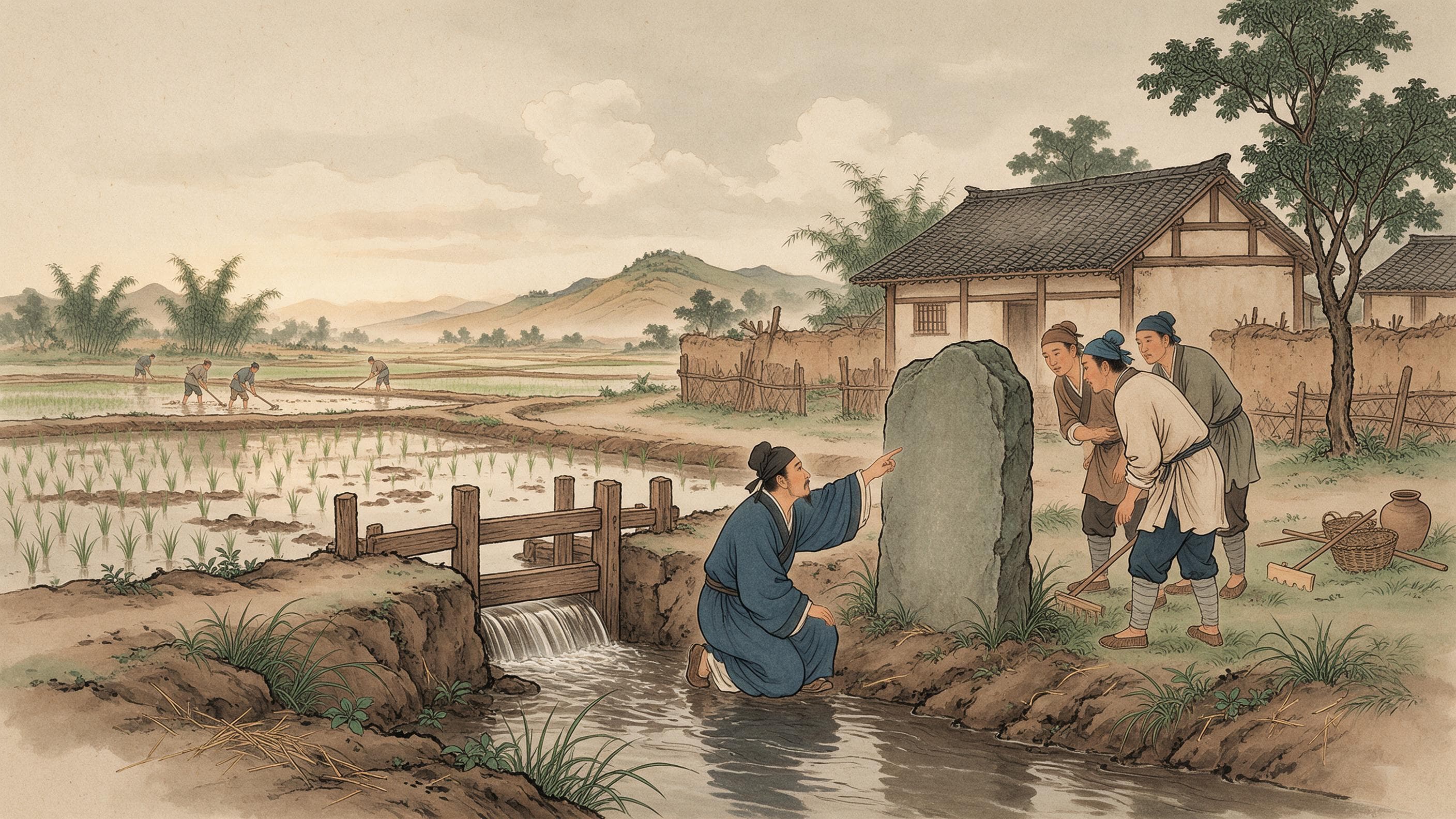
In the tenth month of the eighth year of Duke Ding of Lu, the steward of the Ji family planned to kill his own lord at a feast. The steward was Yang Hu (陽虎); the Ji were one of the three great houses, and the government of Lu had long been in their hands. The Zuo Tradition gives that day in extraordinary detail — names, the sexagenary days, the order of the carriages, the words spoken inside a moving cart — while the Shiji's life of the dukes of Lu covers the same events in five or six sentences. This article uses both: the Zuo Tradition for the day, the Shiji for the frame, and where they differ, both readings stand. The word 家臣 (jiachen), for a great house's private officers, is defined on neither page. That a steward of the Ji could be said to 'administer' Lu is something the pages show; they do not explain it as a system.
The Government in the Ji Family
When Duke Ding came to the throne, Zhao Jianzi asked the historian Shi Mo whether the Ji would perish. 史墨對曰:「不亡。季友有大功於魯,受鄪爲上卿,至於文子、武子,世增其業。魯文公卒,東門遂殺適立庶,魯君於是失國政。政在季氏,於今四君矣。民不知君,何以得國!」 They would not perish: Ji You had done great service to Lu, the family's estate had grown through the generations, and ever since the rightful heir was killed under Duke Wen the ruler of Lu had lost the government — it had been in the Ji for four reigns now, and a people who do not know their lord, how should he hold the state? The passage ends 是以爲君慎器與名,不可以假人: a ruler is careful with emblems and names and does not lend them out. The question comes from a stranger; the answer is a verdict on Lu.
The Shiji gives Yang Hu four entries. Duke Ding's fifth year: 季平子卒。陽虎私怒,囚季桓子,與盟,乃捨之 — on Ji Pingzi's death Yang Hu, in private anger, imprisoned Ji Huanzi, made a covenant with him and let him go. The covenant's content is not described here, and this article uses the sentence only as background. Seventh year: 齊伐我,取鄆,以爲魯陽虎邑以從政 — Qi attacked Lu, took Yun, and it was made Yang Hu's town, from which he took part in government; the Zuo Tradition for the same year says 陽虎居之以為政, 'Yang Hu dwelt there and administered'. A steward with a town and a share of government: the ground the eighth year starts from.
Five Men, Three Seats
The Zuo Tradition first lists the company by their grievances: 季寤、公鉏極、公山不狃皆不得志於季氏,叔孫輒無寵於叔孫氏,叔仲志不得志於魯,故五人因陽虎 — three who had got nowhere in the Ji family, one out of favour with the Shusun, one who had got nowhere in Lu; the five attached themselves to Yang Hu. Then the plan: 陽虎欲去三桓,以季寤更季氏,以叔孫輒更叔孫氏,己更孟氏 — he wished to remove the three houses and replace the Ji with Ji Wu, the Shusun with Shusun Zhe, and the Meng with himself. The sentence is about persons, not institutions: the houses stay, their heads are exchanged. That 己更孟氏 means Yang Hu takes the Meng for himself is the ordinary reading, 一般认为, since the page gives the phrase and no gloss.
The Shiji summarizes the same design differently: 陽虎欲盡殺三桓適,而更立其所善庶子以代之 — he wished to kill all the legitimate heirs of the three houses and put in their places sons of his own choosing. The two accounts are set side by side: one names the replacements, the other says only 'sons he favoured'. Neither is made to correct the other.
Xinmao, Renchen, Guisi
The attempt is dated by three sexagenary days, printed as they stand: 冬十月,順祀先公而祈焉。辛卯,禘於僖公。壬辰,將享季氏於蒲圃而殺之,戒都車曰:「癸巳至」 — in the tenth month he sacrificed to the former dukes in order and prayed; on the xinmao day came the di sacrifice at Duke Xi's temple; on the renchen day he would feast the Ji lord at Puqu and kill him; and he ordered the capital's chariots to arrive on the guisi day. Sacrifice, killing, troops: three steps, three days. The days are not converted here.
The order gave him away. 成宰公斂處父告孟孫曰:「季氏戒都車,何故?」孟孫曰:「吾弗聞。」處父曰:「然則亂也,必及於子,先備諸。」與孟孫以壬辰為期 — the steward of Cheng, Gonglian Chufu, asked the Meng lord why the Ji were calling out the chariots; the Meng lord said he had heard nothing; then it is disorder, said Chufu, and it will reach you, so prepare — and they fixed on the renchen day. That renchen falls one day before Yang Hu's guisi is an inference (據推測): the text only sets the two days side by side and never says 'a day early'.
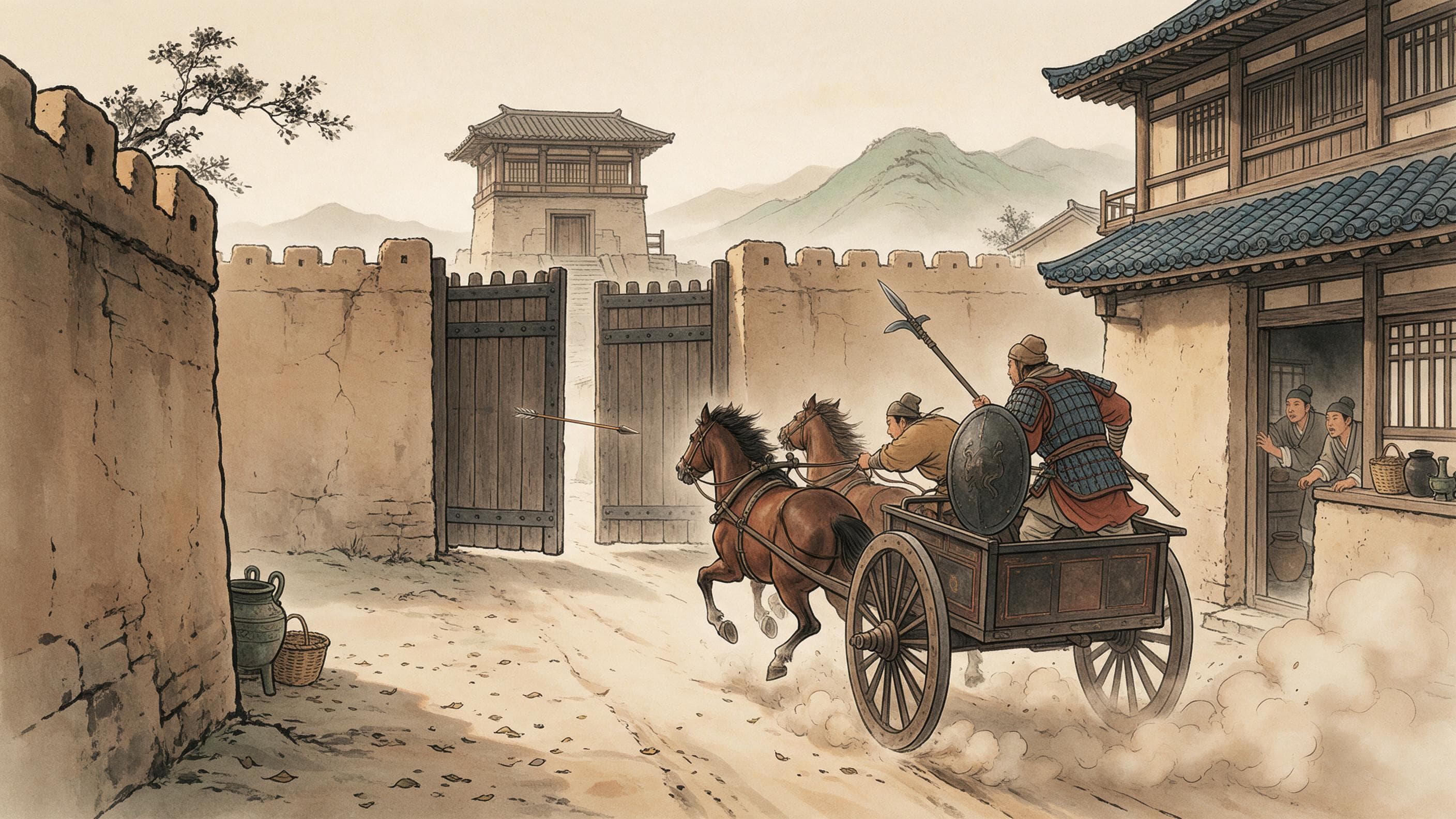
The carriage order is given before anything happens: 陽虎前驅,林楚御桓子,虞人以鈹盾夾之,陽越殿,將如蒲圃 — Yang Hu rode in front, Lin Chu drove Huanzi, foresters flanked him with halberds and shields, Yang Yue brought up the rear; they set out for Puqu. On the Meng side, 孟氏選圉人之壯者三百人,以為公期築室於門外 — three hundred strong men were picked from among the grooms and set to build a house outside the gate. 圉人 is generally taken as grooms or stable hands (一般认为); the page gives the word and no note.
Words in the Cart
On the road there is an exchange, as the page has it: 桓子咋謂林楚曰:「而先皆季氏之良也,爾以是繼之。」對曰:「臣聞命後。陽虎為政,魯國服焉,違之徵死,死無益於主。」桓子曰:「何後之有?而能以我適孟氏乎?」對曰:「不敢愛死,懼不免主。」桓子曰:「往也。」 Huanzi said: your forebears were all good men of the Ji, and you have succeeded them. Lin Chu: I heard my lord's command late; Yang Hu is in power and Lu obeys him, and to disobey is to invite death, and death would do my lord no good. Huanzi: what do you mean, late — can you get me to the Meng? Lin Chu: I do not grudge death; I am afraid of failing my lord. Huanzi: go, then. The day turns inside those few lines.
The escape takes three clauses: 林楚怒,馬及衢而騁,陽越射之不中。築者闔門。有自門間射陽越,殺之 — Lin Chu whipped up, and once the horses reached the open road he galloped; Yang Yue shot and missed; the builders shut the gate; and someone shot Yang Yue from between the gate leaves and killed him. A cart, a missed arrow, a gate: the plot is over.
Street Fighting, the Treasures, and the Road Out
Then the fighting: 陽虎劫公與武叔以伐孟氏,公斂處父帥成人,自上東門入,與陽氏戰於南門之內,弗勝。又戰於棘下,陽氏敗 — Yang Hu seized the duke and Wushu and attacked the Meng; Gonglian Chufu led the men of Cheng in through the eastern gate, fought Yang's men inside the south gate without winning, fought again at Jixia, and Yang's men broke. Then the treasures: 陽氏說甲如公宮,取寶玉大弓以出,舍於五父之衢,寢而為食 — they took off their armour (說甲, to unharness it), went into the ducal palace, brought out the treasures and the great bow, camped at the Wufu crossroads, lay down and ate. The 'classic' entry for the season records only 盜竊寶玉大弓, 'a thief stole the treasures and the great bow'; the narrative names the house. At the end, the boast and its correction: his followers said the pursuit would come, and 虎曰:「魯人聞余出,喜於徵死,何暇追余?」 — when the men of Lu hear I have gone out, they will be glad to have escaped death, and who will have time to chase me? 從者曰:「嘻,速駕,公斂陽在。」
The Zuo Tradition then takes him out of Lu: 陽虎入於讙、陽關以叛 — he entered Huan and Yangguan and held them in rebellion. In the ninth year 陽虎歸寶玉大弓, and the 'classic' notes 書曰得,器用也, they were recovered, a thing of use. When Yangguan was attacked he had the Lai gate burned, 師驚,犯之而出,奔齊 — the army was thrown into confusion, he broke out and fled to Qi — where he asked for an army against Lu and said 三加必取之, 'strike three times and it is certainly taken'; the duke of Qi was on the point of agreeing and Bao Wenzi talked him out of it. 齊侯執陽虎: the duke seized him, and he escaped twice in a covered cart (載蔥靈), then 奔宋,遂奔晉,適趙氏 — to Song, and then to Jin, to the Zhao clan. The Shiji ends the same business in one clause: 九年,魯伐陽虎,陽虎奔齊,已而奔晉趙氏. The Zuo Tradition closes with a saying of Confucius: 趙氏其世有亂乎 — the Zhao will have disorder in their generations. Of Yang Hu in Jin the two pages have only 適趙氏, and nothing is added here.
Related reading:The Music Bureau: A Staff List of 829, and 441 Dismissals · Tiger Tallies: Half in the King's Hand, Half in the General's · Forging Coins: One Death Sentence and Hundreds of Thousands Convicted
Sources & further reading
- 《春秋左氏传·定公》(定公五年、七年、八年、九年传;维基文库本,页面白文无注,未与中华书局点校本复核) — The Zuo Tradition for Duke Ding of Lu. Fifth year: Yang Hu imprisons Ji Huanzi. Seventh year: Yang Hu dwells at Yun and 'administers' from it. Eighth year, the core of this article: five men who had got nowhere attach themselves to Yang Hu, who plans to replace the heads of the three great houses — Ji Wu for the Ji, Shusun Zhe for the Shusun, himself for the Meng; after sacrifices on xinmao and renchen he means to feast and kill the Ji lord at Puqu, ordering the capital's chariots for the guisi day, but the steward of Cheng warns the Meng and they fix on renchen; the carriage order, the exchange between Huanzi and his driver Lin Chu, the Meng's three hundred grooms building outside the gate, the gallop, the missed shot, the shutting gate and the arrow from between its leaves; fighting inside the south gate and at Jixia; the taking of the treasures and the great bow; his boast and his follower's correction; his rebellion at Huan and Yangguan. Ninth year: the treasures returned, Yangguan attacked, his flight to Qi, the twice-used covered cart, and his passage to Song and then to the Zhao clan in Jin.
- 《史记》卷三十三·鲁周公世家(西汉司马迁撰;维基文库本,页面白文无注,未与中华书局点校本复核) — Sima Qian's brief account, used for the frame. When Duke Ding came to the throne, Shi Mo tells Zhao Jianzi that the Ji will not perish: Ji You had done great service, the family's estate grew through generations, and since the killing of the rightful heir under Duke Wen the ruler of Lu had lost the government — 'the government is in the Ji, four rulers now; the people do not know their lord, how should he hold the state?', ending that a ruler is careful with emblems and names and does not lend them out. Then four entries: in Duke Ding's fifth year Yang Hu, in private anger, imprisons Ji Huanzi and makes a covenant before releasing him; in the seventh year Qi takes Yun and it is made Yang Hu's town, from which he takes part in government; in the eighth year he wishes to kill all the legitimate heirs of the three houses and replace them with sons he favours, and when Huanzi escapes by a ruse the three houses attack him and he holds Yangguan; in the ninth year Lu attacks him, and he flees to Qi and then to the Zhao clan in Jin.