A memorial, a list, a total. At the end of the roll: 'in all 829 persons, of whom 388 may not be dismissed but may be attached to the Grand Music Office, and 441, not conforming to the classics or being Zheng and Wei music, may all be dismissed' (大凡八百二十九人,其三百八十八人不可罷……皆可罷). This piece is built around that sentence. And the first caution must be stated at once: 829 is a count made by going through the categories of musicians in one office and adding them up — a count of establishment, not the number of musicians then living in the empire, and not a count of who was actually on duty.
One: the office is older than the expansion
Office first, expansion second. 'At the time of the Founder, Shusun Tong made the ancestral-temple music out of the musicians of Qin' (叔孫通因秦樂人制宗廟樂); 'there was also the chamber sacrifice music, made by the Founder's Lady Tangshan' (房中祠樂,高祖唐山夫人所作也); and 'in the second year of Emperor Hui, the Director of Music Xiahou Kuan was made to prepare its pipes and flutes, and it was renamed the Anshi music' (孝惠二年,使樂府令夏侯寬備其簫管,更名曰安世樂). A Director of Music is already there in the early Han. The page does not say when the bureau was founded, and this piece does not use the later common statement that Emperor Wu founded it.
By the later reigns it was large, and the treatise is not complimentary. 'Within were the talented women of the side courts, without was the Music Bureau at Shanglin, and both spread Zheng music through the court' (內有掖庭材人,外有上林樂府,皆以鄭聲施於朝廷). 'At this time Zheng music was especially strong; the famous singers of the Yellow Gate, Bing Qiang and Jing Wu and their kind, were rich and prominent in the world; the households of the five marquises and of the Fuping consort clan were so extravagant that they even contended with the sovereign for female musicians' (至與人主爭女樂). The refined music offered by the Prince of Hejian was kept only 'to make up the numbers at the seasonal occasions; it was not regularly used, and what was regularly used, and used at the suburban and ancestral sacrifices, was not the refined sound' (歲時以備數,然不常御).
Two: nineteen songs, nineteen titles
What the bureau sang is given as a list: 'the suburban sacrifice songs, nineteen chapters' (郊祀歌十九章). The titles are counted off one by one — Lian shi ri, Di lin, Qing yang, Zhu ming, Xi hao, Xuan ming, Wei tai yuan, Tian di, Ri chu ru, Tian ma, Tian men, Jing xing, Qi fang, Hou huang, Hua ye ye, Wu shen, Chao long shou, Xiang zai yu, Chi jiao. Nineteen titles, like a programme. The page gives the words of the songs and no notation; this piece lists the titles and translates none of them.
Three: the edict
The man who acted was Emperor Ai: 'who had hated this since he was Prince of Dingtao and had no love of music, and on coming to the throne issued an edict: The world is extravagant and clever in ornament, and the music of Zheng and Wei has risen… If you want the common people honest and each household provided, it is like muddying the source and seeking a clear stream' (惟世俗奢泰文巧……猶濁其源而求其清流). Then the order: 'let the Music Bureau officials be abolished. The suburban sacrifice music and the ancient military music which are in the classics and are not Zheng or Wei music, let them be itemised and reported, and attached to other offices' (其罷樂府官……別屬他官). This is not a clean sweep: the office is dissolved, and its music is divided out.
Four: the list, item by item
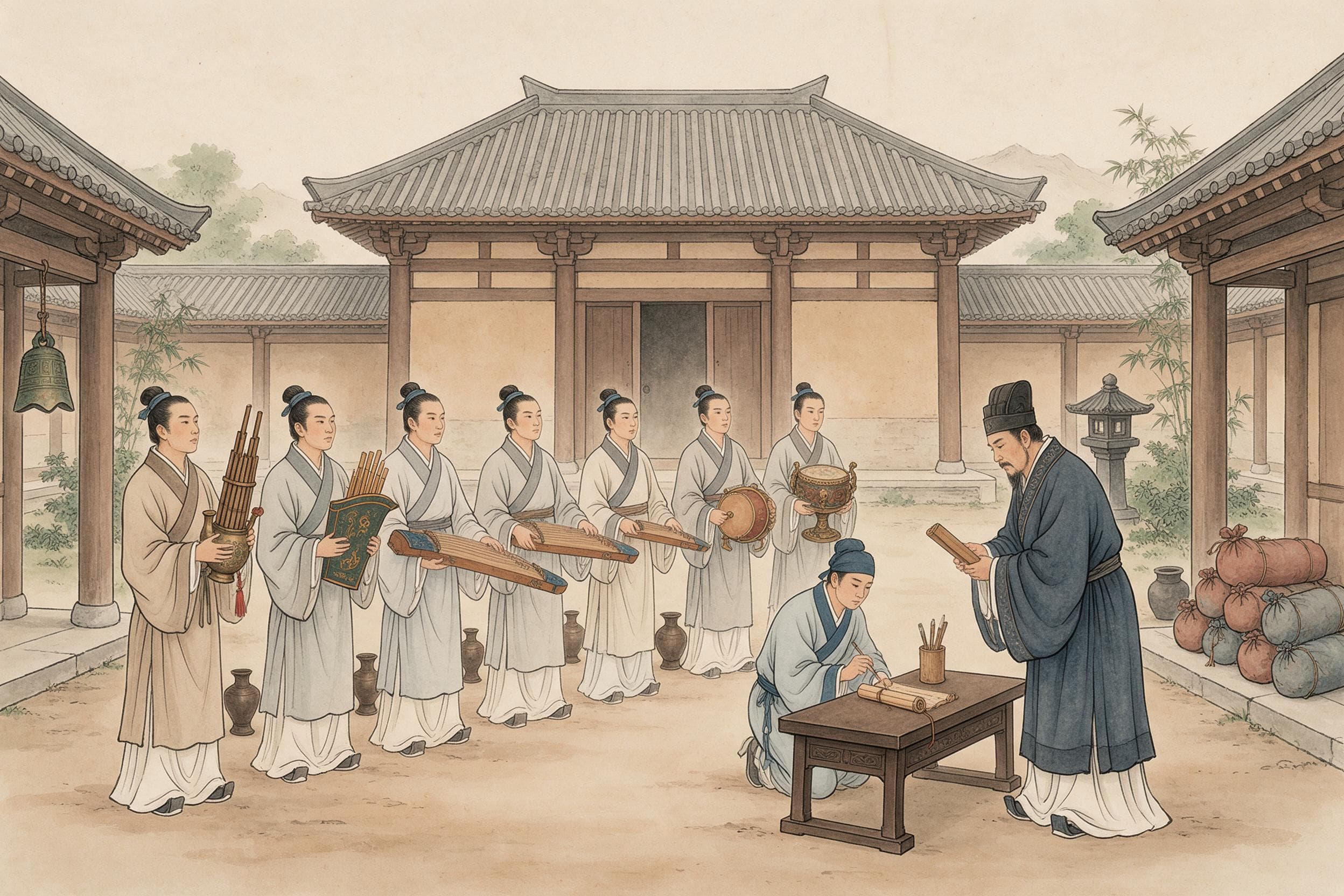
Chancellor Kong Guang and Grand Minister He Wu then went through the staff, category by category, each with its number and its verdict. Kept: 'suburban sacrifice musicians, sixty-two, to serve the sacrifices to Heaven and Earth in the southern and northern suburbs'; twelve kinds of drummers — Da Yue six, Jia Zhi ten, Handan two, cavalry wind three, Jiangnan two, Huainan four, Bayu thirty-six, song-drum twenty-four, Chu yan one, Liang huang four, Linhuai thirty-five, Zifang three — 'in all twelve kinds of drum, one hundred and twenty-eight men, ranged below the hall at court congratulations and wine-feasts, answering the ancient military music'; thirteen outer suburban musicians; sixty-seven of the clan musicians for the southern suburb; four for refined music; five night-chanters; and 'two supervisors to lead the musicians — none of these may be dismissed'.
Then the dismissals, each with its figure. 'Zheng four-ensemble members, sixty-two: one is employed in refined music, sixty-one may be dismissed' (鄭四會員六十二人,一人給事雅樂,六十一人可罷) — the sharpest line on the roll. 'Zhang-se players eight, seven may be dismissed'; 'Anshi music drummers twenty, nineteen may be dismissed'; eight more kinds of drum, one hundred and twenty-eight men, 'not answering the classics'; and a run of ensembles — Chu, Ba, Yao and Qi four-ensembles, Cai and Qi singers, pipe-and-zither players — 'all Zheng music, may be dismissed'. Last: 'students of music, one hundred and forty-two: seventy-two are set to brew mare's-milk wine for the imperial provisioner, seventy may be dismissed' (師學百四十二人,其七十二人給大官挏馬酒,其七十人可罷).
Then the total: 829, 388 kept, 441 dismissed, added up in the text itself. Three numbers, and this piece does no arithmetic with them — no proportion, no cost, no share of anything. The caution stands: this is what two ministers counted in one office's categories, not a census of musicians.
Five: after the dismissals
The result is one sentence: 'The memorial was approved. But the common people had been steeped in it a long time, and no refined music was made to change them; the rich and the officials went soaking on as before, and it decayed down to Wang Mang' (奏可。然百姓漸漬日久,又不制雅樂有以相變,豪富吏民湛沔自若,陵夷壞于王莽). So the dismissal did not end the music: it removed the office and the staff, and left the listeners.
Two sentences from elsewhere, both marked. The Shiji's Book of Music — generally regarded as a later reconstruction, not Sima Qian's own text — says that under Emperors Hui, Wen and Jing nothing was added or changed and 'in the Music Bureau they merely practised the old routines' (於樂府習常肄舊而已), which agrees that the office is early; and that 'when the present emperor came to the throne he made the nineteen chapters and had the palace attendant Li Yannian arrange their sound, appointing him Chief Commandant for the Harmonising of Pitch'. That is another page's sentence, cited as such. And the division of subjects: the piece on this site about the suburban sacrifice is about where and with what the emperor sacrificed; this one is about an office's staff and one reduction of it.
What the pages do not give: what the musicians were paid, what the instruments cost, where and on what occasions they played beyond the few phrases quoted, any notation for the nineteen songs, any programme of a feast. None of it is supplied. Nor does this piece argue that Han music flourished, compare with the Tang teaching court or later bureaus, or convert a reign year into a Western date. What is left is an edict, a list read out item by item, three numbers, and one sentence on what happened afterwards.
Related reading:Tiger Tallies: Half in the King's Hand, Half in the General's · Forging Coins: One Death Sentence and Hundreds of Thousands Convicted · The Announcement to Kang: Governing a Place Just Conquered
Sources & further reading
- 《汉书》卷二十二〈礼乐志〉(维基文库本,未与点校本复核) — The treatise on rites and music, source of the whole staff list. Early Han: 'at the time of the Founder, Shusun Tong made the ancestral-temple music out of the musicians of Qin' (叔孫通因秦樂人制宗廟樂); 'in the second year of Emperor Hui, the Director of Music Xiahou Kuan was made to prepare its pipes and flutes, and it was renamed the Anshi music' (孝惠二年,使樂府令夏侯寬備其簫管,更名曰安世樂); later 'within were the talented women of the side courts, without was the Music Bureau at Shanglin, and both spread Zheng music through the court' (內有掖庭材人,外有上林樂府,皆以鄭聲施於朝廷). It lists the nineteen suburban songs by title, gives Emperor Ai's edict ('let the Music Bureau officials be abolished… the suburban and ancient military music which are in the classics… let them be itemised and attached to other offices' 其罷樂府官……別屬他官), and prints the memorial of Chancellor Kong Guang and Grand Minister He Wu item by item, ending 'in all 829 persons, of whom 388 may not be dismissed… and 441… may all be dismissed' (大凡八百二十九人……皆可罷), followed by 'the memorial was approved. But the common people had been steeped in it a long time… and it decayed down to Wang Mang' (陵夷壞于王莽). The page is plain text without Yan Shigu's commentary; its Western dates in brackets are the transcribers' additions and are not quoted.
- 《史记》卷二十四〈乐书〉(维基文库本,未与点校本复核) — Used for two sentences only, and marked: 'under Hui, Wen and Jing nothing was added or changed; in the Music Bureau they merely practised the old routines' (孝惠、孝文、孝景無所增更,於樂府習常肄舊而已), which agrees that the office is early; and 'when the present emperor came to the throne he made the nineteen chapters and had the palace attendant Li Yannian arrange their sound, appointing him Chief Commandant for the Harmonising of Pitch' (作十九章,令侍中李延年次序其聲). This chapter is generally regarded as a later reconstruction rather than Sima Qian's own text, so it is cited as 'the Shiji's Book of Music', not as Sima Qian's words.