Start with the sentence where the fighting stops: 'Han also withdrew its troops, and sent Liu Jing to conclude the treaty of heqin' (使劉敬結和親之約). The army goes home and a contract takes its place. This piece writes only that contract's documents and its annual presents: three things (a clan daughter, the yearly tribute, a pact of brothers) and a handful of letters, with the numbers they give and the numbers they withhold.
One: a daughter, a tribute, and brothers
Both histories give the terms, in different words. The Shiji: 'the Founder sent Liu Jing to present a daughter of the imperial clan as princess to be the Shanyu's wife, and every year to present the Xiongnu fixed amounts of floss silk, patterned silk, wine, grain and food, agreeing to be brothers in heqin, and Maodun slackened' (歲奉匈奴絮繒酒米食物各有數). The Han treatise: 'a daughter of the imperial clan, a wengzhu, as the Shanyu's wife, with fixed annual presents of floss silk, patterned silk, wine and food, agreeing to be brothers in heqin' (奉宗室女翁主為單于閼氏,歲奉匈奴絮繒酒食物各有數). Princess or wengzhu, brothers twice over, wine-grain-food or wine-food: three variants, side by side, not harmonised. The key words are 'fixed amounts': the tribute has floss silk, patterned silk, wine and grain, and neither page gives a figure.
And keep track of who says the word. 'Heqin' is the Han court's word; the Xiongnu letters use others — 'restore the old agreement', 'matching the letter's intent' — and those are quoted in their place below. This piece does not use one side's vocabulary to define the other.
Two: Maodun's letter and the Empress's reply
After the Founder died, Maodun wrote. The Shiji gives only the fact — 'Maodun made a letter and sent it to Empress Gao, with outrageous words' (妄言) — and no text; the Han treatise gives the text: 'a lone and uncouth ruler, born in the marshes, grown in the wilds of cattle and horses… Your Majesty stands alone; I, uncouth, live alone. Two rulers with no joy: let us exchange what we have for what we lack' (孤僨之君……願以所有,易其所無). 'Outrageous words' is the treatise's comment, marked as comment here.
Empress Gao was furious and would have beheaded the envoy. Fan Kuai offered a hundred thousand men to ride roughshod through the Xiongnu; Jibu said he should be beheaded, and produced Pingcheng: the Han army was three hundred and twenty thousand with Fan Kuai its general, and he could not break the siege. The world sang: 'below Pingcheng it was truly bitter; for seven days we did not eat, we could not draw the crossbow.' The singing has not stopped and the wounded are only now rising, and he would shake the world with a boast. And: 'the Yi and Di are like birds and beasts: their good words are not worth rejoicing at, their bad words not worth anger.' The empress said: 'Good.'
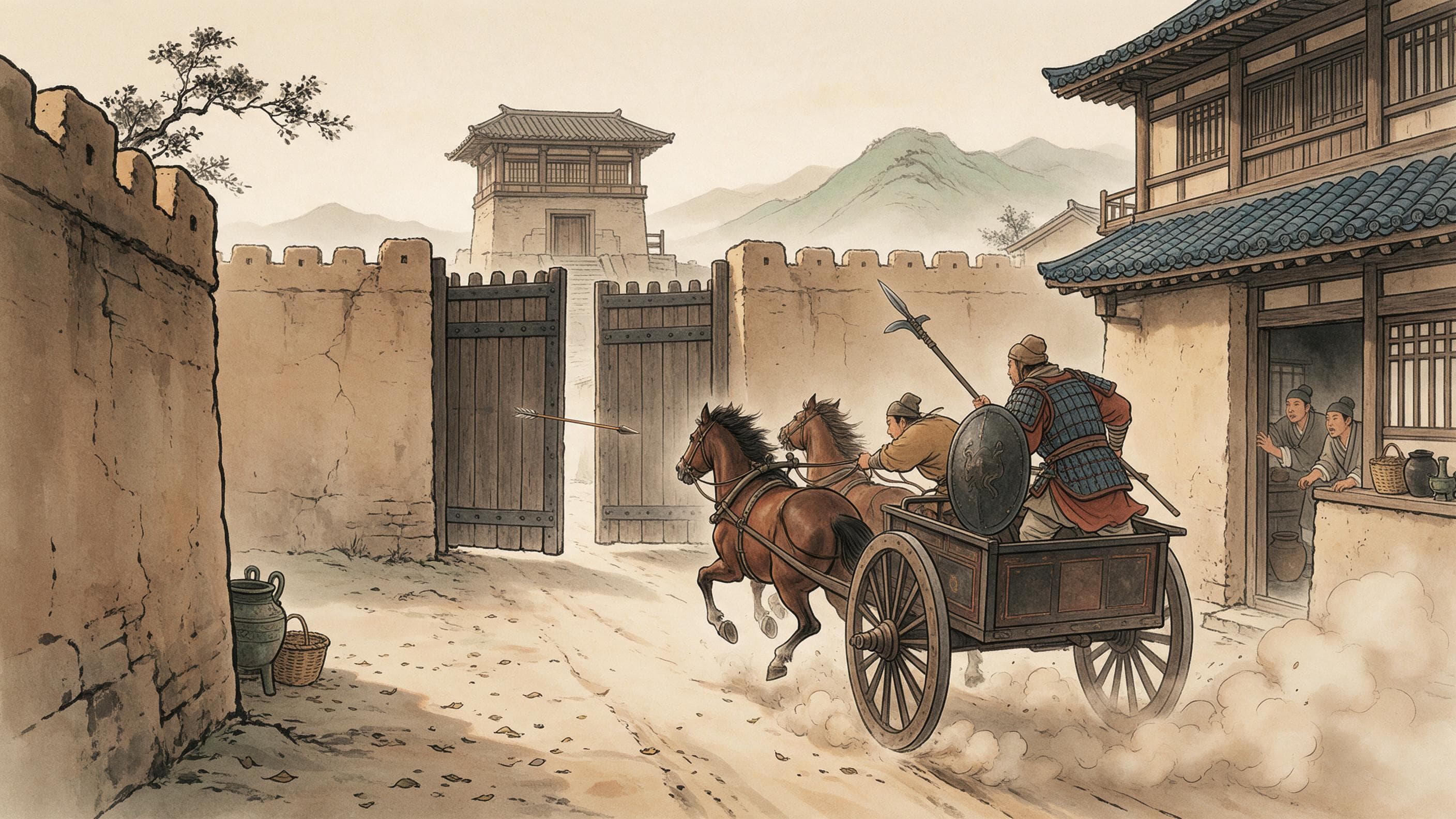
The reply is quoted in full: 'The Shanyu has not forgotten our poor domain and has sent a letter; our poor domain is frightened… we are old, the breath failing, hair and teeth falling out, the step unsteady; the Shanyu has listened too much. Our poor domain is without offence and should be pardoned. Privately we have two carriages and two teams of four horses, to serve your usual driving' (竊有御車二乘,馬二驷,以奉常駕). Maodun received it, apologized — 'we have never heard of the rites of the Middle Kingdom' — presented horses, 'and so the heqin was made'.
Three: Emperor Wen takes it up again
On Emperor Wen's accession 'the heqin affair was taken up again' (復修和親之事). In the third year the Right Worthy King moved into the lands south of the Yellow River; the edict said Han and the Xiongnu 'agreed to be brothers, not to harm each other's borders, and so what has been sent to the Xiongnu is very generous' (輸遺匈奴甚厚), and an army drove him out. The next year the Shanyu wrote: 'the great Shanyu of the Xiongnu, set up by Heaven, asks after the emperor's health. Formerly the emperor spoke of heqin, and the letter matched the intent… let us set aside what is past and restore the old agreement' (復故約), with a camel, two riding horses and two teams. The court debated 'whether to attack or to keep heqin'; the ministers said 'heqin is very convenient', and Han agreed.
Four: one letter, and its two lengths of board
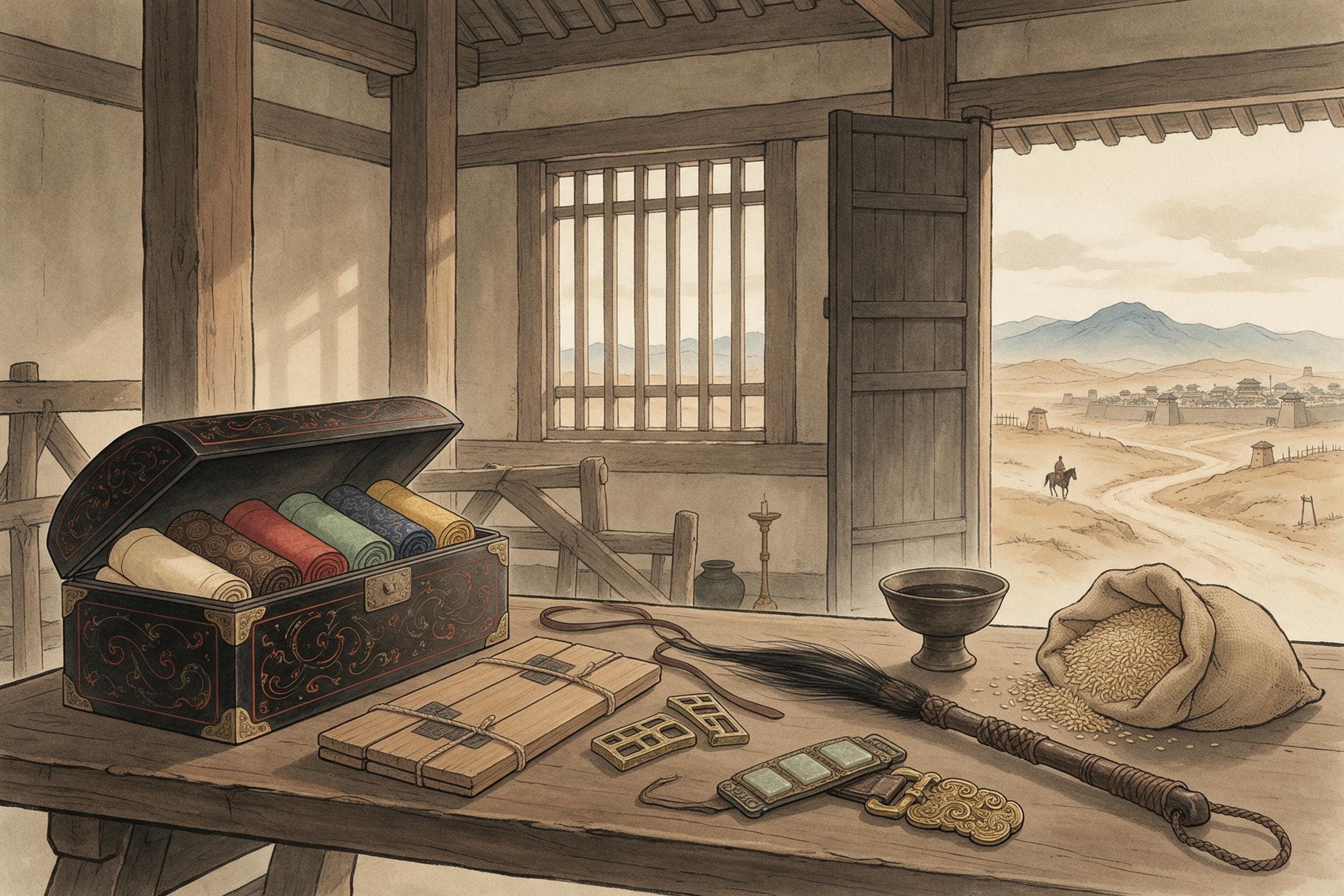
In the sixth year of Emperor Wen, Han sent a letter opening 'the emperor respectfully asks after the health of the great Shanyu' (皇帝敬問匈奴大單于無恙), saying that Han and the Xiongnu agreed to be brothers and what has been sent is very generous, and closing with a gift list: 'one embroidered lined silk robe, one embroidered lined long jacket, one brocade lined robe; one comb; one gold-ornamented belt; one gold buckle; ten bolts of embroidery; thirty bolts of brocade; forty bolts each of red silk and green patterned silk' (繡十匹,錦三十匹,赤綈、綠繒各四十匹). Here are the figures. They are copied; nothing is priced or totalled; and the list is not merged with the annual tribute — that is 'fixed amounts' each year, this is sent once with the letter.
The same passage records a second marriage: when the Laoshang Shanyu came to power, 'Emperor Wen again sent a daughter of the imperial clan as princess, and the eunuch Zhongxing Yue of Yan to tutor her.' Zhongxing Yue went over to the Xiongnu and told the Shanyu: 'the Xiongnu cannot match one commandery of Han in numbers; what makes them strong is that food and clothing are different and they do not depend on Han. Now the Shanyu loves Han goods: Han goods are no more than two tenths of what you have, and the Xiongnu will all be lost to Han. Han silk splits when you ride through thorns; Han food is not as good as mare's milk; throw it away' (得漢繒絮……皆去之). This is a defector speaking, marked as such — but it is the record of how Han silk and food were regarded on the other side.
One more layer is the document itself: 'when Han sent letters to the Shanyu the board was one chi one cun long, and the words were: the emperor respectfully asks after the health of the great Shanyu' (牘以尺一寸). Zhongxing Yue had the Shanyu write on boards one chi two cun, with wide seals, and arrogant wording: 'the great Shanyu of the Xiongnu, born of Heaven and placed by sun and moon, asks after the Han emperor' (尺二寸牍).
Five: who says 'heqin'
The layers must be fixed. The Han court's 'heqin' names a package: a clan daughter as wife, a yearly tribute, a pact of brothers. On the Xiongnu side the words are 'let us exchange what we have for what we lack', and 'formerly the emperor spoke of heqin, and the letter matched the intent', and 'restore the old agreement'. Each side's wording is quoted as it stands, neither merged nor judged: this piece does not decide who was humiliated or who gained. Nor do the pages give the tribute's figures, the princess's name, the size of her escort, how the goods were carried, or whether the payments were ever made on time. None of it is supplied, and no total is computed. What the piece leaves is concrete: one sentence 'concluding the treaty of heqin'; one 'daughter of the imperial clan, a wengzhu'; a yearly tribute said to be 'in fixed amounts' with no amounts; a letter offering 'to exchange what we have for what we lack'; a reply sending 'two carriages and two teams of four horses'; a gift list of ten bolts of embroidery, thirty of brocade, forty each of red silk and green patterned silk; and two lengths of wooden board, one chi one cun and one chi two cun. Names, numbers and units are copied; nothing else is added.
Related reading:The Music Bureau: A Staff List of 829, and 441 Dismissals · The Steward: A Great House's Private Court Turns on Its Lord · Forging Coins: One Death Sentence and Hundreds of Thousands Convicted
Sources & further reading
- 司马迁《史记》卷一百十〈匈奴列传〉(维基文库本,未与点校本复核) — The first agreement and its language: after the siege was lifted, 'Han also withdrew its troops, and sent Liu Jing to conclude the treaty of heqin' (使劉敬結和親之約); then 'the Founder sent Liu Jing to present a daughter of the imperial clan as princess to be the Shanyu's wife, and every year to present the Xiongnu fixed amounts of floss silk, patterned silk, wine, grain and food, agreeing to be brothers in heqin, and Maodun accordingly slackened' (歲奉匈奴絮繒酒米食物各有數,約為昆弟以和親,冒頓乃少止). Later, 'Maodun made a letter and sent it to Empress Gao, with outrageous words' (妄言); 'on Emperor Wen's accession the heqin affair was taken up again' (復修和親之事); and the Shanyu's letter to Emperor Wen: 'formerly the emperor spoke of heqin, and the letter matched the intent and made joy' (前時皇帝言和親事,稱書意,合歡). It also gives the letter Emperor Wen sent in the sixth year with its gift list, and the detail that Han letters were written on boards one foot one inch long while the Shanyu's were made a foot two inches (尺一寸/尺二寸).
- 《汉书》卷九十四上〈匈奴传〉(维基文库本,未与点校本复核) — The parallel account, with its own wording: 'Liu Jing was sent to present a daughter of the imperial clan, a wengzhu, as the Shanyu's wife, with fixed annual presents of floss silk, patterned silk, wine and food, agreeing to be brothers in heqin' (奉宗室女翁主為單于閼氏,歲奉匈奴絮繒酒食物各有數,約為兄弟以和親). It gives Maodun's letter to Empress Gao in full — 'a lone and uncouth ruler, born in the marshes, grown in the wilds of cattle and horses… let us exchange what we have for what we lack' (孤僨之君……願以所有,易其所無) — Empress Gao's council, Fan Kuai's boast of a hundred thousand, Jibu's retort with the soldiers' song 'below Pingcheng it was truly bitter; for seven days we did not eat, we could not draw the crossbow' (平城之下亦誠苦!七日不食,不能彀弩), and Empress Gao's reply with 'two carriages and two teams of four horses to serve your usual driving'. Its numbers for the annual presents are not given either — 'fixed amounts' (各有數) only.