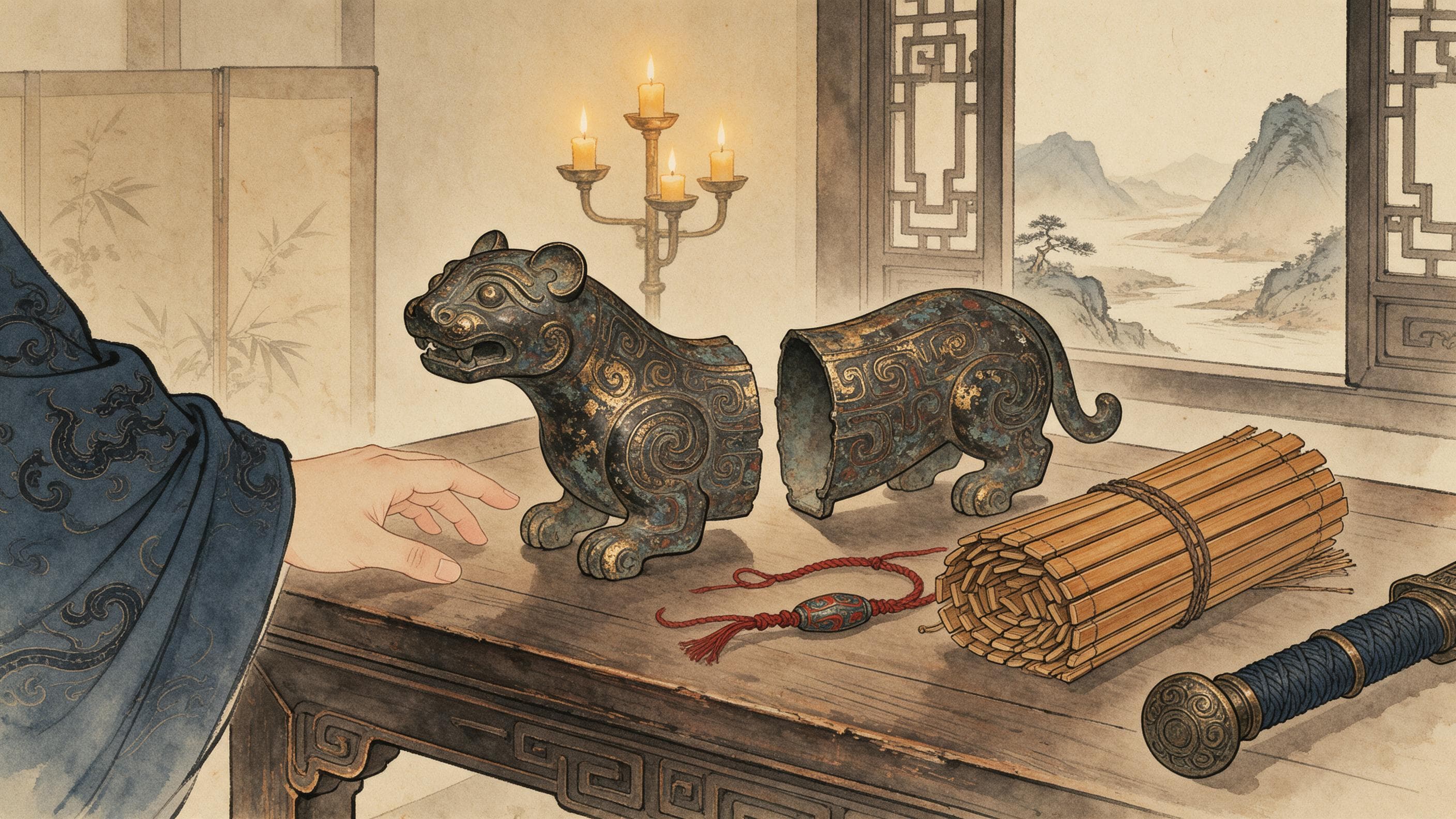
Two pages, two different things, of different periods, and not to be run into one history of an institution. One is in the Shiji's life of Lord Xinling: in the Warring States kingdom of Wei a military tally lies in the king's bedchamber, is stolen, and is then taken to be 'matched' against the half in a general's hands. The other is a single sentence in the Book of Han's annals of Emperor Wen: in the ninth month of the second year, 'for the first time bronze tiger tallies and bamboo envoy tallies were made for the commandery governors' (初與郡守為銅虎符、竹使符). One is a story, one is a Han institution, and they are kept apart here. The tally's form, size and inscription belong to the record of surviving objects; neither page has them, and none is supplied.
A Tally Kept in the King's Bedchamber
The setting is short: in the twentieth year of King Anli of Wei, Qin destroyed the Zhao army at Changping and advanced to besiege Handan; the prince's sister was Lady Pingyuan, and letters for help came repeatedly; the king of Wei sent General Jin Bi with a hundred thousand men to relieve Zhao. The king of Qin sent word: 'I shall take Zhao in a day or two; and any lord who dares rescue it — once Zhao is taken, I shall turn my army and strike him first.' The king of Wei was afraid, 'sent men to stop Jin Bi, and kept the army encamped at Ye, in name to rescue Zhao, in fact holding both ends and watching'. The troops had marched and did not advance; in whose hand the tally lay now mattered.
Hou Sheng's plan is theft: 'I have heard that General Jin Bi's military tally is always in the king's bedchamber, and that Ruji is the favourite, going in and out of that chamber, and has the power to steal it… If you, my lord, will but open your mouth and ask Ruji, she will surely agree, and then you will get the tiger tally, seize Jin Bi's army, rescue Zhao in the north and drive back Qin in the west — this is the campaign of a leader of the five lords' (則得虎符奪晉鄙軍……). Both words are used, 兵符 and 虎符; the tally is what moves that army, and Ruji stole it and gave it to the prince.
Matching: One Half Against the Other
On the point of departure Hou Sheng adds the crucial sentence: 'The general is abroad, and the ruler's command need not be accepted, for the sake of the state. Even if you match the tally, and Jin Bi does not hand the army to you but sends back to ask, the thing will be dangerous' (將在外,主令有所不受……公子即合符,而晉鄙不授公子兵而復請之,事必危矣). So he recommends the butcher Zhu Hai to go along: 'if Jin Bi obeys, very good; if not, have him struck down.' The sentence measures what matching a tally is worth: matching is one thing, handing over an army another.
At Ye it falls out as predicted: 'he forged the king of Wei's order to replace Jin Bi. Jin Bi matched the tally and was suspicious; raising his hand and looking at the prince he said: I now hold a hundred thousand men, encamped on the frontier, a weighty charge of the state — and you come in a single carriage to replace me: what is this? He was minded not to obey' (晉鄙合符,疑之……欲無聽). So the order was forged first, the tally matched second; matched, and still the general doubted, with his reasons in his own words. Then 'Zhu Hai drew from his sleeve a forty-jin iron mallet, struck Jin Bi dead, and the prince took command of Jin Bi's army'. He reviewed the troops, sent home fathers with sons in the army and elder brothers with younger, and only sons without brothers to care for parents; 'he got eighty thousand picked men, advanced and attacked the Qin army; the Qin army broke off and withdrew, and Handan was saved and Zhao preserved'. 'Forty jin' is printed as it stands, not converted.
One Sentence of Han Institution
The Book of Han, in the ninth month of the second year of Emperor Wen: 'for the first time bronze tiger tallies and bamboo envoy tallies were made for the commandery governors' (初與郡守為銅虎符、竹使符). 初 means for the first time; 與郡守為 means made for the governors; and there are two kinds, bronze tiger tally and bamboo envoy tally. An edict on agriculture and a halving of that year's land tax stand in the same month; both are recorded, and no causal link is invented between them.
That sentence yields only so much: a date (the ninth month of the second year of Wen), an addressee (the commandery governors), two materials and names (bronze tiger, bamboo envoy), and a 'for the first time'. How the tally was split, which half was held by whom, how it was matched, and what was done after matching — the page says nothing; Yan Shigu's commentary is not on this page, which is plain text. It therefore cannot be used to fill in the tiger tally of the story.
The two layers must be measured: the 'tiger tally' of the story is Wei's, used to take an army from a general; the Han sentence describes tokens between Emperor Wen and his commandery governors. Different periods, different levels; they can stand side by side but do not license 'this is how it was in the Warring States'. The governors' duties (governor, commandant, inspector) are a separate article; this one is about tokens.
Matching and the Forged Order
In the story the tally must pass two gates: first the theft, to obtain the token; then the matching, to verify it. But the story itself shows that matching is not the same as transfer — Jin Bi matches and still sends back to ask, and the matter is settled with an iron mallet; and alongside runs the forged royal order: tally and order used together, the order false and the tally true. These are the steps the text gives, and only those; no institutional design is inferred from them.
Afterwards comes a verdict: the king of Wei 'was angry that the prince had stolen his military tally and forged an order to kill Jin Bi'; and the retainers' advice is recorded too — 'you forged the king of Wei's order and took Jin Bi's army to save Zhao: toward Zhao you did a service, toward Wei you are no loyal minister' (於趙則有功矣,於魏則未為忠臣也). These are the words of the people involved, printed as such; no moral verdict is added.
What Neither Page Gives
Neither page gives the tally's size, its material or workmanship (inlaid gold, tiger shape), its inscription, any rule for who holds which half, or the ceremony and witnesses of matching. Such things belong to the record of surviving objects and to institutional texts; neither page has them, and this article does not quote inscriptions of the 'right in the ruler's keeping, left in Du' kind, nor state as settled that the tally was split with the ruler holding the right half and the general the left. 'Forty jin' is printed as it stands, not converted.
What can be established is this: a military tally lying in the king's bedchamber, stolen by Ruji, carried off to be matched; after matching the general may still doubt, and the affair ends with a forged order and an iron mallet; and one Han sentence, that in the ninth month of the second year of Emperor Wen bronze tiger tallies and bamboo envoy tallies were first made for commandery governors. What a tally looked like and what was written on it, neither page says; no talk of military codes or centralisation is offered here.
Related reading:The Announcement to Kang: Governing a Place Just Conquered · Royal Fields and Private Dependants: Slaves and Two Edicts in Han China · The Oath: One Sentence Written Down, Punished to the Great-Grandchildren
Sources & further reading
- 《史记》卷七十七·魏公子列传(西汉司马迁撰;维基文库本,页面白文无注,未与中华书局点校本复核) — The theft and matching of a tally: Lord Xinling of Wei, with Qin besieging Handan, has the plan from Hou Sheng that 'the general Jin Bi's military tally is always in the king's bedchamber, and Ruji, the favourite, can steal it'; Ruji steals the tally and gives it to the prince. Hou Sheng warns that 'the general is abroad and the ruler's command need not be accepted… even if you match the tally and Jin Bi does not hand over the army but sends back to ask, the thing is dangerous', so the butcher Zhu Hai goes along. At Ye the prince forges the king's order; Jin Bi matches the tally, is suspicious — 'I hold a hundred thousand men on the frontier, and you come in a single carriage to replace me' — and Zhu Hai kills him with a forty-jin iron mallet. The prince takes the army, dismisses the men with fathers or brothers at home, selects eighty thousand, and raises the siege.
- 《汉书》卷四·文帝纪(东汉班固撰;维基文库本,页面白文无注,未与中华书局点校本复核) — One sentence of institution, in the ninth month of the second year of Emperor Wen: 'for the first time bronze tiger tallies and bamboo envoy tallies were made for the commandery governors' (初與郡守為銅虎符、竹使符), followed in the same month by an edict on agriculture and a halving of that year's land tax. The page gives no description of the tallies, no inscription, and no rule for dividing the halves.