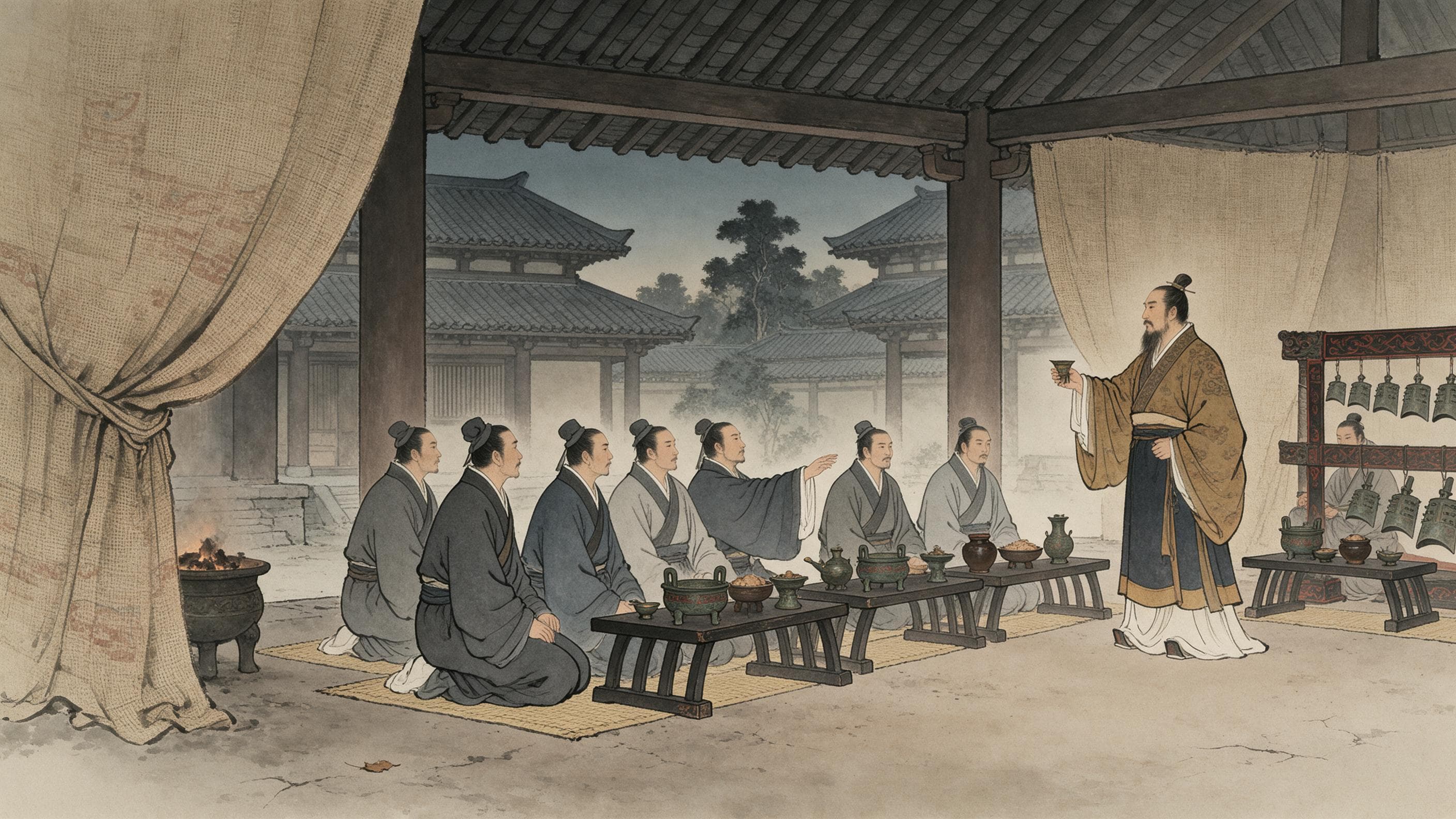
The host says one sentence, and the banquet becomes an examination: 'You seven followed your ruler and did me honour. I ask you all to recite odes, to complete your ruler's gift, and I too shall observe the intentions of the seven of you' (七子從君,以寵武也,請皆賦,以卒君貺,武亦以觀七子之志). The speaker is Zhao Meng of Jin, the guest; the host is the Earl of Zheng; the place is Chuiling. 'To observe the intentions' is the key the whole passage turns on.
One: who entertained whom
'The Earl of Zheng entertained Zhao Meng at Chuiling. Zizhan, Boyou, Zixi, Zichan, Zidashu and the two Zishi attended him' (鄭伯享趙孟于垂隴。子展、伯有、子西、子產、子大叔、二子石從). Six names and 'the two Zishi': the old commentaries take the two to be Yinduan and Gongsun Duan, which makes seven men, matching Zhao's 'seven of you'. This piece says seven, marks the identification as commentary, and adds no eighth name. And one thing must be said first: reciting an ode is not writing one. Each man chose an existing ode to be chanted or read (generally so taken); the choice was the message. The same page, a little earlier, records another banquet kept for the same reason: when the men of Song entertained Zhao Wenzi with Shuxiang as his assistant, 'the marshal set out the jointed victim — that was correct; Confucius had this rite recorded, considering it rich in phrases' (司馬置折俎,禮也。仲尼使舉是禮也,以為多文辭). Two tables, and the historian keeps both for what was said at them.
Two: seven recitations and seven replies
The first four. Zizhan recited the Caochong; Zhao: 'Good indeed — a master of the people. But I am not equal to it' (善哉!民之主也。抑武也不足以當之). Boyou recited the Chun zhi benben; Zhao: 'Words from the bedchamber do not cross the threshold, let alone belong in the open field; this is not what an envoy should hear' (床笫之言不逾閾,況在野乎?非使人之所得聞也). Zixi recited the fourth stanza of the Miaomiao; Zhao: 'My ruler is present; what could I do?' (寡君在,武何能焉). Zichan recited the Xisang; Zhao: 'I ask to accept its last stanza' (武請受其卒章).
The last three. Zidashu recited the Yeyou mancao; Zhao: 'That is your kindness' (吾子之惠也). Yinduan recited the Xishuai; Zhao: 'Good indeed — a master of preserving a house; I have hope' (善哉!保家之主也,吾有望矣). Gongsun Duan recited the Sanghu, and Zhao answered with a line of the ode itself: 'Not factions, not proud — where would blessing go? If you keep to that saying, could you decline blessing and emolument?' (匪交匪敖,福將焉往……).
Two of the seven show how the thing was done. Zixi recited 'the fourth stanza of the Miaomiao', not the whole ode; Zichan recited the Xisang and Zhao asked only for its last stanza. A stanza, a few lines, lifted out of a poem and pointed at the occasion — what later ages called 'cutting off a section' (斷章), though the term is later than the banquet and is marked as later here. Of the seven odes themselves this page gives only the titles, so this piece quotes no line of them; the odes are another book.
Three: the verdict
When the entertainment ended, the verdict came. 'The entertainment over, Wenzi said to Shuxiang: Boyou will be put to death. The odes speak the intent; his intent slandered his ruler, and he made the public grievance his own glory as a guest — how can he last? If he is lucky, he will die later' (文子告叔向曰:伯有將為戮矣!詩以言志,志誣其上,而公怨之,以為賓榮,其能久乎?幸而後亡). Shuxiang agreed: 'So. He is already extravagant; the saying about not lasting five harvests fits this man' (不及五稔). Of the other six: 'all masters for several generations' — Zizhan last of them to perish, because 'in a high place he does not forget to yield'; the Yin clan next, because 'he enjoyed without excess'.
Three things about that verdict. 'The odes speak the intent' (詩以言志) is written here, given to Zhao Wenzi — it is not a later summary of the practice. The verdict is spoken after the banquet, to a third party; the text then records the outcome, so it is a retrospect, not a prophecy made at table, and this piece does not present it as one. And Boyou's end lies outside this passage: the page has already judged him, and this piece gives no year for it. Even the mercy in the verdict is a sentence of death — 'if he is lucky, he will die later' (幸而後亡).
Four: Mencius on reading an ode
Two centuries later Mencius states the rule such reciting presupposes: 'the interpreter of odes does not let the wording injure the phrasing, nor the phrasing injure the intent; to meet the intent with one's own understanding — that is to get it' (不以文害辭,不以辭害志;以意逆志,是為得之). His example is a line of the Yunhan, 'of the remnant people of Zhou, not one was left' (周餘黎民,靡有孑遺) — 'if you believe that sentence, Zhou had no people left.' A poem exaggerates; the reader must go past the words to the intent.
But this is Mencius's rule, spoken in the Warring States, inside an argument over whether Shun treated his father as a subject — not an account of how a Spring and Autumn banquet worked. That reciting a stanza and reading past the words are two sides of one habit is an inference, and is marked as one: neither page says whether the diners knew the rule, or why reciting was thought to reveal a man.
Five: beyond these pages
The boundary: the envoy's gifts and the rules of first meeting are other subjects, and so is the drinking rite. This is one banquet and what was said at it — not an essay on the teaching of the odes or on diplomatic language: one evening, seven men, seven titles, seven replies. The same year's record has another table where talk is the contest: when the Duke of Song entertained the ministers of Jin and Chu together, 'Zimu spoke with him and could not answer; Shuxiang was made to attend the conversation, and Zimu still could not answer' (子木與之言,弗能對……子木亦不能對也). What the pages keep is the talk.
What the pages do not give: the text or meaning of the seven odes (titles only, and none is quoted), the instruments and the chanting, the seating, the food and vessels, any table matching odes to ritual situations. 'The two Zishi' are identified only by old commentary, and the identification is marked as commentary; Zhao Meng and Zhao Wenzi are one man (generally so taken) and are not written as two. What the pages leave is seven men each reciting a poem, seven replies from the host, and one sentence pronounced after the guests had gone.
Related reading:The Yin Fields: Seventy Mu, a Public Field, and Millet · Why Tang Attacked Jie: Three Reasons in One Oath · The Suburban Sacrifice: Where the Emperor Met Heaven, and How Often
Sources & further reading
- 《春秋左氏传》襄公二十七年(维基文库本,未与点校本复核) — The banquet at Chuiling: 'The Earl of Zheng entertained Zhao Meng at Chuiling. Zizhan, Boyou, Zixi, Zichan, Zidashu and the two Zishi attended him. Zhao Meng said: You seven followed your ruler and did me honour; I ask you all to recite odes, to complete your ruler's gift, and I too shall observe the intentions of the seven of you' (鄭伯享趙孟于垂隴……武亦以觀七子之志). Then the seven recitations with their seven replies, each quoted in this piece: Caochong ('a master of the people'), Chun zhi benben ('words from the bedchamber do not cross the threshold, let alone belong in the open field'), the fourth stanza of Miaomiao ('my ruler is present; what could I do?'), Xisang ('I ask to accept its last stanza'), Yeyou mancao ('that is your kindness'), Xishuai ('a master of preserving a house'), Sanghu (answered with the ode's own line, 'not factions, not proud'). After the entertainment Zhao Wenzi tells Shuxiang that Boyou will be killed 'for the odes speak the intent' (詩以言志), Shuxiang answers with 'not five harvests' (不及五稔), and the other six are graded. The page is plain text without Du Yu's or Kong Yingda's commentary; the text uses a middle dot for punctuation, and quotations here follow it in substance while rendering the punctuation.
- 《孟子·万章上》(维基文库本,未与点校本复核) — The later rule for reading an ode: 'the interpreter of odes does not let the wording injure the phrasing, nor the phrasing injure the intent; to meet the intent with one's own understanding — that is to get it' (不以文害辭,不以辭害志;以意逆志,是為得之), with the Yunhan example, 'of the remnant people of Zhou, not one was left' (周餘黎民,靡有孑遺), which taken literally would mean Zhou had no people. This is a Warring States text, spoken inside the argument over whether Shun's father was his subject; it is used here only as a later, separate layer, not as the diners' own account.