Start with the strangest sentence: 'There is a man called Wang Hai, who holds a bird in his two hands and is eating its head' (有人曰王亥,兩手操鳥,方食其頭). That is how Wang Hai enters the Shanhaijing's 'Dahuan East' chapter — not at the head of a narrative but inside the entry for a people, the Kunmin, among the states and marvels of the eastern wastes. This piece does one thing only: it sets out the three places where Wang Hai — or a figure who may be him — is written about, marks what kind of text each is, and does not sew them into a biography.
One: in the Shanhaijing, a bird and some oxen
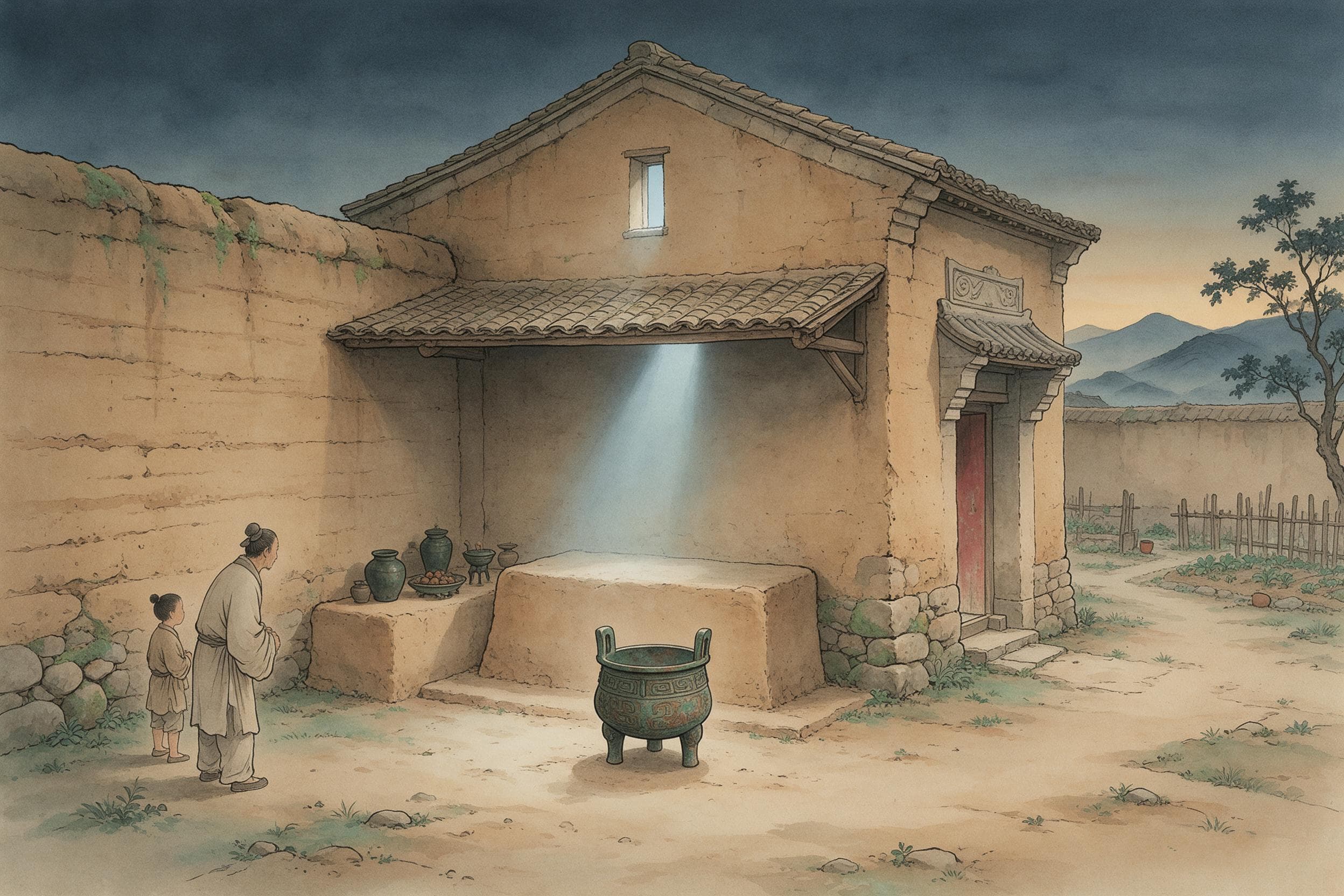
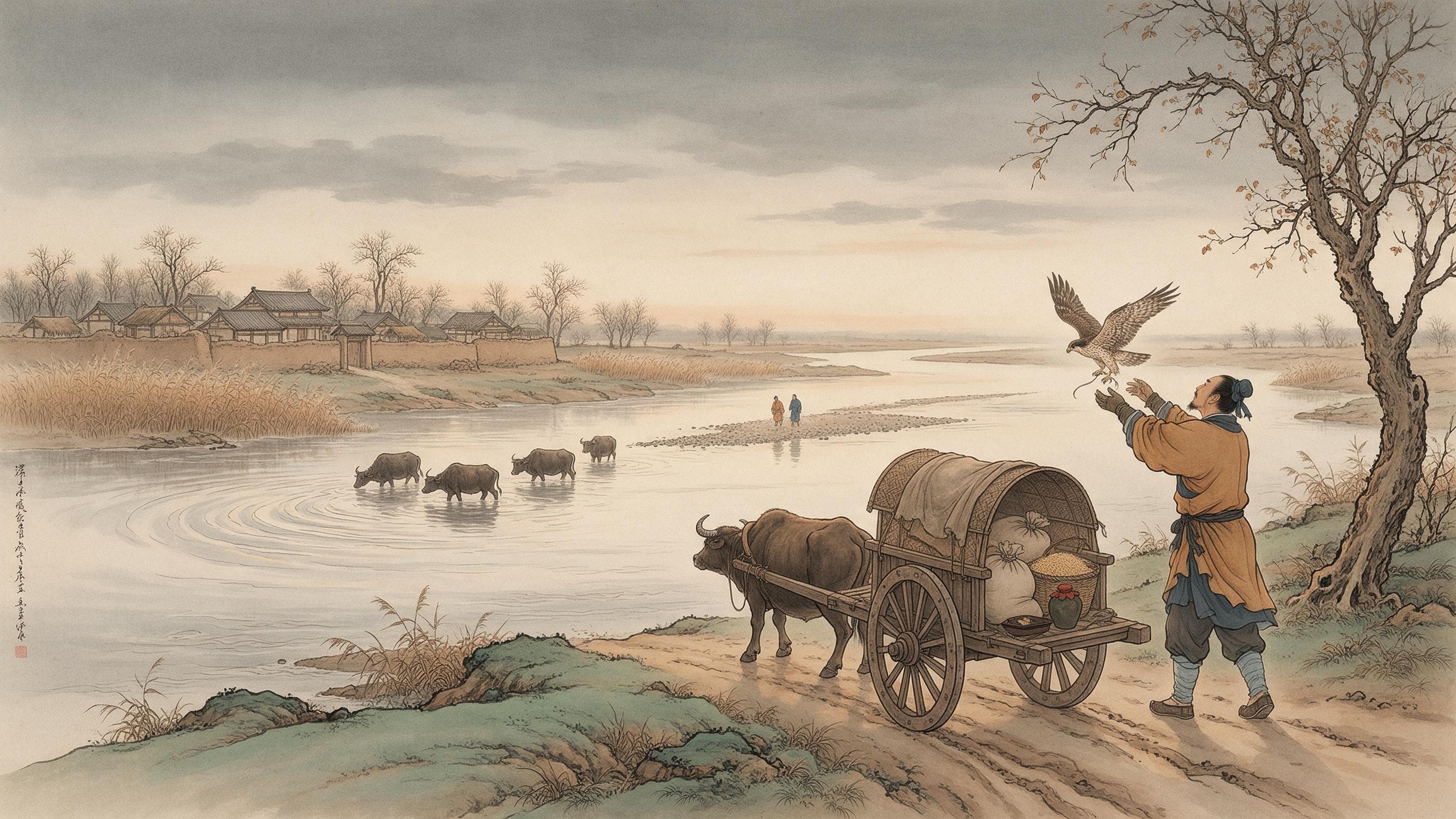
The sentences run together: 'There is the State of the Kunmin, of the Gou surname, who eat millet. There is a man called Wang Hai, who holds a bird in his two hands and is eating its head. Wang Hai entrusted himself to the Youyi and to the Hebo for oxen. The Youyi killed Wang Hai and took the oxen' (王亥托于有易、河伯僕牛。有易殺王亥,取僕牛). Then a further passage: 'The Hebo remembered the Youyi; the Youyi slipped away and made a state among the beasts, and while it was eating, it was named the Yaomin. Emperor Shun begot Xi, and Xi begot the Yaomin.' The page's manner is one sentence to one event, with no explanation, and it does not say why Emperor Shun's descendants belong in the same breath as the Youyi; this piece copies it and supplies no causes.
The names are left where the text leaves them: Youyi, Hebo, and 僕牛 — 'the oxen', or perhaps a name. The page does not say whether 僕牛 means cattle or a man, does not locate Youyi, and does not say why Wang Hai 'entrusted himself' to them. The page also carries the transcribers' variant readings in double brackets (河伯 with 河 as a variant), which are transcription marks and are not quoted here.
Two: the Bamboo Annals fragment
The second place is the reconstructed Old Bamboo Annals. That page is not the original book: it is a collection of fragments quoted elsewhere, each printed with the work it came from, and this fragment sits among 'those with no year to attach them to': 'Prince Hai of Yin was a guest among the Youyi and was licentious there; the lord of the Youyi, Mianchen, killed him and cast him out; therefore the Yin ruler Jia Wei borrowed troops from the Hebo to attack the Youyi, destroyed them, and killed their lord Mianchen' (殷王子亥賓于有易而淫焉,有易之君綿臣殺而放之……遂殺其君綿臣). The note says it was quoted from the commentary to the Shanhaijing's 'Dahuan East' chapter — so this 'annal' layer is itself second-hand.
Beside the Shanhaijing, three things are added: the name of the lord of the Youyi, Mianchen; a motive, that Wang Hai 'was a guest among the Youyi and was licentious there'; and a sequel, in which Jia Wei borrows troops from the Hebo, destroys the Youyi and kills Mianchen. The Shanhaijing has only six words for the killing. The two are set side by side; this piece neither merges them nor decides which is closer to fact, and does not use one to fill the other's gaps.
Three: the Shiji has only 'Zhen'
The third place is the genealogy in the Shiji's 'Basic Annals of Yin': 'Cao Yu died, and his son Ming took his place. Ming died, and his son Zhen took his place. Zhen died, and his son Wei took his place' (冥卒,子振立。振卒,子微立) — then Bao Ding, Bao Yi, Bao Bing, Zhu Ren, Zhu Gui, and Tian Yi, who is Tang. Each entry is one line, birth and succession and nothing else; the chapter's narrative only begins with Tang. The name Wang Hai does not occur. That this 'Zhen' is Wang Hai is an argument of later commentators and of modern scholars since Wang Guowei; it is a view, not the Shiji's own statement, and is marked as a view here.
One name can be matched: 'Wei'. The Shiji writes 微, and the Annals fragment writes 'the Yin ruler Jia Wei' (殷主甲微) — generally taken to be one man. It can be matched, but it does not license sewing the three texts into a biography: one is an oddity, one a quoted fragment, one a genealogy, and none of the pages says they concern the same event.
Four: the oracle bones are not here
The oracle bones are said to contain divinations about Wang Hai, and they are not on these three pages: no inscription, no bone, no divination record appears. So this piece writes plainly: none here. It quotes no oracle text and does not use one to fill the story's gaps; nor does it write about the origins of the Shang clan or proto-Shang history — the pages give one name, one story of a killing, and one line of genealogy, and nothing more.
Five: three texts, three kinds
This must be fixed. The Shanhaijing chapter is written as marvels, one sentence to one event, and its page is marked textquality 75% with several variant readings. The Old Bamboo Annals is a reconstruction whose entries are quoted back out of other books' commentaries, so even the 'annal' layer is one step removed. The Shiji is a Western Han genealogy that writes 'Zhen' and not 'Wang Hai'. They are not the same layer, and must not be sewn into a biography; this piece only sets them beside each other.
What the pages do not give: Wang Hai's date, the location of the Youyi, what 僕牛 was, how the 'entrusting' and the killing actually went, or the details of Jia Wei's revenge. The pages differ or fall silent, and none of it is supplied. One gloss on the Annals page is worth marking as a gloss: 'the Hebo and Pu-niu are both men's names, seen in the Ji nian' (河伯、僕牛皆人姓名,見《紀年》) — a commentator's note, not the received text.
To close: in these texts Wang Hai appears only a few times — once holding a bird and eating its head, once entrusting himself to the Youyi and the Hebo for oxen and being killed for them, once inside a genealogy under the name 'Zhen', and once, in a commentator's note, as 'Prince Hai of Yin'. Read in four places, rather than assembled into one man.
Related reading:Reciting the Odes: Seven Men, Seven Poems, One Verdict · The Wandering Knights: Zhu Jia, Ju Meng and Guo Jie · The Shang High God: Who Sends Fortune and Calamity
Sources & further reading
- 《山海经·大荒东经》(维基文库本,未与点校本复核) — The strangest of the three passages, and the only one that names Wang Hai as a figure: 'there is the State of the Kunmin, of the Gou surname, who eat millet. There is a man called Wang Hai, who holds a bird in his two hands and is eating its head. Wang Hai entrusted himself to the Youyi and to the Hebo for oxen. The Youyi killed Wang Hai and took the oxen. The Hebo remembered the Youyi; the Youyi slipped away and made a state among the beasts, and while it was eating, it was named the Yaomin' (有人曰王亥,兩手操鳥,方食其頭。王亥托于有易、河伯僕牛。有易殺王亥,取僕牛). The page is marked textquality 75% and carries the transcribers' variant readings in double brackets ({{另}}), which are not quoted here; it gives no date, no place, and no explanation of 'the oxen'.
- 《古本竹书纪年辑校》(维基文库本,未与点校本复核) — The Bamboo Annals survive only in fragments quoted by other books, and this page is a reconstruction that prints each fragment with the work it was quoted from. Under 'those with no year to attach them to' it gives: 'Prince Hai of Yin was a guest among the Youyi and was licentious there; the lord of the Youyi, Mianchen, killed him and cast him out; therefore the Yin ruler Jia Wei borrowed troops from the Hebo to attack the Youyi, destroyed them, and killed their lord Mianchen' (殷王子亥賓于有易而淫焉,有易之君綿臣殺而放之,故殷主甲微假帥于河伯以伐有易,滅之,遂殺其君綿臣), with the note that this was quoted from the commentary to the Shanhaijing's 'Dahuan East' chapter. The same page quotes a note that 'the Hebo and Pu-niu are both men's names, seen in the Ji nian' (河伯、僕牛皆人姓名,見《紀年》) — a commentator's gloss, marked here as a gloss and not as the received text.
- 《史记》卷三〈殷本纪〉(维基文库本,未与点校本复核) — Used only for the genealogy, which does not contain the name Wang Hai at all: 'Cao Yu died, and his son Ming took his place. Ming died, and his son Zhen took his place. Zhen died, and his son Wei took his place' (曹圉卒,子冥立。冥卒,子振立。振卒,子微立) — the line continues through Bao Ding, Bao Yi, Bao Bing, Zhu Ren, Zhu Gui to Tian Yi, who is Tang. The identification of this 'Zhen' with Wang Hai is a later commentators' and modern scholars' argument, not something the Shiji says; this piece marks it as such.