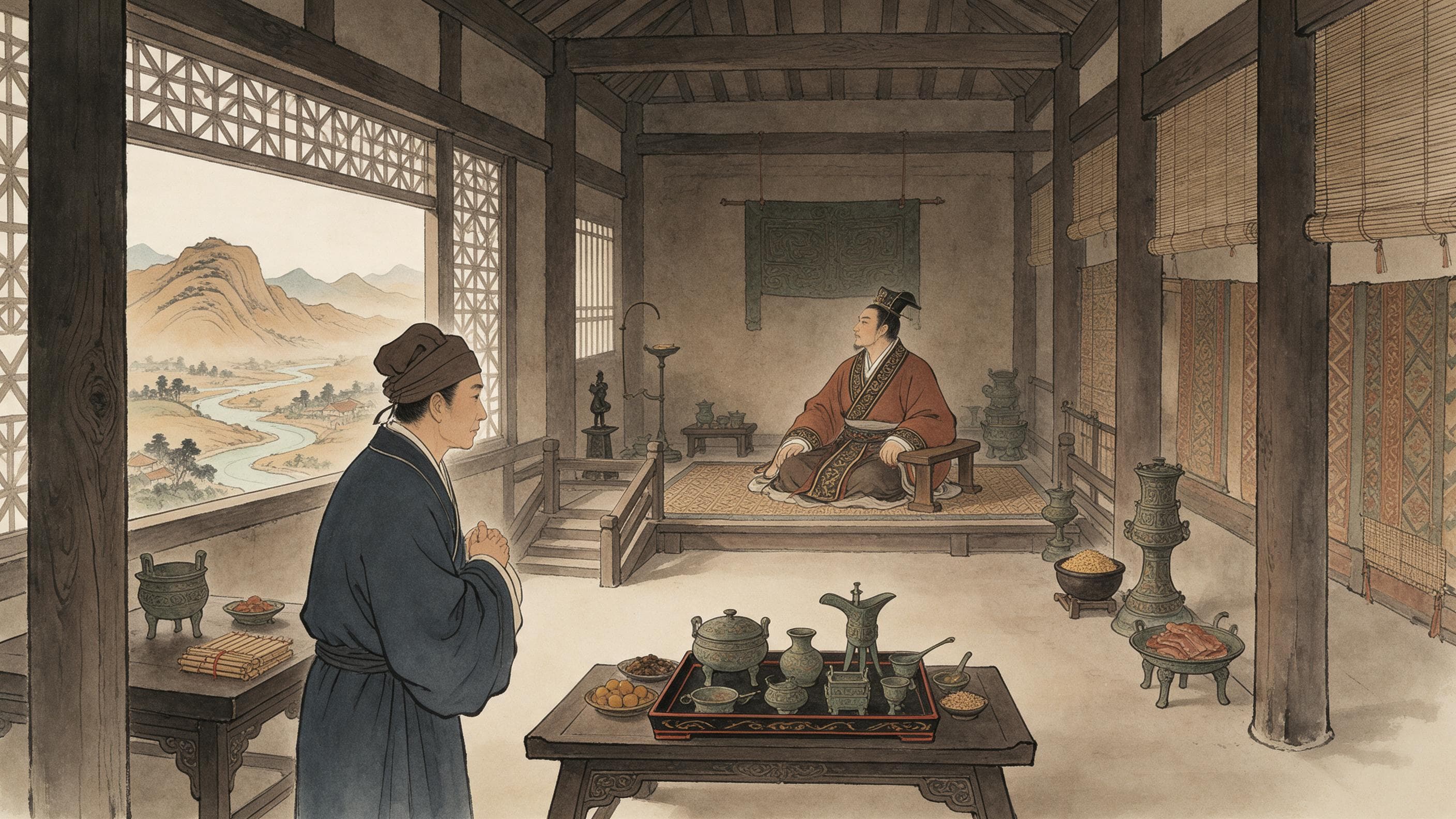
The Han Feizi begins the consultation with a gesture: 'Bian Que saw Duke Huan of Cai, stood a while, and said…' (扁鵲見蔡桓公,立有間). The Shiji begins the same meeting differently: 'Bian Que passed through Qi, and Marquis Huan of Qi entertained him; entering court he said…' (扁鵲過齊,齊桓侯客之。入朝見). No standing a while, and a different patient. Both pages have four visits, in both the illness travels inward; almost everything else between them fails to match.
Two openings
Start with where the Han Feizi passage sits. It is in the chapter 'Illustrating Laozi', surrounded by argument: hard things should be tackled while easy, 'a dyke of a thousand zhang is breached by an ant hole, a house of a hundred chi is burned by a spark through a crack' (千丈之堤,以螻蟻之穴潰). After the story the author states the point himself: 'so the good physician treats it while it is in the skin's grain — all this is contending while it is small; the fortunes of affairs also have their skin's grain, so the sage acts early' (故良醫之治病也,攻之於腠理。此皆争之於小者也……故聖人蚤從事焉). The passage is a parable; Bian Que is the example of contending early, Duke Huan the example of not listening.
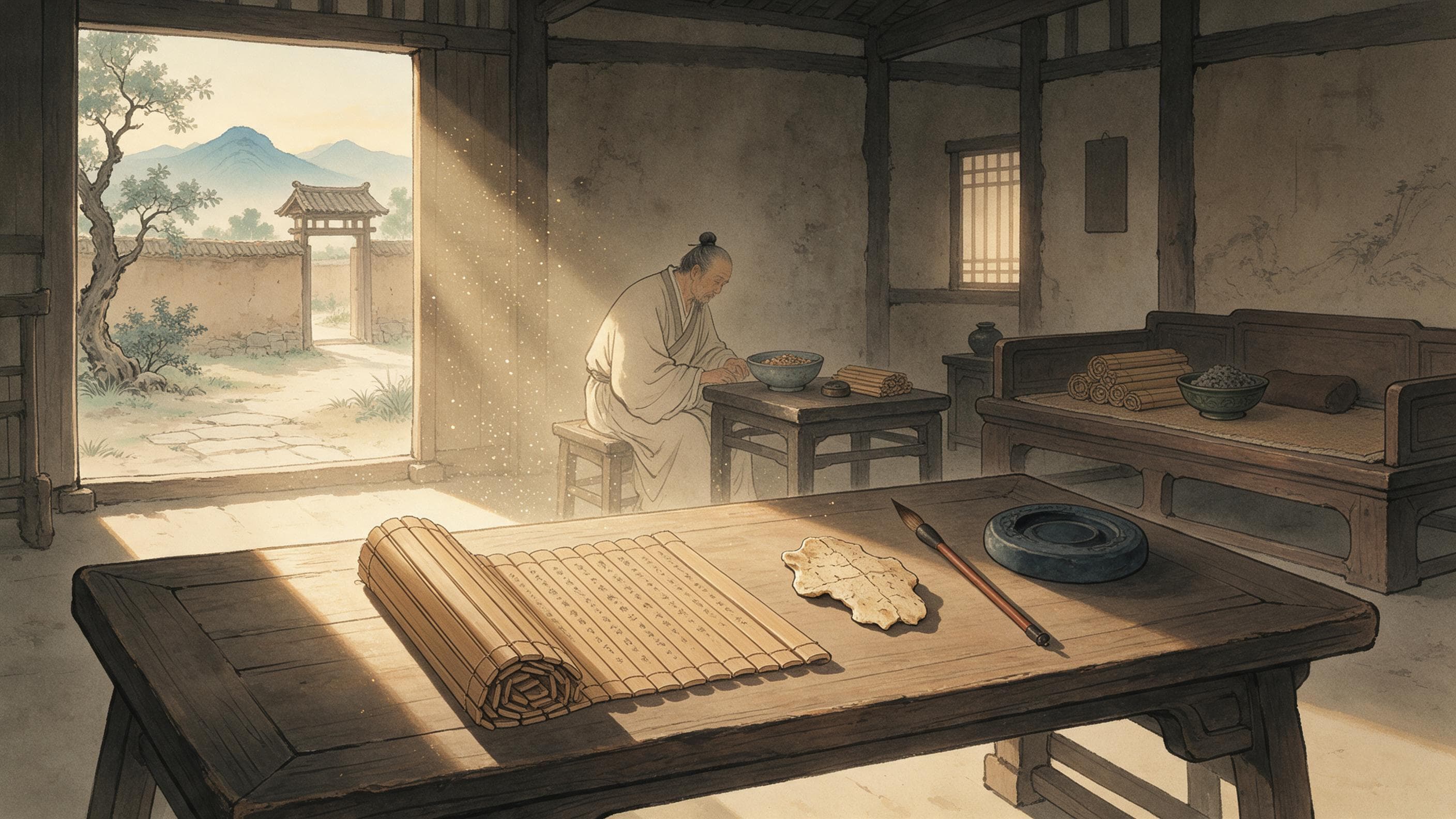
The Shiji's chapter 105 is a biography, and uses the story differently, as one feat among many. It opens by naming the man — 'Bian Que was a man of Zheng in Bohai commandery, of the Qin surname, named Yueren' (勃海郡鄭人也,姓秦氏,名越人) — and then explains the gift: the stranger Chang Sang Jun gives him a drug, 'drink this with water from the upper pool, and in thirty days you will know things' (飲是以上池之水,三十日當知物矣); he does, and 'saw through walls to people on the other side' (視見垣一方人), after which 'he looked at illness and saw all the accumulations in the five organs, and merely used pulse-taking as a name' (盡見五藏癥結,特以診脈為名耳). In the same chapter he also treats Zhao Jianzi and the heir of Guo. One story, two jobs: an illustration in an argument, a deed in a life. The Han Feizi gives him no origin, no master and no dates; the biography is the only one of the two that does.
Four visits, as written
The Han Feizi spaces the visits at 'ten days'. The illness goes 腠理, 肌膚, 腸胃, 骨髓, and the ruler's response cools each time: first 'I have none' (寡人無), then no answer, then displeasure. The three treatments come at the end: 'a disease in the skin's grain is what soup and ironing reach; in the flesh, what needles and stones reach; in the stomach and intestines, what fire-decoction reaches; in the marrow, that belongs to the Director of Destinies, and there is nothing to be done. It is now in the marrow, and that is why I ask nothing' (疾在腠理,湯熨之所及也……在骨髓,司命之所屬,無柰何也). Then two sentences: 'five days later the marquis's body hurt; he sent for Bian Que, who had fled to Qin. The marquis died.'
The Shiji spaces the visits at 'five days', and its second stage is not the flesh but the blood vessels: 腠理, 血脈, 腸胃, 骨髓. Its three treatments differ as well: 'a disease in the skin's grain is what soup and ironing reach; in the blood vessels, what needles and stones reach; in the stomach and intestines, what wine and lees reach; in the marrow, even the Director of Destinies can do nothing' (疾之居腠理也,湯熨之所及也……酒醪之所及也……雖司命無柰之何). And it ends: 'five days later the marquis's body sickened; he sent to summon Bian Que, who had already fled. The marquis died.'
Where the two do not match
Set side by side, the differences can be listed: one, the patient — Duke Huan of Cai in the Han Feizi, Marquis Huan of Qi in the Shiji; two, the second stage — flesh against blood vessels; three, the third treatment — fire-decoction against wine and lees; four, the interval — ten days against five; five, the flight — 'fled to Qin' against 'fled'; six, the opening — the Han Feizi has him stand a while, the Shiji has him enter court and speak. Neither page explains the differences, and neither claims to be the original. Both are given here; neither is adjudicated, and no book outside these two is brought in to settle it.
What can be established is the frame, which both share: four visits, moving inward, each deeper than the last; the same formula, 'untreated it will deepen'; a listener who grows less patient each time; and an ending in which the doctor leaves and the patient dies. Same frame, different flesh — that is as much as the two pages jointly support.
Bian Que himself
What the Shiji adds is a story about why he could see: the stranger Chang Sang Jun 'suddenly vanished — he was probably not a man'; the drug must be taken with water from the upper pool; thirty days before it works; and then he 'saw through walls to people on the other side'. The two sentences that follow matter most: 'he looked at illness and saw all the accumulations in the five organs, and merely used pulse-taking as a name.' In the biography, pulse-taking is the label; seeing is the method. The Han Feizi's version has none of this. Its Bian Que is simply a doctor who can say which level the illness has reached.
One further case in the same chapter makes the point. The heir of Guo has been 'dead' half a day; Bian Que says he can revive him, and when the officer doubts it, answers: 'in my method, I do not wait for cutting the pulse, looking at the colour, listening to the voice or copying the form to state where the disease is' (不待切脈望色聽聲寫形,言病之所在). So the word 'inspection' (望診) is on neither page; the biography gives something more absolute than inspection. This article does not write that inspection began here.
Two kinds of medicine in one chapter
The second half of chapter 105 is the casebook of Cang Gong, Chunyu Yi: case after case, each giving the patient, the symptoms, the pulse, the medicine, how many days until effect, the prognosis, and how the illness was contracted. For instance: 'the Chief of the Palace Guard, Xun, was ill; the physicians all thought it was a blockage and bled him. I diagnosed it and said: rushing hernia… I gave him fire-decoction; one dose restored passage, two a great passage, three and he was cured' (臣意飲以火齊湯,一飲得前後溲,再飲大溲,三飲而疾愈). The third treatment in the Han Feizi's list, fire-decoction (火齊), turns up here as an actual prescription — Cang Gong's 'fire-decoction soup' (火齊湯). In one chapter by one hand, the seeing of the five organs comes first, then case after case of pulse and drug. Two ways of writing medicine stand side by side in one scroll — that is the chapter's structure, not a verdict on either. What neither page gives: Bian Que's dates, which Duke Huan of Cai this was, or the year of any visit. None of it is supplied here.
Related reading:Facing East: Four Seats at the Hongmen Banquet · Drilling the Court: From Swords Struck on Pillars to 'Now I Know How Noble an Emperor Is' · A Northern Wei Meal: Noodles, Roast Suckling Pig and Milk Curd
Sources & further reading
- 《韩非子·喻老》(维基文库本,未与点校本复核) — The parable, in a chapter arguing that hard things should be tackled while easy: after 'a dyke of a thousand zhang is breached by an ant hole', the story runs 'Bian Que saw Duke Huan of Cai, stood a while, and said: your lordship has an illness in the skin's grain; untreated it will go deeper' (扁鵲見蔡桓公,立有間……君有疾在腠理). Four visits at 'ten days' intervals move it from 腠理 to 肌膚 to 腸胃 to 骨髓, with the three treatments 'soup and ironing reach the skin's grain; needles and stones reach the flesh; fire-decoction reaches the stomach and intestines; in the marrow, that belongs to the Director of Destinies, and nothing can be done' (湯熨之所及也……火齊之所及也……司命之所屬,無柰何也). The ruler flees to Qin and dies. The chapter states the point itself: 'the good physician treats it in the skin's grain — all this is contending while it is small' (此皆争之於小者也).
- 司马迁《史记》卷一百〇五〈扁鹊仓公列传〉(维基文库本,未与点校本复核) — The same story inside a biography, with a different ruler and different stages: 'Bian Que passed through Qi, and Marquis Huan of Qi entertained him; entering court he said: your lordship has an illness in the skin's grain; untreated it will deepen' (扁鵲過齊,齊桓侯客之……君有疾在腠理). The stages are 腠理, 血脈, 腸胃, 骨髓, at 'five days' intervals; the treatments are 'soup and ironing reach the skin's grain; needles and stones reach the blood vessels; wine and lees reach the stomach and intestines; in the marrow, even the Director of Destinies can do nothing' (湯熨之所及也……酒醪之所及也……雖司命無柰之何). Bian Que flees and the marquis dies. The chapter opens with his origin — 'Bian Que was a man of Zheng in Bohai commandery, of the Qin surname, named Yueren' (勃海郡鄭人也,姓秦氏,名越人) — and with the drug and water that let him 'see through walls', so that 'he looked at illness and saw all the accumulations in the five organs, and merely used pulse-taking as a name' (盡見五藏癥結,特以診脈為名耳).