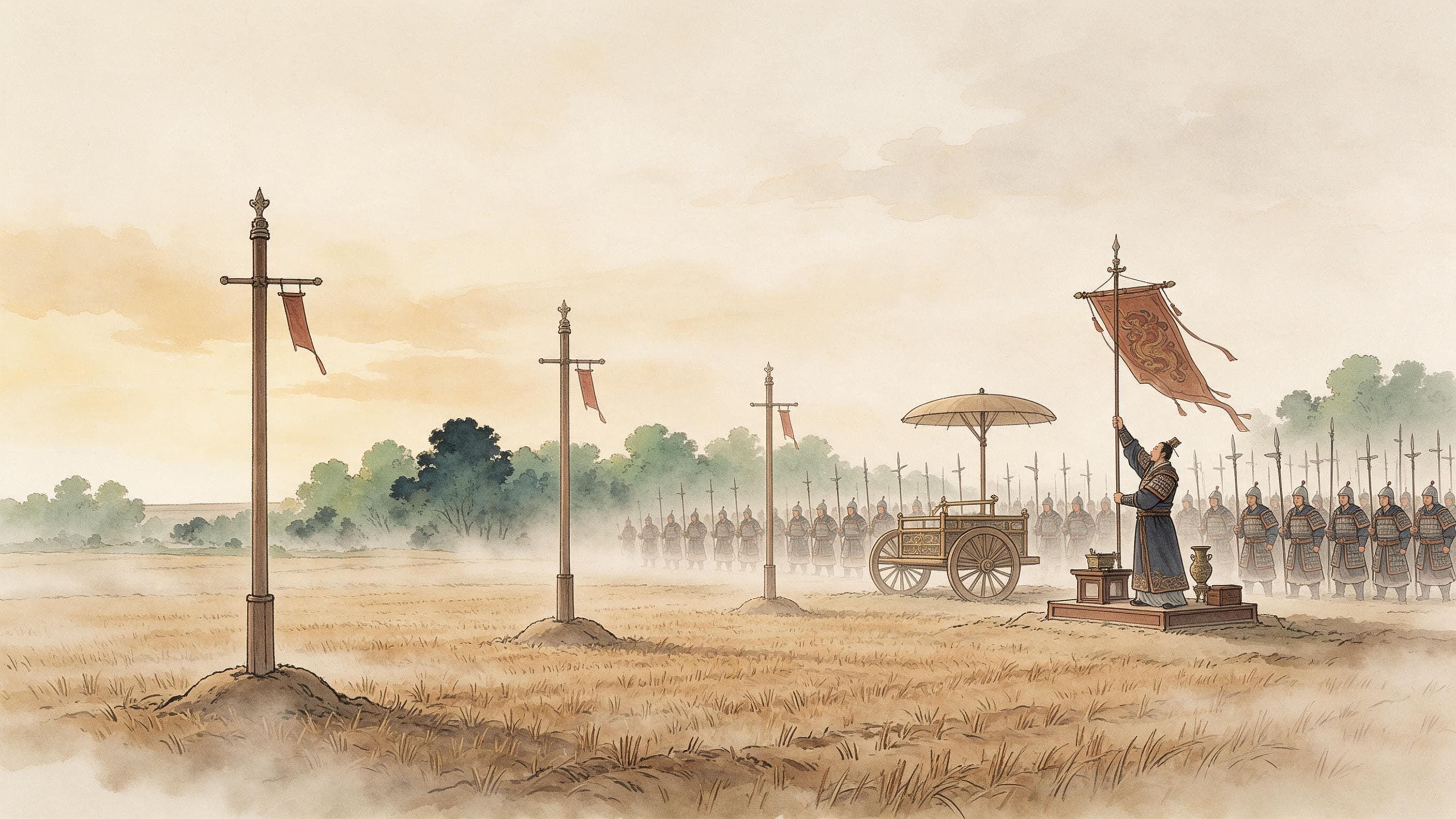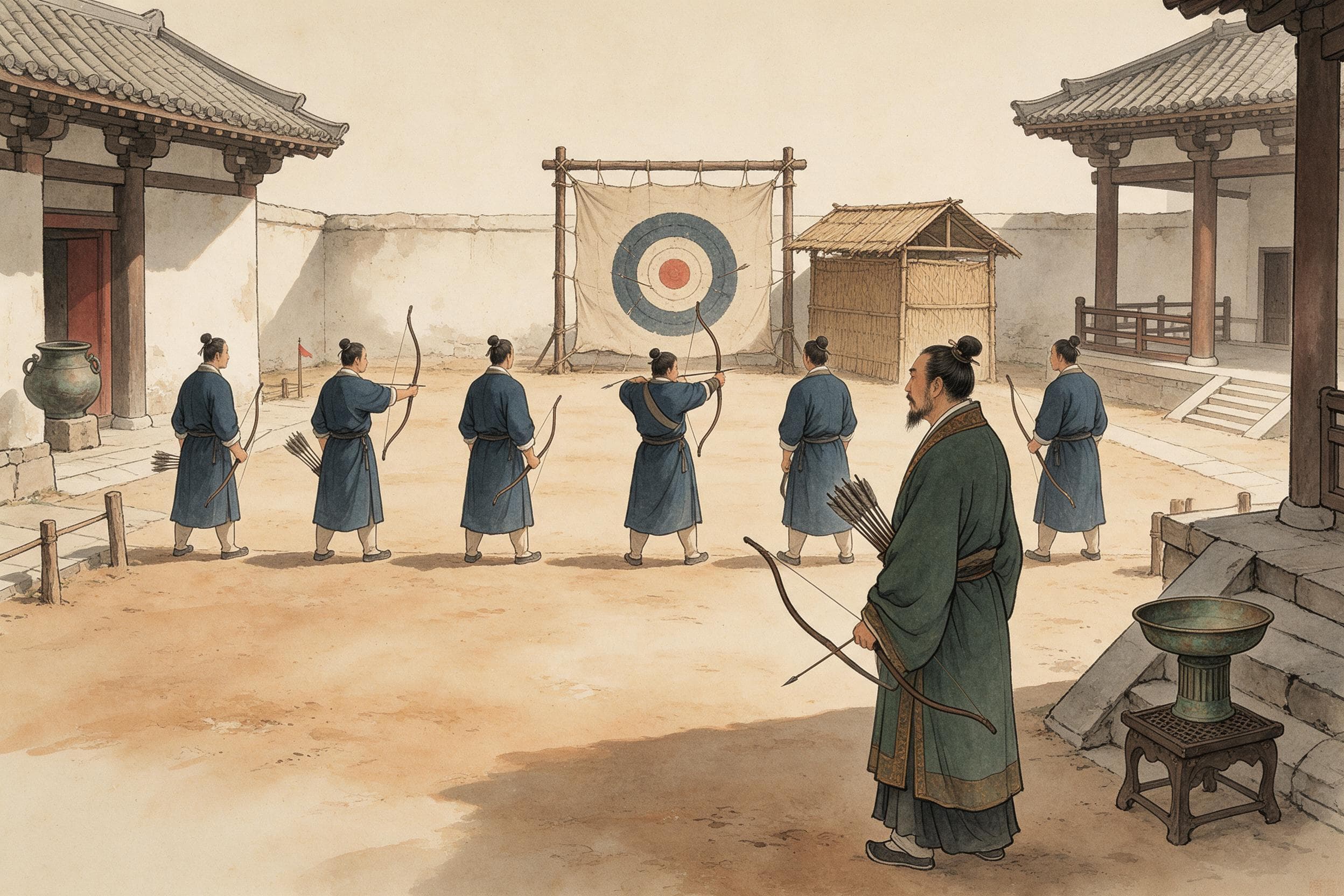
Start with a target. Early in the Yili the target is put up: 'they spread the target, its lower cord not reaching the ground; the lower left cord is left untied, and the middle is folded and bound' (乃張侯,下綱不及地武。不繫左下綱,中掩束之). Beside it stands a small shelter, 'five paces west'. This page begins with that object and goes on to the movements; the other page, the Liji's chapter on the meaning of archery, says why the movements are arranged so. They are not the same kind of text, and this article keeps them apart.
Opening: one target, three pairs
The target belongs to the master of the horse. Halfway through the rite, 'the master of ceremonies became the master of the horse; the master of the horse ordered the target spread, and the disciples untied the binding and tied the lower left cord' (司正為司馬,司馬命張侯,弟子說束,遂繫左下綱). He then orders the flag-bearer, 'lean the banner in the middle of the target' (倚旌于侯中). Actions only; not one word of explanation. The dimensions are relative: the lower cord 'not reaching the ground', the shelter 'five paces' west. No measured figures.
The shooters are three pairs. Before anything starts, 'the three pairs wait west of the hall, facing south, the east first' (三耦俟于堂西). A 耦 is a pair: an upper archer and a lower archer. The master of archery matches the three pairs and gives each its formula: 'he ordered the upper archer: so-and-so drives your carriage; he ordered the lower archer: you shoot with so-and-so' (命上射曰:某御於子;命下射曰:子與某子射). One sentence ties two men into a pair. A note at the end adds where they come from: 'the three pairs are disciples' (三耦者,使弟子).
The master's orders
The master's kit is described exactly: 'he goes west of the hall, bares his arm, puts on the thumb ring and sleeve, takes his bow west of the steps, and carries four arrows under his arm' (司射適堂西,袒決遂,取弓于階西,兼挾乘矢). He reports: 'the bows and arrows are ready; the officers request the shoot' (弓矢既具,有司請射). The guest yields once and consents, and the master asks the host in turn. Then the order to the pairs: 'each with his partner, yield and take bow and arrows, alternating!' (各與其耦讓取弓矢,拾). Then he shoots first himself, as a demonstration — 'he leads the shooting and uses up his four arrows' (誘射).
The orders during a shoot are short and in sequence. 'The master of the horse orders the flag-bearer to carry the banner and stand behind the target' (司馬命獲者執旌以負侯); once the archers are in place he raises his bow and orders 'leave the target!' (命去侯), and the man answers without a break in his voice and walks to the shelter, sits, and lowers the banner facing east. The master of archery then crosses before the steps and orders the upper archer: 'do not shoot the flag-bearer, do not hunt the flag-bearer!' (無射獲,無獵獲). For counting: 'not piercing, not counted!' (不貫不釋); with music it becomes 'not drummed, not counted!' (不鼓不釋).
Counting, and who drinks
Victory is judged by counters, not by eye. When counting is requested, 'the tally-keeper holds the deer-shaped vessel, and one man carries the counters after him' (釋獲者執鹿中), and 'sets eight counters in the vessel' (坐實八筭于中). As the shooting goes: 'if a hit is made, the tally-keeper sits and releases a tally, one counter each; the upper archer's on the right, the lower archer's on the left' (每一个釋一筭。上射於右,下射於左). The counting has its own grammar of bundles and odd counters. The result is one of three sentences: 'the right is better than the left'; 'the left is better than the right'; or, if equal, 'left and right are equal' (左右鈞).
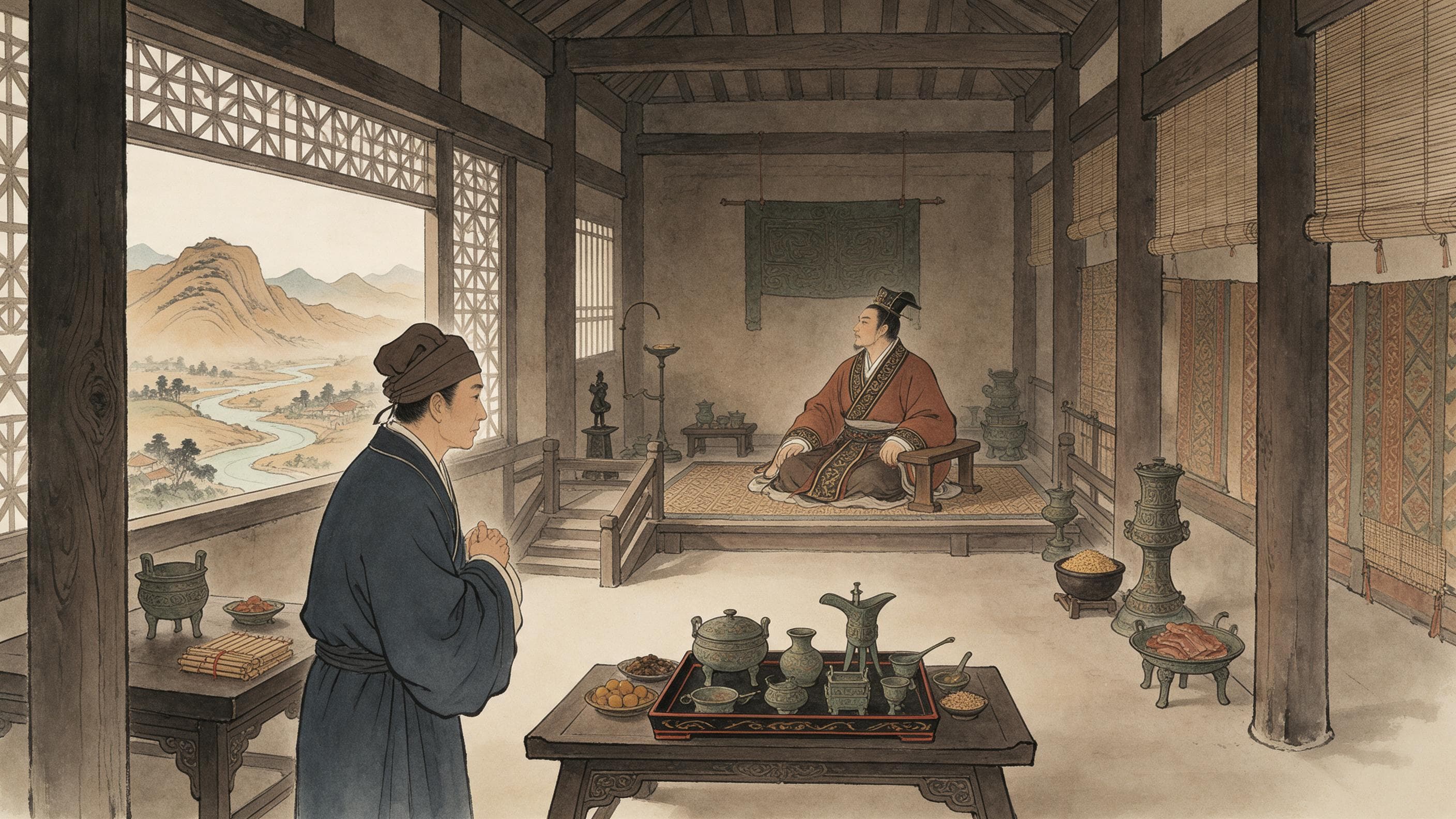
The losers drink. A stand called the 豐 is set west of the western pillar; the winning side's disciple washes a cup, pours, and sets it there. Then the order to both sides: 'the winners bare their arms, wearing ring and sleeve, and hold strung bows; the losers put on their robes, remove ring and sleeve, turn the left hand over, lay the unstrung bow on it, and hold the grip' (勝者皆袒決遂,執張弓。不勝者皆襲……右加弛弓於其上). The winners go up first; the loser 'sits facing north, takes the cup from the stand, rises, steps back a little, and drains it standing' (坐取豐上之觶……立卒觶), then sets the empty cup below the stand. One cup per pair, and 'the three pairs finish drinking' (三耦卒飲). If a guest, host or grandee loses he need not hold the bow: the cup-bearer washes and fills the cup, hands it to him at his mat, and he drinks standing. The amount stops at the cup; no capacity is given.
The other page: the meaning of archery
The Liji's chapter first puts the shoot back where it belongs: 'the archery of the nobles was always preceded by the feast; the archery of the ministers, grandees and officers was always preceded by the village drinking rite' (卿、大夫、士之射也,必先行鄉飲酒之禮). That is the line between the two chapters of the corpus: one village ceremony in two parts — the drinking rite describes the drinking, this article describes the shooting — and the Liji states the relation itself. The reasoning follows: 'in advancing and retiring, turning and circling, one must hit the rites. The inner aim correct, the outer body straight, and only then may one hold bow and arrow steadily; only then may one speak of hitting. By this one may observe character' (內志正,外體直,然後持弓矢審固). First hit the rites, then hit the target.
The chapter gives each rank its musical measure — Zouyu for the Son of Heaven, Lishou for the nobles, Caiping for ministers and grandees, Caifan for officers (其節:天子以騶虞爲節……士以采蘩爲節) — and explains each: completion of offices, keeping the times of assembly, following the law, not losing one's duty. The Yili's bare 'not drummed, not counted' becomes a rule with content. The cup is explained too, and against the action: 'the poem says, I shoot at that mark, to beg off your cup; to seek to hit is to decline the cup; wine is for supporting the aged and the sick, so to decline the cup is to decline being supported' (求中以辭爵也……辭養也). The same cup: the Yili says how it is drunk, the Liji says why a man would rather not drink it.
Two layers, and what the pages do not give
The layers are kept apart not because one is higher but because their material differs: the Yili's page is actions, positions, orders and the names of things — how a rite is done; the Liji's page is standards and reasons — why it is worth doing. Run them together and the result is an essay on archery culture; kept apart, one can see a layer of orders and a layer of meanings. What neither page gives: the target's real distance (only 'five paces west' and the like), the measured size of the ground, any measurement beyond the number of arrows, the capacity of the cup, or how many guests stood beyond the three pairs. None of it is supplied here.
Related reading:Fifty Get a Staff: Old Age in a Ritual Book and an Edict · Three Years: One Rule, Several Calculations · Facing East: Four Seats at the Hongmen Banquet
Sources & further reading
- 《仪礼·乡射礼》(维基文库本,未与点校本复核) — The ritual itself, act by act. The target goes up first: 'they spread the target, its lower cord not reaching the ground; the lower left cord is left untied, and the middle is folded and bound' (乃張侯,下綱不及地武。不繫左下綱,中掩束之), with the shelter 'five paces west' of it. The master of archery (司射) takes his bow and four arrows, reports the equipment ready and asks the guest's leave; the master of ceremonies (司正) becomes the master of the horse (司馬), who orders the target spread and the banner leaned in its middle. The three pairs (三耦) are matched west of the hall and named one by one: 'so-and-so drives your carriage' to the upper archer, 'you shoot with so-and-so' to the lower. Orders are quoted verbatim — 'do not shoot the flag-bearer, do not hunt the flag-bearer' (無射獲,無獵獲), 'not piercing, not counted' (不貫不釋), 'not drummed, not counted' (不鼓不釋). Counting uses counters set in a deer-shaped vessel, eight at a time; the result is announced as 'the right is better than the left', 'the left is better than the right', or 'left and right are equal' (左右鈞). The losers drink: a cup is set on the stand (豐), winners take up strung bows and losers unstrung ones, the winners ascend first, and the loser takes the cup and drains it standing (立卒觶).
- 《礼记·射义》(维基文库本,未与点校本复核) — The other layer: why the shoot is arranged so. It opens by placing the shoot after another rite — 'the archery of the ministers, grandees and officers was always preceded by the village drinking rite' (卿、大夫、士之射也,必先行鄉飲酒之禮). It states the standard in the body: 'in advancing and retiring, turning and circling, one must hit the rites; the inner aim correct, the outer body straight, and only then may one hold bow and arrow steadily; only then may one speak of hitting — by this one may observe character' (內志正,外體直,然後持弓矢審固). It gives each rank its musical measure — Zouyu for the Son of Heaven, Lishou for the nobles, Caiping for ministers and grandees, Caifan for officers — with its reasons, and explains the cup: 'the poem says, I shoot at that mark, to beg off your cup; begging is seeking; to seek to hit is to decline the cup; wine is for supporting the aged and the sick, so to decline the cup is to decline being supported' (求中以辭爵也……辭養也).