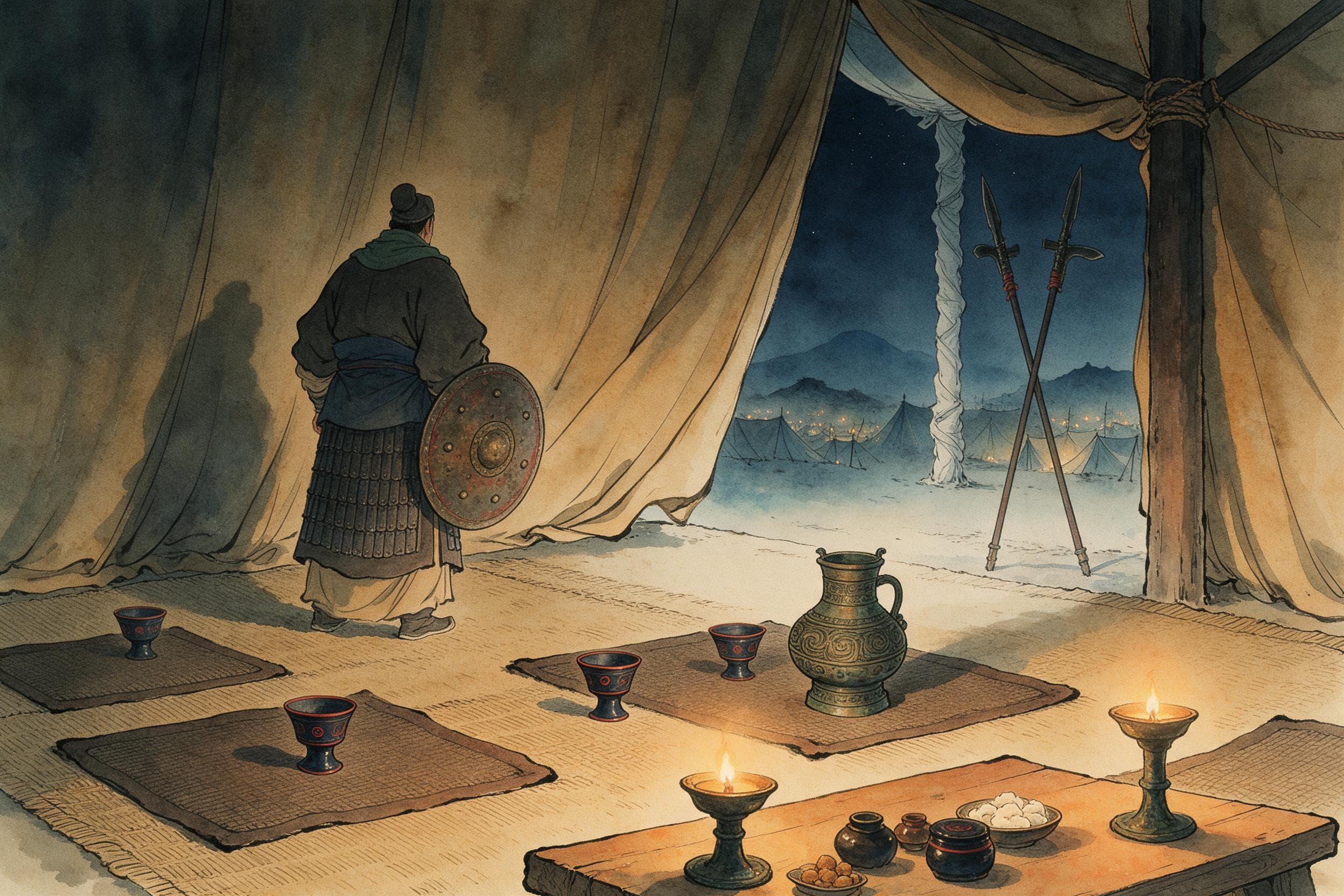
At the Hongmen banquet the Shiji gives the room in one line: 'the King of Chu and Xiang Bo sat facing east. The Second Father sat facing south. The Second Father was Fan Zeng. The Duke of Pei sat facing north, and Zhang Liang attended facing west' (項王、項伯東嚮坐。亞父南嚮坐。亞父者,范增也。沛公北嚮坐,張良西向侍). A little later a man bursts in, also facing west, also on his feet: 'he pushed aside the curtain and stood facing west' (披帷西向立). Two east, one south, one north, two west. Neither page says why east is the good side.
One source, two very different sizes
What has to be established first is that this is one book's account, not two. The Hanshu has a chapter on the same events, on Chen Sheng and Xiang Ji, and it reaches Hongmen in a single compressed paragraph: 'the next day the Duke of Pei came to Hongmen with a hundred-odd riders to apologise to Yu, and set out his own case — I sealed the Qin treasuries, returned the army to Bashang to await the great king, closed the pass against other bandits, and did not dare turn my back on his virtue. Yu's anger was dissolved; Fan Zeng wished to harm the Duke of Pei, and but for Zhang Liang and Fan Kuai he escaped. The details are in the Annals of the High Emperor' (羽意既解,范增欲害沛公,賴張良、樊噲得免。語在高紀). Not one seat is named. That chapter does not describe the drinking at all; it says the danger passed.
The Shiji spends the scene, and the sentence that makes it a scene comes just before the seating: 'the King of Chu kept the Duke of Pei that same day to drink with him' (項王即日因留沛公與飲). Then the four directions, then Fan Zeng's signals, then the sword dance, then Fan Kuai. The Hanshu's chapter has none of it and says where it put it — 'the details are in the Annals'. So the seating list is evidence for the Shiji, not for 'what the sources say about the banquet'. This article keeps that asymmetry visible.
The four directions, as written
Read the directions as they stand. East: the King of Chu and Xiang Bo, two men. South: Fan Zeng, one. North: the Duke of Pei, one. West: Zhang Liang — and the verb used for him is not 坐, to sit, but 侍, to attend: 'Zhang Liang attended facing west'. The other three sit. Whether Zhang Liang stood, knelt or sat, the text does not say; it says he attended. That one character separates him from the three who have seats.
Then Fan Kuai, whose posture is given exactly: 'Fan Kuai turned his shield sideways and struck; the guards fell; Kuai entered, pushed aside the curtain and stood facing west, glared at the King of Chu, his hair standing on end, the corners of his eyes splitting' (披帷西向立,瞋目視項王,頭髮上指,目眥盡裂). West again, and 立, standing. The wine and meat that follow are in the same flat register: 'the King of Chu said: a strong man — give him a cup of wine. Then he was given a dou-cup of wine. Kuai bowed, rose and drank it standing. The King of Chu said: give him a pig's shoulder. Then he was given a raw pig's shoulder. Fan Kuai turned his shield over on the ground, laid the shoulder on it, drew his sword, cut and ate it' (則與斗巵酒……則與一生彘肩……拔劍切而㗖之).
Why east: the text does not say
Neither page explains the arrangement. There is no sentence saying east is the honoured side, no ranking, no note on where a host sits and where a guest; the later commentators who argue about the order are not on these pages, and this article does not supply them. What the text gives is a pattern that can be counted: three men sit, one attends, and the man who bursts in stands. Whether the pattern encodes honour, and by what sequence, the two pages leave open. The directions are data; the etiquette is something a reader adds.
What happens around the seats
The action around the seating is recorded with the same economy. Fan Zeng 'counted' the King of Chu with his eyes and 'three times raised the jade gui he wore to show him; the King of Chu was silent and did not respond' (范增數目項王,舉所佩玉珪以示之者三,項王默然不應). Fan Zeng went out, called Xiang Zhuang, and told him to enter, offer a toast and then dance with his sword 'and strike the Duke of Pei where he sits' (因擊沛公於坐). Xiang Zhuang danced; 'Xiang Bo also drew his sword and danced, and kept shielding the Duke of Pei with his body, so that Zhuang could not strike' (常以身翼蔽沛公). Zhang Liang went to the army gate and found Fan Kuai, who came in with sword and shield; when the guards with crossed halberds tried to stop him, 'he struck with the edge of his shield, and they fell to the ground' (交戟之衛士欲止不內,樊噲側其盾以撞,衛士仆地).
Two accounts, not one
Set the two accounts side by side and the difference is not a matter of wording. The Shiji makes the banquet a place: a curtained tent with a gate, guards with crossed halberds, a man who has to push his way in, four directions and a standing man. The Hanshu's chapter makes it a result — 'Yu's anger was dissolved… but for Zhang Liang and Fan Kuai he escaped' — and sends the reader elsewhere for the rest. The Shiji gives the room; the Hanshu gives the outcome. Both are quoted here, and neither is treated as the whole version.
Several famous details exist only on the Shiji side and must not be reported as common to both. Fan Kuai's speech — 'I do not avoid death; how should I decline a cup of wine' (臣死且不避,巵酒安足辭) — is in the Shiji; the Hanshu chapter has none of it. So is the ending with the gifts: Zhang Liang stays behind to present 'a pair of white bi' and 'a pair of jade dou', the King of Chu 'received the bi and set it on his seat', and Fan Zeng 'received the jade dou, put it on the ground, drew his sword and smashed it, saying: that boy is not worth planning with' (豎子不足與謀). The Hanshu chapter ends the episode without a single object. Two books, two sizes of scene.
What the pages never give: which way the tent faced, how the mats were laid out, how large the dou-cup or the pig's shoulder was, and what east, south, north and west meant in rank. What they give is directions and a verb for each man — three sit, one attends, one stands — and nothing about why. The four seats are in the text; the order of honour is added by the reader.
Related reading:The Taichu Calendar: Twenty-odd Men and a One-Line Rule · The Men on Mount Tai: Who Went Up to Seal the Summit · Lowering the Coffin: The Day of the Burial
Sources & further reading
- 司马迁《史记》卷七〈项羽本纪〉(维基文库本,未与点校本复核) — The only page of the two that gives the seating: 'the King of Chu kept the Duke of Pei that same day to drink with him. The King of Chu and Xiang Bo sat facing east. The Second Father sat facing south. The Second Father was Fan Zeng. The Duke of Pei sat facing north, and Zhang Liang attended facing west' (項王即日因留沛公與飲。項王、項伯東嚮坐。亞父南嚮坐。亞父者,范增也。沛公北嚮坐,張良西向侍). It also has Fan Kuai entering: 'he pushed his shield sideways and struck, the guards fell, and Kuai entered, pushed aside the curtain and stood facing west, glared at the King of Chu, his hair standing on end, the corners of his eyes splitting' (披帷西向立), the dou-cup of wine and the raw pig's shoulder (斗巵酒、生彘肩), Fan Zeng raising his jade gui three times, the sword dance, and the ending with the white bi and the smashed jade dou.
- 班固《汉书》卷三十一〈陈胜项籍传〉(维基文库本,未与点校本复核) — The same episode compressed into one paragraph, with no seating at all: 'the next day the Duke of Pei came to Hongmen with a hundred-odd riders to apologise to Yu… Yu's anger was then dissolved; Fan Zeng wanted to harm the Duke of Pei, and but for Zhang Liang and Fan Kuai he escaped. The details are in the Annals of the High Emperor' (羽意既解,范增欲害沛公,賴張良、樊噲得免。語在高紀). No east-facing seat, no curtain, no dou-cup, no pig's shoulder; the chapter itself says where the detail was put.