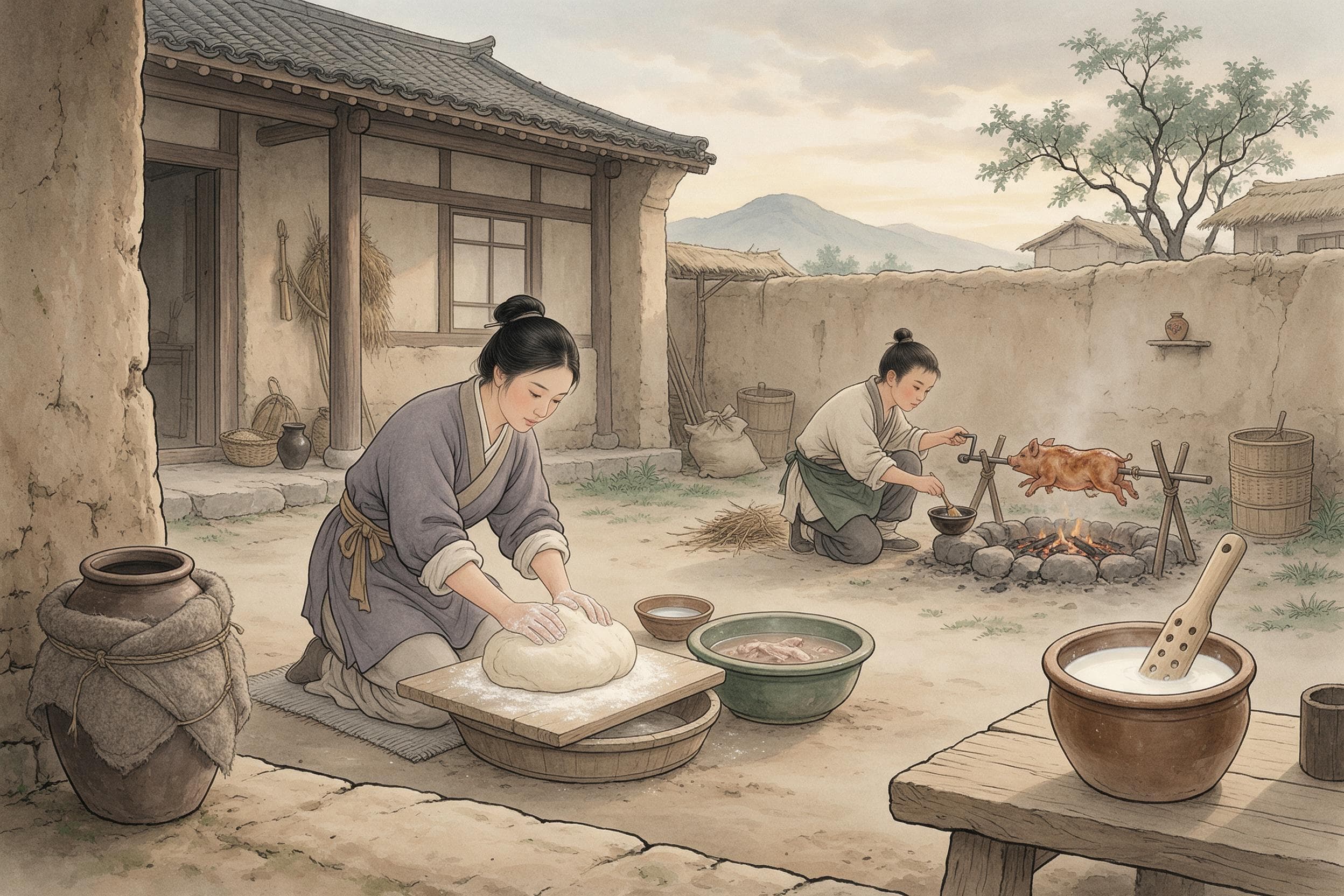
Before dawn in a north Chinese kitchen, the first thing that moves is a cutting board. Fine wheat flour, sifted through silk, sits in a heap. Beside it is a basin of meat broth — the liquid from a pot of stewed meat, skimmed of fat and left to go cold. The dough is not kneaded with water but with that cold broth. The Qimin Yaoshu (齊民要術, Essential Techniques for the Common People) opens its chapter on cakes with exactly this: sift the flour through fine silk, knead it with cooled, seasoned meat broth. Hard dough, cold liquid — both are fixed in the text.
1. The board: two gauges for one dough
The dough becomes two things. Shuiyin (水引) is rolled as thick as a chopstick and cut every chi — a foot — then laid in a basin of water. At the pot, the cook holds each strip over the boiling water and thins it between the fingers until it is, in the text, 'as thin as a leek leaf', dropping it in as the water keeps rolling. Botuo (餺飥) is coarser: as thick as a thumb, cut every two cun, rested in a basin, pressed thin against the side of the basin, then boiled hard and fast. The book adds a line of praise: it is not only 'bright white and pleasing to look at' but 'slippery and fine beyond the ordinary'.
The foot and the inch are not decorative. They were the measures of the day, and the day's foot was roughly a quarter of a metre, its inch about two centimetres, though the standards shifted by region and reign. What matters is that one dough gets two written gauges: strips a foot long, sheets two inches long. A gauge that can be written down is a job that can be handed to someone else — the difference between a recipe and a cook's habit.
2. The pot: boiling water, and a second pot behind it
The noodles cook by zhufei (逐沸), 'following the boil': the water must never stop rolling, and the dough goes in and floats. They are lifted out and dressed with huo (臛), a meat stew. The broth used for kneading is only what was left over; the sauce itself is made separately, with minced meat, salt, fermented bean juice (shizhi, 豉汁) and scallion, boiled down thick. A bowl of noodles at the table is the work of two pots.
Nothing in this sequence is stir-fried. The book does know the verb chao (炒): in the chapter on chickens there is a recipe for eggs broken into a pan, stirred until yolk and white mix, with scallion, salt and fermented beans, fried in sesame oil. But the eggs are a side dish. The meal is built on boiling, steaming, roasting and fermenting. What the cook watches is the fire, not the wok.
3. The fire: a suckling pig, turned without pause
The meat course is the one that eats labour. For zhitu (炙豚), choose a pig still nursing and as fat as possible; male or female, either will do. Kill and dress it as for boiling, scrape it clean, open the belly, take out the organs, wash again. Stuff the belly full of cogongrass. Spit it on oak. The fire must not come close: 'low fire, roasted at a distance; turn it fast and never stop.' A note adds that the turning must go all the way round, 'for if it does not go round, one side burns'.
Then colour and gloss. Clear wine is brushed on repeatedly — 'when the colour is enough, stop'. Fresh lard, as white and clean as it can be, is rubbed on without pause; clean sesame oil will do if there is no lard. The finished pig is 'the colour of amber, and like true gold'. Amber, gold, cracked ice: the three comparisons are all about one thing, the layer of fat and collagen on the skin driven by heat to the edge of transparency.
'Colour like amber, and like true gold. It melts at the mouth, like cracked ice, holding its juices and its fat — quite beyond the ordinary.' — Qimin Yaoshu, juan 9, 'Roasting a Suckling Pig'
Inside those instructions is a labour bill no one itemises. The fire must be low and far; the pig must be turned and brushed and rubbed without stopping. To bring a small pig to 'melts at the mouth', somebody has to stand at the fire and not leave it. The text never says how many people that is, but 'turn it fast and never stop' already pins one person in place.
4. The jar: a spoon of starter to a measure of milk
The same meal needs lao (酪), milk set into a soft curd. The sheep chapter of the same book is more detailed about this than about the pig. Cow's or sheep's milk will both do. When milking, leave one part in three for the lamb or calf, or the young ones starve thin. The milk is simmered gently for four or five boils — too hot and it catches and burns on the bottom; while it simmers it is lifted with a ladle, never stirred in circles, because circling 'breaks' it. Poured into a basin and cooled a little, the skin is lifted off the surface; that skin is the raw material for butter.
Everything turns on the starter. To one sheng of scalded milk, half a spoon of finished sweet curd; stir it through, wrap the jar in felt to keep it warm, and 'by morning the curd is done'. Out in the country, with no curd to borrow, sour rice broth will serve: one spoonful to a dou of milk. The temperature is given as a sensation rather than a number — 'warm, a little warmer than the human body, is right'. Too warm and the curd turns sour; too cold and it will not set at all.
Butter, su (酥), is a separate shift. A plunger is made from an elm-wood bowl with holes cut in its sides and a long handle fitted to the base. The curd goes into a wide jar and stands in the sun until afternoon; then the cook works the plunger up and down to the bottom, adds hot water once, then cold water, and the butter floats. It is gathered by hand in a basin of cold water, squeezed into balls and simmered slowly to drive off the water. Half a day of sun and half a day of arms. In winter it keeps in a sheep's stomach; in summer, in a jar that does not seep.
5. Whose meal this was
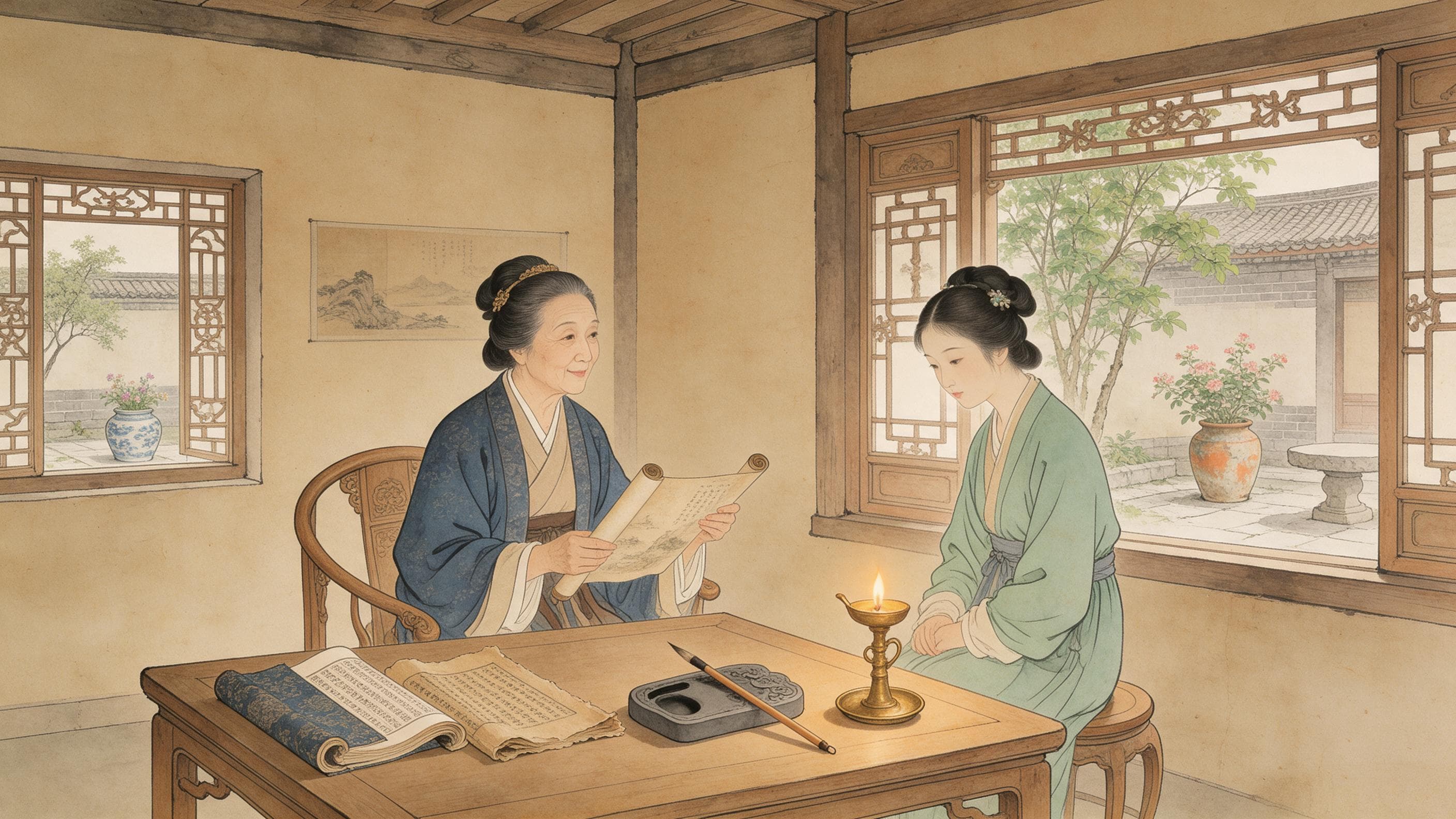
It should be said plainly: the Qimin Yaoshu is not a record of what everyone ate. It is a farming manual for a household with land, animals, grain and wine, from ploughing to vinegar and sauce. Its recipes are standards of what can be done, written for people who can assemble a suckling pig, clear wine, white lard, cow's or sheep's milk and a clay jar. In the sixth century, that was a minority.
So this table is neither a peasant's dinner nor a prince's banquet list. It is closer to a kitchen's upper limit: what a northern cook with full stores and enough hands could do with dough, meat and milk. The scene in the Luoyang Qielan Ji where the southern official Wang Su eats mutton and milk gruel in the emperor's hall is evidence that such food reached a court, not that it reached every stove. On ordinary days most bowls held millet, vegetable broth, salt and beans.
What is interesting here is not that the ancients ate well. It is how much the text reads like an operating manual: so many inches, so many boils, this colour means enough, stop at this point. The instruments are eyes, hands and nose. The first thing to do before the next meal is still to check whether the water is boiling.
Sources & further reading
- 贾思勰《齐民要术》卷第九「饼法第八十二」「炙法第八十」(Jia Sixie, Qimin Yaoshu, juan 9: 'Methods for Cakes' and 'Methods for Roasting') — The recipes followed here: shuiyin and botuo noodles, and the roast suckling pig with its wine and lard glaze.
- 贾思勰《齐民要术》卷第六「养羊第五十七」(附作酪、作干酪、作漉酪、抨酥法)(Jia Sixie, Qimin Yaoshu, juan 6: 'Raising Sheep', with the methods for curd, dried curd, drained curd and butter) — The dairy section of the meal: starter quantities, the warmth of the jar, and the plunger used to beat butter out of the curd.
- 杨衒之《洛阳伽蓝记》卷三「报德寺」条(王肃条)(Yang Xuanzhi, Luoyang Qielan Ji, juan 3, the Wang Su passage) — Used only for the court context: a southern official at Luoyang eating mutton and milk gruel, which shows who such food was served to.