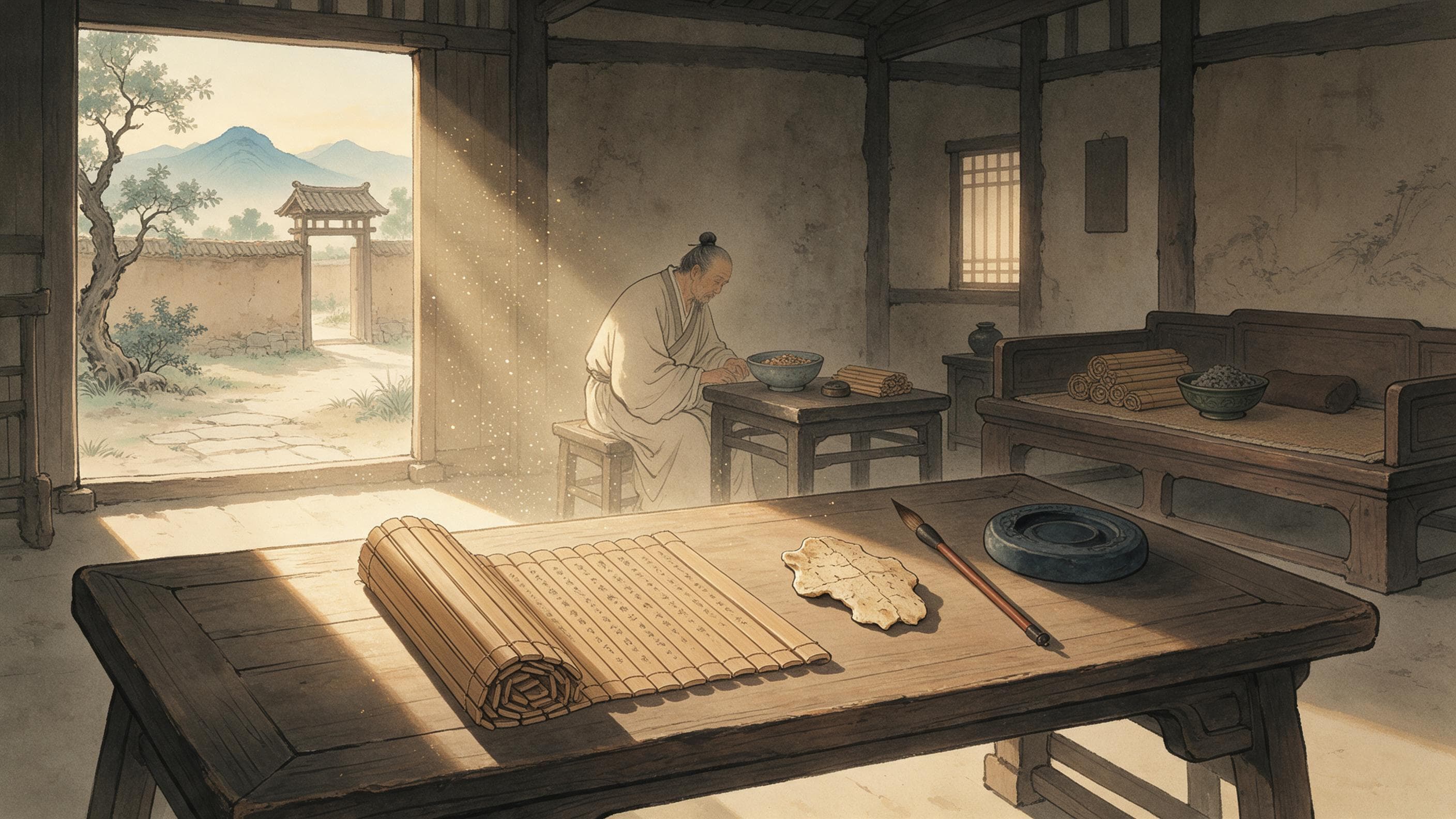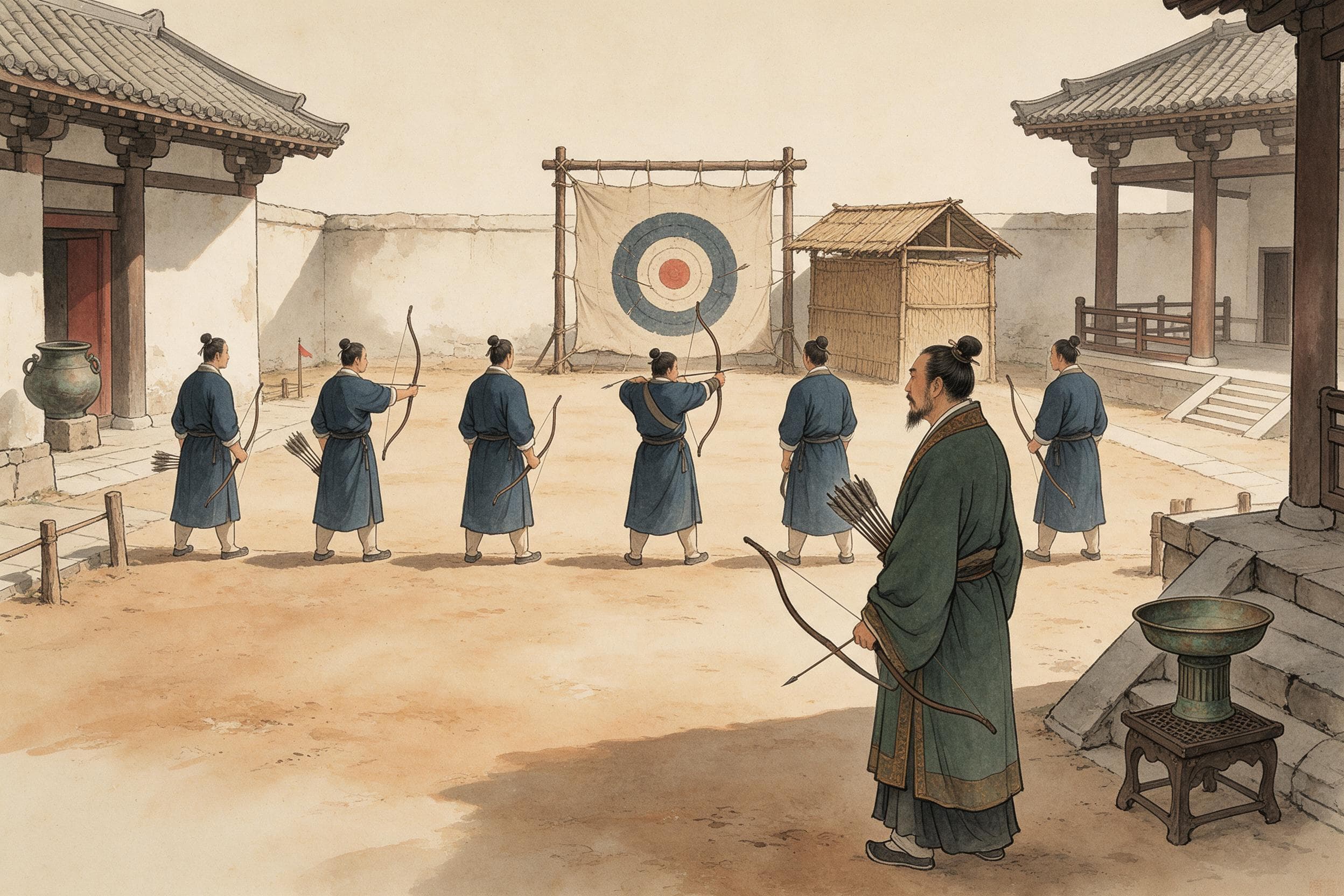
Four characters carry the picture: 'drew swords and struck the pillars' (拔劍擊柱). Hanshu 43: 'The Emperor, having done away with the Qin ceremonial, kept things simple. The ministers drank and quarrelled over merit; when drunk some shouted wildly and struck their swords on the pillars, and the emperor was troubled by it' (高帝悉去秦儀法,為簡易。群臣飲爭功,醉或妄呼,拔劍擊柱,上患之). Shiji 99 has the same passage with one word more: what the emperor abolished was 'the harsh ceremonial of Qin' (秦苛儀法). The two accounts are printed side by side; where they differ, both readings appear.
What the Emperor Wanted Changed
The proposal came from a man who had changed his clothes for him: Shusun Tong, a scholar of Xue, came over to the Han and changed his dress for the king: 'the short jacket of Chu, and the king was pleased' (服短衣,楚製,漢王喜). At court he saw a ruler who had cut ceremony down and ministers who treated the throne as a camp: 'the Confucians are hard to use for taking ground and can be used for holding it; I ask to summon the scholars of Lu and with my pupils to raise a court ceremony' (夫儒者難與進取,可與守成……共起朝儀). The emperor's terms: 'try it; make it easy to understand; measure it to what I can do' (可試為之……度吾所能行為之). His definition: 'ceremony is what trims conduct according to the times and the feelings of men' (禮者,因時世人情為之節文者也); his method: 'old ceremony and Qin ceremony mixed' (頗采古禮與秦儀雜就之).
Of the thirty-odd scholars from Lu, two refused; their refusal is the sharpest voice in either chapter: 'The lord you serve has already served nearly ten rulers, and won his place by flattering every face. Now the dead are not yet buried, the wounded not yet up, and you want to raise music and ceremony. What ceremony rises from needs a hundred years of accumulated virtue before it can be undertaken… Go, and do not smear us' (公所事者且十主,皆面諛以得親貴……積德百年而後可興也……無汙我). Shusun Tong laughed: 'You are indeed vulgar scholars, who do not know the changes of the time' (若真鄙儒也,不知時變). Both speeches are printed here; the article takes no side. The books differ inside the refusal too: Hanshu prints 面腴 where Shiji has 面諛, and reverses the sentence on virtue.
A Month in the Open Field
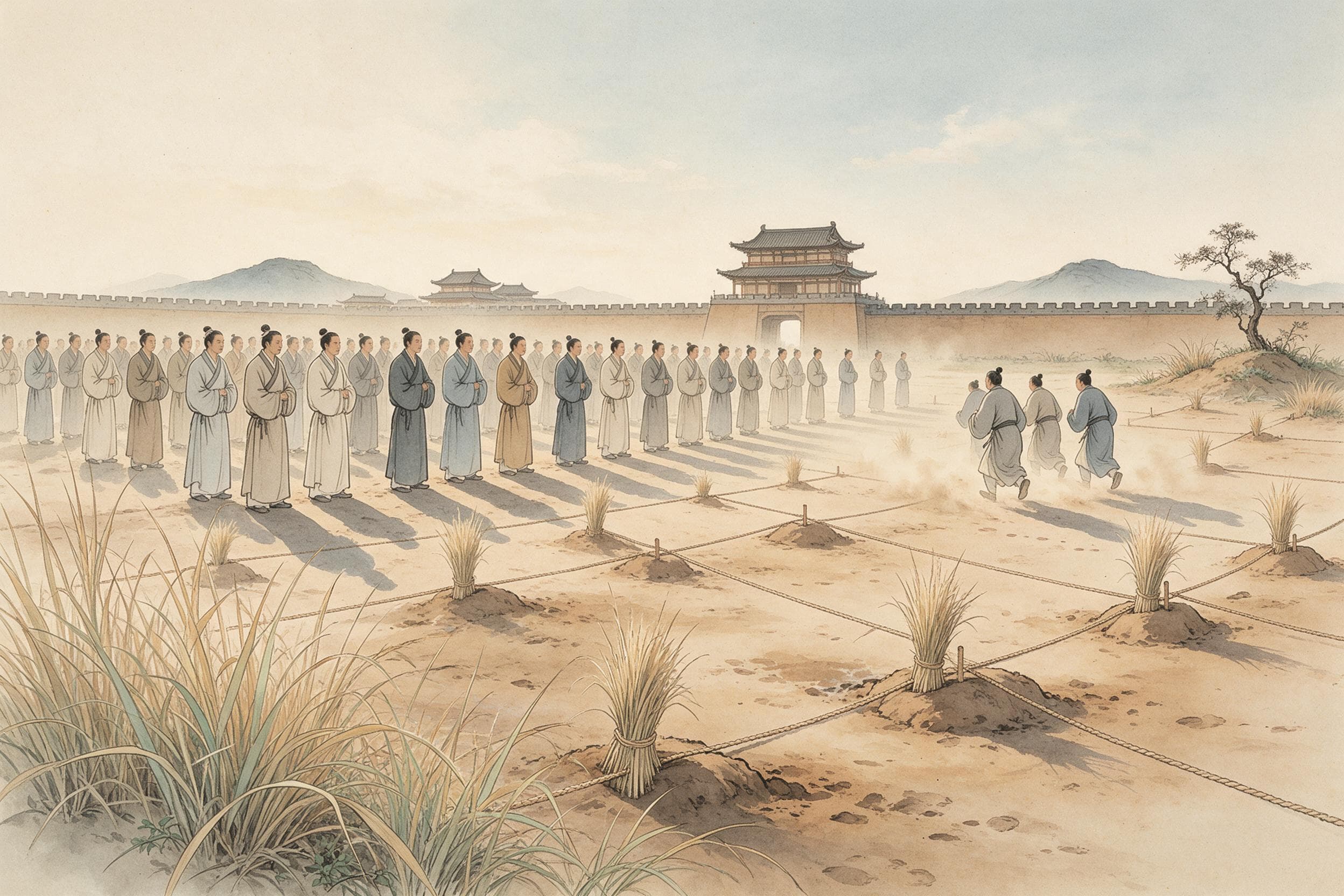
'With the thirty he had summoned he went west, and with the emperor's own scholars and his pupils, more than a hundred men, he made the wei-cui in the open field and drilled it for over a month' (及上左右為學者與其弟子百餘人為綿蕞野外。習之月餘). What 綿蕞 was, neither page says; the usual explanation is ropes stretched and bundles of grass set up to mark the ranks — a common account, not stated by either text, and not elaborated here. The emperor then examined the rehearsal himself: 'the emperor had the ceremony performed, and said, "I can do this"' (上使行禮,曰:「吾能為此」); 'then he ordered the ministers to rehearse it, and fixed on the tenth month' (乃令群臣習肄,會十月).
Both pages give the tenth month without explanation. In the reckoning the Han took over from Qin, the tenth month was the first month of the year — the usual account, not stated on either page, and not converted into another calendar here. The day: 'in the seventh year of Han, when the Changle palace was completed, the marquises and ministers all came to court in the tenth month' (漢七年,長樂宮成,諸侯群臣皆朝十月). They do not begin at the same point: Shiji has 'in the fifth year of Han, when the world was already united' (漢五年,已并天下), Hanshu only 'when the king of Han had united the world' (漢王已並天下), with no year.
The Day: What the Texts Actually Stage
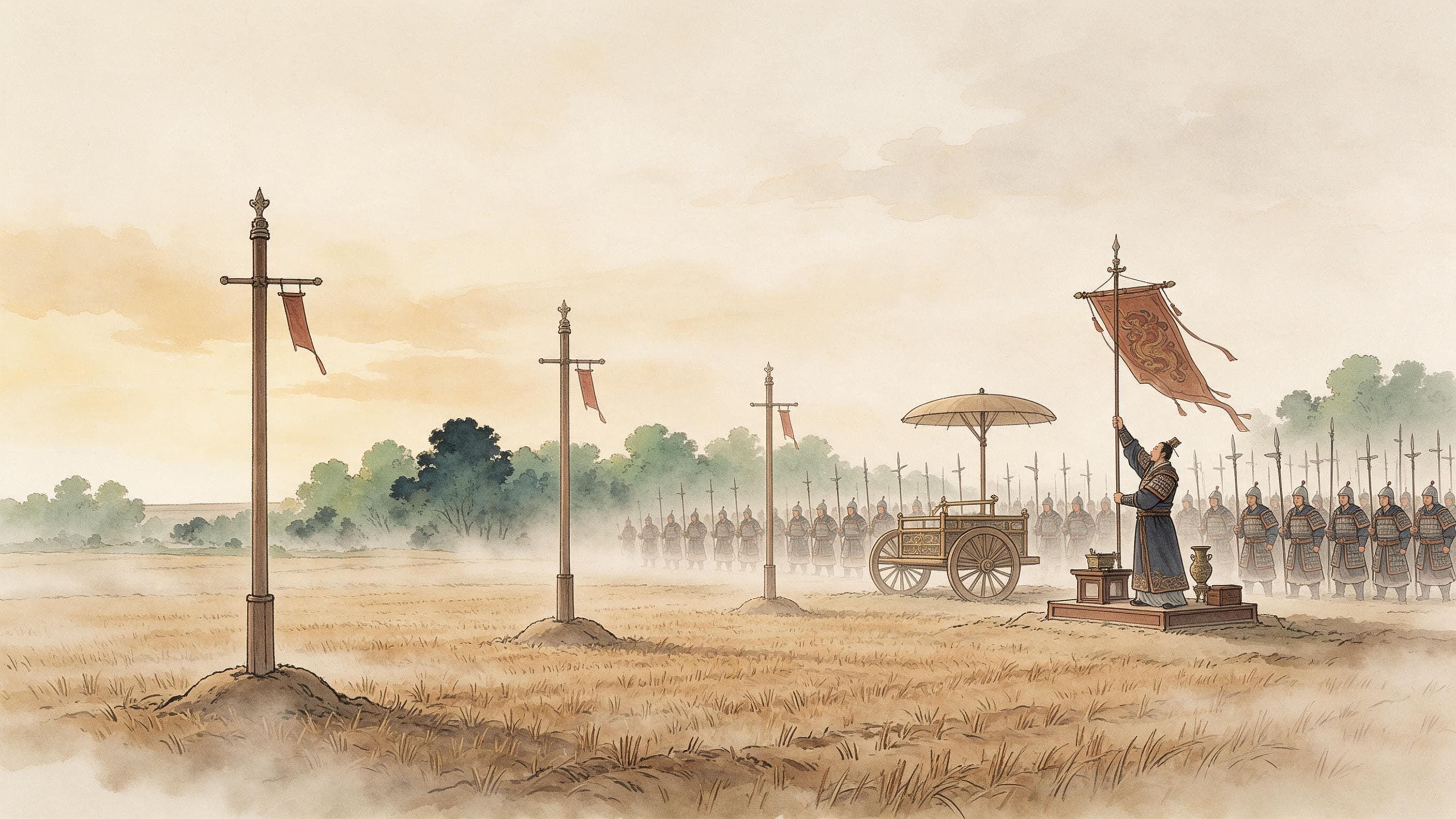
The audience is not a blank: both pages give the same sequence, the most concrete thing in either chapter. Before dawn 'the ushers arranged the ceremony and led them in order through the palace gate' (先平明,謁者治禮,引以次入殿門). In the courtyard 'chariots, cavalry and guards were displayed to guard the palace, weapons set out and banners raised' (廷中陳車騎戍卒衛官,設兵,張旗志) — Shiji has 'step soldiers' and 'guarding the palace' for 'garrison soldiers' and 'guarding the officers'. Then the word passed down: 'the word "hasten" was relayed' (傳言「趨」), Hanshu 'the relay said "hasten"' (傳曰「趨」). Below the steps 'the gentlemen of the palace flanked the steps, several hundred of them' (殿下郎中俠陛,陛數百人).
Then the ranks: 'the men of merit, the marquises, the generals and the officers of the army were ranged on the west side, facing east; the civil officials from the chancellor down on the east side, facing west' (功臣列侯諸將軍軍吏以次陳西方,東鄉;文官丞相以下陳東方,西鄉). The master of ceremonies 'set the nine guests and relayed the calls in clauses' (大行設九賓,臚句傳) — Shiji has simply 臚傳. Then 'the emperor's carriage came out of the chamber, and the hundred officers, holding their halberds, passed the warning' (皇帝輦出房,百官執戟傳警); Shiji has 'holding their duties' (執職). 'The marquises and kings and below, down to officers of six hundred shi, were led in order to offer congratulations' (引諸侯王以下至吏六百石以次奉賀), and 'none was not shaken and reverent' (莫不振恐肅敬); Hanshu writes 震恐 for 振恐.
The drinking had rules: 'when the ceremony was done, the set wine was laid out again; those seated in the hall all bowed their heads low and rose in order of rank to offer the long life; the cup went nine rounds, and the usher said, "stop the wine"' (復置法酒……觴九行,謁者言「罷酒」). The books differ twice here: Hanshu has 'all bowed low; the set wine was laid out' (盡伏,置法酒) and seats 'below the hall' (殿下) for seats 'in the hall' (殿上). Order was kept by law: 'the censors took away anyone who did not follow the ceremony' (御史執法舉不如儀者輒引去), and 'through the whole audience no one dared break the ceremony' (竟朝置酒,無敢讙譁失禮者). Neither page gives the level below this — paces, angles, invocations, vessels; none of it is supplied here.
One Sentence at the End
Afterwards the emperor said one sentence, the one the affair is remembered for: 'Only today do I know how noble it is to be emperor' (吾乃今日知為皇帝之貴也). He did not praise the ceremony; he named the position. Then the rewards: 'he appointed Tong director of offerings' — 奉常 in Hanshu, 太常 in Shiji — 'and gave him five hundred jin of gold' (賜金五百斤); the pupils asked for offices and 'the emperor made them all gentlemen of the palace' (悉以為郎); Shusun Tong went out and 'gave all the five hundred jin of gold to the scholars' (皆以五百金賜諸生), the sum left as the pages leave it. The scholars' verdict forks too: 'Master Shusun is a sage who knows the business of the age' (叔孫生聖人,知當世務); in Shiji, 'truly a sage, who knows the essentials of it' (誠聖人也,知當世之要務).
Where the Two Books Part
Side by side, the two accounts are one affair with a dozen small forks. Shiji dates the beginning to the fifth year and calls the abolished rules 'harsh Qin ceremonial'; Hanshu gives neither. Hanshu prints 面腴 where Shiji has 面諛, and reverses the sentence on virtue. In the audience: garrison troops guarding the officers or step troops guarding the palace; the relay 'say' hasten or 'speak' it; calls relayed in clauses or plain; officers holding halberds or duties; the wine laid out again or the company bowing first; seats below the hall or in it; trembling or shaking. The post is 奉常 in one, 太常 in the other. Neither page says which reading is older; none is corrected here.
Both chapters close in their own way, and both closings are verdicts, not records. Sima Qian: 'Shusun Tong measured the business of the world… and in the end became the Confucian patriarch of the Han house' (叔孫通希世度務……卒為漢家儒宗). Ban Gu's eulogy: 'Shusun Tong left the drum and set up the ceremony of one king: he met his time' (叔孫通舍枹鼓而立一王之儀,遇其時也). Neither page says the court ceremony was established by this; nor does this article. What they record is a quarrel at a drinking party, a month of drilling in a field, one audience, and one sentence from the emperor.
Related reading:The Taichu Calendar: Twenty-odd Men and a One-Line Rule · The Men on Mount Tai: Who Went Up to Seal the Summit · Lowering the Coffin: The Day of the Burial
Sources & further reading
- 《汉书》卷四十三·郦陆朱刘叔孙传·叔孙通(东汉班固撰;维基文库本,页面白文无注,未与点校本复核) — The court ceremony in the Hanshu: the emperor abolished Qin ceremonial for simplicity, the ministers drank and quarrelled over merit and struck their swords on the pillars; Shusun Tong's argument that Confucians are hard to use for advance and easy for holding ground; the emperor's three conditions — try it, keep it easy to understand, measure it to what I can do; the two Lu scholars who refused because the dead were unburied and virtue needed a hundred years; over a hundred men drilling the wei-cui in the open field for more than a month; the tenth-month audience in the seventh year at the completed Changle palace, from daybreak and the ushers through the relayed word 'hasten', the ranks east and west, the nine guests, the carriage, the congratulations, the set wine, nine rounds of cups and the censors removing anyone out of order; the emperor's sentence about knowing how noble an emperor is; the appointment as 奉常 and the five hundred jin of gold given away to the scholars.
- 《史记》卷九十九·刘敬叔孙通列传(西汉司马迁撰;维基文库本,页面白文无注,未与点校本复核) — The Shiji's second telling, with small but telling variants: it dates the beginning to the fifth year of Han, calls the abolished rules 'the harsh Qin ceremonial', prints 面諛 for the Hanshu's anomalous 面腴 and orders the sentence on virtue the other way, has step soldiers guarding the palace and officers 'holding duties' rather than halberds, relays the calls without the extra character, sets out the wine again rather than having the company bow first, seats them in the hall rather than below it, and appoints Shusun Tong 太常 where the Hanshu has 奉常. It closes with Sima Qian's verdict that he became 'the Confucian patriarch of the Han house'.