There is a small scene in the Shiji's annals of the founder of the Han. As head of the Sishui post, Liu Bang had a cap made of bamboo skin; he sent his 'thief-catcher' (求盗) to Xue to have it finished, wore it often, and kept wearing it after he became emperor, so that people called it the Liu family cap. A post head, a bamboo cap, one subordinate called a thief-catcher — that is the most concrete picture of a Han ting anywhere in these two books.
The rule
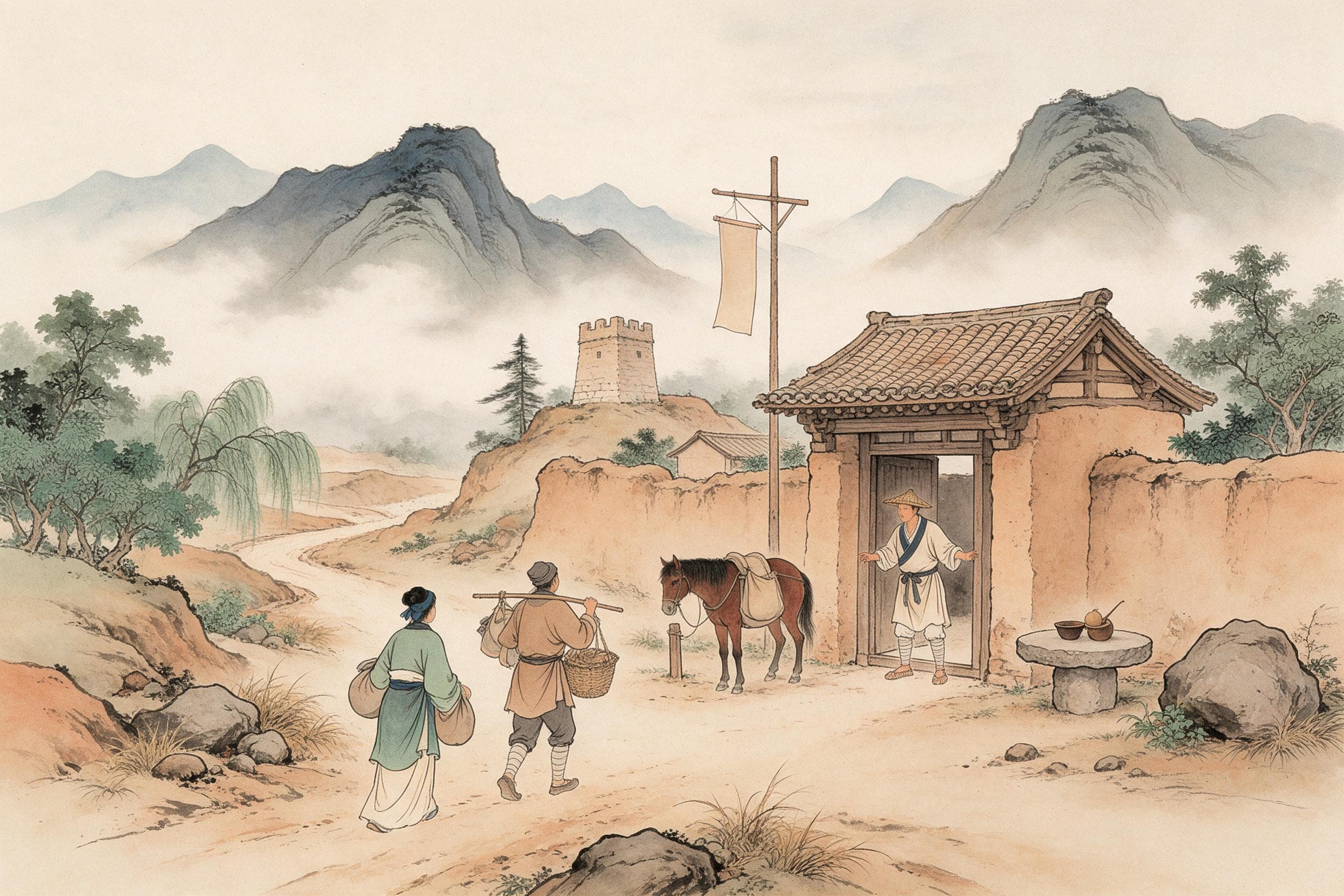
Start with the rule. The Han shu's table of officials, in its section on county magistrates, describes the ladder below the county: 'As a rough rule, one post every ten li, and each post has a head. Ten posts make a township, and the township has the Three Elders, the salaried headman, the granary officer and the patrol officer. The Three Elders oversee instruction; the headman hears disputes and collects taxes; the patrol officer goes about suppressing thieves. A county is roughly a hundred li square; where the people are dense it is reduced, where they are sparse it is left open, and townships and posts likewise. All this is Qin system.'
Two things in that passage matter. First, 'roughly' appears twice: ten li to a post is rough, and so is the hundred-li county, and the text says outright that where people are dense the unit shrinks and where they are sparse it spreads. So 'one post every ten li' is an institutional sketch, not a surveyed map. Second, the duties listed — instruction, hearing disputes, collecting taxes, suppressing thieves — belong to the township's Three Elders, headman and patrol officer, not to the post head. The post head's duties are not given here at all. The same table also gives totals: 'In all, counties, marches, fiefs and towns: one thousand five hundred and eighty-seven; townships: six thousand six hundred and twenty-two; posts: twenty-nine thousand six hundred and thirty-five.' Set the last two side by side and the arithmetic is not ten to one: nearly thirty thousand posts against some six and a half thousand townships comes to under five posts per township. So 'ten posts to a township' is a rule of thumb, not the table's own count. That gap is exactly what the repeated 'roughly' was warning about.
The man
Now the man. The Shiji says Liu Bang, when grown, 'tried for office and became head of the Sishui post; there was no clerk in the county hall he did not mock; he loved wine and women, and regularly drank on credit at the houses of Wang and Wu.' Later, when the magistrate of Pei had an honoured guest, the local worthies and clerks all came to congratulate him; Xiao He managed the gifts and ruled that anyone giving less than a thousand cash sat below the hall. Liu Bang, 'who as post head had always made light of the clerks, lied on his card, “a gift of ten thousand cash”, though he brought not a coin', and took the seat of honour. The post head that emerges is a petty officer moving among the county office and the local elite.
His tasks are concrete too. 'When Liu Bang was post head he often took leave to go back to his fields.' And 'as post head he escorted convict labourers for the county to Lishan, and many of them ran away on the road'; he ended by letting the rest go. Add the cap: he had a thief-catcher whom he could send to Xue on an errand. Escorting, leave, one subordinate who caught thieves — that is the daily work of a post head as these two pages show it.
What the post was for
Put the two pages together and this is what can be said: a ting was a node below the county, set at roughly ten-li intervals, with a head; by the Han shu's table there were nearly thirty thousand of them; the head was a clerk, could enter by trial, had a place in the county office, was tasked at least with escorting convicts, and had a 'thief-catcher' under him. Whether the ting also carried mail, lodged travellers or kept order generally is what later commentators say, not what these two pages say. So this piece does not call the ting a police station, and does not call it a post station.
Nor can 'ten li' be used as a ruler. The table itself says the unit shrinks where people are dense and spreads where they are sparse, and that townships and posts alike follow this. So one cannot divide the empire's area by the number of posts to get a grid, or draw 'one post every ten li' as an even net. What can be said is that this was a mesh laid out at roughly ten-li intervals, and that at one administrative moment it was counted at nearly thirty thousand.
How much one man shows
Liu Bang's case must be handled with care. That he 'tried for office' shows a post head need not be hereditary or high-born; that he loved wine and drank on credit shows the post was small and the pay modest; that he could mock the county clerks and take the seat of honour shows he had local standing and connections. But all this is the writing of an imperial biography, which also contains dragons, cloud vapour and the slaying of the white serpent — details shaped to show that he was destined for greatness. Use him to show what one post head could be like; do not use him to argue that all post heads were low-born or fond of drink.
His errands, by contrast, can be trusted: escorting convicts, taking leave for the fields, sending a thief-catcher on an errand are duties, not omens. As for salary, staff, buildings and budget, neither page gives them; the thief-catcher is the only subordinate named, and no establishment can be computed from him.
What the sources do not show
The gaps should be stated. The post head's duties are not in the table; the duties the table lists are the township officers'. The mail, lodging and police functions of the ting come from later commentators and are not used here. Nothing is said of the post building, its staff or its money. The table's figure of nearly thirty thousand is a count at one administrative moment, not the number in Liu Bang's day; and the Han shu's table is an Eastern Han institutional summary, while the Shiji is a Western Han biography — two pages roughly two centuries apart, and of different kinds.
So the two pages give a rule and a man: roughly one post every ten li, each with a head, counted at nearly thirty thousand across the empire; and one head of one post who wore a bamboo cap, drank on credit, escorted convicts, and later became emperor. The mesh is real in the text. What happened on it day by day is mostly missing. The word ting outlived the Han, but these pages leave us the post and the man, not the desk.
Related reading:Six Chi Six Cun: A War Chariot's Measurements and Two Ways of Counting a Sheng · How Big Should a City Be? The Nine Li of the Kaogong ji and the Hundred Zhi of the Zuo zhuan · Fifty Paces Wide and Eighteen Hundred Li Long: What Qin's Roads Look Like in the Sources
Sources & further reading
- 班固《汉书》卷十九·百官公卿表(东汉;维基文库本,未与点校本复核) — The table's section on county magistrates describes the sub-county ladder: 'as a rough rule one post (亭) every ten li, each with a head; ten posts to a township, and the township has the Three Elders, the salaried headman, the granary officer and the patrol officer', then gives the duties of those township officers, adds that counties are 'roughly a hundred li square, reduced where the people are dense and left open where they are sparse, and townships and posts likewise', and calls the whole scheme Qin in origin. The same section counts 1,587 counties, marches, fiefs and townships; 6,622 townships; and 29,635 posts. It gives no duties, staff or budget for the post head himself.
- 司马迁《史记》卷八·高祖本纪(西汉;维基文库本,未与点校本复核) — The Western Han biography of Liu Bang, the future Emperor Gao. It says he 'tried for office and became head of the Sishui post', mocked the county clerks, drank on credit at two wine shops, had a bamboo-skin cap made by his 'thief-catcher' (求盗) and wore it later as emperor, took leave to work his fields, bluffed his way into a county banquet with a claim of a ten-thousand-cash gift, and as post head 'escorted convict labourers for the county to Lishan, and many of them ran away on the road'. The biography is shaped by imperial legend; its details of the post are usable, its miracles are not.