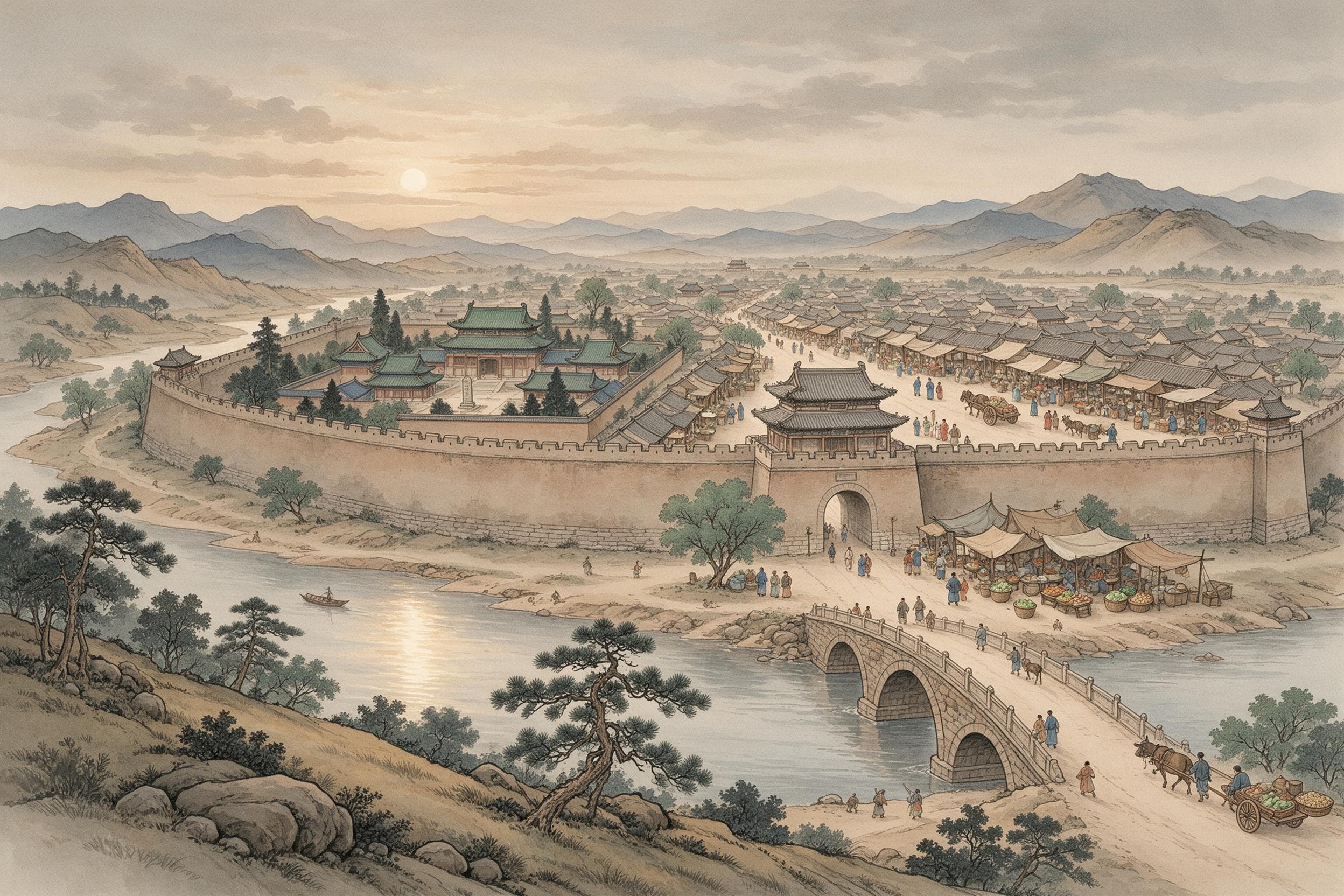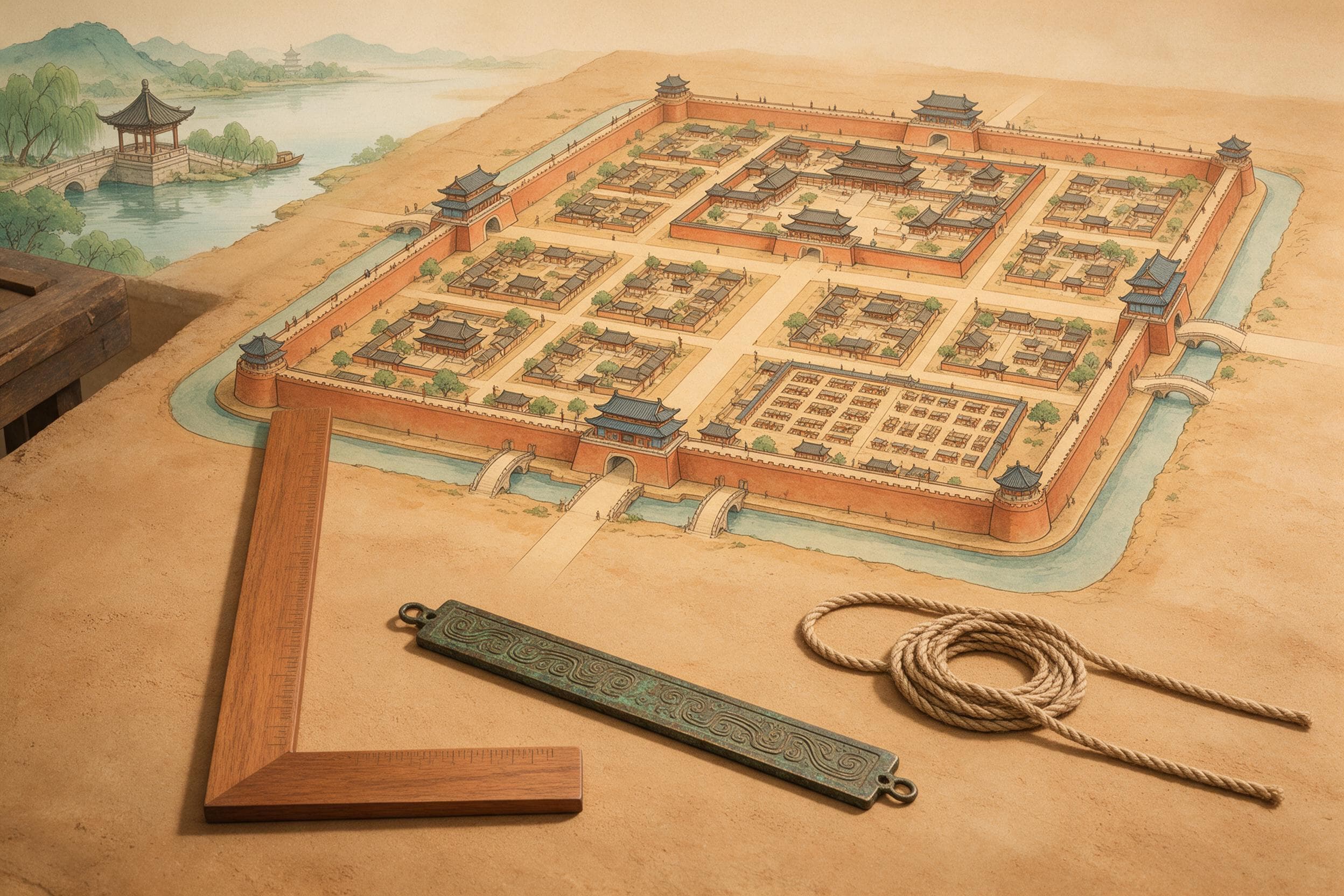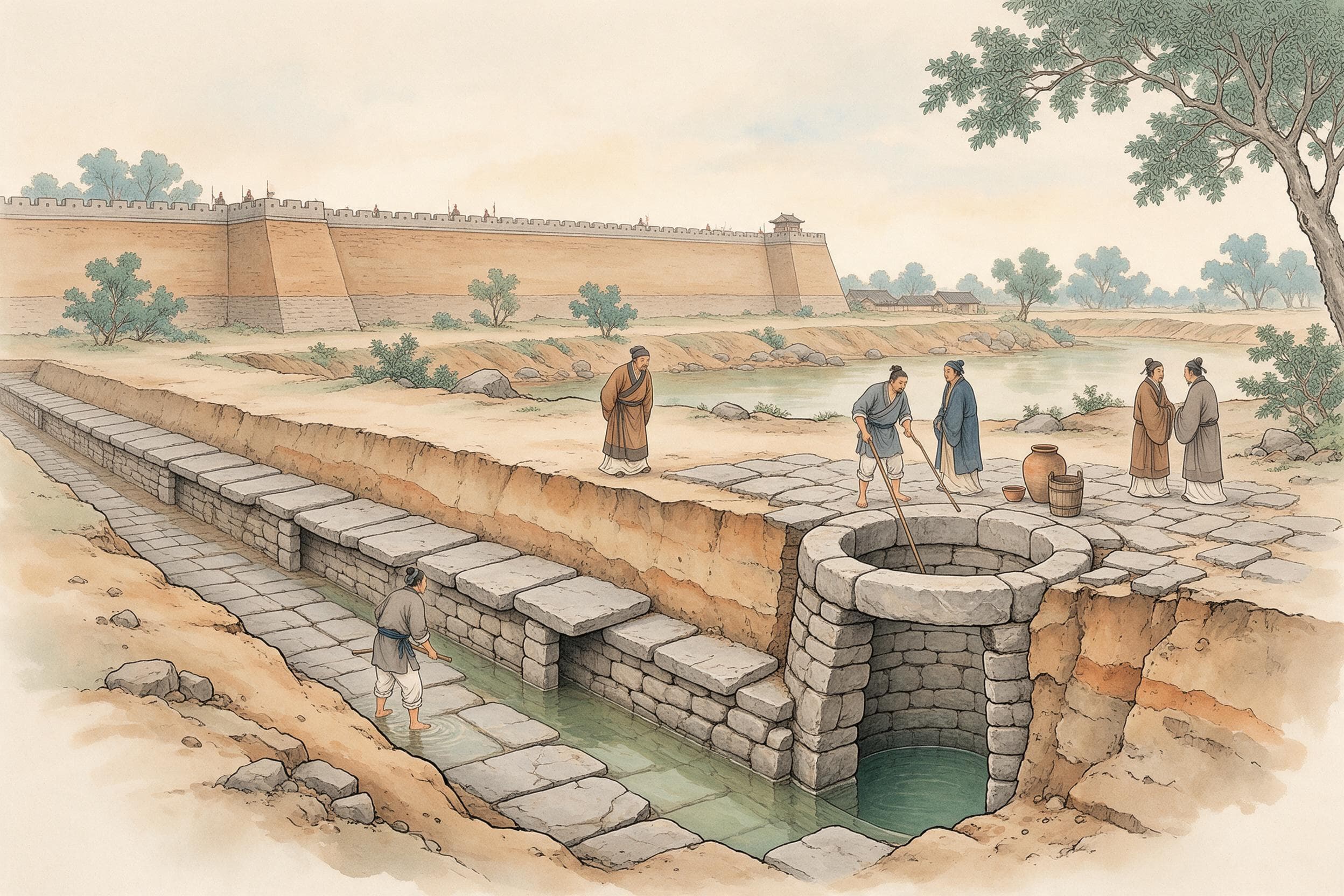
The entry for the twenty-seventh year of the First Emperor's reign runs through a tour of the northwest, a new palace, a temple, a covered walkway from Xianyang, and then ends with three characters: zhi chidao, "he built the imperial highways". That is what the Qin state itself left behind about its road programme. No length, no width, no route.
Three characters and a Han memorial
What the highways looked like comes from a memorial written a generation later, by Jia Shan, advising Emperor Wen of Han. It survives in the Book of Han: roads were made across the empire, reaching east to Yan and Qi and south to Wu and Chu, to the lakes and rivers, until "every view worth seeing by the sea was reached". They were fifty paces wide, trees were planted at intervals of three zhang, the surface was rammed thick on the outside and "hidden with iron pestles", and green pines were set along them. Then comes the sentence that shows what the passage is for: built on that scale, later ages "could not even find a footpath to put a foot on".
So the specification has a position. Jia Shan was using Qin to argue with his own emperor, and his theme was that Qin's extravagance destroyed it. "East to Yan and Qi, south to Wu and Chu" is rhetorical reach, not an itinerary, and "every view worth seeing" is not a road list. Fifty paces need not be converted into metres: it is not an engineering figure in the first place but a figure meant to stagger a reader.
A road rammed with iron
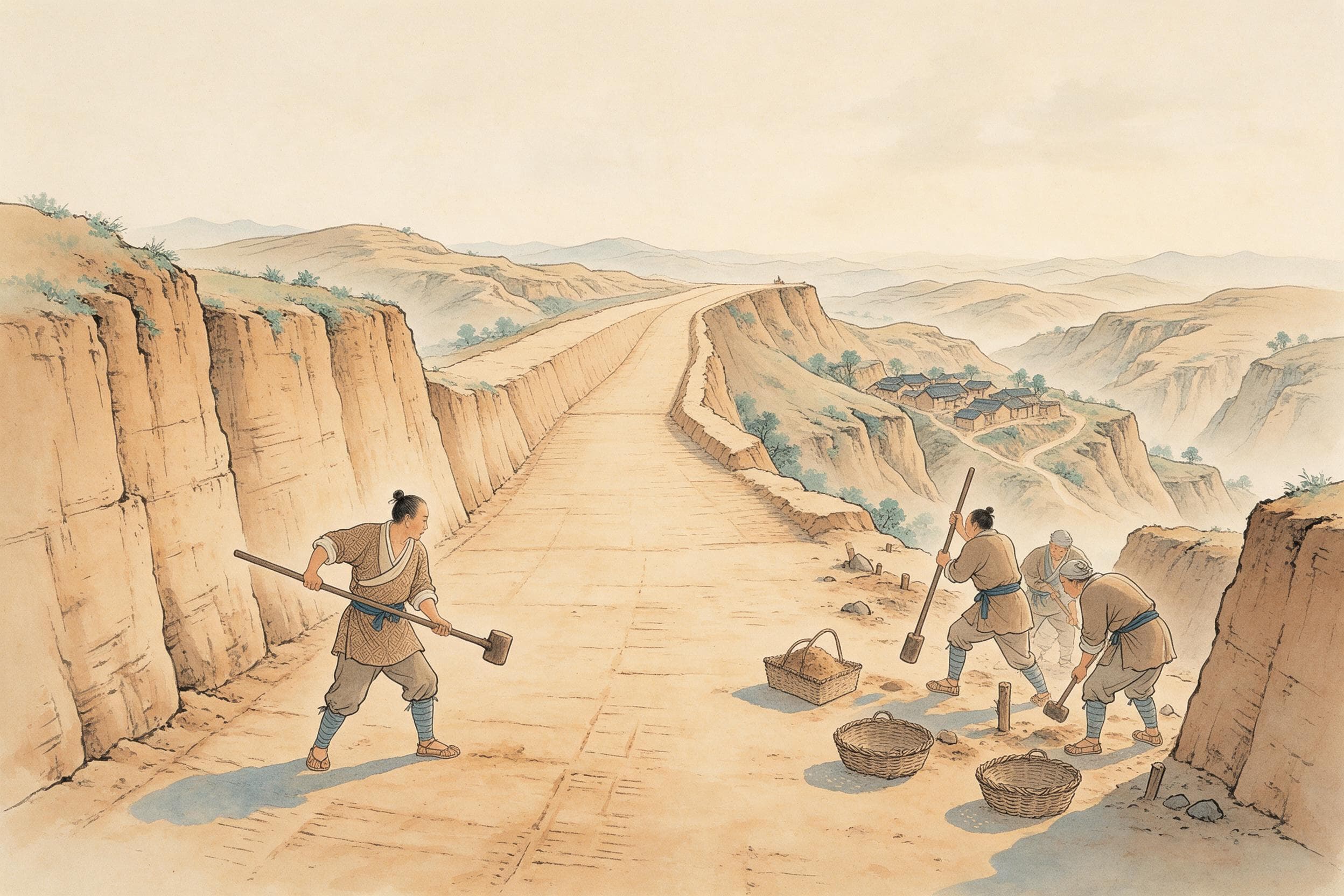
Only a few actions in the passage can be taken as technique. "Rammed thick on the outside" describes a raised, compacted roadbed. "Trees at three zhang" is generally read as a pine every three zhang, though the original is compressed enough that the reading should be marked as the usual one. The difficult phrase is "hidden with iron pestles" — the jin zhui, an iron rammer — and the two surviving commentaries disagree about it. One, by Fu Qian, says walls were built like those of a covered corridor and rammed with the iron tool; the other, by Yan Shigu, says the roadbed was simply rammed firm and raised, with no walls at all. Both are printed here; the article will not choose between them.
Put together, the picture is a road far wider than most modern carriageways, its bed rammed thick and high, pines planted at measured intervals. The Han writer calls it li, splendid. The word is a description and an accusation at the same time.
The Straight Road: eighteen hundred li
The other road is a different kind of object, and the material is firmer. In the thirty-fifth year, 212 BCE, the annals record an order to clear a road from Jiuyuan to Yunyang, "cutting mountains and filling valleys, driving straight through". The biography of the general Meng Tian gives more: the emperor wanted to tour the empire, so Meng Tian was sent to open a road from Jiuyuan to Ganquan, "cutting mountains and filling valleys, eighteen hundred li. The road was not completed." The two chapters name the far end differently, one Yunyang and one Ganquan, and the original inconsistency is kept here rather than smoothed away. The eighteen hundred li are left as recorded, not converted.
The verbs of construction are qian shan yin gu: cutting through mountains and filling in valleys, the same four characters in both chapters. And at the end of the biography Sima Qian adds something better than either: he went there himself. Sent north, he came back by the Straight Road and saw the mountains Meng Tian had cut, the valleys he had filled, and the walled posts and forts built for the Qin. His verdict was that the man had indeed made light of the people's strength.
Unfinished, and still carrying a coffin
The striking words are "the road was not completed". Eighteen hundred li, and it was never finished. Yet in the thirty-seventh year, when the emperor died on tour at Shaqiu, his followers hid the death, took the body from Jingxing to Jiuyuan, and then came the shortest of sentences: "They went by the Straight Road to Xianyang and the mourning was proclaimed." A road that was never completed carried the emperor's coffin home.
The two statements must be left side by side. The sources say the road was unfinished; they do not say work stopped. They say the funeral went from the Straight Road to Xianyang; they do not say the whole line was open. Nor can the fifty paces and the pines be transferred to the Straight Road: those belong to a different description of a different road.
What each kind of source is doing
This article has no numbers for labourers or for years of work. The "several hundred thousand officials and convicts" in Jia Shan's memorial belong to the First Emperor's tomb, not to roads. Qin left no engineering archive, no post-station register, no mileage book, and no excavation report this piece could cite; those gaps are marked in the research notes as not to be used.
So Qin's roads are, in these pages, two kinds of document: an administrative trace three characters long, and a Han memorial written to condemn Qin. The two figures English readers quote most confidently, fifty paces of width and pines every three zhang, both come from the second. That does not make them false. It makes them unverifiable from Qin's own records.
What is genuinely informative is the juxtaposition: a road recorded as unfinished, carrying the First Emperor's body back to his capital, and a Han historian who walked home along it and wrote that the builders had made light of the people's strength. Whether it deserves to be called the world's first highway is not a question the sources ask, and there is no need to answer it for them.
Sources & further reading
- 司馬遷《史記》卷六·秦始皇本紀(Sima Qian, Records of the Grand Historian, juan 6, "Basic Annals of the First Emperor of Qin") — The twenty-seventh year (220 BCE) ends with the three-character entry 'he built the imperial highways'; the thirty-fifth year (212 BCE) orders a road cut from Jiuyuan to Yunyang, 'cutting mountains and filling valleys'; and after the emperor's death the funeral procession 'went by the Straight Road to Xianyang and the mourning was proclaimed'.
- 司馬遷《史記》卷八十八·蒙恬列傳(Sima Qian, Records of the Grand Historian, juan 88, "Biography of Meng Tian") — The emperor wanted to tour the empire, so Meng Tian was sent to open a road from Jiuyuan to Ganquan, 'cutting mountains and filling valleys, eighteen hundred li; the road was not completed'. Sima Qian adds that he himself came home by the Straight Road and saw the cut mountains and filled valleys.
- 班固《漢書》卷五十一·賈山傳(Ban Gu, Book of Han, juan 51, "Biography of Jia Shan") — Jia Shan's memorial to Emperor Wen describes the Qin highways as reaching east to Yan and Qi and south to Wu and Chu, fifty paces wide, planted at three zhang intervals, rammed thick outside and 'hidden with iron pestles', with green pines set along them; the two surviving commentaries on the iron pestles disagree.