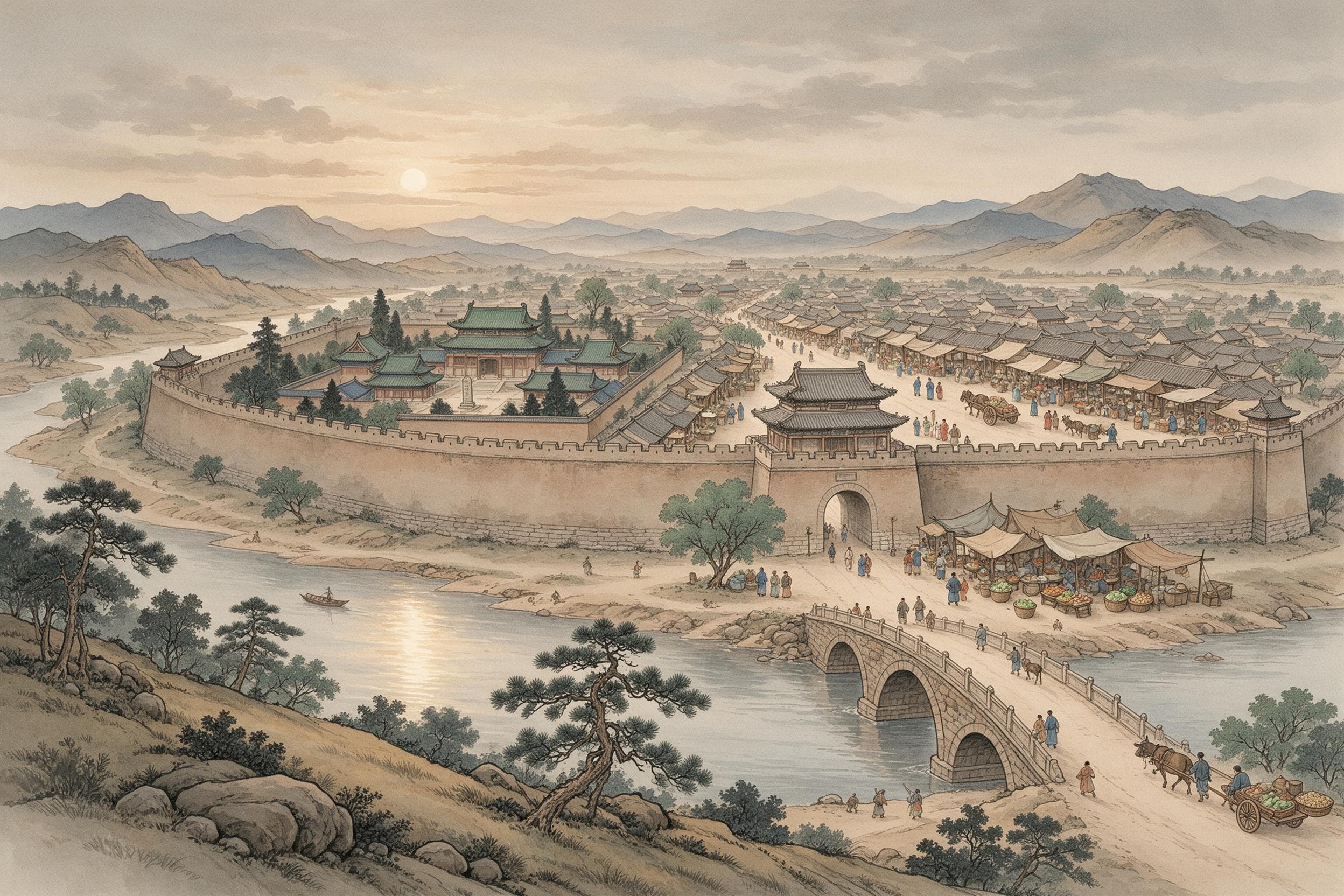
Set two sentences side by side and they almost make a couplet. One is a drawing: 'The master builder lays out the capital: nine li square, three gates to each side.' The other is a prohibition: 'If a secondary capital exceeds a hundred zhi, it is a danger to the state.' The first says how a city should be arranged; the second says how large a city may not be. Neither measures a particular city — which is the thing easiest to forget when reading them.
A plan nine li square
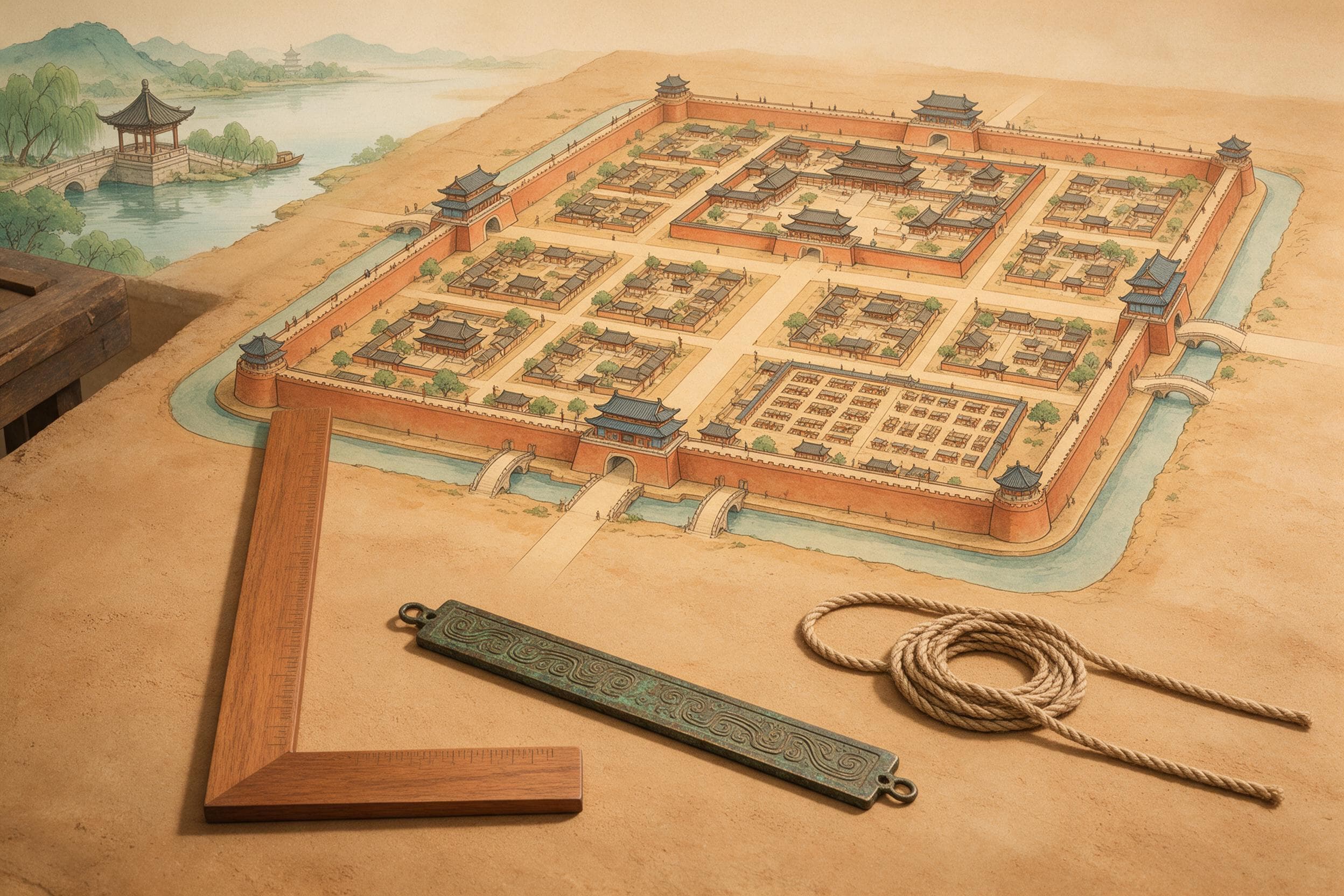
The 'Artificers' Record' in the Rites of Zhou gives a whole scheme for laying out the capital: 'nine li square, three gates to each side; within the city nine north-south and nine east-west avenues, the main avenues nine carriage-tracks wide; the ancestral temple on the left, the altars of soil and grain on the right, the court in front and the market behind, the market and court each one fu.' Number, gates, roads, temple and altars, court and market — everything fixed by position. Every element is positional: the number of gates, the grid of avenues, the width of the main road in carriage-tracks, the ancestral temple and the altars of soil and grain, the court and the market. Nothing in the sentence is a dimension taken from a site; it is a specification for one to be built.
The same chapter then grades people by the zhi: 'The royal palace gate-screen is five zhi; the palace corner, seven; the city corner, nine.' And further: 'The gate-screen standard is to serve for the walls of secondary capitals; the palace-corner standard for the walls of the lords.' In this text the size of a city is not an engineering question but a question of rank.
A prohibition of a hundred zhi
The Zuo zhuan, under the first year of Duke Yin, shows the other face. Duke Zhuang of Zheng had enfeoffed his younger brother Duan at Jing, and Zhai Zhong warned him: 'If a secondary capital exceeds a hundred zhi, it is a danger to the state. By the former kings' rule, the great secondary capitals are no more than one third of the capital, the middle ones one fifth, the small ones one ninth. Now Jing is out of measure, contrary to rule; you will not be able to bear it.' What follows in the Zuo zhuan is the story: Duan expands, arms, and finally flees.
The passage is often read as a Zhou building code, but it is a piece of advice about one city in one state: the object is a secondary capital of Zheng, the lever is the line at a hundred zhi, the conclusion is that the duke will not be able to bear it. Whether 'one third of the capital' measures wall length or wall circuit, the commentators explain and the text does not; this article keeps the ratios as stated, does not turn them into areas, and does not compute the size of Jing — the material never gives it.
What a zhi was
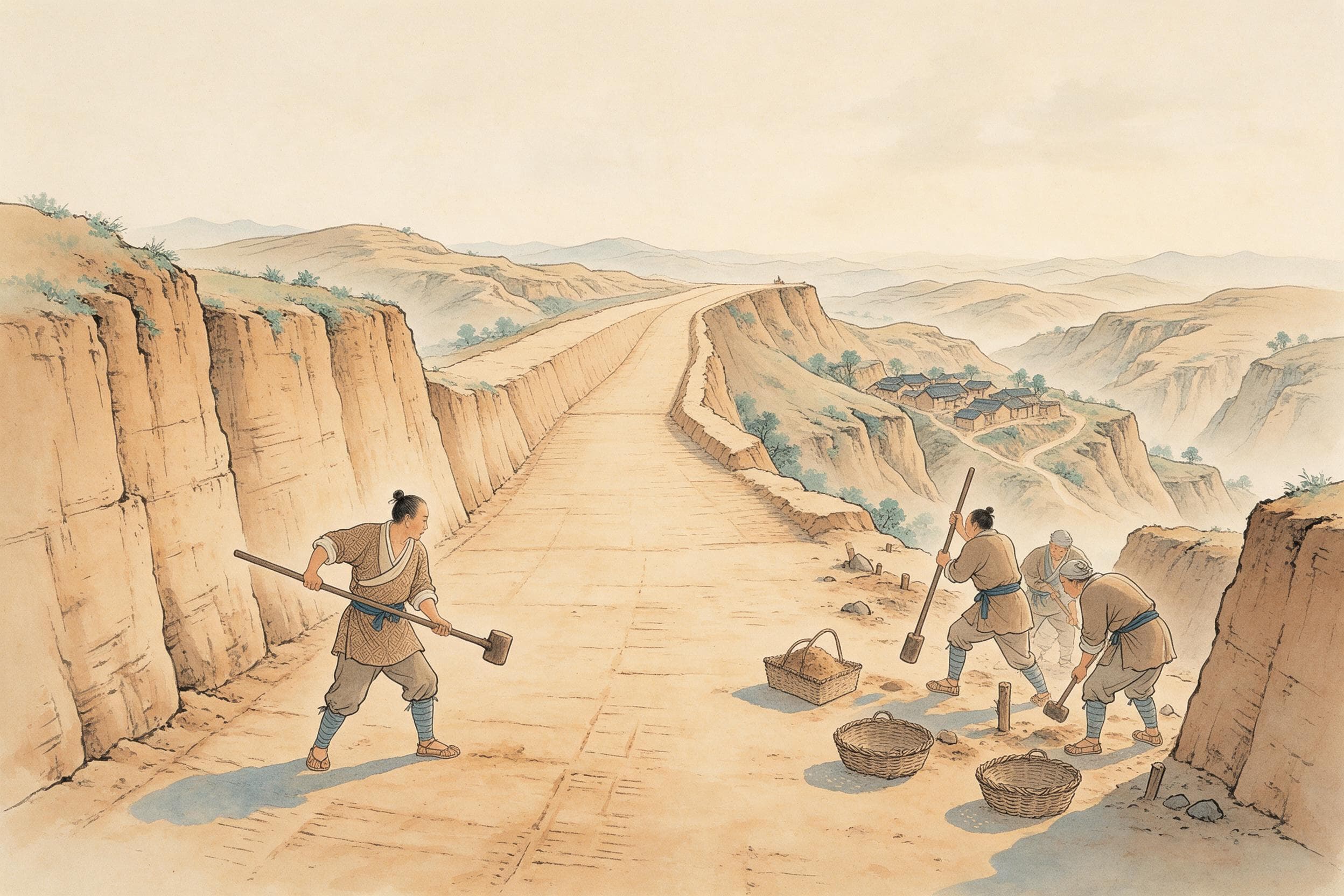
A zhi is a unit for walls. The Family Sayings of Confucius has the line 'a town has no wall of a hundred zhi', and an old gloss unpacks the unit: 'A wall one zhang high and one zhang long is a du; three du are a zhi' — so a zhi of wall is three zhang long and one zhang high. This article quotes the gloss at the level of the zhang and goes no further: how long a Zhou foot was, and how many metres a zhi came to, is another question, and the material gives no ready answer. The same word appears in the Kaogong ji as a height rather than a length: gate-screen, palace corner, city corner. A unit that can measure either a wall's length or a building's height is the kind of unit a ritual text likes — it grades more than it measures.
Read together, the same word does two different jobs. The Kaogong ji uses the zhi for the heights of gate-screen, palace corner and city corner — a hierarchy for building. The Zuo zhuan uses a hundred zhi as a limit on the wall of a secondary capital — a red line for governing. One set of measures, one use for planning and one for controlling men. That double duty is why the two passages cannot be merged into one 'Zhou city code': one is a designer's scheme, the other a courtier's warning.
Rules, not surveys
Three things need saying. First, 'nine li square' is a scheme for laying out a capital, not a survey of any city: it fixes shape, gates, road grid, temple, altars, court and market, and never claims that a particular city was built so. Second, 'a hundred zhi' is a threshold in a prohibition, not the measured wall of any town. Third, neither passage contains a single measurement taken on the ground — no site, no rammed earth, no wall that was actually measured. So what these texts answer is 'how large should it be' and 'how large may it not be', not 'how large was it'. For the last question one has to go to the walls themselves: a measured site such as Linzi is another road, treated in another article. The two roads cannot answer for each other, and the nine li of the Kaogong ji cannot be used as archaeological evidence for any city. The absence is not an accident of survival: a ritual text and a political anecdote are simply not the genres in which measurements are taken.
What can and cannot be said
What can be stated flatly is only what the texts give: nine li square, three gates a side, nine by nine avenues, main roads nine tracks wide; gate-screen five zhi, palace corner seven, city corner nine; great secondary capitals one third of the capital, middle ones a fifth, small ones a ninth; a hundred zhi as the limit. These are quoted as they stand, without being turned into modern units.
What cannot be said: converting nine li into metres or into an area; converting a hundred zhi into metres; claiming that Zhou cities really were nine li square; claiming that the states enforced this hierarchy; using the Kaogong ji to date or identify an excavated city; using one sentence of the Zuo zhuan to reconstruct the size of Jing. None of that is in the material.
Seen this way, the value of the two passages is not in their numbers but in the fact that they make the size of a city two different things: an ideal order (nine li, three gates, the grid, temple and altars) and a political reality (a hundred zhi, a third, a fifth, a ninth). The first says what a city should look like; the second says how large it may not grow. Real walled cities in China probably followed neither exactly — but that is a question for archaeology, not for these two pages.
Sources & further reading
- 《周礼·冬官考工记·匠人》(维基文库本;「前朝后市」一作「面朝后市」) — The planning text: 'The master builder lays out the capital: nine li square, three gates to each side; within the city nine north-south and nine east-west avenues, the main avenues nine carriage-tracks wide; the ancestral temple on the left, the altars of soil and grain on the right, the court in front and the market behind, the market and court each one 'fu'.' The same chapter measures rank in zhi: the royal palace gate-screen five zhi, the palace corner seven, the city corner nine; and rules that the gate-screen standard is to serve for the walls of secondary capitals, the palace-corner standard for the walls of the lords. An ideal scheme, not a survey of any city.
- 《春秋左氏传·隐公元年》(维基文库本) — The prohibition, spoken by Zhai Zhong against Duke Zhuang of Zheng, who had given his younger brother Duan the city of Jing: 'If a secondary capital exceeds a hundred zhi, it is a danger to the state. By the former kings' rule, the great secondary capitals are no more than one third of the capital, the middle ones one fifth, the small ones one ninth. Now Jing is out of measure, contrary to rule; you will not be able to bear it.' A political limit, not a measurement of any wall.
- 《孔子家语》卷一(存「邑无百雉之城」及旧注「高丈、长丈,曰堵。三堵,曰雉」;维基文库本) — Used only for the traditional gloss on the unit: 'a wall one zhang high and one zhang long is a du; three du are a zhi' — i.e. a zhi of wall is three zhang long and one zhang high. The article states the gloss in zhang and does not convert it into metres.