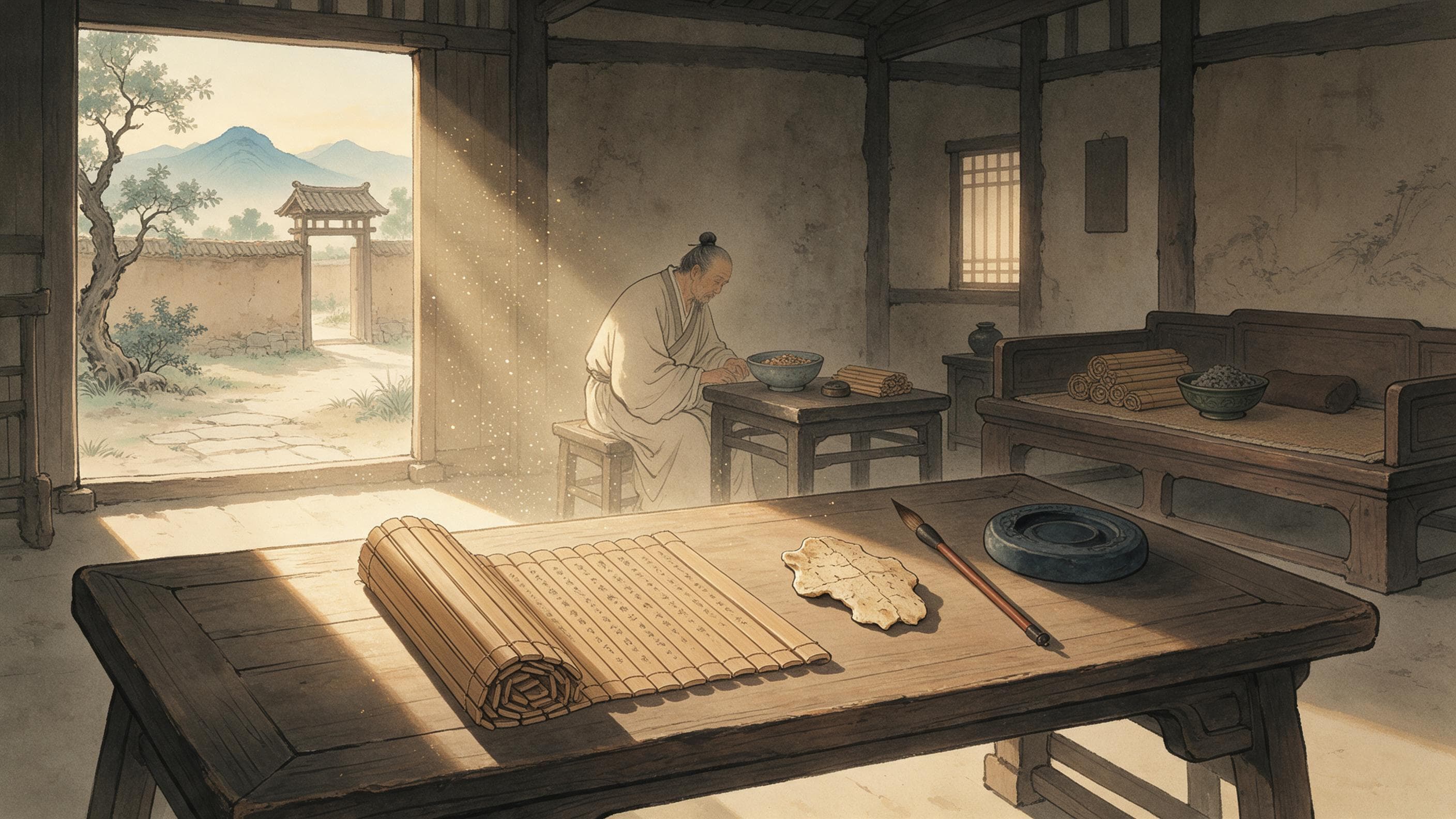
The chapter opens with a definition rather than a rite: 'Yu is to set at rest. When a knight has buried his father or mother, he welcomes the spirit back and at midday sacrifices to it in the mortuary hall, to set it at rest. Yu belongs among the inauspicious of the five classes of rites' (虞,安也。士既葬其父母,迎精而反,日中祭之于殯宮以安之。虞於五禮屬凶). The sentence is Zheng Xuan's comment, not the ritual text; the page puts it first anyway, because without it the word yu means nothing to a reader.
A Rite at Midday
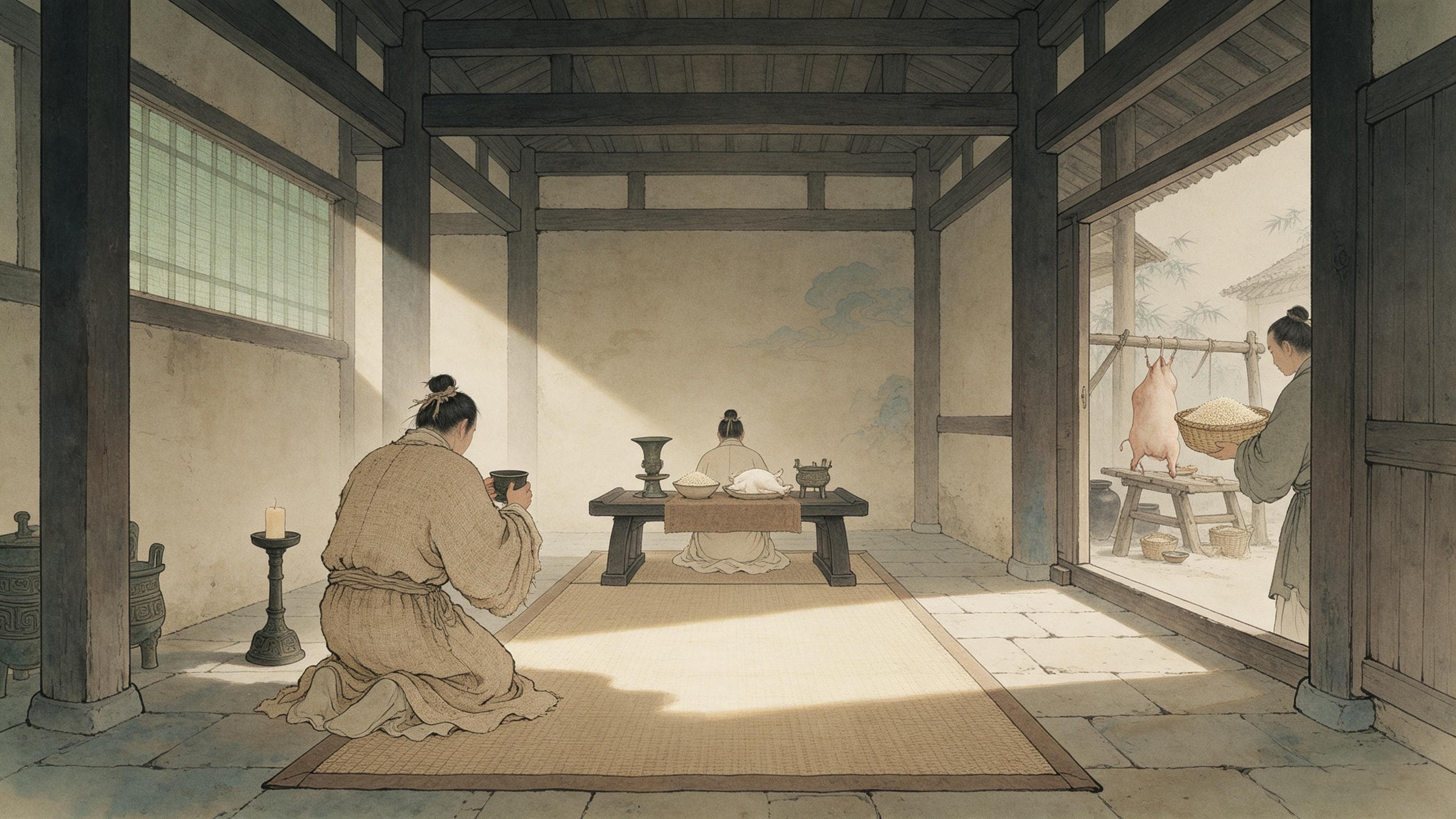
The ritual text itself is thin. 'The knight's yu rite: a single pig is fed' (士虞禮。特豕饋食); 'the service is held at midday' (日中而行事); 'the killing is done west of the temple gate; the master does not watch; the pig is quartered' (殺於廟門西,主人不視。豚解). Three sentences, and the day's timetable is inside them: a burial in the morning, a pig killed outside a gate, a service at noon.
The comment fills in what the text leaves out. 'Fed' is glossed as 'a kind of giving' (饋猶歸也). Midday is explained: 'Burial in the morning, yu at midday — the noble man acts at the due point of the day-hour. The second and third yu are both at first light' (朝葬,日中而虞,君子舉事必用辰正也。再虞、三虞皆質明). The master not watching the killing is 'because funeral matters are kept spare' (凡為喪事略也), and the quartering is 'the legs, spine and ribs only; when cooked it is divided into cuts and lifted into the tripods' (解前後脛脊脅而已,熟乃體解,升於鼎也). None of this is in the ritual text; all of it is what a later reader needed.
The Gloss: A Host, Not a Corpse
Then the ritual text brings in the shi: 'The invocator welcomes the shi. One man in hemp mourning, carrying a basket, follows the shi weeping' (祝迎尸。一人衰絰奉篚,哭從尸). The character 尸 looks like 'corpse', and the comment blocks that reading at once: 'The shi is the host. In the filial son's sacrifice he does not see his parent's form, his heart has nothing to hold to, so a shi is set up to be the master of the intention' (尸,主也……立尸而主意焉). A living person, seated in the dead person's place and treated as the ancestor for the length of the rite. The sub-commentary adds that the shi must come from the grandson's generation.
The comment keeps explaining the text's silences. When master and invocator bow to 'settle' the shi, the gloss says 'to settle is to sit at ease' (妥,安坐也); when the master does not come down to meet the shi, the gloss says 'in mourning one leads with grief, not with respect' (喪事主哀不主敬); when the shi sits without taking off his shoes, the gloss says 'serving a spirit, one does not dare be at ease' (侍神,不敢燕惰). When the shi eats nine times, the comment says 'nine helpings only: the knight's rite' (九飯而已,士禮也), and the sub-commentary adds the scale: the junior sacrifice has eleven, the lords thirteen, the king fifteen.
The Sub-commentary Argues
The third voice is Jia Gongyan's sub-commentary, written to explain Zheng Xuan's glosses. Where Zheng defines a word, Jia argues about the definition. 'Fed' gets a page: Jia quotes the Rites of Zhou on 'presenting' and 'giving', the Records on a son's gifts to his parents, the Analects on a friend's gift, and the Provisioner's entry, and concludes that 'presenting' is for a superior while 'giving' runs up and down between ranks (獻雖主於尊……其云饋者,上下通稱). One word, four citations.
Jia is also the one who repairs a contradiction. The ritual text says the pig is killed at the 'temple gate'; Zheng's catalogue says the sacrifice is 'in the mortuary hall' (殯宮). Jia: 'the temple is the mortuary hall… yu and the ending of weeping are in the chamber; placing the tablet in the temple comes later' (廟則殯宮也……虞、卒哭在寢,祔乃在廟). He explains the half pig too: 'In auspicious rites the whole animal is used, both halves; here it says "side", so one half only — because in yu there is no pledging of cups' (吉禮皆全,左右胖皆亨……以其虞不致爵).
One Cup
After the shi has eaten, the master makes the first offering: 'The master washes the discarded cup, pours wine and offers it to the shi to settle his food. The shi bows and receives the cup; the master, facing north, bows in return. The shi makes the wine-offering and tastes it' (主人洗廢爵,酌酒酳尸。尸拜受爵,主人北面答拜。尸祭酒,嘗之). The comment: 'A cup without feet is called the discarded cup. To settle is to set the food at rest. The master faces north to offer and return the cup: a change from the auspicious rite. Every difference is a change from the auspicious' (爵無足曰廢爵。酳,安食也。主人北面以酳酢,變吉也).
The cup comes with liver: 'A senior guest brings the liver, sets it on the stand, with the root toward the shi and salt on the right' (賓長以肝從,實於俎,縮,右鹽). The comment says that in mourning 'the root end is offered' and 'one does not aim at flavour' (以喪不志於味). When the shi empties the cup, 'the invocator takes it; there is no escorting of the cup' (不相爵), because 'in mourning rites the ceremony is kept short' (喪祭於禮略).
The rite then runs on: the shi pledges the master with the same cup; the mistress washes a footed cup and makes the second offering; a senior guest makes the third with a cup engraved at mouth and foot. The chapter continues in the next juan, where the shi is sent off: 'The shi rises; the invocator goes before him, facing him' (尸謖,祝前,鄉尸), turning to face him again at the door, at the master, at the steps.
Three Voices, One Midday
One more voice sits outside the ritual. The Records' Tan Gong chapter gives the reason for the timing, not the procedure: 'When the grave is sealed, the master makes his parting gift, and the invocator stays to prepare the shi of the yu' (既封,主人贈,而祝宿虞尸). 'The officers set mat and table with a deposit at the left of the grave; they return, and at midday comes the yu. The yu on the day of burial is because he cannot bear one day's separation; on that day yu replaces the food-offering' (葬日虞,弗忍一日離也。是日也,以虞易奠). This is argument, not rubric: it answers why the rite cannot wait for morning. The three layers do different work. The ritual text gives the acts and almost no reasons; Zheng Xuan's comment gives the meanings and the reasons; Jia Gongyan's sub-commentary gives the arguments, the cross-references and the repairs where text and comment do not quite fit. The Records give the argument that the rite is necessary. Read as one voice the page is a muddle; read as three, it records how a ritual was understood — by the man who wrote the acts down, by the man who glossed them centuries later, and by the man who defended the gloss.
What the page does not give is equally plain: no full inventory of vessels and places beyond those it mentions, no account of how often a family performed the rite, no evidence that it was ever performed exactly as written. This is a knight's rite, not a village custom. But at midday the text is exact: a pig, a gate, a cup without feet, and a living man seated where the dead man should be while a son bows to him facing north.
Related reading:Sauce and Shi: A Hundred and Twenty Jars, Three Dou of Beans · Three Bows, Three Yields: The Village Drinking Rite · When She Played, the Road Became a Market: Music and Entertainers in Luoyang
Sources & further reading
- 《仪礼注疏》卷四十二·士虞礼第十四(汉郑玄注、唐贾公彦疏;维基文库本,未与点校本复核) — The three layers on one page. Zheng Xuan's opening comment: 'Yu is to set at rest; when a knight has buried his father or mother he welcomes the spirit back and at midday sacrifices in the mortuary hall; yu belongs to the inauspicious among the five classes of rites' (虞,安也……虞於五禮屬凶). The ritual text: 'a single pig is fed' (特豕饋食), 'the service is at midday' (日中而行事), 'killed west of the temple gate, the master does not watch, the pig quartered' (殺於廟門西,主人不視。豚解), 'the invocator welcomes the shi; one man in hemp, carrying a basket, follows weeping' (祝迎尸), the first offering with the footless cup (主人洗廢爵,酌酒酳尸), the liver brought by a senior guest (賓長以肝從), 'no escorting of the cup' (不相爵). Zheng's glosses: '饋猶歸也', '尸,主也……立尸而主意焉', '朝葬,日中而虞,君子舉事必用辰正也。再虞、三虞皆質明', '凡為喪事略也', '變吉也', '以喪不志於味', '九飯而已,士禮也'. Jia's sub-commentary: why only one half of the pig (虞不致爵), how the temple (廟) of the text is the mortuary hall (殯宮) because yu and the ending of weeping are in the chamber, the scale of helpings (少牢十一飯,諸侯十三飯,天子十五飯), and the argument over 獻 versus 饋.
- 《仪礼注疏》卷四十三(汉郑玄注、唐贾公彦疏;维基文库本,未与点校本复核) — The chapter's continuation, used here only for the sending-off of the shi: 'The shi rises; the invocator goes before him, facing him' (尸謖,祝前,鄉尸), and the turning at the door, at the master, at the steps (還,出戶,又鄉尸。還,過主人,又鄉尸。還,降階,又鄉尸); Zheng notes that the invocator 'must first face him, to give him the measure' (必先鄉之,為之節). The juan also supplies the rule that the shi comes from the grandson's generation (尸須得孫列者) and that male and female shi are separate, 'of different surname, not a low-born woman' (必使異姓,不使賤者).
- 《礼记·檀弓下》(维基文库本,未与点校本复核) — The argument, not the rubric: 'When the grave is sealed, the master makes his parting gift, and the invocator stays to prepare the shi of the yu' (既封,主人贈,而祝宿虞尸); 'the officers set mat and table with a deposit at the left of the grave, return, and at midday comes the yu. The yu on the day of burial is because he cannot bear one day's separation; on that day yu replaces the food-offering' (葬日虞,弗忍一日離也。是日也,以虞易奠); and 'yu sets up the shi, with a table and mat' (虞而立尸,有幾筵). Also 'the day is changed to the auspicious sacrifice' at the ending of weeping.