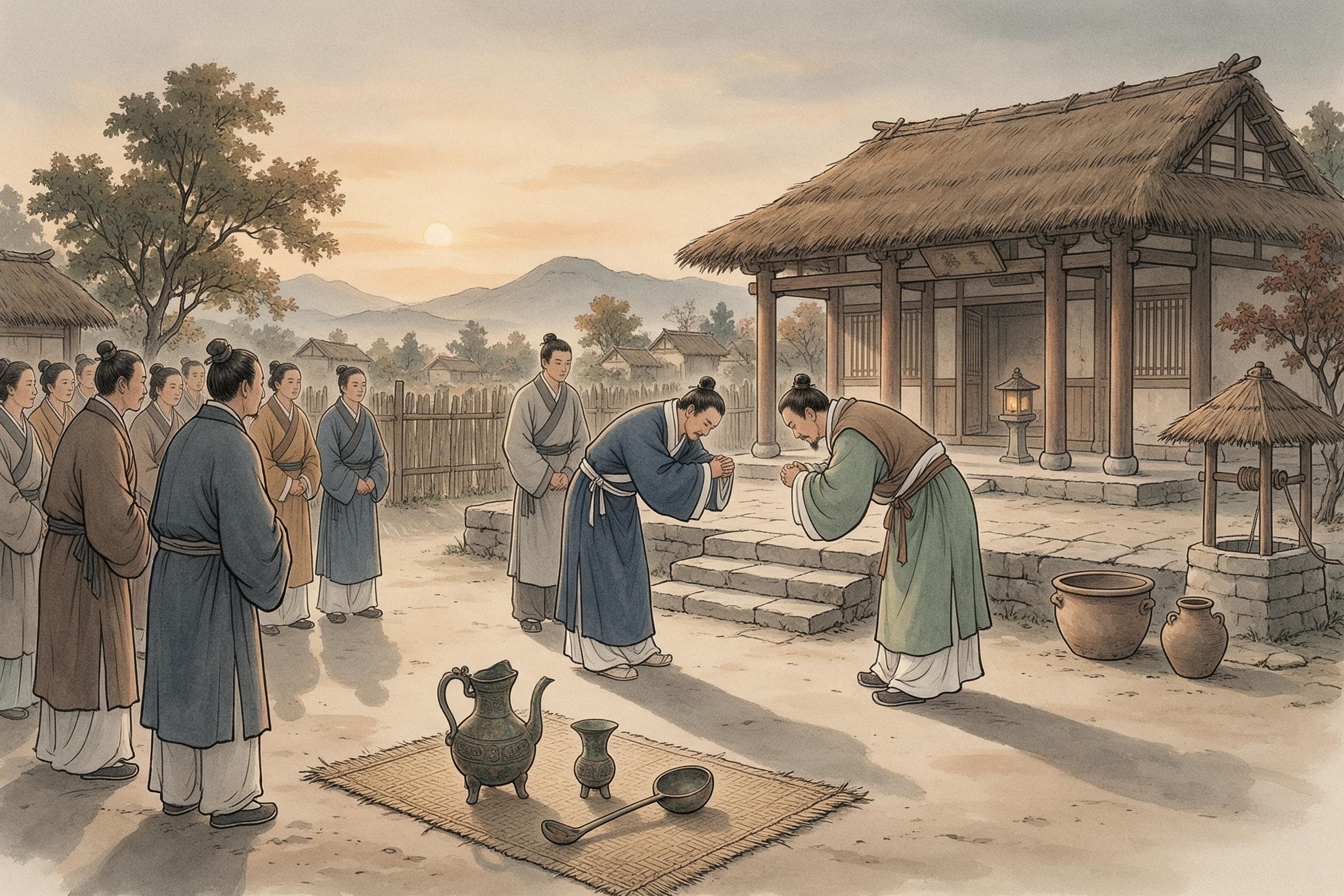
The village drinking rite begins with two men refusing to go first. 'The host bows to meet the guest outside the gate of the school; entering, they bow three times before reaching the steps, and yield three times before ascending' (主人拜迎賓于庠門之外,入,三揖而後至階,三讓而後升). The essay on the rite calls this 'bringing about deference': the yielding is done in full first, and only then does the drinking begin.
Choosing the Guests
The Yili starts with the choice of persons: 'the host goes to the elder to choose the guest and the assistant' (主人就先生而謀賔、介), then invites them formally. The day before, the mats are laid out, two jars of wine are set between the door and the room with the water-jar west of them, the washing basin goes south-east of the eastern steps with water east of it. When the food is ready the host fetches the guest, and the guest, the assistant and the other guests come after him. The seating is stated at the outset: the mats of guest, host, assistant and other guests are 'all not joined' — none touching the next.
At the gate a run of bows begins: host and guest bow three times to the steps, yield three times and go up, bow again on arrival; then the host takes the cup, goes down to wash it, and the guest must come down too and decline the washing; when it is washed they go up and the guest 'bows for the washing'. The essay reduces the sequence to three lines: three bows before the steps and three yields before ascending 'to bring about deference'; washing and raising the cup 'to bring about purity'; and bowing at arrival, at the washing, at receiving, at sending off and at finishing 'to bring about respect'. Deference, purity, respect — this, says the essay, is how gentlemen deal with one another.
Offer, Return, Pledge
The wine moves in three actions, not one round of toasts. The host fills the cup and offers it to the guest at his mat, bowing; the guest bows to receive it and the host bows as he sends it — that is the offer (獻). The guest goes down to wash a cup, comes back and returns a cup to the host — the return (酢). The host then takes another vessel and pledges the guest — the pledge (酬). Each action has its own bows, washings and ascents. The assistant gets the same rite 'reduced' — no bowing for the washing, no announcement of the wine's goodness, fewer steps. The other guests are simpler still: they receive the cup, sacrifice sitting, drink standing, and go down without returning a cup. One rite, three degrees of fullness; the hierarchy is written in these differences.
So the 'respect' here is not an attitude but a count: how many bows, how many washings, who goes first, who returns a cup and who does not. The essay is explicit that if the form is carried through, 'the gentleman defers and does not contend; being pure and respectful he is not rude', and so 'there is no calamity of violence'.
Sitting and Standing
Besides roles there is a line of age. 'Those of sixty sit; those of fifty stand and serve, to hear the duties: this makes clear who is senior' (六十者坐,五十者立侍,以聽政役,所以明尊長也). And the dishes increase with age: 'sixty gets three, seventy four, eighty five, ninety six, so that the old are provided for' (六十者三豆…). Only the ladder of numbers is recorded here; the dishes themselves are not listed, because a ritual manual's menu and everyday food are two different things.
Two axes therefore cross. Age decides sitting and standing; role decides the order and fullness of the toasting. The guest has the fullest form, the assistant less, the other guests least; but by sixty all sit, and at fifty all stand. The ritual book keeps the two axes separate precisely so that both are in force at once.
Music and the Round of Pledges
Music comes in the middle, and it is not background. 'The musicians enter; three songs are sung, and the host offers them wine. The pipes enter for three pieces, and the host offers again. Three are sung in alternation, and three are played together; the musicians report the music complete and withdraw' (工入,升歌三終…合樂三終). When the music ends, 'one man raises a cup and the overseer is installed' — and the rite moves to its second stage: the guest pledges the host, the host pledges the assistant, the assistant pledges the other guests, 'in order of age, ending with the man who poured the washing water' (少長以齒,終於沃洗者焉). The essay's comment: 'one knows that he can defer to elders and leave no one out.'
After that the shoes come off, seats are taken, dishes are brought, and 'the cups are without count and the music is without count' (無筭爵,無筭樂). The guest leaves to pipe music; the next day he comes in village dress to thank the host, and the host returns the courtesy and then dismisses the overseer. The essay gathers the whole into five results — 'high and low made clear, the full and the reduced distinguished, harmony without dissolving, deference to elders with no one left out, ease without disorder' (貴賤明,隆殺辨,和樂而不流,弟長而無遺,安燕而不亂) — and records Confucius saying: 'when I watched the village rite, I knew how easy kingly government would be' (吾觀於鄉,而知王道之易易也).
Not a Picture of Village Life
This is a ritual text. It sets out how one ceremony is ordered; it does not record how often a village held one, who actually came, or whether a village could afford it. So one cannot write that 'this is how people did it then'. The participants are villagers, officers and gentlemen, with guest, assistant and senior guests each in their place: a rite with a list of those qualified, not a whole village at table.
Nor should 'those of sixty sit' be turned into social fact. It is the book's arrangement of seats, not a survey of village life. What the book wants is to 'make clear who is senior' and 'provide for the old' — to put the order of age on display in the seating of one evening's drinking.
The skeleton is short: meeting, offering, returning, pledging, music, the round of pledges, the guest's departure. Its two words are deference and seniority: let the other man go first at the gate, then seat everyone by age, and finally work even the man who poured the washing water into the order. It should be read as structure — who goes first, who has the fuller form, who sits and who stands — not as a warm picture of a village feast.
Related reading:Five Grades of Mourning: A Table of Kin and Cloth · Nine Generations of Disorder: Succession as the Shiji Tells It · Fifty Disciples: The Han Academy That Was an Appointment Pipeline
Sources & further reading
- 《仪礼·乡饮酒礼》(战国至汉初成书;维基文库本,未与点校本复核) — The rite step by step. The host goes to the elder to choose the guest and the assistant (主人就先生而謀賔、介), invites them, and lays out the mats, two wine jars between the door and the room, the washing basin south-east of the eastern steps, water east of it. When the food is ready he fetches the guest; at the gate the host bows and the guest returns it, they bow to each other three times and reach the steps, yield three times, and go up; there are bows at arrival, at the washing, at receiving and at sending the cup. The host takes the cup, washes it, offers it to the guest at his mat, and the guest returns the courtesy with a cup (酢), after which the host pledges him with another vessel (酬). The assistant is treated to a reduced version, and the other guests simply receive, sacrifice sitting, drink standing, and go down without returning a cup. The musicians then enter: three songs, three pieces on the pipes, three alternating and three together, with wine offered to them. A cup is raised to instal the overseer; then guest pledges host, host pledges assistant, assistant pledges the other guests, 'in order of age, ending with the man who poured the washing water' (少長以齒,終於沃洗者). Shoes come off, seats are taken, and the drinking and music go on without count; when the guest leaves the pipe music sounds. The record notes the victim was a dog and that the cup was used for the formal offer, other vessels for the rest.
- 《礼记·乡饮酒义》(战国至汉初成书;维基文库本,未与点校本复核) — The essay on meaning. It opens with the three yields — 'meeting the guest outside the gate of the school, entering, three bows before the steps, three yields before ascending: this is to bring about deference' (三揖而後至階,三讓而後升,所以致尊讓也) — then washing the cup for purity and the five bows for respect. It gives the two social rules: 'those of sixty sit; those of fifty stand and serve to hear the duties: this makes clear who is senior' (六十者坐,五十者立侍,以聽政役,所以明尊長也), and the graded dishes for the aged — sixty gets three, seventy four, eighty five, ninety six — 'so that the old are provided for'. It reads the seating cosmologically (guest and host as heaven and earth, assistants as yin and yang, the three guests as the three lights, the three yields as the moon's three days), links the rite to teaching filial and fraternal conduct, and records Confucius: 'when I watched the village rite I knew how easy kingly government would be' (吾觀於鄉,而知王道之易易也). It ends with five results: high and low clear, full and reduced distinguished, harmony without dissolution, deference to elders with no one left out, ease without disorder.