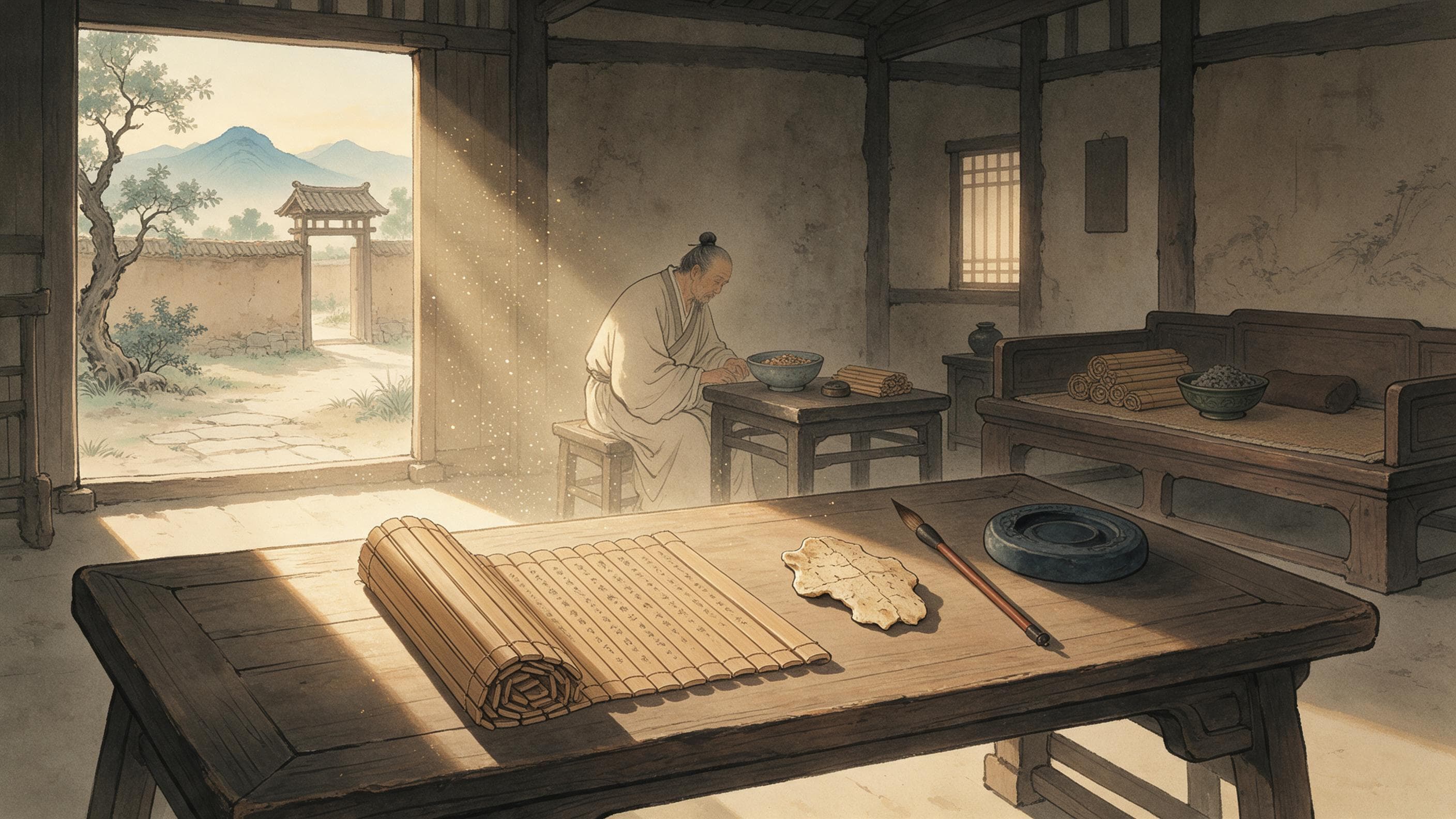
By the arrangement of the Rites of Zhou, the king's table required a hundred and twenty jars of sauce. The entry for the Provisioner is blunt: when the king takes a meal, 'sauce is used in one hundred and twenty jars' (醬用百有二十罋). No recipe, no ingredient, no jar size — only a number, and an office that owes it.
A Hundred and Twenty Jars
Two offices supply it. The Meat-Paste Officer 'holds the four sets of dou vessels', with one eunuch, twenty women and forty servants under him; at the king's meal he 'supplies sixty jars of meat paste, filling them with five qi, seven hai, seven zu and three ni' (共醢六十甕,以五齊、七醢、七菹、三臡實之), and for the reception of guests 'fifty jars' (共醢五十甕). The Vinegar Officer, with a similar staff, supplies 'sixty jars of vinegar preparations' at the king's meal and fifty for guests. The text even pairs the contents of the four dou sets by name: for the morning service, chives pickled with ant-egg paste, and sweet-flag root with elk mince.
The numbers run beyond these two offices. The Inner Cook, preparing the king's food, must 'select the hundred delicacies, the sauce things and the precious things'; the Food Physician harmonises 'the hundred sauces' and notes that 'sauce is seasoned as in autumn' (醬齊視秋時). What the chapter builds is a division of a royal table into offices and jar counts: who supplies, on what occasion, how much, to whom. How a sauce ferments, how much salt goes in, how many days it takes — not one word. The Rites of Zhou is itself a programme of offices: it describes posts as they should be, not a kitchen on a given morning.
Another Line: A Northern Wei Farm
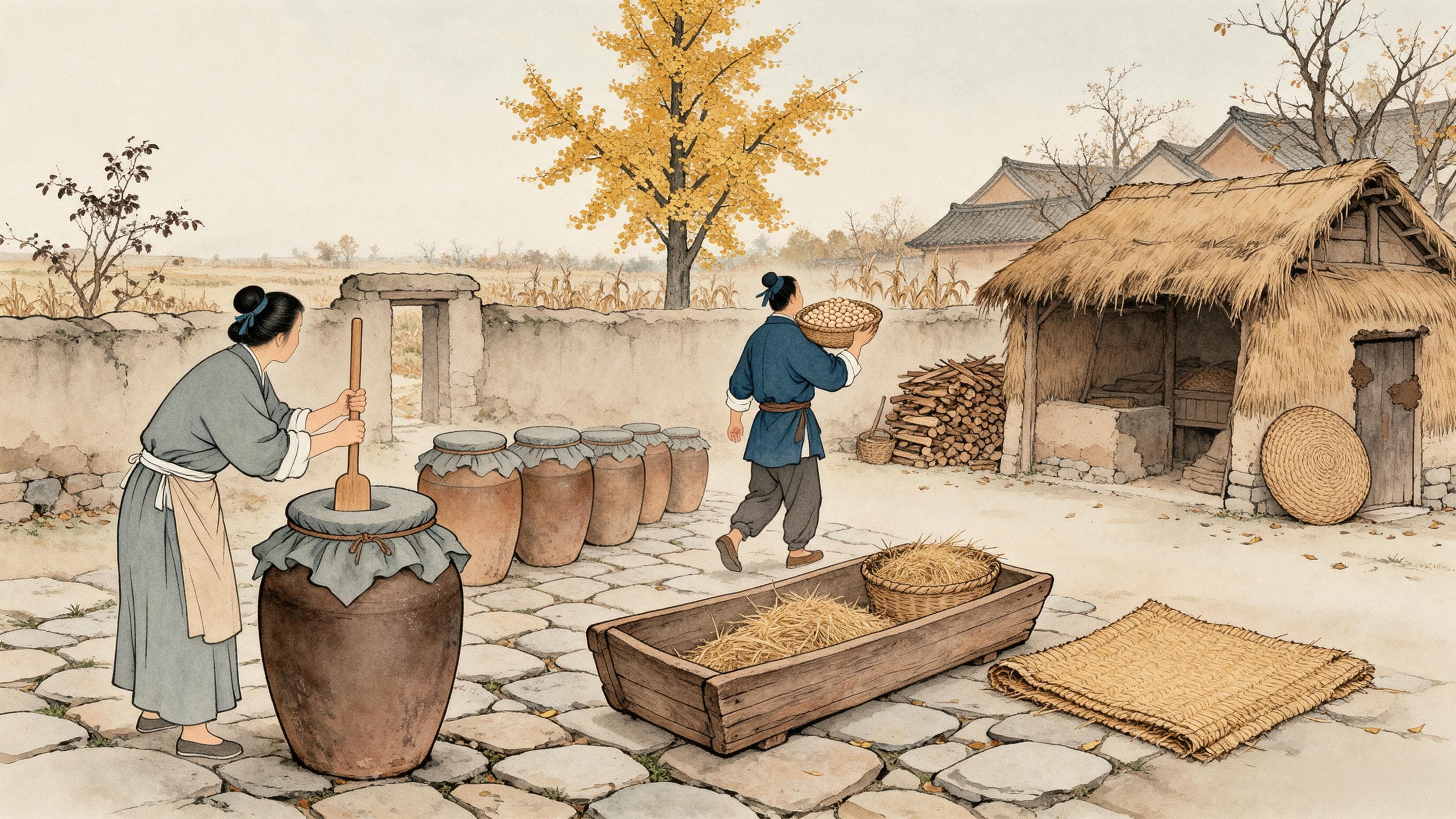
Nearly a thousand years later, the eighth chapter of the Essential Techniques for the Welfare of the People answers a different question: how a household turns beans into sauce. The method begins with the season — 'the twelfth and first months are the best time, the second is middling, the third the worst' — then the proportion: 'as a rule, bean yellow three dou, ferment powder one dou, steamed yellow wheat one dou, white salt five sheng' (豆黃三斗,麴末一斗,黃蒸末一斗,白鹽五升). Ripening is counted in sevens: 'in the twelfth month five sevens, in the first and second four sevens, in the third three sevens' — thirty-five, twenty-eight, twenty-one days. Then brine is added at 'one shi of water to three dou of salt', stirred several times a day for ten days and once a day after that, and 'it can be eaten twenty days after opening, but it takes a hundred days to be properly ripe'.
Meat paste has its own numbers: 'meat one dou, ferment powder five sheng, white salt two and a half sheng, steamed yellow wheat one sheng', sealed with mud and set in the sun; 'open it after two sevens of days, and when the paste comes out without the smell of ferment it is done' (二七日開看,醬出無麴氣,便熟矣). Fish paste uses 'one dou of prepared fish, three sheng of yellow coat, two sheng of white salt, one sheng of dried ginger, one ge of orange peel'; shrimp paste 'one dou of shrimp, three sheng of cooked rice, two sheng of salt, five sheng of water'. An instant meat paste — meat, wine, ferment powder, yellow wheat and salt, buried in a heated pit — is done overnight. Slow and fast each have their recipe.
Making Shi: Heat and Turning
Shi begins with scale: 'three rooms will make a hundred shi of beans; twenty shi go to a heap' (三間屋,得作百石豆。二十石為一聚). A smaller batch will not do — 'the very least is still ten shi to a heap; three or five shi will not warm itself'. The room is purpose-built: a pit two or three chi deep, thatched above, windows sealed with mud, one small door just wide enough for a man. The beans are boiled until 'they give when pinched', cooled, and heaped in the shed. The test is by hand: go in twice a day and thrust a hand into the heap; 'if it is as warm as the armpit, it must be turned' (如人腋下暖,便須翻之). After four or five turnings the heap has been spread from two chi thick down to six cun; when white mould shows it is spread to three cun and put into the storage pit.
Time in the pit is counted by season: 'ten days in summer, twelve or thirteen in spring and autumn, fifteen in winter' (夏停十日,春秋十二三日,冬十五日). The beans are washed 'until the water runs clear', or the shi turns bitter. It is severe about the risk: 'shi is hard to make well and easy to spoil; it needs a careful man, and must be looked at twice a day. Miss the heat and it rots to mud that not even pigs or dogs will eat' (失節傷熱,臭爛如泥,豬狗亦不食). A wheat shi is made in the seventh and eighth months, left two sevens of days until black and fragrant, then pressed into cakes, strung on cord and hung up.
Eight Harmonies: One to Eight
The same chapter sets down one proportion like a mnemonic: 'garlic one, ginger two, orange peel three, white plums four, cooked chestnut five, rice six, salt seven, sauce eight' (蒜一,薑二,橘三,白梅四,熟栗黃五,粳米飯六,鹽七,醬八). This is the eight-harmony relish, eight things in the proportions one to eight. The method has an order too: pound the white plums, ginger and orange peel to powder and set them aside; pound chestnut and rice; add raw garlic gradually; pound until done; add salt; only at the end add the plum, ginger and peel, and thin it with vinegar. The book says the mixture is 'only for the relish of raw fish'.
One mark: the chapter quotes Cui Shi's Monthly Ordinances of the Four Seasons twice — 'in the first month one may make the various sauces, meat sauce and clear sauce; in the fourth month, after the beginning of summer, a sauce of tong fish; in the fifth month one may make sauce', and 'in the eighth month gather chive flowers and make pounded relish'. Cui Shi was an Eastern Han man: these lines are Han month-by-month rules copied into a Northern Wei farm book. They are quotations, not the practice of the sixth century.
A Thousand Years Apart
Set side by side, the two pages ask different questions. The Rites of Zhou asks which office, on what occasion, how many jars — it gives posts and specifications, and no method at all. The Essential Techniques asks how many dou of beans, how many sheng of salt, how many days, how warm — it gives process and proportion, down to 'as warm as the armpit', and never asks who eats it, what it costs, or which bureau controls it. One is the ledger of an office, the other the ledger of a kitchen.
Nearly a thousand years lie between them, and no line joins the two: it cannot be said that 'the Chinese have always made sauce this way', because the Rites of Zhou gives no method and the Essential Techniques makes no claim about offices. Two things are certain: the hundred and twenty jars are the number the ritual book sets for the king's table, and the three dou of bean yellow are the measure the farm book sets for one vat of sauce. Each number is clear, and neither should be called as a witness for the other.
Related reading:The Shi Yu Rite: Three Voices at One Midday Sacrifice · Three Bows, Three Yields: The Village Drinking Rite · When She Played, the Road Became a Market: Music and Entertainers in Luoyang
Sources & further reading
- 《周礼·天官冢宰》(维基文库本,未与点校本复核) — The offices: the Provisioner (膳夫) supplies the king's meals with 'sauce in one hundred and twenty jars' (醬用百有二十罋); the Meat-Paste Officer (醢人), with one eunuch, twenty women and forty servants, 'holds the four sets of dou vessels' and on the king's meal supplies sixty jars filled with five qi, seven hai, seven zu and three ni, and fifty jars for guests; the Vinegar Officer (醯人), with two eunuchs, twenty women and forty servants, supplies sixty jars of vinegar preparations at the king's meal and fifty for guests; the Inner Cook selects 'the hundred delicacies, sauce things and precious things'; the Food Physician harmonises 'the hundred sauces' and says 'sauce is seasoned as in autumn' (醬齊視秋時). A programme of offices, not a kitchen record: no method, no ingredient proportions.
- 贾思勰《齐民要术》卷第八·作酱法第七十、作豉法第七十二、八和齏第七十三(北魏;维基文库本,未与点校本复核) — The farm recipes: bean paste timed to the twelfth and first months, with 'bean yellow three dou, ferment powder one dou, yellow steamed wheat one dou, white salt five sheng', ripening in five, four or three sevens of days by month, brine at 'one shi of water to three dou of salt', 'a hundred days before it is properly ripe'; meat paste at 'meat one dou, ferment powder five sheng, white salt two and a half sheng, yellow steamed wheat one sheng', opened after two sevens 'when the paste comes out without the smell of ferment it is done'; fish and shrimp pastes with their own proportions. Shi: 'three rooms will make a hundred shi of beans; twenty shi to a heap', the smallest batch ten shi; a sealed warm shed, 'always keep it as warm as the armpit'; turning the heap from two chi down to six cun; ripening in the pit, 'ten days in summer, twelve or thirteen in spring and autumn, fifteen in winter'; and the warning that shi 'spoils easily — rotten as mud, not even pigs or dogs will eat it'. Eight-harmony relish: garlic one, ginger two, orange peel three, white plums four, chestnut five, rice six, salt seven, sauce eight. The chapter also quotes Cui Shi's Monthly Ordinances of the Four Seasons (Eastern Han), which must be marked as Han, not Northern Wei.