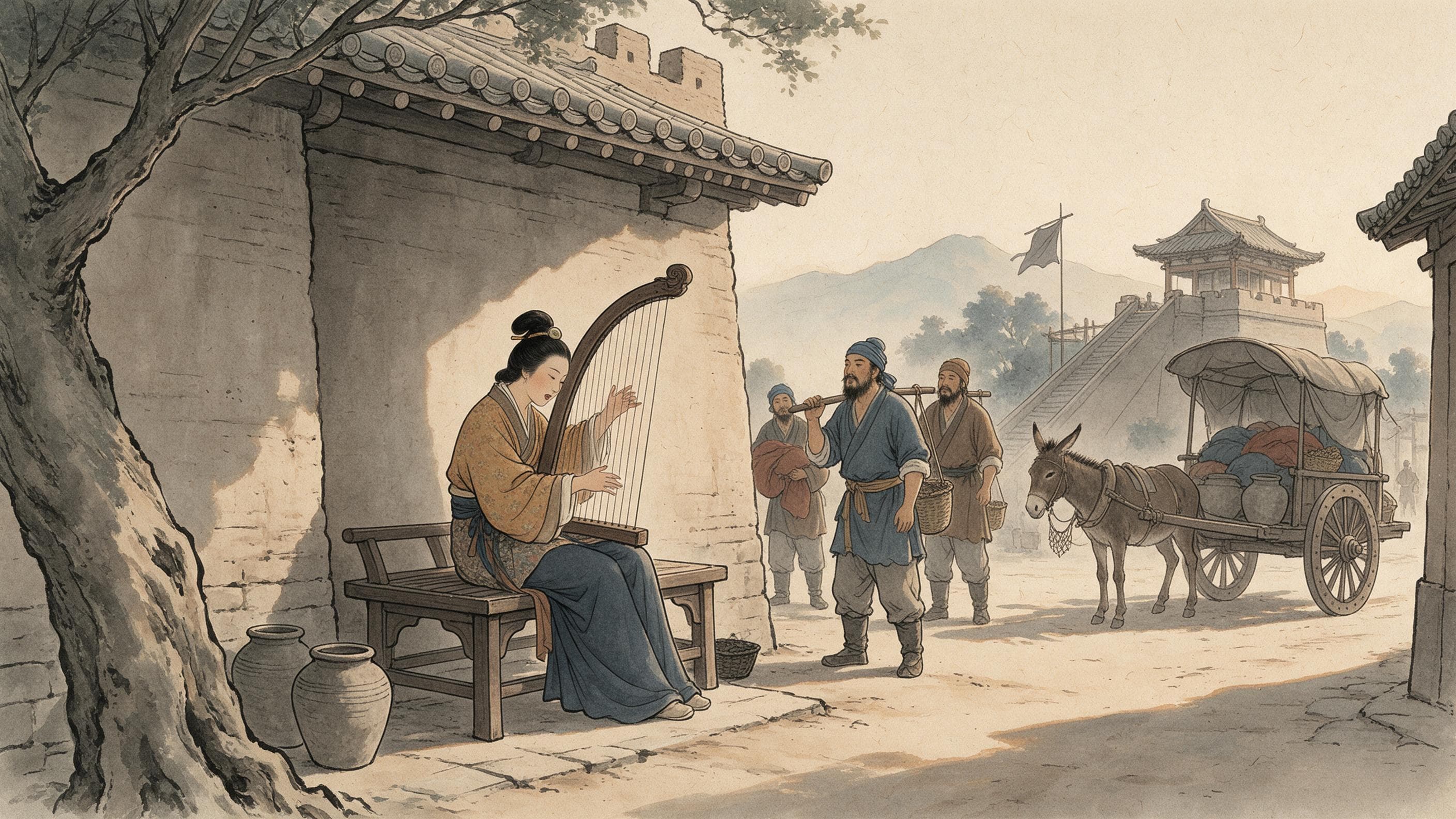
Near the Qingyang Gate in Luoyang, a woman took up her konghou, a vertical harp held against the shoulder, and sang a song called "Mingfei Leaves the Frontier". Her voice, the record says, went up into the clouds; people on the road stopped to listen, and within a short while the road had turned into a market. Her name was Xu Yuehua, and she had begun as a musician in the household of Yuan Yong, Prince of Gaoyang.
A household that kept its own band
Yuan Yong, Prince of Gaoyang, was a chancellor of the Northern Wei. The record describes his household's music without dwelling on his wealth: when the prince went out, outriders cleared the road and flutes sounded behind him; when he came in, singers and dancers, struck zithers and blown mouth organs followed one another, "all night and all day". Music there was not an evening's amusement but part of a great household's display, kept on something like the scale of a military unit. Nor was it only private: in the Zheng'guang years the court gave him a feather-canopied drum-and-flute band and a hundred sword-bearing guards, honours in which the band itself was part of the insignia of rank.
After Yuan Yong was killed by the warlord Erzhu Rong, his mansion was given to the Buddhist church and became the Gaoyang Wang temple. Of the women who made that music the book has a single sentence: after the prince's death they were all ordered into religious life, and some were married off. They were not a group that chose where to go; they were disposed of together when their owner died.
The woman who turned a road into a market
Xu Yuehua is the one among them whose name survives. She was a fine player of the konghou and could sing "Mingfei Leaves the Frontier" so that no one who heard it remained unmoved. In the Yong'an years she became a secondary wife of the general Yuan Shikang, whose house stood near the Qingyang Gate, and it was there that she played and sang, with the result the record gives: a voice reaching the clouds, listeners on the road, and a market forming in a moment. The song was about Wang Zhaojun, the palace woman sent away to the Xiongnu; a musician who had herself been moved from one household to another was singing, in the street, about a woman sent away from home. The konghou she held was an imported instrument, generally thought to have come in from Central Asia, and it must have carried a very different sound from the bells and drums heard inside the temple walls.
She also used to tell her new husband about two women of the old household: Xiurong, who could sing "Green Water", and Yanzhi, who danced "Fire Phoenix", both of them favourites who outshone the other women. Hearing this, Yuan Shikang often had her play the two tunes. The passage is very short and does a great deal: a remarried musician speaks of her former house through its repertoire, and the new husband's request brings the old owner's music back into his own hall.
The nunnery that admitted no men
The other stage was inside a monastery. The Temple of Joyful Music was founded by Yuan Yi, Prince of Qinghe, a son of Emperor Xiaowen. On the six fast days the temple kept female musicians: "song wound around the beams, dancing sleeves turned slowly, strings and pipes rang out clear, in a harmony that seemed inspired." But it was a nunnery, and men were not admitted. Those who did get in, the record says, thought they had reached paradise. After the prince died the rule loosened, and ordinary people came and went without hindrance.
Later another prince, Yuan Yue of Ruyang, restored the place and summoned every kind of music into it, adding strange birds and beasts dancing in the courtyard and illusions of the kind described as "flying and bewildering": a donkey skinned and thrown into a well, jujubes planted and melons grown, and within moments food to eat. The men and women watching were, in the words of the text, left dazed. After 528, when the city went through a series of wars, the shows vanished.
There is supporting evidence elsewhere. At the Zhaoyi nunnery the image procession of the seventh day of the fourth month set out with music so grand that the record compares it to the household of the eunuch Liu Teng. The Yaoguang nunnery, founded by Emperor Xuanwu, housed palace women and daughters of good families who took vows. In 530, when Erzhu Zhao's soldiers sacked Luoyang, some dozens of them entered the nunnery and behaved outrageously; afterwards came the mockery, and a rhyme went round the capital: "Luoyang girls, do up your hair quickly: the nuns of Yaoguang are stealing husbands." It is a cruel couplet, but it is also the plainest evidence of how the city saw its nunneries.
The half the record does not give
These accounts supply scenes, not accounts: no notation, no measurements of instruments, no fee for a performance, no audience numbers. The most precise statement available is that a market formed in a moment. Yang Xuanzhi was a court official writing after the capital had been moved to Ye, remembering a city already lost, and his account of a great household's scale is both report and indictment. The two layers should be read separately.
What can be said is narrower. In a princely house the musicians were counted among the property. In the street they were a sound that gathered a crowd. In a monastery they were part of a fast-day liturgy. There was no wall between the three: the same woman could appear in all of them, in that order. Who listened, who paid, and what the performers thought are not in the record; Xu Yuehua's name survives in a book about monasteries, not in one about musicians.
Related reading:Three Geese, One Gander: Hatching and Roasting Poultry in the Northern Wei · A Bundle of Dried Meat: What Confucius Asked of a Student · How the Zhou Talked About Shang Drinking: Orders, Exceptions, and an Explanation
Sources & further reading
- 楊衒之《洛陽伽藍記》卷三·城南(Yang Xuanzhi, A Record of the Buddhist Monasteries of Luoyang, juan 3, "South of the City") — The Gaoyang Wang temple chapter: the prince's establishment of 6,000 servants and 500 female entertainers, music day and night, the performers sent to nunneries or married off after his death, Xu Yuehua's konghou and her 'Mingfei Leaves the Frontier' song, the listeners who gathered until the road became a market, and the other two women's 'Green Water' song and 'Fire Phoenix' dance.
- 楊衒之《洛陽伽藍記》卷一·城內(Yang Xuanzhi, A Record of the Buddhist Monasteries of Luoyang, juan 1, "Inside the City") — The Temple of Joyful Music chapter: female musicians at the six fast days, a nunnery where men were not admitted, the loosening of that ban after the founder's death, the later prince's added spectacles and illusions, the entry that the shows disappeared after the wars of 528; also the Zhaoyi nunnery's processional music and the Yaoguang nunnery for palace women.