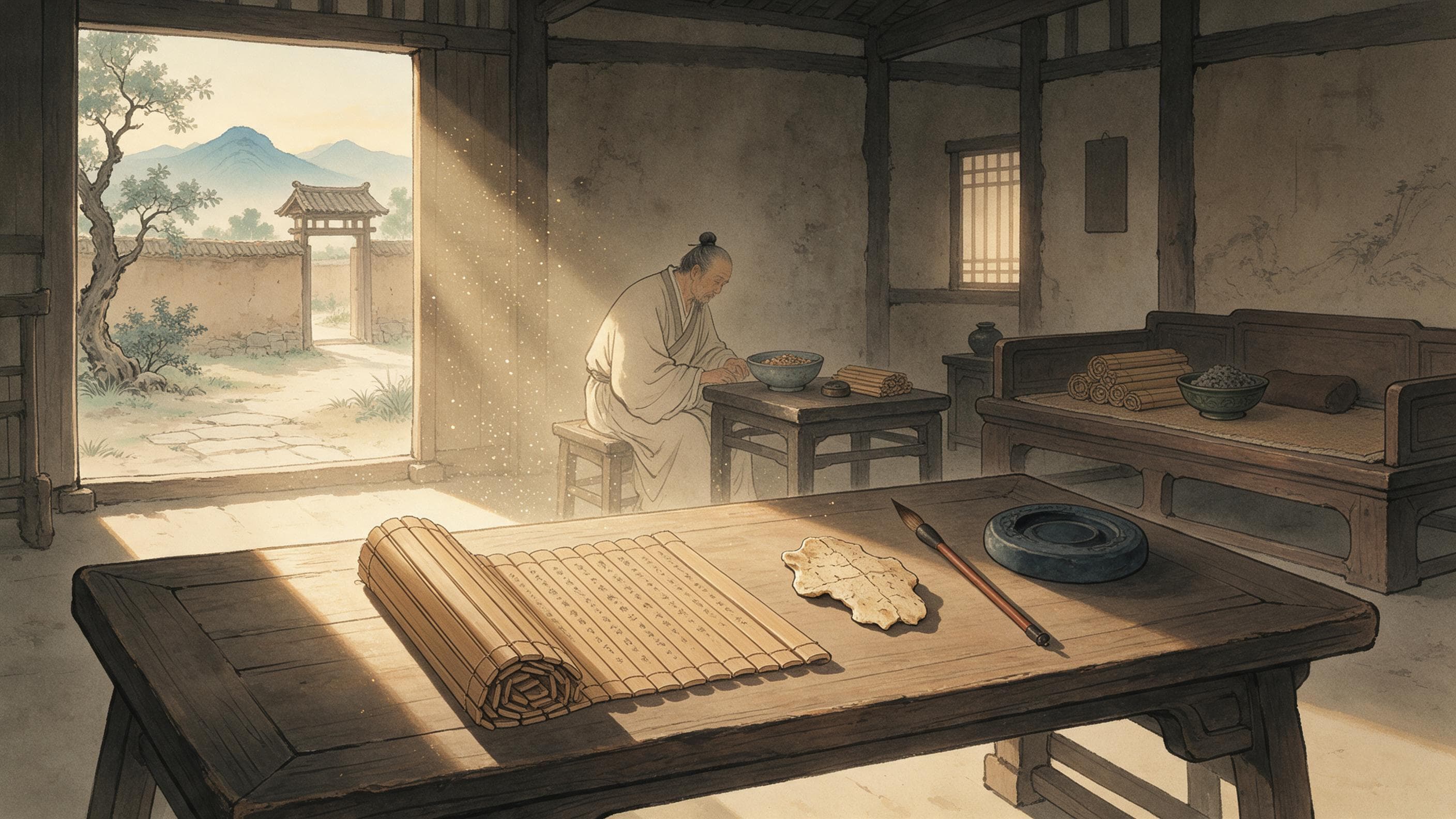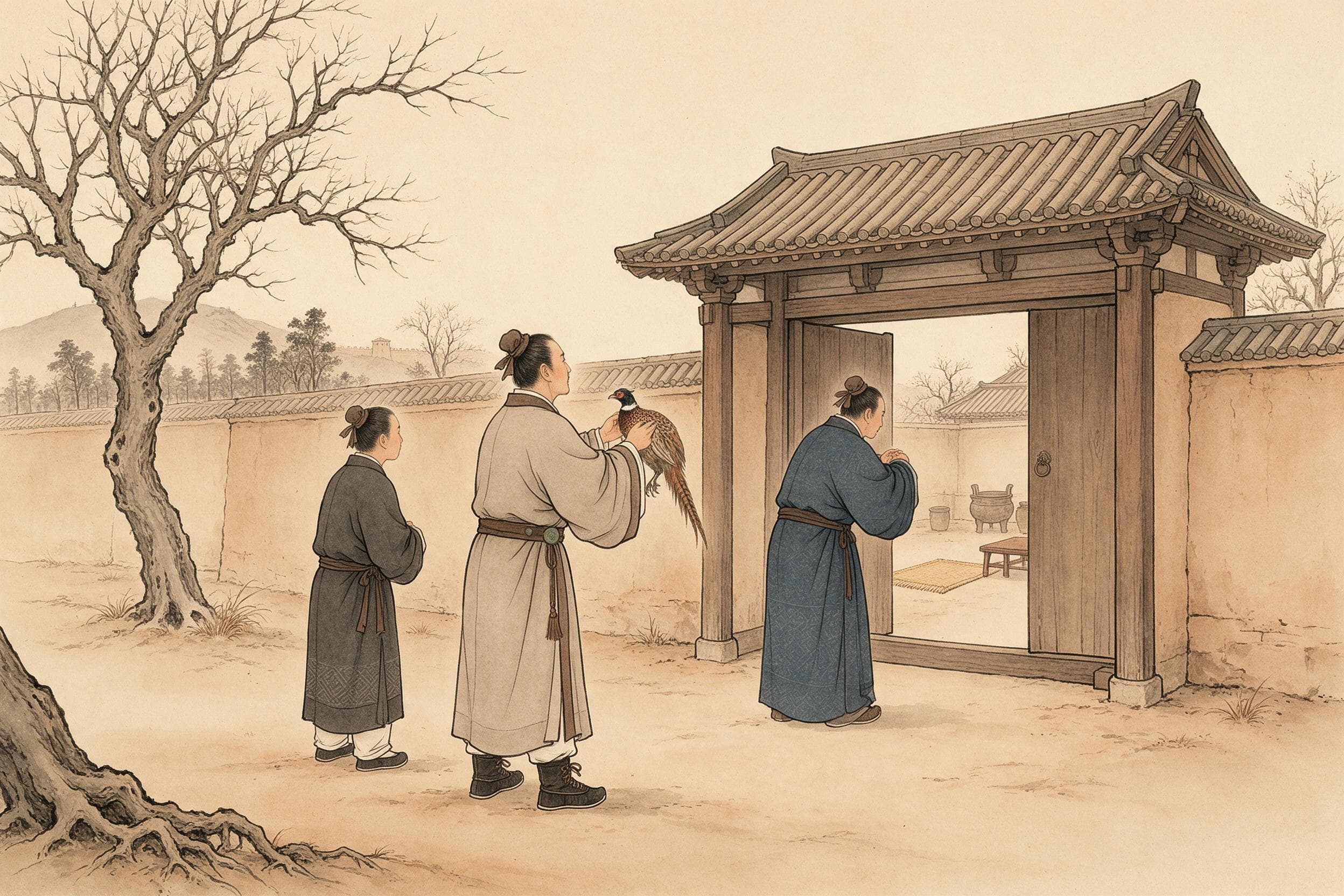
A first formal meeting begins with something in the hand. The Shi Xiangjian li, the rite of a knight's first meeting, states it in its opening line: 'The gift is a pheasant in winter, a dried pheasant in summer, held with the head to the left, the drying being, as Zheng says, 'to guard against rot and stench' (備腐臭也)' (摯,冬用雉,夏用腒。左頭奉之). Only then does it say what to say, how to enter, how to bow.
The classic records only what to carry and how; the reason appears in the comment. Zheng says the knight's pheasant is taken 'for its firmness, mating at a season and apart after' (取其耿介,交有時,別有倫也); the bird is used dead 'because a live pheasant cannot be made to submit' (為其不可生服也); the head is to the left 'the head being yang' (左頭,頭,陽也). In summer it is dried for one stated reason: 'to guard against rot and stench' (備腐臭也).
One Pheasant, Graded by Rank
The gift (zhi) changes with rank. A knight brings a pheasant or a dried one; lower great officers meeting each other bring wild geese, 'dressed with cloth and tied with cord, held as a pheasant is' (飾之以布,維之以索,如執雉); upper great officers bring lambs, 'tied at four points with the knot at the face, head to the left, held like a fawn' (四維之,結於面;左頭,如麛執之).
Rank subtracts: a knight seeing a great officer 'declines his gift outright' (終辭其摯); a knight or great officer seeing the ruler 'lays the gift down, bows twice and knocks his head' (奠摯,再拜稽首) while the ruler answers with one bow; a commoner seeing the ruler is not required even to compose his face — 'no bearing, he advances and withdraws at a run' (不為容,進退走). If the visitor is a man of another state, the ruler has his gift returned to him. And the carrying has its own rules: 'one who carries cloth or silk does not hurry, and composes his face the more as the mark of ritual; one who carries jade only slows his pace, lifting the front foot and dragging the heel' (凡執幣者,不趨,容彌蹙以為儀。執玉者,則唯舒武,舉前曳踵). A former subordinate is a case of its own: the gift is declined with ceremony, laid down inside, and the messenger carries it back out to him (若嘗為臣者,則禮辭其摯……使擯者還其摯於門外). Why does a knight seeing a great officer decline even this? The comment: 'he declines it finally because he will not answer the visit in person' (終辭其摯,以將不親答也); only a ruler receives a gift without answering it.
Eight Sentences of Refusal
Then come the words: four exchanges, eight sentences of refusal. The guest: 'I wished to see you and had no way to reach you; master so-and-so ordered me to come' (某也願見,無由達。某子以命命某見). The host: 'Master so-and-so ordered me to see you; you do me too much honour. Pray go home, and I shall come to you' (某子命某見,吾子有辱。請吾子之就家也,某將走見). The guest presses, the host declines again; in the third exchange the host shifts to refusing the gift: 'Hearing that you have brought a gift, I venture to decline it' (聞吾子稱摯,敢辭摯). The guest is firm — 'without a gift I dare not meet you' (某不以摯,不敢見) — and after two more refusals the host yields: 'Since I cannot be excused, how dare I not respectfully obey' (某也固辭,不得命,敢不敬從). Eight sentences, and not one word of self-introduction: every sentence pushes the speaker down and the other up. Everyone is 'so-and-so' (某), the ritual text's way of writing, not actual speech.
The comments explain not the ritual but who is meant. 'Master so-and-so is the name of the introducer' (某子,今所因緣之姓名也); 'to command means to relay the host's intention' (以命者,稱述主人之意); 'not daring to make a show means not putting up an outward dignity while truly wishing to come' (不敢為儀,言不敢外貌為威儀,忠誠欲往也). The classic gives the lines; the comment says who is speaking.
Why the going back and forth? The Qu Li gives the ground: 'Rites value reciprocity; to go and not return is not ritual, nor to come and not go' (禮尚往來。往而不來,非禮也;來而不往,亦非禮也). And: 'Ritual is to humble oneself and honour others; even a pedlar has something to be honoured for, how much more the rich and noble' (夫禮者,自卑而尊人). The refusals are not politeness; they settle who is high and who is low before anyone crosses the threshold.
Right and Left at the Gate
Only after the refusals does the meeting happen, and the text is very thin: 'He comes out to meet him outside the gate and bows twice; the guest answers with two bows. The host bows him in, entering on the right; the guest carries the gift and enters on the left. The host bows twice and receives it; the guest bows twice and hands it over; he goes out' (出迎於門外,再拜。賓荅再拜。主人揖,入門右。賓奉摯,入門左。主人再拜受,賓再拜送摯,出). One sentence, one movement: who bows first, who takes which side, who receives.
The detail of going up into the hall comes from the Qu Li: 'In entering with a guest, at every gate the host yields to the guest. When the guest reaches the chamber door, the host asks leave to go in and spread the mat, then comes out to meet him; the guest declines; the host leads him in. The host enters on the right, the guest on the left; the host takes the eastern steps, the guest the western… host and guest yield the ascent, the host goes up first, the guest follows, feet together on each step. On the eastern steps the right foot first, on the western the left' (凡與客入者,每門讓於客……上於東階則先右足,上於西階則先左足).
The Return Visit, and the Gift Returned
After the meeting comes a return visit, and this time the gift goes back. 'The host visits him again, bringing his gift, and says: "The other day you did me the honour of letting me see you; pray return the gift to your messenger"' (主人復見之,以其摯,曰:向者吾子辱,使某見。請還摯於將命者). The other declines, he asks again, three rounds in all, and then 'the guest brings the gift in, the host bows twice and receives it; the guest bows twice and hands it over, and goes out' (賓奉摯入,主人再拜受。賓再拜送摯,出). The pheasant goes back to the man who brought it. The gift is not a present to be kept; it is the token that makes the meeting a meeting. The comment: 'he asks to see him because the guest came with honour and the glad heart had not yet been exchanged; when the guest returns the visit, then there is ease' (請見者……歡心未交也。賓反見,則燕矣).
After the Meeting: What to Say, Where to Look
The same chapter governs speech and gaze. 'With the ruler speak of employing officers; with a great man, of serving the ruler; with the old, of teaching the young; with the young, of filial duty; with the crowd, of loyalty and kindness; with an official, of loyalty and good faith' (與君言,言使臣……與居官者言,言忠信). The eyes have their measure too: 'In speaking with a great man, begin by looking at his face, in the middle at his breast, at the end at his face again, without shifting' (始視面,中視抱,卒視面,毋改); with one's father one may let the eyes wander, but not above the face nor below the sash.
Two limits must be kept. This text is written for the knight, not for commoners or for the son of heaven; it is a ritual programme, not a record of two families in some year. And it never explains why. It says only what to carry, what to say, which side to enter by, who goes up the steps first, and when to give the gift back.
Related reading:A Stone, Six Dou of Rice: How a Ming Scholar Began · The Shi Yu Rite: Three Voices at One Midday Sacrifice · The Monthly Ordinances: The State's To-Do List for Every Month
Sources & further reading
- 《仪礼·士相见礼》(维基文库本,未与点校本复核) — The whole procedure: 'The rite of a knight's first meeting: the gift is a pheasant in winter, a dried pheasant in summer, held with the head to the left' (摯,冬用雉,夏用腒。左頭奉之). The eight-fold exchange of refusals before the visit (某也願見……敢不敬從), then 'he comes out to meet him outside the gate and bows twice; the guest answers with two bows; the host bows him in, entering on the right; the guest carries the gift and enters on the left; the host bows twice and receives it; the guest bows twice and hands it over; he goes out'. The return visit, when the host brings the gift back — 'pray return the gift to your messenger' (請還摯於將命者). The grading of gifts: a knight seeing a great officer declines his gift outright; the lower great officers exchange wild geese dressed in cloth and tied with cord; the upper great officers exchange lambs, tied at four points and knotted at the face. Seeing the ruler: gift laid down, two bows and a bow to the ground, the ruler answering with one bow; a man of another state has his gift returned. Speech and gaze: 'with the ruler speak of employing officers; with elders of teaching the young; with the young of filial duty; with officials of loyalty and good faith' (與君言,言使臣……與居官者言,言忠信); 'begin by looking at the face, in the middle at the breast, at the end at the face again, without changing' (始視面,中視抱,卒視面,毋改).
- 《仪礼注疏》卷七·士相见礼第三(汉郑玄注、唐贾公彦疏;维基文库本,未与点校本复核) — The comment and sub-commentary on the same page, quoted for the reasons the classic withholds. Zheng on the gift: 'The pheasant is taken for its firmness and independence, mating at a season and keeping apart after' (取其耿介,交有時,別有倫也); 'the pheasant must be used dead because a live one cannot be made to submit' (為其不可生服也); 'the head to the left, the head being yang' (左頭,頭,陽也); 'in summer a dried pheasant, to guard against rot and stench' (夏用腒,備腐臭也). Zheng on the rank rule: 'he declines the gift finally because he will not answer the visit in person' (終辭其摯,以將不親答也). Zheng on the return visit: 'he asks to see him because the guest came with honour, the meeting was all gravity and the glad heart had not yet been exchanged; when the guest returns the visit, then there is ease' (請見者……歡心未交也。賓反見,則燕矣). Jia explains the 'so-and-so' of the exchange as the introducer's name and the sentences as relayed speech (某子,今所因緣之姓名也;以命者,稱述主人之意).
- 《礼记·曲礼上》(维基文库本,未与点校本复核) — The general rules behind the meeting: 'Rites value reciprocity; to go and not return is not ritual, nor to come and not go' (禮尚往來。往而不來,非禮也;來而不往,亦非禮也); 'ritual is to humble oneself and honour others' (夫禮者,自卑而尊人). The passage at the gate and the steps: entering by every gate the host yields to the guest; at the chamber door the host asks leave to spread the mat and then comes out to meet him; 'the host enters on the right, the guest on the left; the host takes the eastern steps, the guest the western'; at the ascent host and guest yield, the host goes up first, the guest follows, feet together on each step and continuous; 'on the eastern steps the right foot first, on the western the left' (上於東階則先右足,上於西階則先左足); and 'going up into the hall, the voice must be raised' (將上堂,聲必揚).