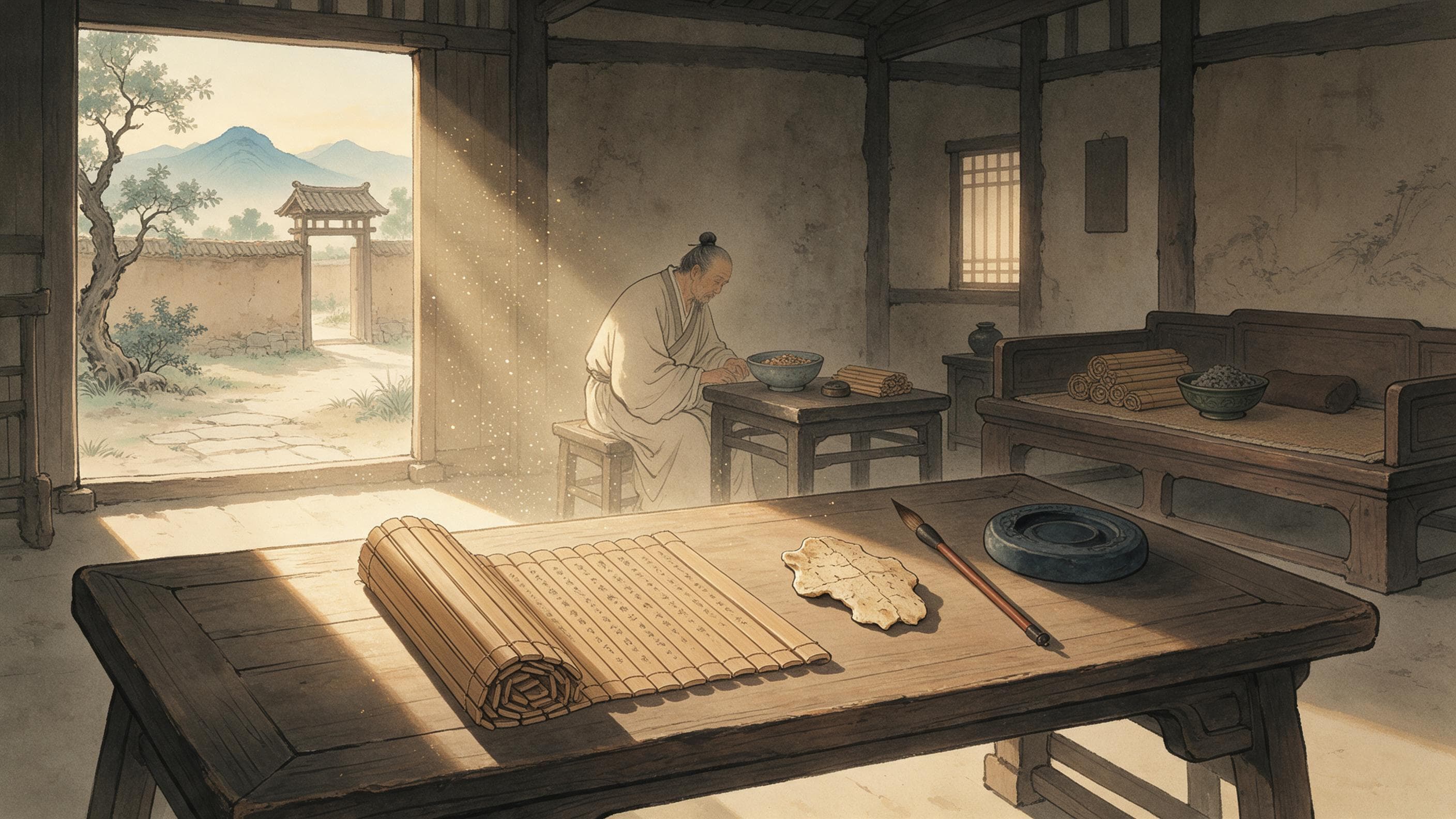
The month opens with a sky: 'In Meng Chun the sun is in Yingshi; at dusk Shen is at the meridian, at dawn Wei' (孟春之月,日在營室,昏參中,旦尾中). Zheng Xuan's comment explains why an almanac begins with stars: 'Whoever records the culminating stars at dusk and dawn does so for the ruler who faces south, to watch the seasons and give the people their work' (凡記昏明中星者,為人君南面而聽天下,視時候以授民事).
Where the King Sits, What He Wears
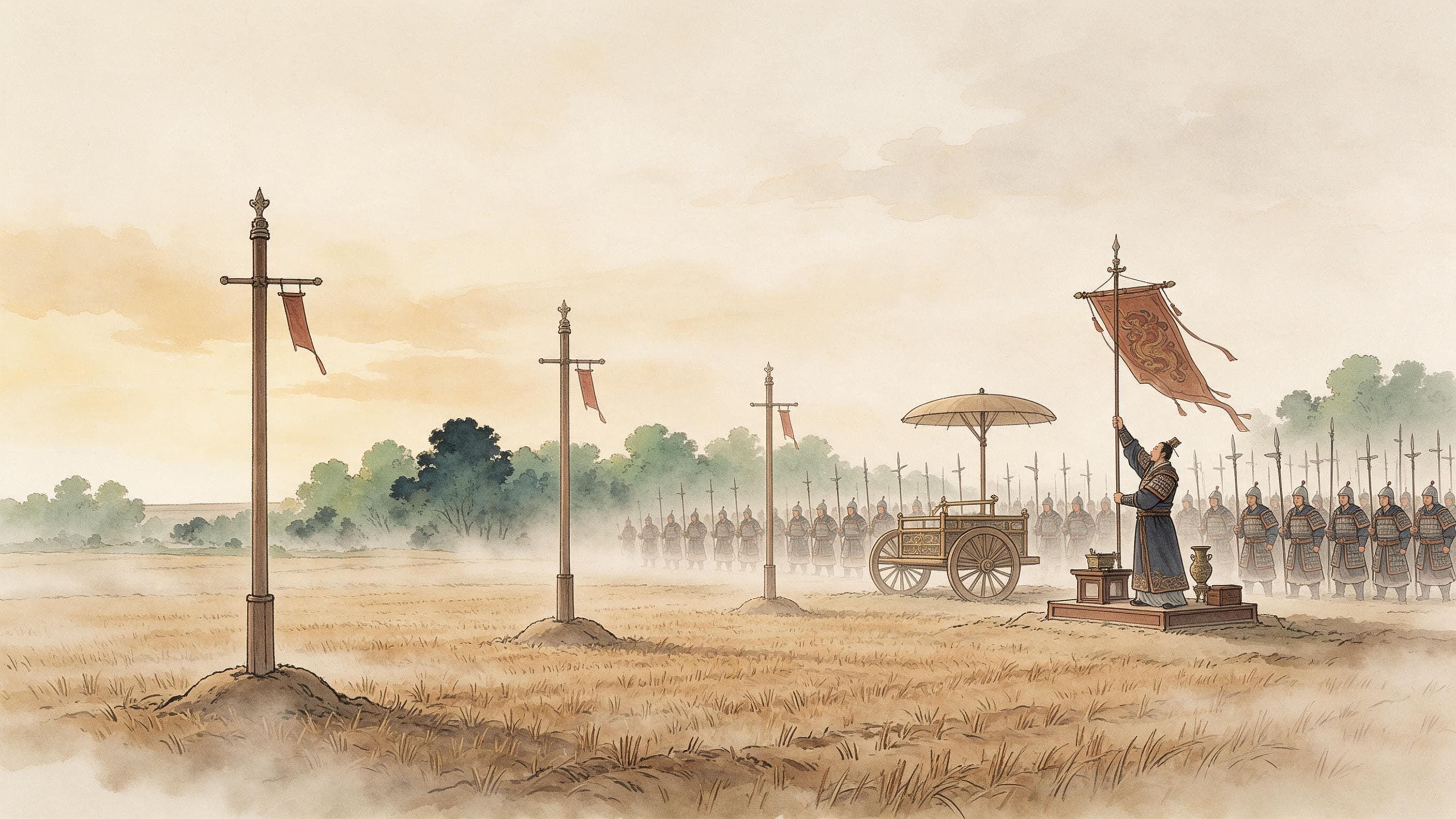
Then the month's arrangements: the king 'dwells in the Qingyang left chamber, rides the phoenix carriage, drives the blue-green dragon horses, raises the blue-green banner, wears blue-green robes and the granary jade, eats wheat and mutton, and his vessels are open-worked so that they let through' (天子居青陽左個……其器疏以達). Three days before spring the grand scribe announces the day and that 'the abundant virtue lies in wood'; at the start of spring the king leads the dukes, ministers, lords and officers to welcome spring in the eastern suburb, and rewards them at court on his return.
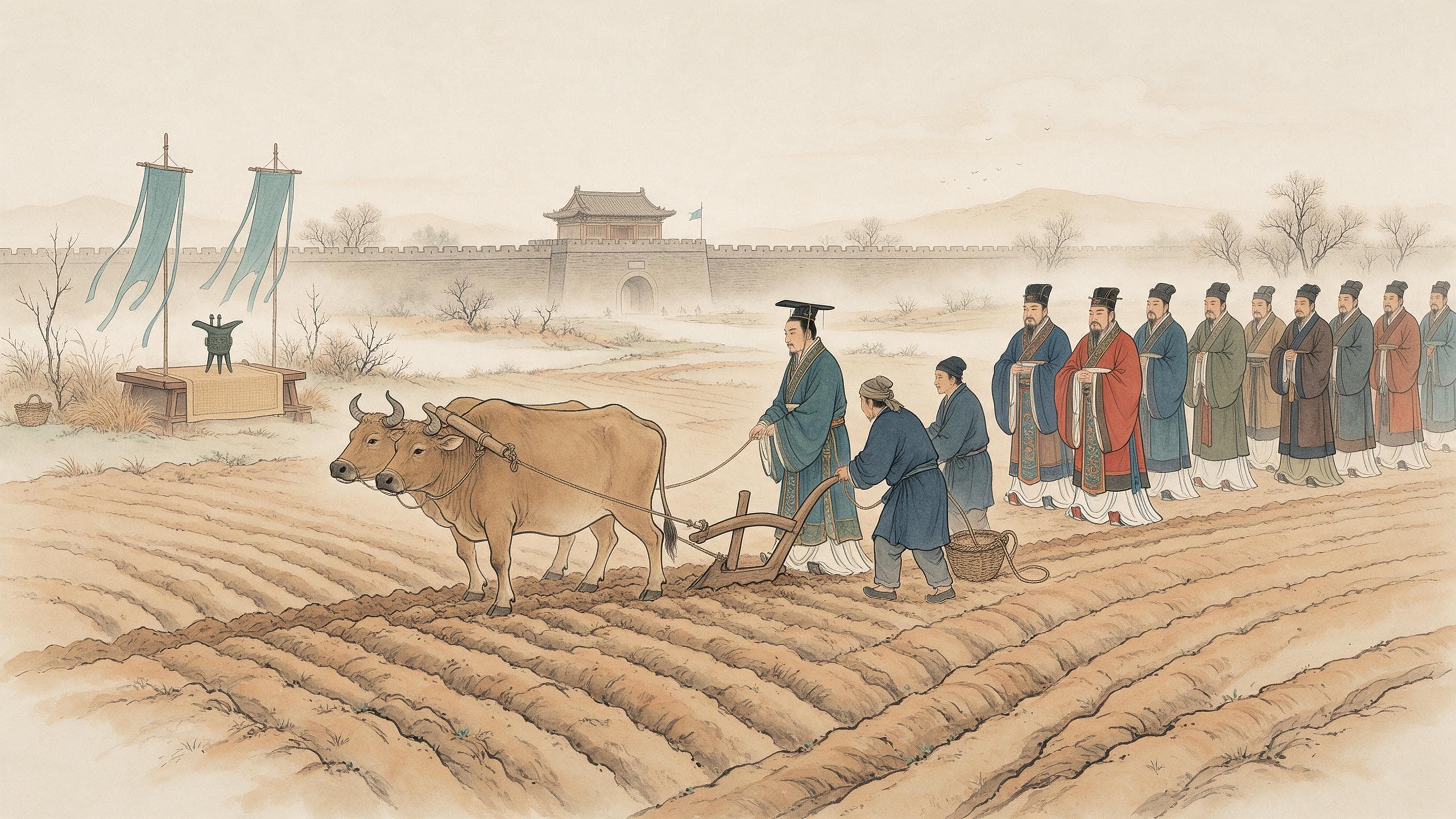
Then the work is handed out. The chancellor must 'spread virtue and harmonise prohibitions, carry out rewards and extend kindness to the myriad people'; the grand scribe must 'keep the statutes and the law, oversee the sun, moon and stars, taking the beginning as the constant' (宿離不貸,毋失經紀,以初為常). He prays for grain on the first auspicious day, then loads the plough between guard and driver and goes to the divine acres, where he pushes three times, the dukes five, the lords nine; back in the great chamber he lifts the cup, 'labour wine'. The comment explains the field — 'land worked by the people's strength, lent to the god of heaven' — and the plough's position, 'to show that he encourages farming, not that he is a farmer' (明己勸農,非農者也).
The last block is farming and prohibition. 'Heaven's qi descends, earth's qi rises, heaven and earth are in harmony, grasses and trees stir' (天氣下降……草木萌動) — the sign, says the comment, that ploughing may begin. Farming is published, the field officer moves east, boundaries and ditches are set right, the people taught what each soil grows. Then the prohibitions: 'forbid cutting timber'; 'do not overturn nests, do not kill the young, the unborn, the fledglings; do not take fawns or eggs' (毋覆巢,毋殺孩蟲胎夭飛鳥,毋麛,毋卵); no great levies, no walls; 'cover the bones and bury the carcasses'; 'in this month one may not raise troops; to raise troops brings certain disaster' (是月也不可以稱兵,稱兵必天殃). The comment gives each a reason: timber is 'where the abundant virtue lies', nests 'lest the budding young be hurt', bones 'the qi of death against life', troops 'against the qi of life'.
The Comment Pins the Words
Zheng Xuan's work here is pinning words down. Meng is 'eldest'; the Qingyang left chamber is 'the northern side of the eastern hall of the great chamber'; 'field' is the field officer, 'the officer in charge of farming'; 'shu' is read 'sui', the ditch between fields; the open-worked vessels are 'carved to let through, like things breaking the soil'. He cites densely: the Xia xiao zheng on hibernating insects and fish bearing ice; an agricultural book on 'the soil rising over the marker, old roots pulled, the ploughman setting to work'; the Spring and Autumn on the suburban sacrifice to Hou Ji for farming.
He records a variant and his own judgement. 'In the present Monthly Ordinances the goose is everywhere hou' (今月令鴻皆為候) — where this text reads 'the wild geese come', another reads 'the hou geese come', which the sub-commentary identifies as Lü Buwei's version. And on the seasonal carriages and colours he says plainly that they 'are taken from the Yin and altered; they are not the Zhou system' (非周制也), noting that in the Rites of Zhou court, sacrifice, war and hunt each have their own dress, not the season's.
The Reading: How to Say It
The third layer is Lu Deming's sound-and-meaning notes, in small type after the comment, governing pronunciation and character forms: 'Shen is read si-lin; zhong as written, though Xu reads zhu-zhong' (參所林反,中如字,徐竹仲反); 'Taihao takes tai, and so do the great-tsou, grand scribe, great chamber and the rest' (大皥上音太……皆同); 'ge is read he' (个古賀反). This layer asks neither about ritual nor meaning; it keeps the text pronounceable and copyable.
The Sub-commentary Argues with the Comment
Kong Yingda's sub-commentary explains and defends Zheng. On the month: 'This Meng Chun is the first month of the Xia calendar… Lü Buwei lived under Qin, which began the year in the tenth month; that it used the Xia seasons is because the Xia reckoning obtained the true standard of heaven' (此言孟春者……以夏數得天正故用之也). On the stars it works through the Santong and Yuanjia calendars and concedes that 'the culminating stars are all greatly approximate and do not agree with the calendar' (大畧而言,不與厯正同). And it separates two days the text leaves joined: the suburban sacrifice uses a xin day, while 'ploughing uses a hai day, hence the first branch-day' (耕用亥日,故云元辰).
On welcoming spring it lays out a disagreement: Zheng says the object is the Blue Emperor Lingweiyang, while 'Jia, Ma and Cai Yong all took it as sacrificing to Taihao and Goumang' (賈、馬、蔡邕皆為迎春祭大皥及句芒), and it notes Zheng's reliance on the apocrypha. On the fasting: 'the Zhou rule fasted ten days before the four seasonal welcomes… the Qin rule was simplified, hence three days' (今秦法簡省,故三日也). On the three pushes it compares the Guoyu's 'the king ploughs one furrow, the ranks threefold' (王耕一墢,班三之). On the bans it supplies the exceptions: timber is protected only in reserved ground and the state may fell what it needs, nests of ominous birds may be overturned, fawns and eggs are barred all year but may be taken for offerings.
The Same Month in Another Book
The Huainanzi's Seasonal Rules gives the same month: 'In Meng Chun the Dipper points to yin; at dusk Shen, at dawn Wei' (孟春之月,招搖指寅,昏參中,旦尾中) — and then the same east, jia-yi days, wood, scaly creatures, the jue note, the great-tsou pipe, the number eight, sour and rank, the door sacrifice and the spleen. The same signs follow — thaw, waking insects, fish on the ice, the otter's offering, 'the hou geese go north' — and the same prohibitions: no timber, no nests, no unborn or young, no fawns, no eggs, no levies, no walls, bones covered. The differences are plain: the Records read 'the wild geese come', the Huainanzi 'the hou geese go north'; the Records' 'Qingyang left ge' appears as 'Qingyang left diu' (青陽左丢), a character suspected to be an error and recorded as it stands; the Records say 'welcome spring', the Huainanzi 'welcome the year', drops the lords, and adds coins and male victims. It is generally held that the two share a source; the page does not say who copied whom, so they cannot prove each other. Both books carry the four-season frame: the Huainanzi welcomes the year at the southern suburb in early summer, the western in early autumn, the northern in early winter — one suburb a season, matching the eastern suburb of Meng Chun. What the page gives is a work order — where the king lives, what he wears, what officers do, what is forbidden — with three layers of explanation and a parallel from another book. Not cosmic philosophy; a very detailed schedule.
Related reading:Three Thousand Guests and a Bowl of Rice: What Mengchangjun's Retainers Ate · One Script for the Empire: A Decree and an Explanation Three Centuries Later · Sauce and Shi: A Hundred and Twenty Jars, Three Dou of Beans
Sources & further reading
- 《礼记·月令》(孟春之月;维基文库篇名页) — The ritual text itself: in the first month the sun is in Yingshi, at dusk Shen culminates and at dawn Wei; the east wind thaws the ice, insects stir, fish rise to the ice, otters make their offering, wild geese come; the son of heaven dwells in the Qingyang left chamber, rides the phoenix carriage, raises the blue-green banner, wears blue-green and the granary jade, eats wheat and mutton; three days before spring the grand scribe announces the day; on the day the king leads the dukes, ministers, lords and officers to welcome spring at the eastern suburb and rewards them at court; the chancellor spreads virtue, the grand scribe keeps the calendar, the king prays for grain and ploughs the divine acres three times while the dukes push five and the lords nine; the month forbids cutting timber, overturning nests, killing the young or taking eggs, gathering crowds or raising walls, and orders bones and carcasses buried. A programme for the month, not a diary of one.
- 《淮南子·时则训》(孟春之月;维基文库篇名页) — The parallel month: 'In Meng Chun the Dipper points to yin; at dusk Shen, at dawn Wei' (孟春之月,招搖指寅,昏參中,旦尾中), then the same east, jia-yi days, wood, scaly creatures, the jue note, the great-tsou pipe, the number eight, sour and rank, the door sacrifice and the spleen; the same signs, with small variants — 'fish rise bearing the ice' (魚上負冰), 'the hou geese go north' (候鴈北); 'holds court in the Qingyang left diu' (朝于青陽左丢, probably a scribal error for 左个); 'welcomes the year at the eastern suburb' (迎歲于東郊), with coins and prayers and male victims; and the same prohibitions — no timber, no nests, no unborn or young, no fawns, no eggs, no levies, no walls, bones covered. Used only as a parallel version; the page itself does not claim a common source.
- 《礼记注疏》卷十四·月令(汉郑玄注、唐陆德明音义、唐孔颖达疏;四库全书本,维基文库本,未与中华书局点校本复核) — Juan 14 is Meng Chun to 'Meng Chun in winter orders'; juan 15 begins at mid-spring, so the mid-spring bans (no draining marshes, no burning hills) are not in this juan. The page runs four layers continuously without section marks: the classic, Zheng Xuan's comment (注), Lu Deming's sound-and-meaning (音義) and Kong Yingda's sub-commentary (疏); the 考證 at the end is a Qing collation note (Siku editors), not Han-Tang commentary, and is not used here. Zheng: the Qingyang left chamber is 'the northern side of the eastern hall of the great chamber'; the seasonal carriages and colours are 'taken from the Yin and altered — not the Zhou system' (非周制也); the field is 'land worked by the people's strength, lent to the god of heaven'; the plough is placed between guard and driver 'to show that he encourages farming, not that he is a farmer'; the bans are explained as sparing pregnant animals and budding life. Kong: the month is the Xia calendar's first month though Qin began the year in the tenth month; the culminating stars are approximate; the day of the sacrifice and the day of ploughing are two days (郊用辛日,耕用亥日,故云元辰); on welcoming spring he records that Jia Kui, Ma Rong and Cai Yong all took it as sacrificing to Taihao and Goumang while Zheng used the Blue Emperor Lingweiyang; the timber ban covers only reserved ground and allows state needs; nests of ominous birds may be overturned; fawns and eggs may be taken for offerings.