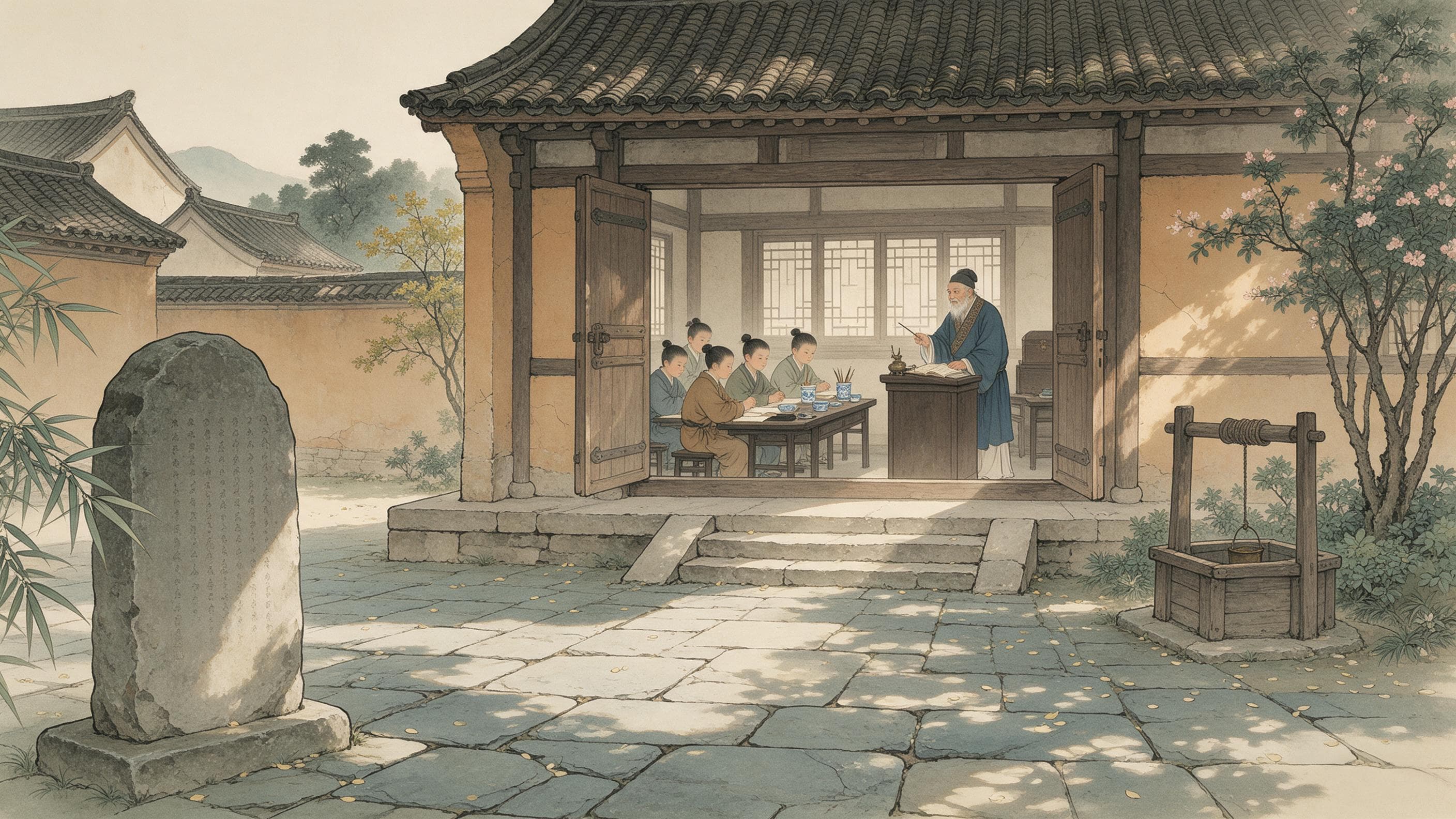
In 1382 the court sent twelve prohibitions to every school in the empire and had them cut into a low stone slab set to the left of the Minglun Hall, where students assembled. The slab lay flat, which is why it was called the recumbent stele, and anyone who broke its rules was to be punished as if he had broken a statute. A boy entering school met the stone before he met the books. Thirteen years earlier, in 1369, the founding emperor had ordered a school in every prefecture, department and county: a professor in each prefecture, a director of studies in each department, an instructor in each county, with assistants — four in a prefecture, three in a department, two in a county. Forty students in a prefectural school, ten fewer at each step below.
Community schools, under fifteen
Below the government schools stood the community school. An order of 1375 told these schools to hire teachers for the sons of commoners and to read, alongside the primers, the emperor's Great Warnings and the statutes of the dynasty; in the Zhengtong period their pupils were permitted to be enrolled as government students. In 1504 the court ordered community schools set up in every prefecture, department and county, with well-chosen teachers, and 'boys of the people under fifteen' sent to study there, learning the rites of capping, marriage, mourning and sacrifice. This is the only clause in the Ming History that gives an age of entry for commoner children: fifteen is the upper limit. At what age a boy began, the text does not say.
What was read depends on which school. The community schools read the Great Warnings, the statutes and the four family rites — rules and law first. In the government schools a student 'specialised in one classic', and the curriculum was divided among rites, music, archery, charioteering, writing and arithmetic. In the examination hall he wrote something else again: one essay on the Four Books, not fewer than two hundred characters, and one on his classic, not fewer than three hundred, 'aiming only at a clear grasp of the meaning, with no esteem for ornament'.
Who paid
The accounts of the government schools are specific. Within the establishment — forty students in a prefecture and ten fewer at each step down — teachers and students received six dou of rice a month each, the authorities added fish and meat, and the teaching staff drew a salary graded by post. As numbers grew, the students were ranked: those who drew the stipend were 'stipendiary' students, those added beyond the quota were 'expanded' students, and those taken in later still, at the end of the roll, were 'attached' students. In the Xuande period the expanded quota was fixed at sixty in the metropolitan prefectural schools and forty elsewhere, dropping by ten as the unit got smaller. The six dou of rice originally went to the students within the quota; the text only names the later grades, but the implication is that only the stipendiary drew it, and the expanded and attached had none. A new entrant was merely 'attached' until the examination grades let him move up.
For the community schools there is no account at all. The court said to hire teachers and to choose good ones; who paid them, and how much, is not recorded. The fee a Ming pupil gave his teacher — the shuxiu — has no figure anywhere in the Ming History's chapters on education. The only sums in them are the state's: six dou of rice to a student, a salary to a teacher. One is a ration, the other a wage. Private and family schools, the kind a household hired a teacher for, have no article in this chapter, and are left out here.
How one got in
'Those who have not yet entered school,' the chapter says, 'are all called tongsheng' — boy candidates. Only entry made a boy a student. The official in charge was the education intendant, who served a three-year term and examined the students twice. First came a ranking in six grades, the annual examination: those at the top of the first grade filled vacancies among the stipendiary students as they came up, the next filled the expanded quota; the first and second grades received rewards, the third nothing, the fourth a flogging, the fifth a demotion by one grade — attached students were reduced to blue gowns — and the sixth expulsion. From the first and second grades the intendant then chose the examination candidates, who were allowed to sit the provincial examination. This second test was called the qualifying examination.
It is worth pausing here: the Ming History's chapter on schools has no county, prefectural and provincial rounds of a preliminary examination. It has boy candidates, the intendant, the annual examination and the qualifying one. Even the office changed. Entry was at first supervised by the regional inspector, the provincial authorities and the prefectural and county officials; only in 1436 was an intendant appointed specifically for education, a censor in the two metropolitan provinces and a vice-commissioner or assistant commissioner elsewhere. There was also a side door: in a provincial examination year the authorities might admit one or two unusually bright boy candidates who could handle all three sessions, letting them sit with the students; a pass made them juren outright, a failure sent them back to await the intendant's examination.
After entry
Becoming a student was not the end. Above lay the provincial examination, held every third year in the eighth month, in three sessions on the ninth, twelfth and fifteenth; those who passed were juren. The quotas were first fixed in 1425 and then rose; by the Zhengtong period the two metropolitan provinces took a hundred each, Jiangxi sixty-five, falling to twenty in Yunnan. Another road was the tribute roll: only a stipendiary student of long standing could be sent as a regular tribute to the National Academy. There was also a way down: a student who had been in school ten years without achievement, or who committed a serious fault, was sent to the ministry to serve as a clerk, and his stipend was clawed back.
The quotas could also tighten. In 1531 an order to purge the student body was issued and then dropped after a censor argued against it; under Zhang Juzheng in the Wanli period the empire's students were cut, and the intendants overdid it — 'in one county only one boy candidate was admitted in a year'. One in a county is not the norm; it is the extreme the book chose to record.
The rule and the reality
The Ming History is a Qing compilation: it gives regulations and a dynasty's summary, not a schoolboy's diary. So it supplies the rules, and also the record of how they lapsed — and the lapse is its own admission. The community schools 'had long since fallen into disuse and were no longer carried out'. Teaching posts were graded by how many of their pupils passed the provincial examination — nine from a prefecture, six from a department, three from a county was the top mark — but in time the demotion of teachers and the drafting of students for clerical service 'were all left unenforced, and even the recumbent stele was mere form'. A slab carved with twelve prohibitions had become part of the furniture of the schoolyard.
Sources & further reading
- 《明史》卷六十九·选举一(学校)(清修,张廷玉等;维基文库) — The core source, and a Qing compilation of Ming regulations, not a Ming schoolboy's diary: the 1369 order for schools in every prefecture, department and county, with posts, student quotas and monthly stipends of six dou of rice plus fish and meat; the 1382 twelve prohibitions cut on a recumbent stele; shengyuan grades (stipendiary, 'expanded', 'attached'); the education intendant's three-year cycle, the six-grade examination, and the qualifying examination that made a student eligible for the provincial examination; community schools from 1375 and the 1504 rule sending boys under fifteen to them; the admissions that the community schools had long fallen into disuse and that the stele was 'mere form'.
- 《明史》卷七十·选举二(科目)(清修,张廷玉等;维基文库) — The provincial examination: every third year, in the eighth month, three sessions on the ninth, twelfth and fifteenth; passers are juren. Quotas were first fixed in 1425 (Hongxi 1); the figures of a hundred for each metropolitan province, sixty-five for Jiangxi and twenty for Yunnan at the lowest belong to the Zhengtong period. The set texts are here; the required lengths of examination essays are in juan 69, not in this juan.