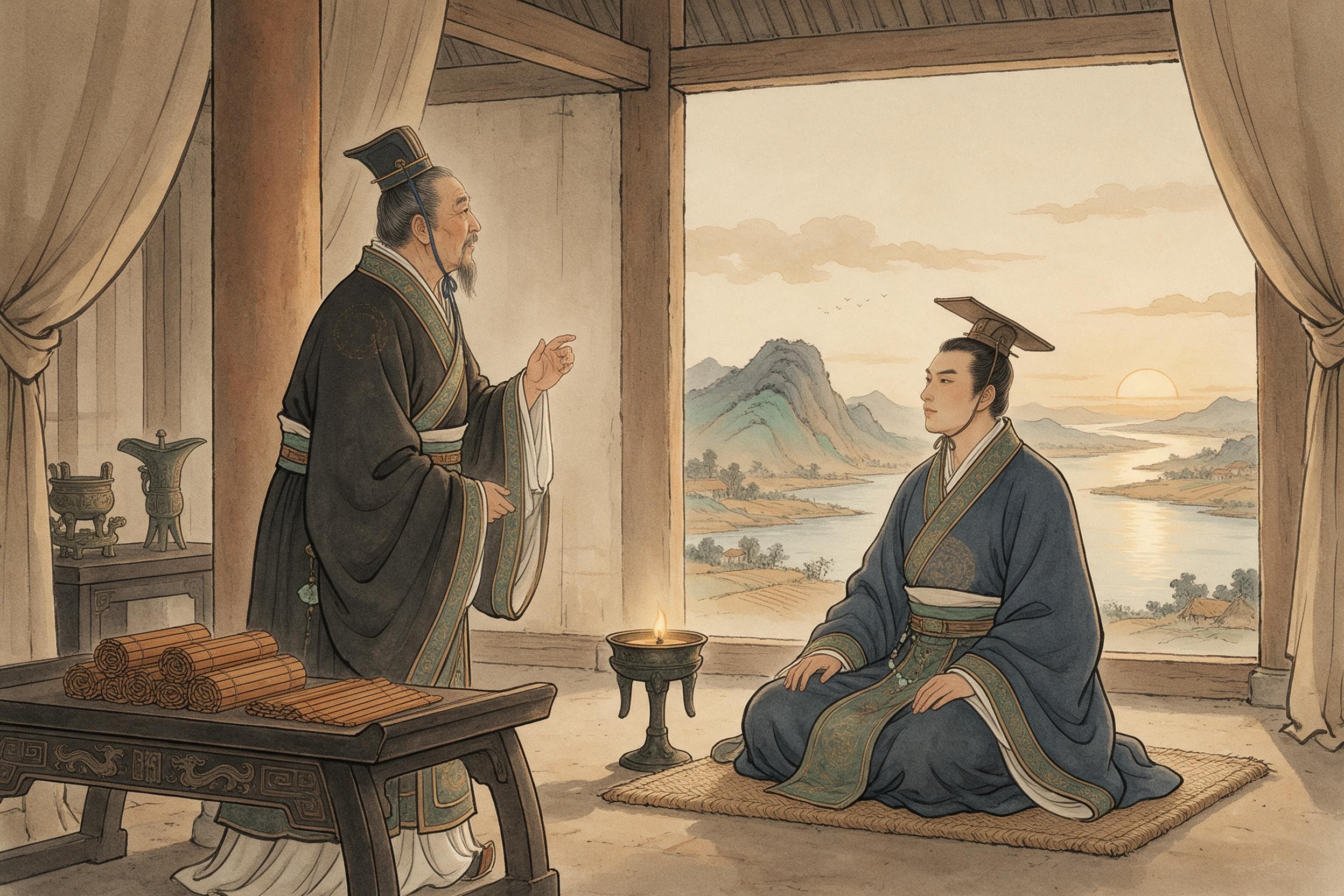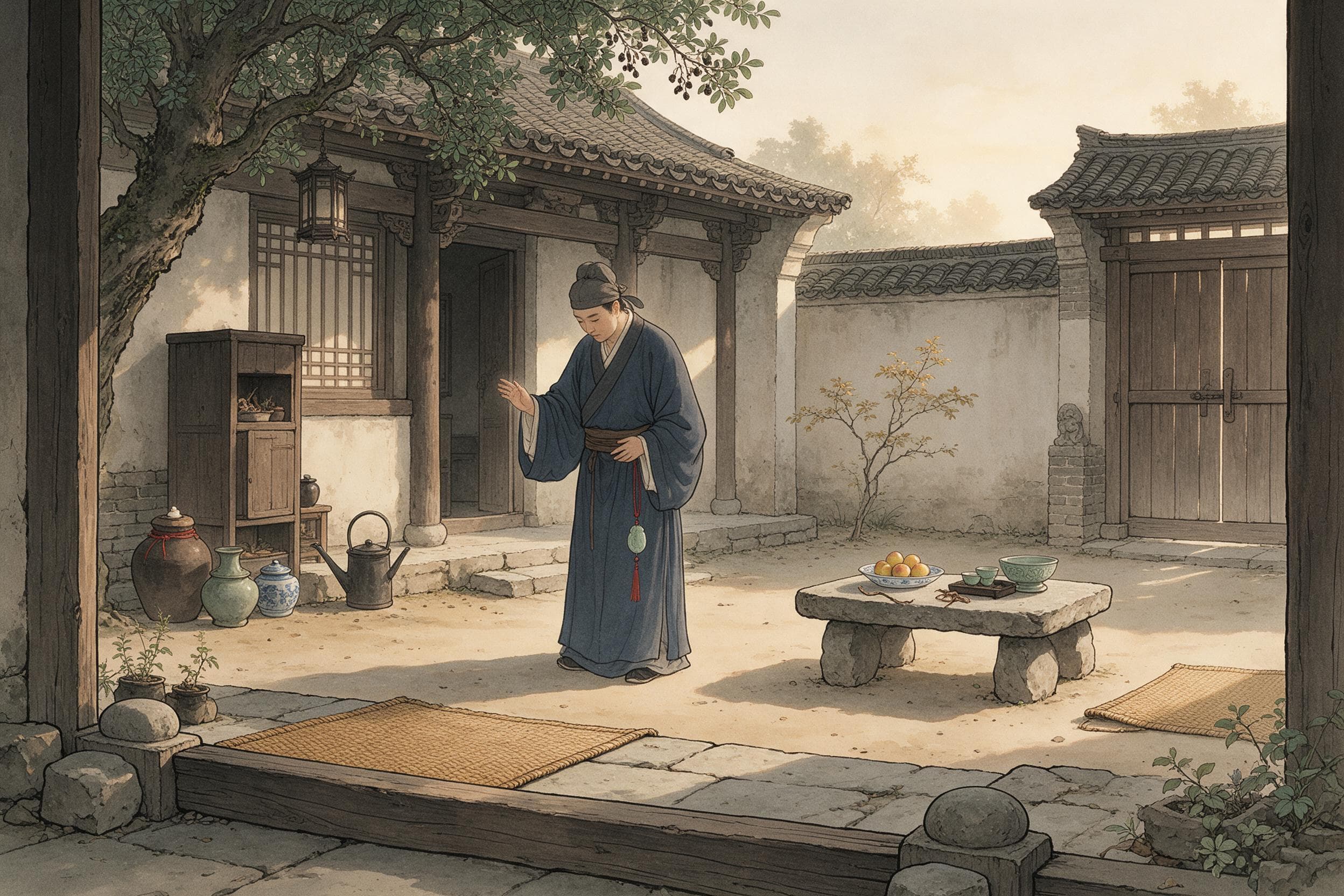
Before a man left for the ruler's court, the Book of Rites says, he stayed the night in an outer room, fasted and bathed, took from the scribe the ivory tablet on which he had written the answers he might be asked for, and put on his robes. Then two last things: he practised his bearing, and 'looked to the sound of his jade' (習容,觀玉聲). Then he went out. Bathing, fasting, tablet, robe — all of it comes before the final check, which is made with the ears.
First the Jade, Then the Gate
The passage comes from the 'Yu Zao' (玉藻) chapter of the Li Ji. The title is taken from its first sentence, about the crown: 'The Son of Heaven's jade fringe, twelve strands, hanging before and behind' (天子玉藻,十有二旒,前後邃延). The chapter works through food and drink, caps, belts, tablets and furs before reaching the pendant, with rules for the Son of Heaven, the lords, the grand officers and the shi. It is a book of what should be done, commonly dated to the Warring States and early Han, and it never says what the jade looked like. The verb in 觀玉聲 is 'look'; the page gives no note, and the usual reading is that he listened to the sound his steps produced.
The pendant belongs to the belt: 'every belt has its pendant jade; only in mourning it has none' (凡帶必有佩玉,唯喪否). Then the chapter names one component and stops: 'the pendant jade has a chongya' (佩玉有衝牙). What a chongya was, how many pieces hung beside it, how they were strung — none of it is said. What the chapter cares about is the obligation: 'the gentleman, without cause, does not let the jade leave his body' (君子無故,玉不去身), and then 'the gentleman compares virtue to jade' (君子於玉比德焉). That is the only sentence of its kind here; no list of virtues follows.
Zhi and Jue on the Right, Gong and Yu on the Left
Then the famous passage: 'The gentleman of old always wore his jade: zhi and jue on the right, gong and yu on the left; at the quick step he kept to Cai Qi, at the walk to Si Xia. A full turn matched the compass, an angled turn the square. Advancing, he inclined; retreating, he lifted — and then the jade rang' (古之君子必佩玉,右徵角,左宫羽,趨以采齊,行以肆夏。周還中規,折還中矩。進則揖之,退則揚之,然後玉鏘鳴也). Zhi, jue, gong and yu are four of the five notes; Cai Qi and Si Xia are, on the usual reading, names of pieces of music. None of this is glossed. Which stone sounds which note, how many pieces hang on a side, who played the music — the chapter does not say.
The reason it gives is a continuous audit. 'So the gentleman, in his carriage, hears the bells of luan and he; walking, he sounds his jade — and no improper thought finds a way in' (故君子在車則聞鸞和之聲,行則鳴佩玉,是以非辟之心無自入也). Every step reports on the body that takes it: a wrong pace makes a wrong sound. This is the rule-maker's account of why the pendant exists. It is not evidence that men walked this way; the chapter never shows a man walking.
Which Stone, Which Cord
The stone and the cord are graded together: 'The Son of Heaven wears white jade on a black cord; the lords, mountain-dark jade on a red cord; the grand officers, water-green jade on a plain cord; the heir, yu jade on a dark blue cord; the shi, ruan-min jade on a reddish-brown cord' (天子佩白玉而玄組綬……士佩瓀玟而緼組綬). Five ranks, five stones, five cords. Every one of those adjectives is a colour or a quality the page leaves undefined. Then, outside the ladder: 'Confucius wore an ivory ring five inches across, on a dark blue cord' (孔子佩象環五寸而綦組綬) — a named man, a different material, and the only measurement in the passage.
Five inches is the only dimension the chapter gives for any piece of pendant jade: no price, no weight, no source for the stone, no cutter, no count of pieces, no account of stringing. The one structural term, chongya, is named and left. With the chapter in hand a reader could not have a pendant made, and could not say what one cost. The rules govern a body in motion; the object stays outside the text.
When the Jade Must Be Silent
The chapter is just as precise about when the jade is not worn. 'In the ruler's presence he does not wear his jade: the left pendant is tied up, the right is set' (君在不佩玉,左結佩,右設佩). At home both are set; at court both are tied; in the fast they are tied in another fashion, with the knee-cover of the rank's colour (齊則綪結佩而爵韠). The verbs do the work: 設, 'set', leaves the pieces free to strike; 結, 'tie', gathers them. That tying silences them is inference from the verbs — the page does not say so. What the rule assumes is that before the ruler the sound stops, and elsewhere it is there. In mourning there is no jade at all.
Jade in the hand is a third case, treated as a different object. Holding jade or a tortoise shell, a man closes his outer robe over the inner one (執玉、龜,襲), the reverse of display. And the walk changes: 'holding a tortoise shell or jade, he lifts the front of the foot and drags the heel, treading carefully' (執龜玉,舉前曳踵,蹜蹜如也). Worn jade must ring; held jade must be carried with the robe shut and the step shortened. The same material, two disciplines of the body.
The Jade in the Other Room
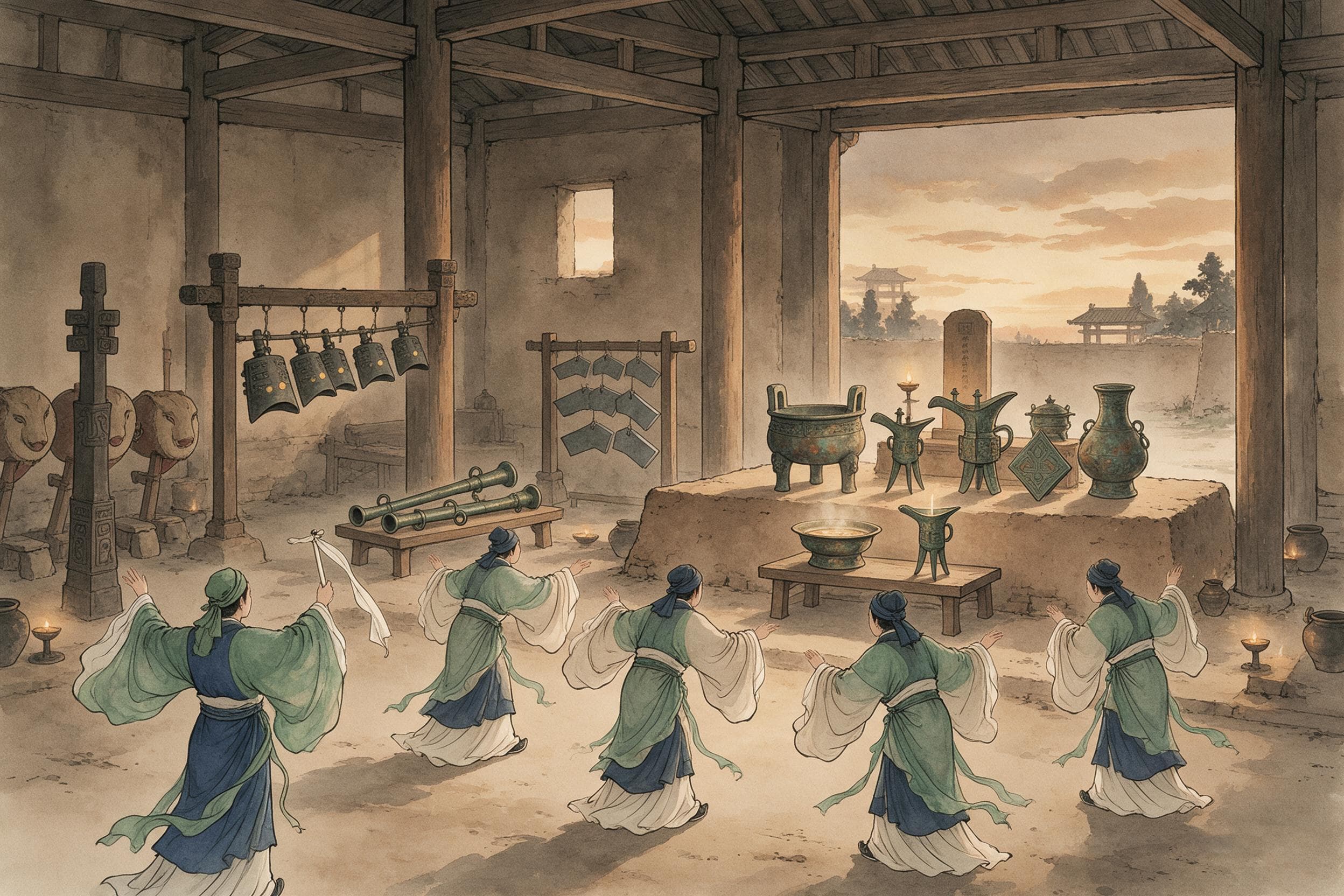
Another room, another use of jade, in the 'Gu Ming' chapter of the Shang Shu. The king is dying; after his death the Grand Protector has the hall set out, jade on the tables at the four positions: 'at the window facing south … a table with flowered jade; at the west wall facing east … a table with figured shell; at the east wall facing west … a table with carved jade' (牖間南嚮……華玉仍几……雕玉仍几). Then the treasures are ranged along the two walls: 'five tiers of Yue jade: Chen Bao, the Red Knife, the Great Instructions, the Hong Bi, the Wan and the Yan, at the west wall; the Great Jade, the Yi Jade, the Heavenly Globe, the River Diagram, at the east wall' (越玉五重:陳寶、赤刀,大訓、弘璧、琬、琰,在西序;大玉、夷玉、天球、河圖,在東序). Every piece has a name and a place; not one has a size, a colour or a description. 'Still tables' is the usual reading: tables on which the jade rests; the page gives no note. Traditionally the chapter is the death of King Cheng and the accession of King Kang, though the page says only 'the king' and 'the eldest son Zhao'. Then the rite begins and jade moves into hands: 'the Grand Protector holds the great jie tablet; the Grand Ancestor holds the tong and mao' (太保承介圭,上宗奉同瑁). Later the cup is received, the hands washed, a different tong used to return the toast; the king bows, offers and pours three times each. These jades rest on tables or pass through hands. None is worn; none rings.
So the two pages divide the subject and never meet. One is a rulebook for a body in motion, where jade is heard; the other an account of a hall and a rite, where jade is placed and handed over. Neither says what a pendant looked like, where the stone came from, or what it cost. What survives is position, verb and sound: 設, 結, 承, 奉 — and 鏘鳴.
Related reading: Shang Bronzes and Jades · Han Clothing
Sources & further reading
- 《礼记·玉藻》(维基文库本,未与点校本复核) — The whole pendant material comes from one chapter. Before court: 'he practised his bearing and looked to the sound of his jade' (習容,觀玉聲). On the belt: 'every belt has its pendant jade; only in mourning it has none… the pendant jade has a chongya… the gentleman, without cause, does not let the jade leave his body… the gentleman compares virtue to jade' (凡帶必有佩玉,唯喪否。佩玉有衝牙。君子無故,玉不去身。君子於玉比德焉). The sound rules: 'zhi and jue on the right, gong and yu on the left; at the quick step he kept to Cai Qi, at the walk to Si Xia; a full turn matched the compass, an angled turn the square; advancing he inclined, retreating he lifted, and then the jade rang' (右徵角,左宫羽,趨以采齊,行以肆夏。周還中規,折還中矩。進則揖之,退則揚之,然後玉鏘鳴也), with the stated reason: 'in his carriage he hears the bells of luan and he, walking he sounds his jade, and no improper thought finds a way in' (故君子在車則聞鸞和之聲,行則鳴佩玉,是以非辟之心無自入也). The rank list gives five stones and five cords, from the Son of Heaven's white jade on a black cord to the shi's ruan-min jade on a reddish-brown cord, then 'Confucius wore an ivory ring five inches across' (孔子佩象環五寸而綦組綬) — the only measurement. Silence: 'in the ruler's presence he does not wear his jade: the left pendant is tied up, the right is set' (君在不佩玉,左結佩,右設佩); also 'holding jade or a tortoise shell, he closes his outer robe' (執玉、龜,襲) and 'holding a tortoise shell or jade, he lifts the front of the foot and drags the heel' (執龜玉,舉前曳踵,蹜蹜如也). The page is the text only: no commentary, no gloss on any jade name, no size, price or description of any piece except the ivory ring's five inches.
- 《尚书·顾命》(维基文库本,未与点校本复核) — Jade set out, not worn. After the king's death the hall is prepared: 'at the window facing south … a table with flowered jade; at the west wall facing east … a table with figured shell; at the east wall facing west … a table with carved jade; at the west side-room facing south … a table with lacquer' (牖間南嚮……華玉仍几。西序東嚮……文貝仍几。東序西嚮……雕玉仍几。西夾南嚮……漆仍几). The treasures: 'five tiers of Yue jade: Chen Bao, the Red Knife, the Great Instructions, the Hong Bi, the Wan and the Yan, at the west wall; the Great Jade, the Yi Jade, the Heavenly Globe, the River Diagram, at the east wall' (越玉五重:陳寶、赤刀,大訓、弘璧、琬、琰,在西序;大玉、夷玉、天球、河圖,在東序). In the accession rite jade is held: 'the Grand Protector holds the great jie tablet; the Grand Ancestor holds the tong and mao' (太保承介圭,上宗奉同瑁). The chapter names pieces and places them; it gives no size, colour, material or carving for any of them, and nobody in it wears jade. Its figures are called only 'the king' and 'the eldest son Zhao'; the identification as King Cheng's death and King Kang's accession is traditional, not stated on the page.