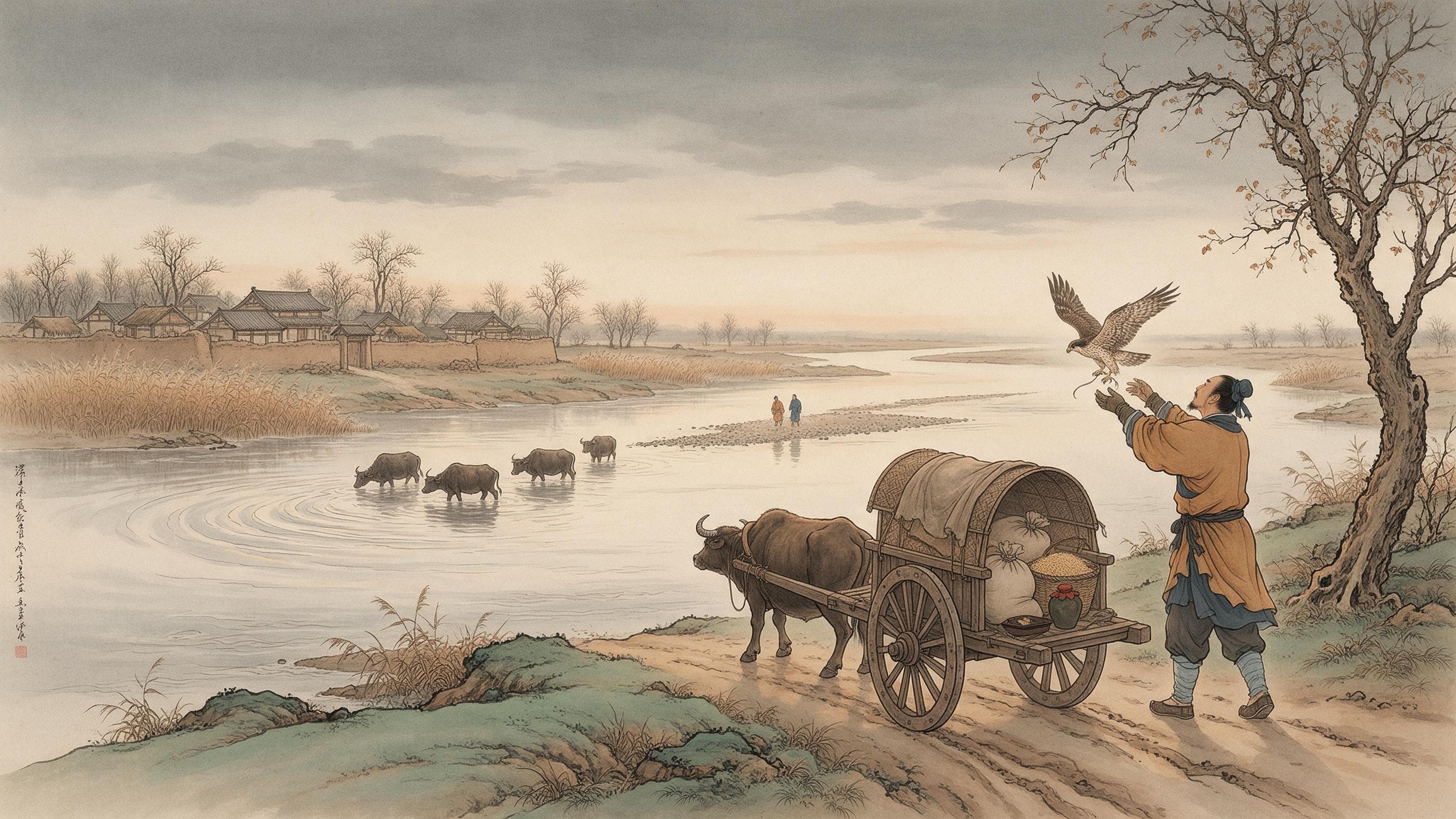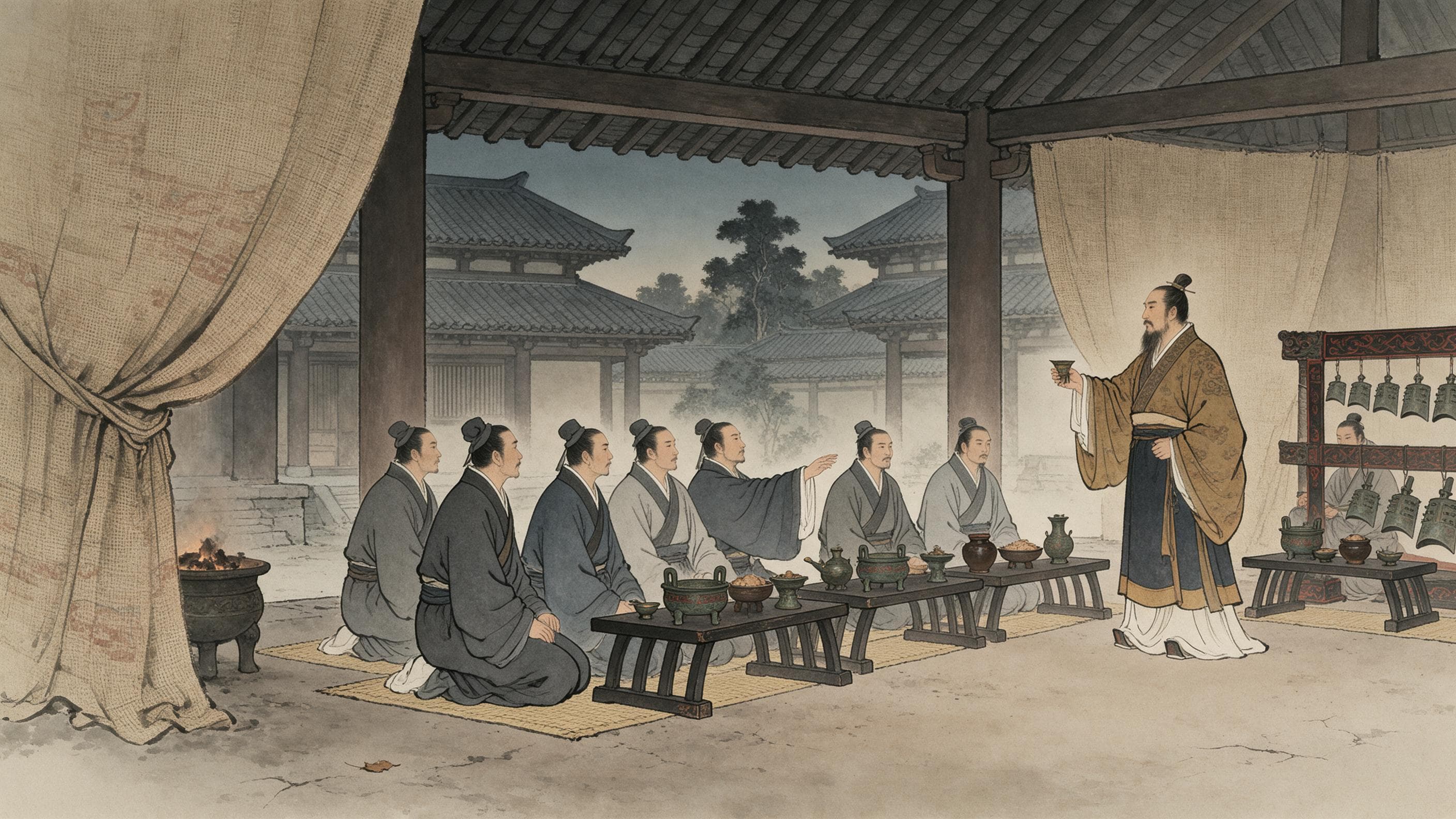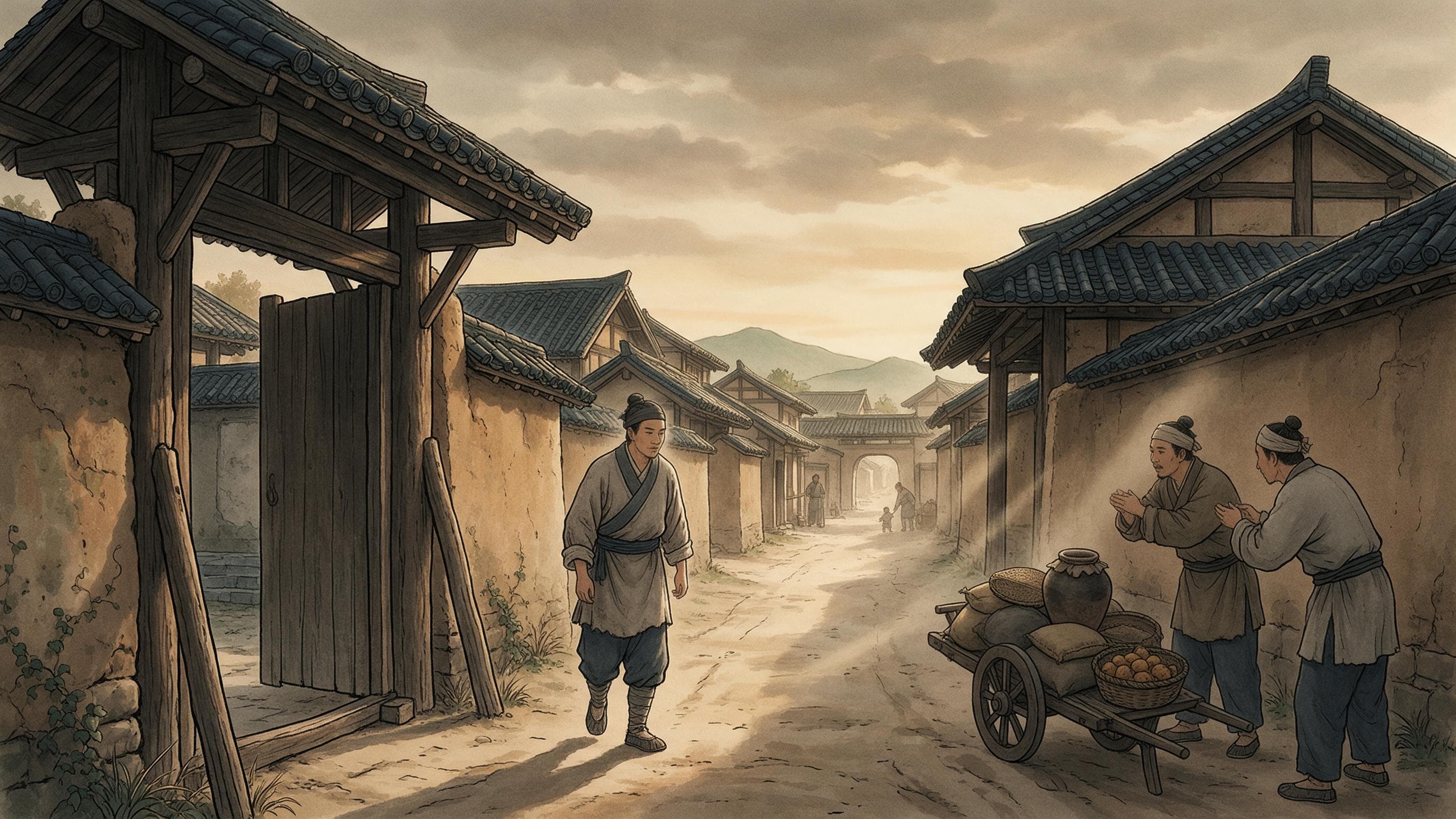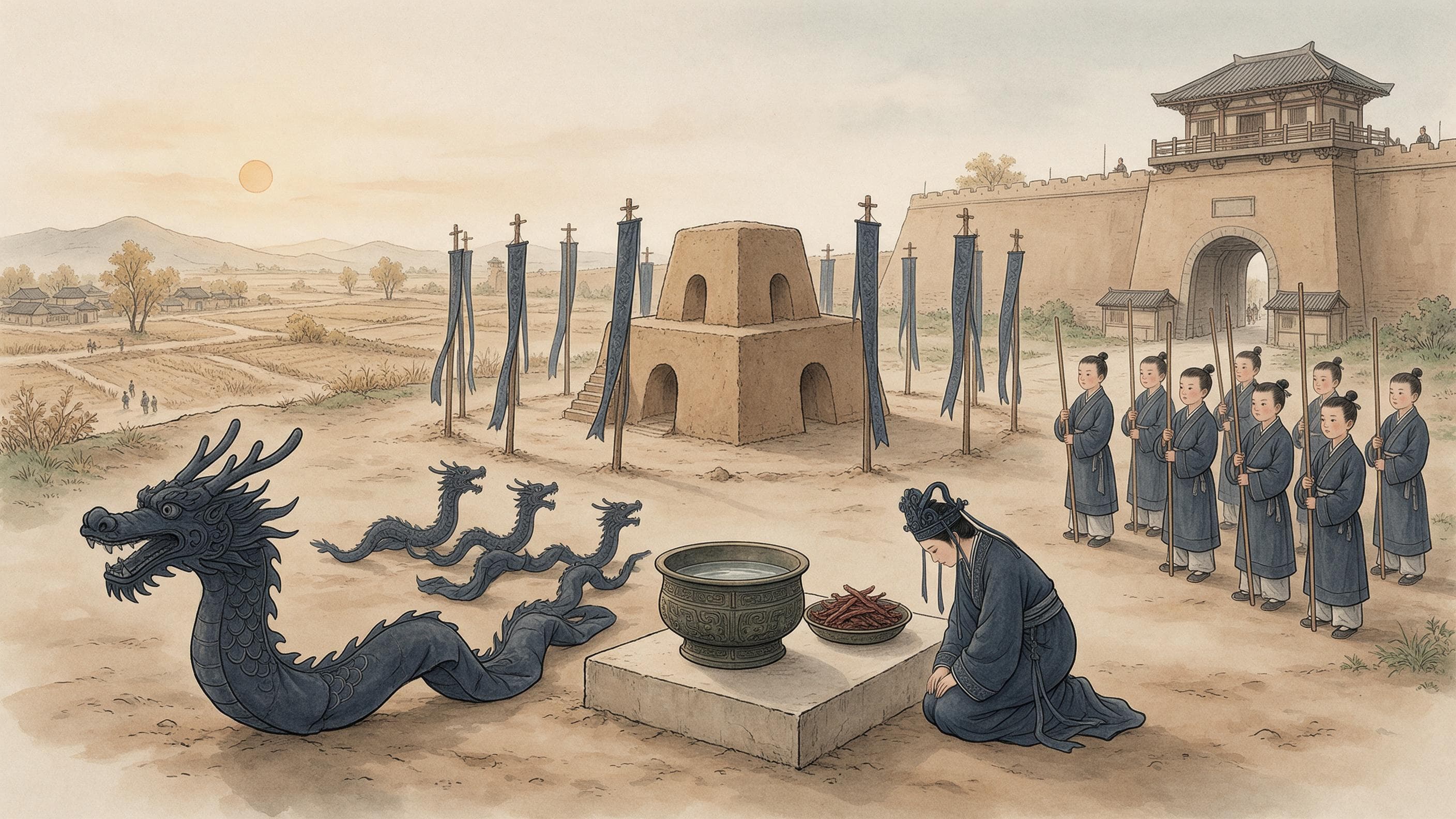
A spring drought, and the first instruction goes to the county: 'In spring when drought comes, order the county and its towns, on a water day, to pray at the altars of soil and grain, at the mountains and rivers; the families sacrifice to the door; do not fell famous trees; do not cut the mountain forests; expose the witches; gather the crippled; on the eighth day, outside the east gate of the town, make an altar open on four sides, eight chi square, plant eight lengths of dark blue silk' (春旱求雨……為四通之壇,方八尺,植蒼繒八). The rite begins with a direction and a measurement: east gate, four-sided altar, eight chi, eight pieces of blue.
One: spring, the altar and the colour
The god on the altar is Gonggong, and the offerings are 'eight live fish, dark wine, clear wine and dried meat' (生魚八、玄酒、具清酒、膊脯). The invoker is chosen from among the witches: 'choose a witch clean and eloquent to be the invoker'; he 'fasts three days, wears dark blue, bows twice, then kneels and sets out the prayer, bows twice again and rises'. The prayer is quoted too: 'Great Heaven bore the five grains to nourish men; now the five grains suffer from drought and we fear they will not ripen; we respectfully present clear wine and dried meat and bow twice to ask for rain. If the rain comes in good abundance, we shall then present victims' (昊天生五穀以養人……雨幸大澍,即奉牲禱). Ask first; pay after.
Then the dragons: 'on a jia or yi day make one great dark-blue dragon, eight zhang long, in the middle, and seven small dragons, each four zhang long, in the east, all facing east, eight chi apart; eight boys, each fasting three days, wearing dark blue, dance with them; the field bailiff also fasts three days, wears dark blue and stands by' (以甲乙日為大蒼龍一,長八丈,居中央,為小龍七,各長四丈……田嗇夫亦齋三日,服青衣而立之). Eight zhang, seven dragons, four zhang, eight chi, eight boys, blue — this chapter's rite is nearly written out of numbers and colours: the great dragon in the middle, the small ones east of it, all facing east, eight chi apart, eight boys dancing, a bailiff standing.
The rest is a list of physical acts: hollow out the altar of soil and join it to the ditch outside the lane; set five toads in the altar; a pool eight chi square and one chi deep with water in it; a three-year-old cock and a three-year-old boar, both burned at the four-sided shrine; 'shut the south gate of the town and lane and set water outside it, and open the north gate'; a boar outside the lane's north gate and another in the market; 'when the drum is heard, burn the boars' tails'; bury dead men's bones; open the mountain springs and burn brushwood; clear the bridges and ditches. If the rain comes: 'repay with one pig, wine, salt and millet, sufficient; a mat of thatch, do not cut it' (報以處一,酒鹽黍財足,以茅為席,毋斷).
Two: four seasons, five colours, five numbers
The scheme runs four times a year with the numbers and colours changed. Spring: altar eight chi, eight pieces of dark blue, great dragon eight zhang, seven small, eight boys in blue, facing east. Summer: seven chi, seven red, seven zhang, six small, seven strong men in red, facing south. Late summer: five chi, five yellow, five zhang, four small, five men and five elders in yellow. Autumn: nine chi, nine white, nine zhang, eight small, nine widowers in white, facing west. Winter: six chi, six black, six zhang, five small, six old men in black, facing north. chi, pieces, zhang, persons, colours and directions are copied as they stand; nothing is converted and no theory of yin and yang is built on them here.
There is a rite for the opposite: 'when rain is too much, block the water channels, cut the roads, cover the wells, and forbid women to go into the market'; the altars are swept, three days of fasting and three of drumming, 'drumming without singing', red silk wound ten times around the altar, red clothes and headcloth, and after three days it stops. The chapter ends with an actual order: 'On the bingwu day, the eighth month, twenty-first year, the chancellor of Jiangdu, Zhongshu, informed the inner secretary and the commandant: the rain has been too long… hasten to stop it' (二十一年八月甲申朔丙午……), sent to seventeen counties and eighty sub-districts, officials of a thousand shi and below sending their wives home. Seventeen counties, eighty districts: as written.
Three: one sentence in the Han history
Ban Gu's biography compresses it into a principle and a result: 'Zhongshu governed by using the anomalies of the Springs and Autumns to infer how yin and yang went astray; so for rain he closed the yang and released the yin, and to stop rain did the reverse; he practised it in one state, and never failed to get what he wanted' (以《春秋》災異之變推陰陽所以錯行……行之一國,未嘗不得所欲). The received text gives the principle only. What 'closing the yang' looked like appears in Yan Shigu's commentary — closing the south gate, forbidding fires, opening the north gate, sprinkling water on people. That is a note, not the text; it is marked as a note, and is not used to certify the other book's details. One book's text gives measurements, the other's gives one sentence.
Four: Wang Chong, Eastern Han
Two centuries later Wang Chong answers it chapter by chapter. He names the school he is against: 'the partisans of change and response take long rain as flooding and long drought as drought' (變復之家,以久雨為湛,久為旱). His own thesis: 'man cannot move Heaven by his conduct, and Heaven does not answer man by following his conduct' (人不能以行感天,天亦不隨行而應人). He does not deny that the rite is old — 'the Springs and Autumns: Lu's great rain sacrifice was a sacrifice to seek rain in drought; when drought lasts and no rain comes, one prays and sacrifices to seek blessing, as when a man is ill one sacrifices to the gods to avert harm' — what he denies is the causal claim that sacrificing brings rain.
Then he names Dong Zhongshu: 'Dong Zhongshu prayed for rain, extending the meaning of the Springs and Autumns, setting up empty altars; a father does not eat at a branch-line son's, Heaven does not eat on the low earth; what god the feudal lords' rain sacrifice worships, we do not know. If it is a Heaven-god, only a king is feasted by Heaven… If the god does not enjoy it, how is the god to be obtained? And if cloud and rain are qi, what would qi enjoy?' (董仲舒求雨……雲雨之氣,何用歆享). His analogy: 'rain between Heaven and earth is like tears in a man's body… tears cannot be asked out, so how can rain be asked and obtained?' (夫泣不可請而出,雨安可求而得). On Yao and Tang: 'if it was caused by government, then Yao and Tang were bad rulers; if not, it was the movement of qi.'
But Wang Chong does not want the rite abolished. He splits calamity in two: 'calamity from government' and 'unwarranted change'. The first calls for 'an outer rain sacrifice and an inner reform' (外雩而內改); the second for 'holding to the old government within, repairing the rain rite without, to comfort the people's hearts' (內守舊政,外修雩禮,以慰民心). He adds: 'the mind of one who performs the yu sacrifice is the mind of a loving father and a filial son' (雩祭者之用心,慈父孝子之用意也), and 'that is why there is a yu rite; that is why Confucius did not condemn it and Dong Zhongshu extended it; so the yu sacrifice is a sacrificial rite' (故有雩禮……雩祭,祀禮也). What he denies is that praying brings rain for certain, not the rite itself. This has to be marked clearly, or a Han refutation gets read as something else.
Five: beyond these pages
Three pages, three layers and two dates: a Western Han ritual text; a Western Han history's single-sentence summary, with a Tang commentary attached; and an Eastern Han critic's chapter. They are set side by side, not merged into one account of 'Han rain prayer'. One line must also be drawn: the rain sacrifice is not the suburban sacrifice to Heaven — that is the standing rite outside the capital; this is a drought rite at a county's east gate. What the pages do not give: any dated occasion except the rain-stopping order, any record of whether rain actually fell, any total number of participants, any cost, any vessel dimensions beyond the eight chi and one chi written into the text. And this piece neither builds a theory of cosmic response nor grades the rite as science or superstition.
Related reading:The Yin Fields: Seventy Mu, a Public Field, and Millet · Why Tang Attacked Jie: Three Reasons in One Oath · The Suburban Sacrifice: Where the Emperor Met Heaven, and How Often
Sources & further reading
- 董仲舒《春秋繁露》卷十六〈求雨第七十四〉〈止雨第七十五〉(维基文库本,未与点校本复核) — The ritual text itself, with the measurements. Spring: 'make an altar open on four sides, eight feet square, plant eight lengths of dark blue silk' (為四通之壇,方八尺,植蒼繒八), its god Gonggong, offerings of eight live fish, dark wine, clear wine and dried meat, a witch chosen for being 'clean and eloquent' as invoker; then 'on a jia or yi day make one great dark-blue dragon, eight zhang long, in the middle, and seven small dragons, each four zhang, in the east, all facing east, eight feet apart; eight boys fast three days, wear blue and dance' (以甲乙日為大蒼龍一……小童八人……服青衣而舞之); then the toads, the boar, the shut south gate and opened north gate, the burning of boars' tails at the drum, and the repayment 'with one pig, wine, salt and millet… a mat of thatch, do not cut it' (報以處一,酒鹽黍財足,以茅為席,毋斷). Summer, late summer, autumn and winter repeat the scheme with different numbers (seven, five, nine, six). The rain-stopping chapter has its own orders, and ends with a dated instruction from 'the chancellor of Jiangdu, Zhongshu' in the twenty-first year, eighth month, to seventeen counties and eighty sub-districts. The page is marked textquality 50%; it also prints several evident slips — 丙刃日 for 丙丁日, 送尤 for 蚩尤, 蝦暮 for 蝦蟆 — which are quoted as printed and flagged, not silently corrected.
- 《汉书》卷五十六〈董仲舒传〉(维基文库本,未与点校本复核) — The summary sentence, and only the principle: 'Zhongshu governed by using the anomalies of the Springs and Autumns to infer how yin and yang went astray; so for rain he closed the yang and released the yin, and to stop rain did the reverse; he practised it in one state and never failed to get what he wanted' (以《春秋》災異之變推陰陽所以錯行,故求雨閉諸陽,縱諸陰,其止雨反是;行之一國,未嘗不得所欲). What 'closing the yang' meant in practice appears only in Yan Shigu's interlinear commentary — 'closing the south gate, forbidding fires, opening the north gate, sprinkling water on people and the like' — which is a note, not the received text, and is marked as a note here. The page prints Yan's commentary inline throughout.
- 王充《论衡》第四十五〈明雩篇〉(维基文库本,未与点校本复核) — The Eastern Han rebuttal, used as its own layer. It names the school it argues against ('the partisans of change and response' 變復之家), states the thesis — 'man cannot move Heaven by his conduct, and Heaven does not answer man by following his conduct' (人不能以行感天,天亦不隨行而應人) — defines the rite ('the Springs and Autumns: Lu's great rain sacrifice was a sacrifice to seek rain in drought' 《春秋》,魯大雩,旱求雨之祭也), and then names Dong Zhongshu: 'Dong Zhongshu prayed for rain, extending the meaning of the Springs and Autumns, setting up empty altars… what god the feudal lords' rain sacrifice worships, we do not know' (董仲舒求雨,申《春秋》之義,設虛立祀……未知何神). He ends by keeping the rite while denying its efficacy: 'outwardly perform the rain sacrifice and inwardly correct yourself… keep the old government within and practise the rain rite without, to comfort the people's hearts' (政治則外雩而內改……以慰民心).