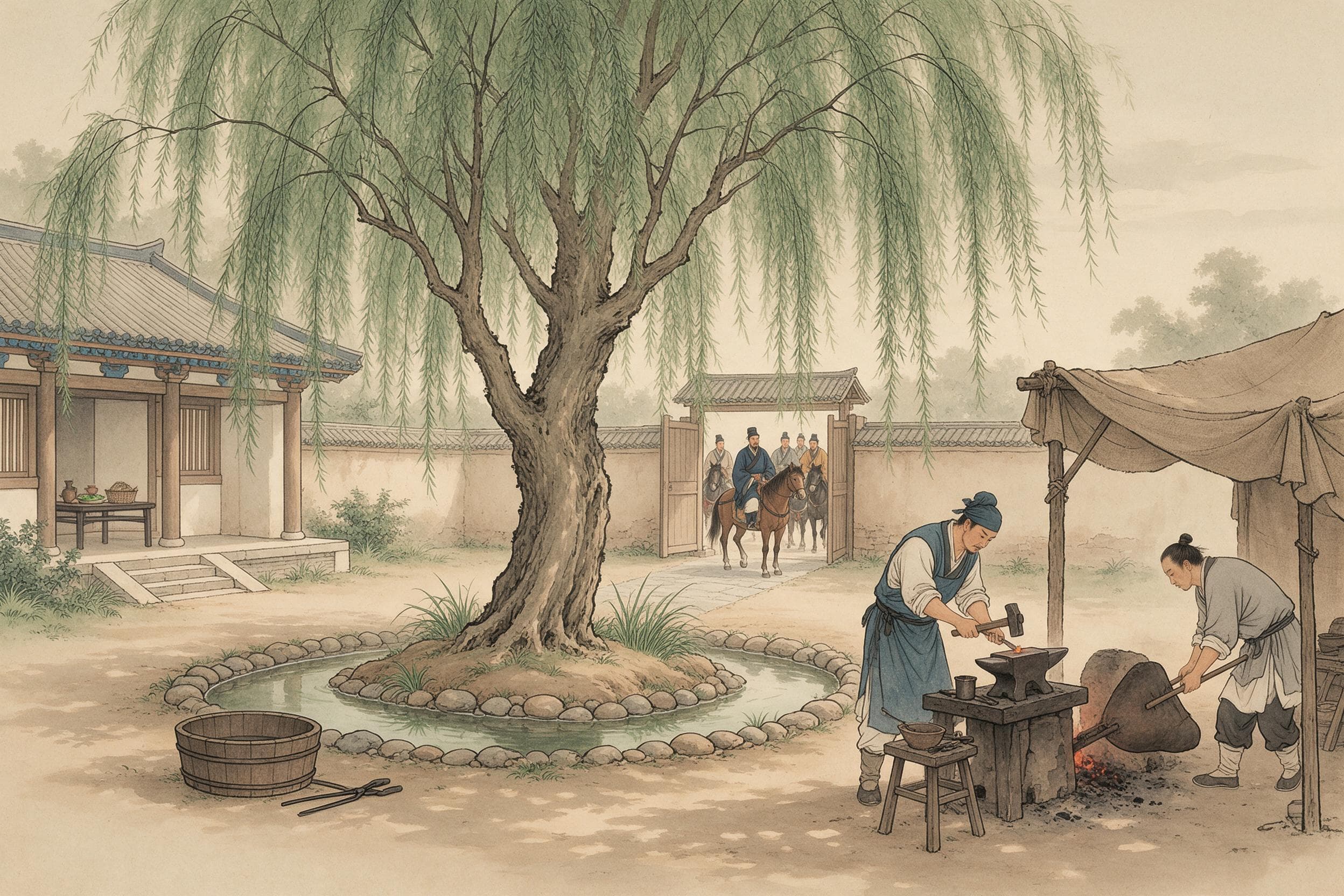
Begin with a tree. The Jinshu's life of Ji Kang: 'of a most ingenious nature and fond of forging. There was a very flourishing willow in his courtyard, and he led water in a ring around it; every summer month he stayed under it and forged' (性絶巧而好鍛。宅中有一柳樹甚茂,乃激水圜之,每夏月,居其下以鍛). This piece begins in that summer courtyard, then goes to the day a party stopped outside the gate, and ends in the eastern market of Luoyang.
One: the willow and the water
What the ring of water was for is put plainly in a note. Liu Xiaobiao's note to the Shishuo quotes the Wen Shi Zhuan: 'Kang was of a most ingenious nature and could work iron. His house had a flourishing willow, and he led water round it; in summer it was very cool, and he stayed under it at his ease and forged himself' (激水以圜之,夏天甚清涼,恆居其下傲戲,乃身自鍛). The cooling is the note's word; 'at his ease' is also copied, and not expanded.
Whether the forging was a living is answered two ways, and both are kept. The Jinshu: 'at first, Kang being poor, he once forged under a great tree together with Xiang Xiu, to support himself' (與向秀共鍛於大樹之下,以自贍給). The Shishuo note: 'though his family was poor, when someone asked him to forge he took no payment; only old friends and relatives brought chickens and wine, and they drank and ate together and talked pure talk' (康不受直。唯親舊以雞酒往與共飲噉). One says he lived by it, the other that he took no money for it; the two stand side by side and this piece decides neither. What he made, who bought it, what it cost — neither page says.
Two: the visit
The visitor came in style. The Shishuo note quoting the Wei Shi Chunqiu: 'Zhong Hui was favoured by the great general's brothers, and hearing of Kang's name he went to call. Hui was a famous young gentleman, valued for his ability; he rode fat horses and wore light furs, and his followers were like clouds' (乘肥衣輕,賓從如雲). The main text gives the courtyard: 'Zhong invited the worthy men of the time and went with them to seek Kang. Kang was forging under a great tree, with Xiang Ziqi working the bellows for him. Kang raised his hammer without pausing, as though no one were there, and for a long while did not exchange a word' (康揚槌不輟,傍若無人,移時不交一言). The Jinshu puts it as 'Kang offered him no courtesy and did not stop hammering'; the note adds 'Kang was sitting with legs sprawled, forging' (箕踞而鍛) — that posture appears only in the note, not in the main text.
The heart of the scene is two sentences. As Zhong rose to go, Kang spoke: 'What did you hear that brought you here? What did you see that takes you away?' Zhong answered: 'Hearing what I heard, I came; seeing what I saw, I go' (何所聞而來?何所見而去?/聞所聞而來,見所見而去). The Jinshu and the Shishuo's main text are almost word for word; they are set side by side as a parallel, not used to prove each other. The Shishuo's extra clause, that he did not speak for a long while, is copied too. Question and answer are built alike: the question asks with 何所, the answer shifts to 所; the question says come and go, the answer says come and go. The dismissal is done by syntax.
The grudge starts here. The Jinshu: 'Hui resented him for this' (會以此憾之). The Shishuo note: 'Hui bore it deeply, and later used the Lü An affair to slander him' (會深銜之。後因呂安事,而遂譖康焉). The slander itself the Jinshu gives in full: 'when the matter came, he said to Emperor Wen: Ji Kang is a crouching dragon, and cannot be raised. Let the duke not worry about the realm; his only concern should be Kang. He then slandered him, saying Kang wished to aid Guanqiu Jian and that Shan Tao had not listened. In antiquity Qi killed Hua Shi and Lu killed Shao Zhengmao, because they harmed the times and disordered teaching, and the sages put them away. Kang and An and their like talk loose and unbridled, defaming the statutes; a king should not tolerate them. It would be well to use the occasion to remove them, to purify the customs. The emperor, having listened to and trusted Hui, had them both killed' (帝既昵聽信會,遂并害之). Hui speaks the slander; the emperor makes the decision; both actions are there, and this piece does not reduce them to a private quarrel. 'Emperor Wen' is generally taken to mean Sima Zhao, though neither page glosses it.
Three: Lü An and the character on the gate
The friendship is one sentence in both books. The Shishuo: 'Ji Kang and Lü An were close; whenever one thought of the other, he would drive a thousand li' (每一相思,千里命駕). The Jinshu: 'Lü An of Dongping admired Kang's high manner; whenever he thought of him he would drive a thousand li, and Kang befriended and liked him.' Then the arrest: 'afterwards An was falsely accused by his elder brother and imprisoned on the matter, and his testimony implicated others, and so Kang was arrested again' (辭相證引,遂復收康). The details of the case are on neither page.
One more record of contempt is in the same chapter: 'An came later, when Kang was out; Xi came out to welcome him, and he would not go in. He wrote the character 鳳 on the gate and left. Xi did not notice, and was still pleased, for 鳳 is made of 凡 and 鳥 — a common bird' (題門上作「鳳」字而去。喜不覺,猶以為欣,故作「鳳」字,凡鳥也). The note quotes the Shuowen: '鳳 is a divine bird; it follows 鳥, with 凡 as its sound' (從鳥,凡聲). So this is a character game, not an insult to the face: the man mocked was pleased for a while.
Four: the eastern market
The last scene is only in the Jinshu, and its order is tight: 'Kang was about to be executed in the eastern market; three thousand students asked to have him as their teacher, and it was refused. Kang looked at the sun's shadow, asked for a lute and played it, saying: formerly Yuan Xiaoni wished to learn the Guangling San from me, and I always withheld it; the Guangling San is from today ended. Aged forty' (太學生三千人請以爲師,弗許。康顧視日影,索琴彈之……《廣陵散》於今絶矣!時年四十). The petition, the refusal, the look at the sun, the lute: four steps in one breath, and this piece keeps their order. The three thousand are the text's figure, not a census of the academy.
The date of this passage must be marked: the Shishuo's chapter on arrogance has no execution scene; it appears only in the Tang-compiled Jinshu of 648. So it is a later account, and cannot be written as 'the record of the time says'. As for the Guangling San's origin, the very next passage in the Jinshu tells of a night at Huayang Pavilion and a guest 'who called himself a man of antiquity' — that is a tale of the strange, and is not used here. Nor does this piece say the tune was lost because of this; it quotes only what he said.
Five: beyond these two pages
Three layers, kept apart: the Shishuo's main text, about the fifth century; Liu Xiaobiao's notes, about the sixth, which quote earlier books (the Wen Shi Zhuan, the Wei Shi Chunqiu, the Jin Baiguan Ming, Gan Bao's Jin Ji, the Shuowen); and the Tang Jinshu of 648, which drew on Jin-period histories — its later compilation does not mean its material formed last, and that distinction must be stated rather than writing 'the histories say'. On the seven worthies of the bamboo grove the pages give a list and the phrase 'the bamboo grove outing'; this piece writes no group, no leader, no history of pure conversation. What the pages do not give: the tools, buyers or prices of the forge; the size of the academy or the procedure of the petition; any interrogation or prison testimony after the slander; the year of his birth. Seven chi eight cun is not converted, the three thousand are not counted, no reign year is turned into a Western date. Nor does this piece write about 'Wei-Jin style' or 'the bearing of famous scholars'. What is left is a willow, a ring of water, one exchange of sentences, a character on a gate, and one look at the sun in the eastern market.
Related reading:Sima Xiangru: Four Walls, One Lute, One Wine Shop · Touhu: The Rite and the Wager at a Drinking Party · The Bo Altar: What to Do with a Conquered Capital's Earth Shrine
Sources & further reading
- 《晋书》卷四十九〈嵇康传〉(唐房玄龄等撰;维基文库本,页面白文无注,未与中华书局点校本复核) — The biography, compiled in 648, carrying the whole arc: Ji Kang, style Shuye, of Zhizhi in Qiao; the family, originally of Shangyu in Kuaiji, moved to avoid a feud, and took its surname from Mount Ji beside which they settled; his elder brother Xi; left fatherless early; 'seven chi eight cun tall, fine in voice and manner, with the bearing of a gentleman, but a body of earth and wood that he never adorned' (身長七尺八寸……土木形骸,不自藻飾); 'he studied without a formal teacher' (學不師受); 'married into the Wei imperial clan and was appointed Palace Grandee' (與魏宗室婚,拜中散大夫); 'of a most ingenious nature and fond of forging' (性絶巧而好鍛); the willow in his courtyard with water led round it, under which he forged every summer; Lü An, who 'would drive a thousand li at a single thought of him' (每一相思,輒千里命駕); the arrest after Lü An's brother's false accusation; the scene with Zhong Hui — 'Kang offered him no courtesy and did not stop hammering' (康不爲之禮,而鍛不輟) — the exchange 'what did you hear that brought you here? what did you see that takes you away?' (何所聞而來?何所見而去?), and Zhong's grudge; Zhong's long denunciation before Emperor Wen ('a crouching dragon', 'wanted to aid Guanqiu Jian', 'words loose and unbridled, defaming the statutes'), and 'the emperor, having listened to and trusted Hui, had them both killed' (帝既昵聽信會,遂并害之); the execution in the eastern market, 'three thousand students asked to have him as their teacher, and it was refused' (太學生三千人請以爲師,弗許), the look at the sun's shadow, the lute, 'the Guangling San is from today ended' (《廣陵散》於今絶矣), and 'aged forty' (時年四十). The page marks variant graphs with editorial -{…}- brackets, which are not quoted. The story of the night at Huayang Pavilion follows immediately and is not used here.
- 《世说新语·简傲》(南朝宋刘义庆撰,梁刘孝标注;维基文库本,正文与注同页,注以「注」标出,未与中华书局点校本复核) — The Anecdotes, chapter on arrogance, third and fourth entries, with Liu Xiaobiao's sixth-century notes. Main text: 'Zhong Shiji, refined and eloquent, had not known Ji Kang before. He invited the worthies of the time and went with them to seek Kang. Kang was forging under a great tree, with Xiang Ziqi working the bellows for him. Kang raised his hammer without pausing, as though no one were there, and for a long while did not exchange a word. Zhong rose to go; Kang said: What did you hear that brought you here? What did you see that takes you away? Zhong said: Hearing what I heard, I came; seeing what I saw, I go' (康揚槌不輟,傍若無人,移時不交一言……聞所聞而來,見所見而去). Note quoting the Wen Shi Zhuan: Kang could work iron; the willow with water led round it; in summer it was cool, and he stayed under it at his ease and forged himself; 'though his family was poor, when someone asked him to forge he took no payment; only old friends and relatives brought chickens and wine, and they drank and ate together and talked pure talk' (有人說鍛者,康不受直。唯親舊以雞酒往與共飲噉,清言而已). Note quoting the Wei Shi Chunqiu: Zhong Hui, favoured by the great general's brothers, 'came with fat horses and light furs and a following like clouds'; 'Kang was sitting with legs sprawled, forging, and when Hui arrived offered no courtesy; Hui bore it deeply, and later used the Lü An affair to slander him' (康方箕踞而鍛,會至不爲之禮,會深銜之). The fourth entry: Lü An's visit when Kang was out, his refusal to enter, and the character for phoenix written on the gate, which Xi took as a compliment; note quoting the Shuowen that 鳳 'follows 鳥, with 凡 as its sound'.