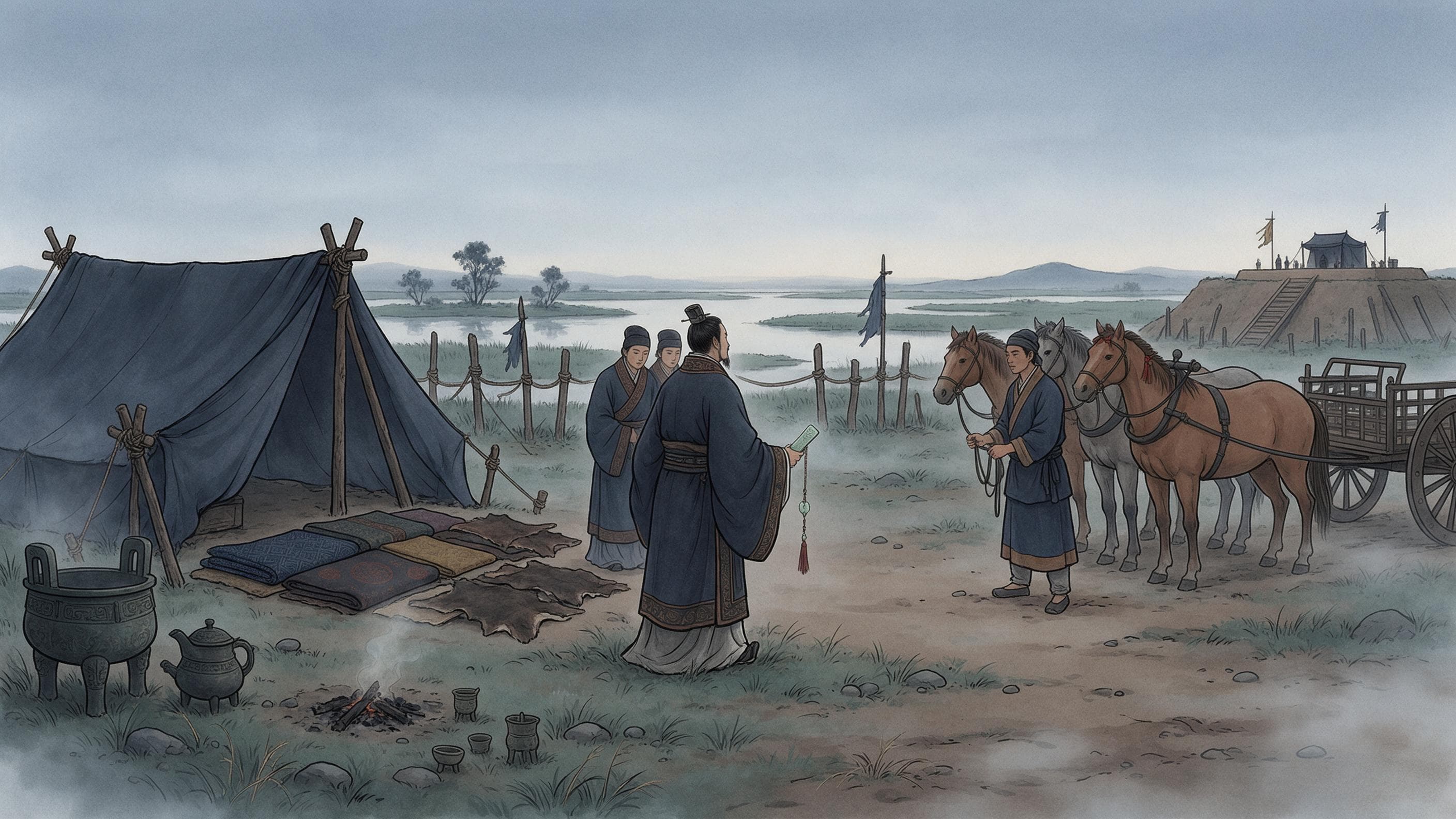
The evening before the embassy leaves, the gifts are laid out under a tent outside the envoy's gate: skins with their heads to the north, the silk bundles set on the skins, the horses standing north of them with the gifts before their feet. The envoy stands facing north, his officers at his left; the ministers face west; the recorder reads the list aloud (史讀書展幣), and the steward hands it to the envoy, who hands it to his chief assistant. Then the gifts are loaded and kept at the court.
Taking the Command
At dawn the envoy announces the mission at his father's temple: a bundle of dark and red silk is laid under the tablet and afterwards buried east of the west steps; he announces it again to the spirit of the road (又釋幣于行). Then, at court, the command. A jeweller opens the box and lifts out the jade tablet with its cord hanging; the steward takes it and gives it to the envoy, who holds it cord hanging as he hears the charge; he repeats the charge and hands the tablet to his chief assistant, who returns it to the jeweller. He then receives the silk bundle with the jade disc, the jade tablet for the ruler's wife, and the bundle with the jade tube (受享束帛加璧,受夫人之聘璋,享玄纁束帛加琮). They set out, camp outside the city, and furl the flag.
The 記 lists the tablets by size: 'for an audience with the Son of Heaven the tablet and its cord are both nine inches long, cut half an inch at the top, half an inch thick, three inches broad, with a cord of three colours in six grades; for asking of a feudal lord, a red and green cord, eight inches' (圭與繅皆九寸,剡上寸半,厚半寸,博三寸,繅三采六等…問諸侯,朱綠繅,八寸). And the principle: 'of the four jades, whichever the state treasures may be used for a visit' (凡四器者,唯其所寶,以聘可也).
On the Road
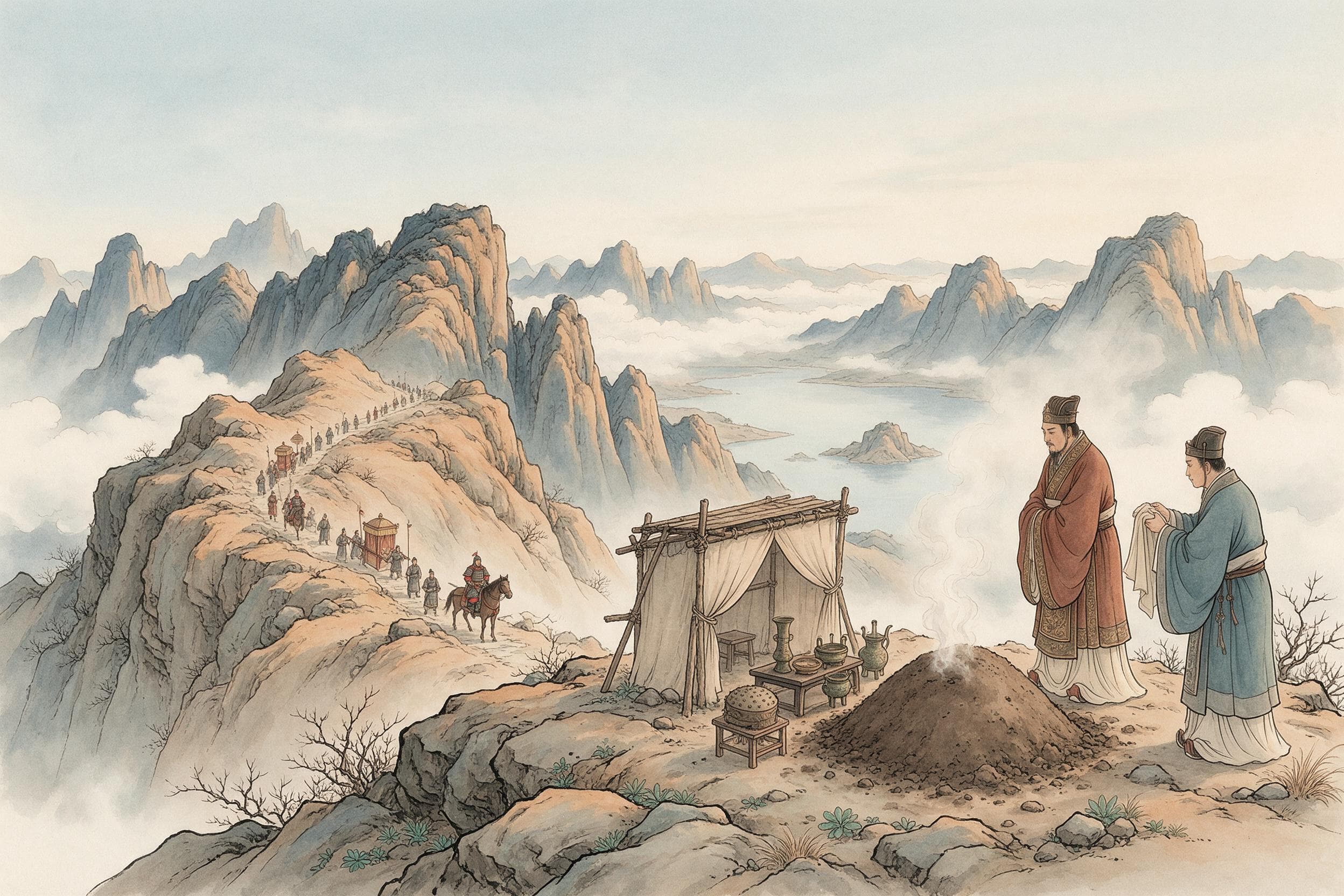
Passing through another state, an envoy sends his junior assistant with a silk bundle to ask for the road: 'We beg to lead' (請帥). At the border the company swears the oath — the recorder reads it, the marshal stands behind with his staff. Before entering, it rehearses: a low altar of earth is raised, steps drawn on the ground, a curtain hung on the north, no house at all, and the envoy rehearses the presentation but 'not the private business' (習公事,不習私事). At the border he raises the flag, swears again, and asks for the gate-keeper, who asks how many followers he has; he answers by the number of his officers (關人問從者幾人,以介對). Inside, the flag is furled and the gifts are checked and displayed (乃展).
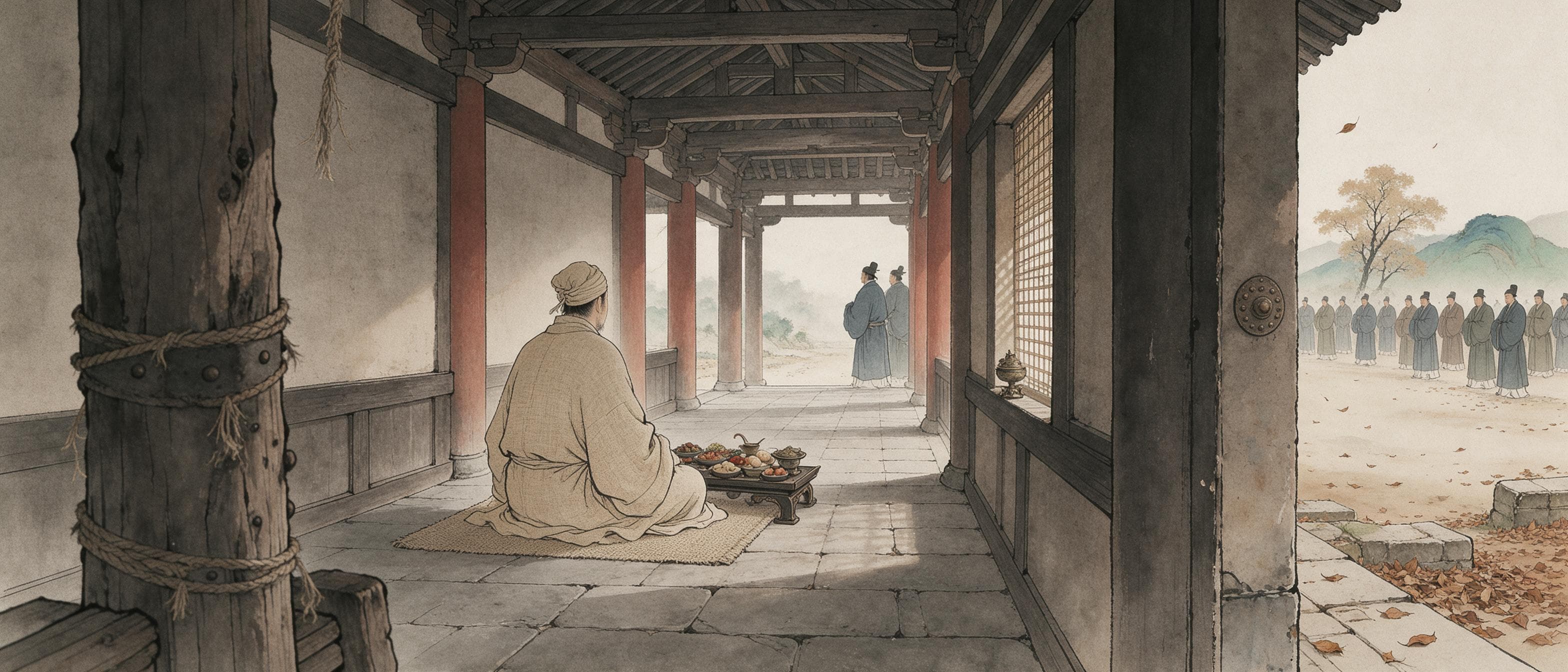
Near the capital a minister in court dress brings a bundle of silk in the ruler's name to comfort the traveller by the road (君使卿朝服,用束帛勞); the envoy returns a bundle of brocade while skins are set out (乘皮設); the Liji has a great officer do this, the Yili a minister. The ruler's wife sends a lesser minister with two square bamboo boxes with black covers and red linings, holding steamed dates and chestnuts (二竹簋方,玄被纁里…其實棗蒸栗擇). Then the minister lodges him at the guest-house (卿致館), and the steward sets out his provisions: one set of cooked meats, one of raw, tripods of nine, the three shame-tripods, and seven, and outside the gate twenty-four each of rice and millet with fodder double the millet (門外米、禾皆二十四,薪芻倍禾). The 記 grades even the lodging: 'a minister lodges with a great officer, a great officer with a knight, a knight with a craftsman or merchant' (卿館於大夫,大夫館於士,士館於工商).
The Audience and the Private Visit
On the next day the envoy presents himself in leather cap and court dress; the ruler meets him at the inner gate. The jeweller takes the tablet from its box; the envoy, sleeve drawn over his hand, holds it, and the master of ceremonies goes in and comes out asking him to put the jade away — refused. Three bows, three yieldings at the steps; the envoy delivers the charge; the ruler receives the jade between the central hall and the east pillar. Then, for the presentation, 'the envoy uncovers and offers the silk bundle with the jade disc' (賓裼,奉束帛加璧享), and skins are set out as the accompanying gifts. For the ruler's wife a tablet of jade, and a jade tube for her presentation; and if the embassy has something to say, a silk bundle carries the words (若有言,則以束帛,如享禮).
Afterward comes the private visit. The envoy takes a bundle of brocade and asks to be received (賓奉束錦以請覿); the ruler has him enter, sets a mat for him, offers sweet wine and a bundle of silk, and the envoy leaves leading the left-hand horse. For the visit itself he brings brocade and a team of horses with two men to lead them (奉束錦,總乘馬,二人贊). His senior and junior assistants also ask to be received, with brocade, bundles of jade-patterned silk and pairs of skins.
What the Ritual Says It Means
The Liji on the meaning of the pin says what the numbers are for: 'For the visit of a duke seven attendants, for a marquis or count five, for a viscount or baron three, to make clear rank' (上公七介,侯伯五介,子男三介,所以明貴賤也). And the manner: 'the greetings pass through the attendants; a gentleman does not address a superior directly — that is the height of respect' (介紹而傳命…敬之至也); three yieldings before the message is passed, three bows before the steps. 'It is respect and yielding by which gentlemen meet each other' (敬讓也者,君子之所以相接也).
The same chapter gives the point: 'To visit with a jade tablet is to make much of the rite; to return the jade after the visit is to make little of goods and much of the rite' (以圭璋聘,重禮也。已聘而還圭璋,此輕財而重禮之義也). The Yili's notes say the same in a few words: 'too much goods harms the virtue; too fine a gift drowns the rite' (多貨,則傷於德。幣美,則沒禮). And on what to say, the notes are brief: 'the words have no fixed form, modest and pleasant; too many words is pedantry, too few does not get through; words that get through are the height of what is right' (辭無常,孫而說…辭苟足以達,義之至也).
Coming Home
The jade goes home too. The ruler sends a minister in leather cap to return the tablet at the guest-house (君使卿皮弁,還玉于館); the envoy receives the tablet and hands back the wife's tablet; the minister presents a bundle of white silk, ritual jade, silk and skins. Then the envoy goes back: 'when the envoy returns and reaches the suburbs he asks to report the mission' (使者歸,及郊,請反命); in court dress, the flag hoisted, he enters and lays the gifts out at the court. His report is a formula: 'By my lord's command I visited such-and-such a lord; that lord received the gifts in such-and-such a hall and bowed twice; and I presented the offerings and he bowed twice' (以君命聘於某君,某君受幣於某宮,某君再拜). Private gifts are not reported (私幣不告); the ruler comforts him, and he makes the announcement at his own gate and then at his father's temple.
This is a rulebook, not a record of any visit that happened: no names, no dates, no outcome, no cost, no count of embassies sent. The gifts it counts are counted out on the page — silk bundles, jade tablets of nine or eight inches, horses, skins, tripods of nine and seven. And the rulebook's own emphasis is that the jade comes home: what travels out is a token, and what the visit spends is mostly time. The text says only that words have no fixed form — enough to be understood is enough.
Related reading:Two Books About Wine: An Office Manual and a Recipe · The Call from the Roof: A Death, Step by Step · The Dark Bird and the Birth of Shang: Two Lines of Verse and a Story
Sources & further reading
- 《仪礼·聘礼》第八(战国至汉初成书;维基文库本,未与点校本复核) — An envoy's mission from the evening the gifts are counted and the charge taken at court: the jade tablet passed from jeweller to steward to envoy and back; the silk bundle with a jade disc, the wife's tablet, the jade tube; passage through other states, the oath and rehearsal at the border, the comfort by the road, the lodging, the audience, the private visits, and finally the return of the jade and the report at court. A rulebook, not a record of any mission.
- 《礼记·聘义》(战国至汉初成书;维基文库本,未与点校本复核) — The meaning of the pin: attendants by rank (seven, five, three), relays of speech, three yieldings; 'it is respect and yielding by which gentlemen meet each other'; jade is given and then returned, 'making little of goods and much of the rite'. Note that this chapter has a great officer comfort the envoy by the road, where the Yili has a minister.