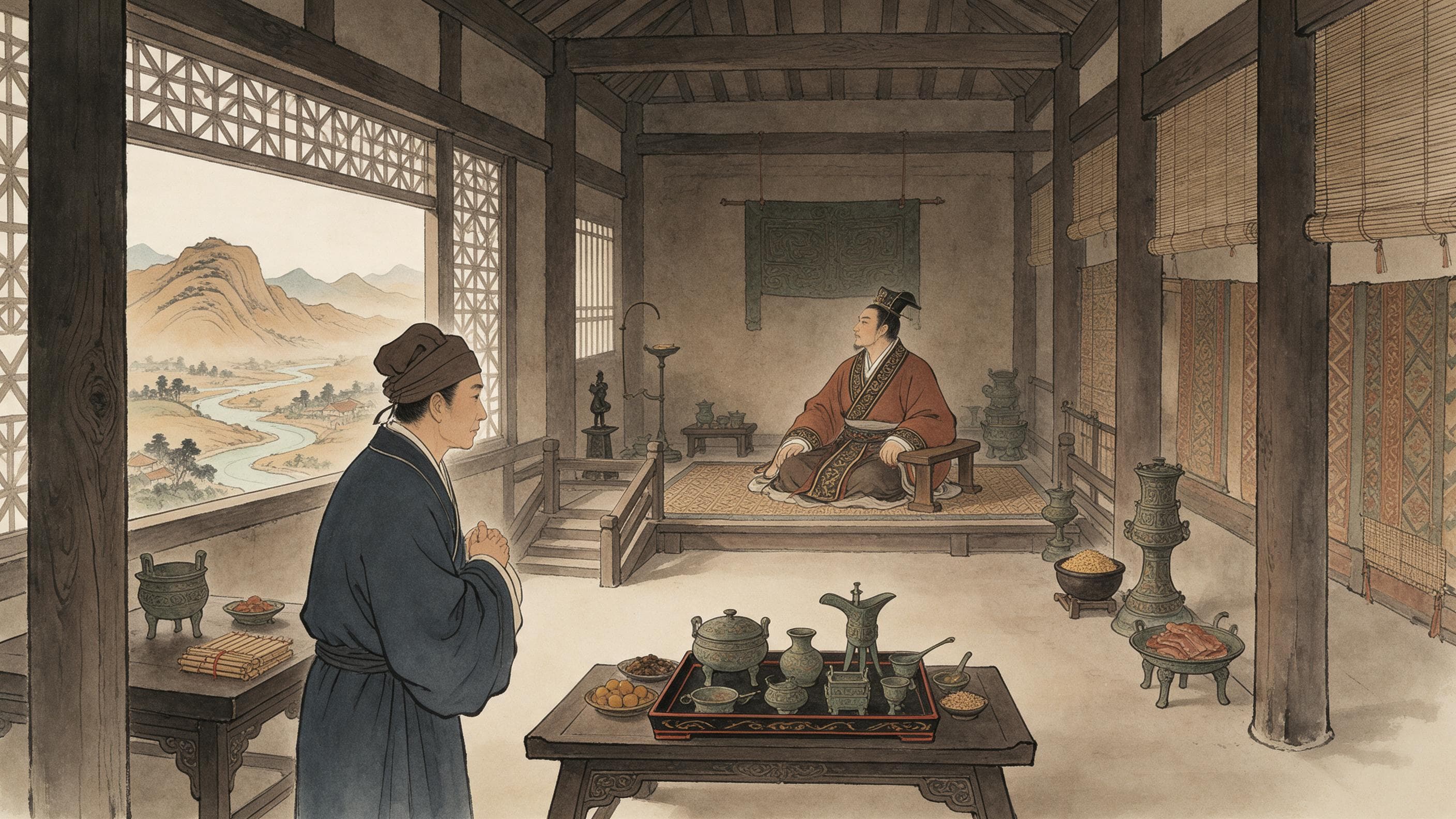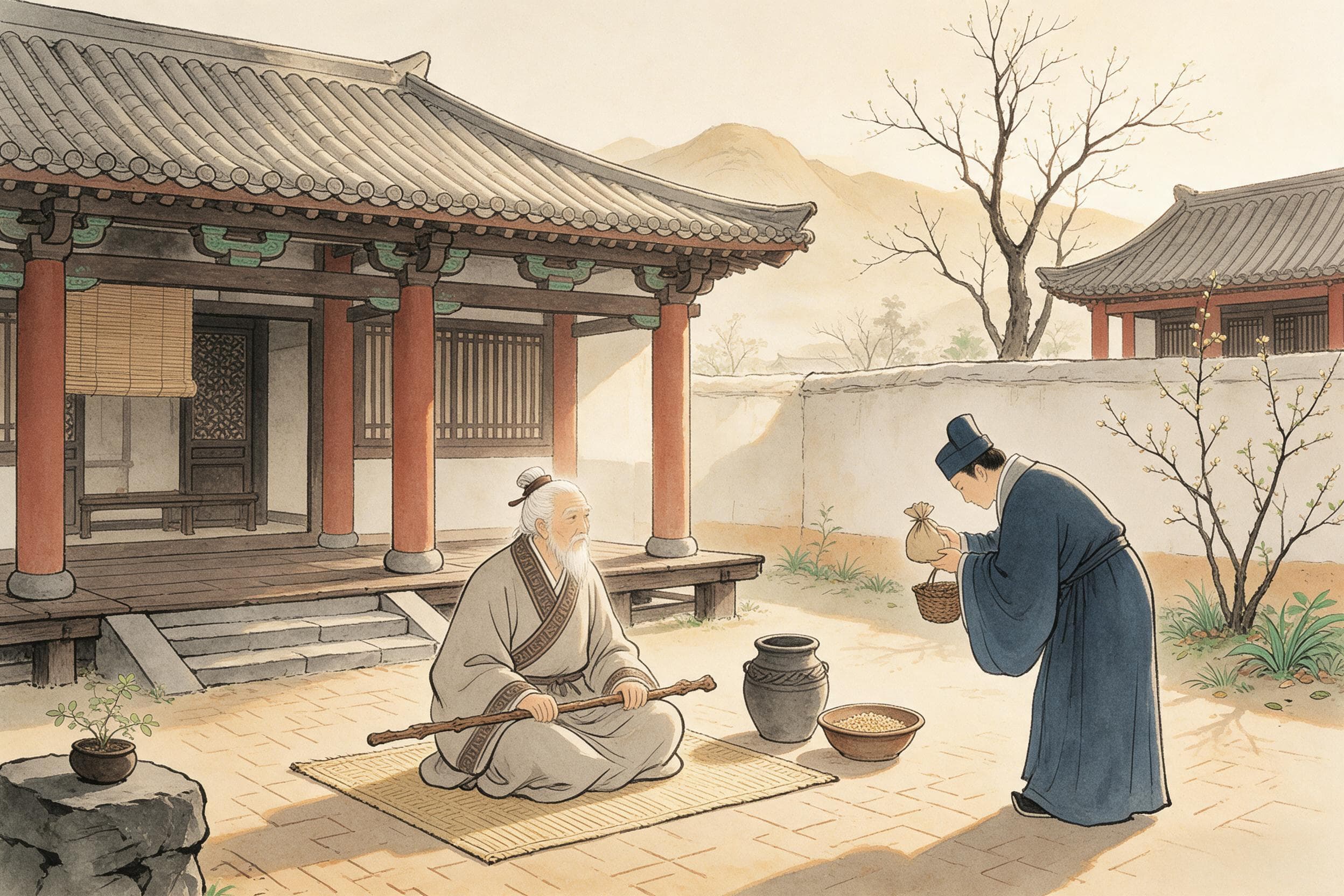
A man of fifty is given a staff to keep and use at home. At sixty the staff may be used in the district, at seventy in the state, at eighty at court; and at ninety, if the Son of Heaven wants to ask him something, the Son of Heaven goes to his room, taking delicacies along. That ladder is in the Liji's chapter 'Wangzhi' — the 'regulations of the kings'. It is a ritual book's picture of how old age ought to be honoured, not a Han statute — a design for a kingdom, drawn without a single case.
A Ladder of Staves
The passage: 'At fifty, a staff at home; at sixty, a staff in the district; at seventy, a staff in the state; at eighty, a staff at court; at ninety, if the Son of Heaven wishes to ask him anything, he goes to his room, taking delicacies with him' (五十杖於家,六十杖於鄉,七十杖於國,八十杖於朝,九十者,天子欲有問焉,則就其室,以珍從). The same chapter adds: at eighty, when the ruler's command comes, he bows once seated and twice more (八十拜君命,一坐再至); at ninety, he sends someone to receive it (九十使人受).
The ladder is ordered by age alone. It does not name an office, a rank or a family, and it does not say who hands over the staff or what happens to a man who has none. The chapter is a design for a kingdom — who is fed where, who is exempt from service, how a ruler behaves toward the old — and it is a design with no case attached.
Food by Age
The same chapter grades the table: 'At fifty, separate grain; at sixty, meat kept overnight; at seventy, a double dish; at eighty, delicacies always; at ninety, food and drink do not leave his chamber, and may follow him when he goes out' (五十異粻,六十宿肉,七十貳膳,八十常珍,九十飲食不離寢,膳飲從於遊可也). The grades are not of amount so much as of distance: the older the man, the closer the table stays to his bed. And it explains them by the body: 'At fifty he first declines; at sixty he is not full without meat; at seventy he is not warm without silk; at eighty he is not warm without people; at ninety, even with people, he is not warm' (五十始衰,六十非肉不飽,七十非帛不暖,八十非人不暖,九十雖得人不暖矣).
It also says where the old are supported — the village at fifty, the state at sixty, the school at seventy (五十養於鄉,六十養於國,七十養於學) — and names the schools of four ages, from the upper and lower halls of the Youyu to the east膠 and Yu school of Zhou. It exempts households too: 'For an eighty-year-old, one son is not taken for service; for a ninety-year-old, the household is not taken' (八十者,一子不從政;九十者,其家不從政). All of it is stated in the same voice, as what is proper, and none of it is dated.
The Emperor's Order
The Hanshu's annals of Emperor Wen have a different kind of text. In the third month of his first year an edict says: 'The old are not warm without silk, not full without meat. Now at the year's head, no one is sent at the right time to ask after the elders, and there is no gift of cloth, silk, wine and meat — how shall this help the sons and grandsons of the realm support their parents? I hear that the officials who issue the gruel to those entitled to it sometimes use old millet; how does that suit the meaning of supporting the old? Let this be made into an ordinance' (老者非帛不煖,非肉不飽…今聞吏稟當受鬻者,或以陳粟,豈稱養老之意哉!具為令).
The ordinance that followed, drafted by the officials, is all quantities. 'Those of eighty and over: rice, one shi a month per person; meat, twenty jin; wine, five dou. Those of ninety and over: in addition, cloth, two bolts per person, and three jin of wadding' (年八十已上,賜米人月一石,肉二十斤,酒五斗。其九十已上,又賜帛人二疋,絮三斤).
It also says how the gift is to arrive: 'For gifts and for the gruel rice, the senior officer is to inspect them, and the assistant or the commandant is to deliver them; for those under ninety, the bailiff or the clerk delivers. The two-thousand-bushel officer is to send an inspector round, and those who fail are to be corrected' (賜物及當稟鬻米者,長吏閱視,丞若尉致…二千石遣都吏循行,不稱者督之). The exclusion at the end is worth notice: this ordinance is not for every old person, and the state's duty here is not to all of them. And it ends with an exclusion: 'Those who have been mutilated or who have committed an offence of shaving or above are not covered by this ordinance' (刑者及有罪耐以上,不用此令).
Two Kinds of Text
So the two pages are not two versions of one rule. The Wangzhi is a ritual book's outline — probably compiled in the Warring States or early Han — of an ideal order with no dates and no cases. The Hanshu passage is an edict of the Western Han with a date (the third month of the first year of Emperor Wen), quantities, delivery instructions and a clause excluding offenders. Read together they show the same idea in two grammars: old age numbered, then old age supplied. But the edict is still not an account of what happened. It does not say how many received the rice, whether the deliveries were made, what they cost, or whether anyone was punished for failing. The ritual book gives no instance of a kingdom that did these things. And neither page is evidence for the others' claims: the Wangzhi cannot be used to explain the Han edict, and the Han edict cannot be used to prove that the Wangzhi's ladder was ever used.
What the Pages Do Not Give
Neither page gives a staff, nor its wood, its length, or the hand that made it. There is no example of one, no description of its length or material, no record of a man who carried one; the silver-haired staff of later finds is not in either text. Nor is there a count of the old in any district, a price for rice or cloth, or any statement of how long the ordinance remained in force. The Wangzhi gives an order of honour, the Hanshu an order of supply, and both stop at the order.
What is left is small and concrete: a staff kept at home, a dish doubled, twenty jin of meat a month, two bolts of cloth for ninety years. One text says what age deserves; the other says what age is given. Neither says whether the old got it. That is the difference between a book of rites and a book of annals: one can be read as an ideal, the other had to be administered — and the gap between the two is not a thing this article can close.
Related reading:Two Books About Wine: An Office Manual and a Recipe · Seven Names and Five Kings: The Shang Ministers the Zhou Remembered · The Zha and the She: Two Sacrifices, Not One
Sources & further reading
- 《礼记·王制》(战国至汉初成书;维基文库本,未与点校本复核) — The ritual book's ladder of old age: a staff at home at fifty, in the district at sixty, in the state at seventy, at court at eighty, and at ninety the Son of Heaven comes to his room; grain, meat, dishes and delicacies graded by decade; support in the village, the state and the school; one son exempt for an eighty-year-old, the whole household for a ninety-year-old. A design, with no case and no date.
- 班固《汉书》卷四·文帝纪(东汉;维基文库本,未与点校本复核) — The third month of the first year of Emperor Wen: the edict that the old are not warm without silk nor full without meat, and that gruel is being issued from old millet — 'let this be made into an ordinance'. The ordinance: for the eighty and over, one shi of rice a month, twenty jin of meat, five dou of wine; for the ninety and over, two bolts of cloth and three jin of wadding; with delivery by named officers and an inspector, and an exclusion for the mutilated and for offenders of shaving and above.