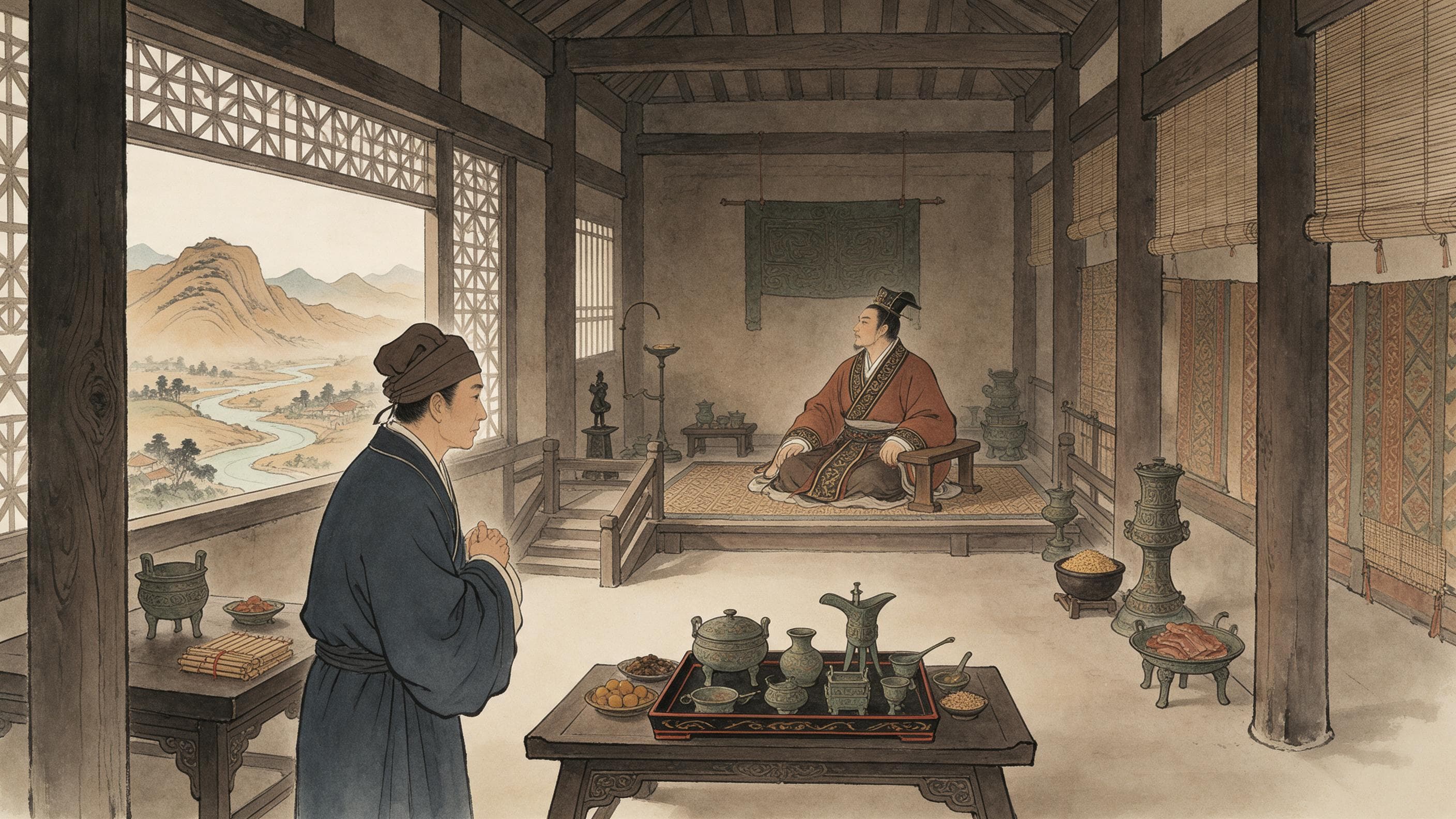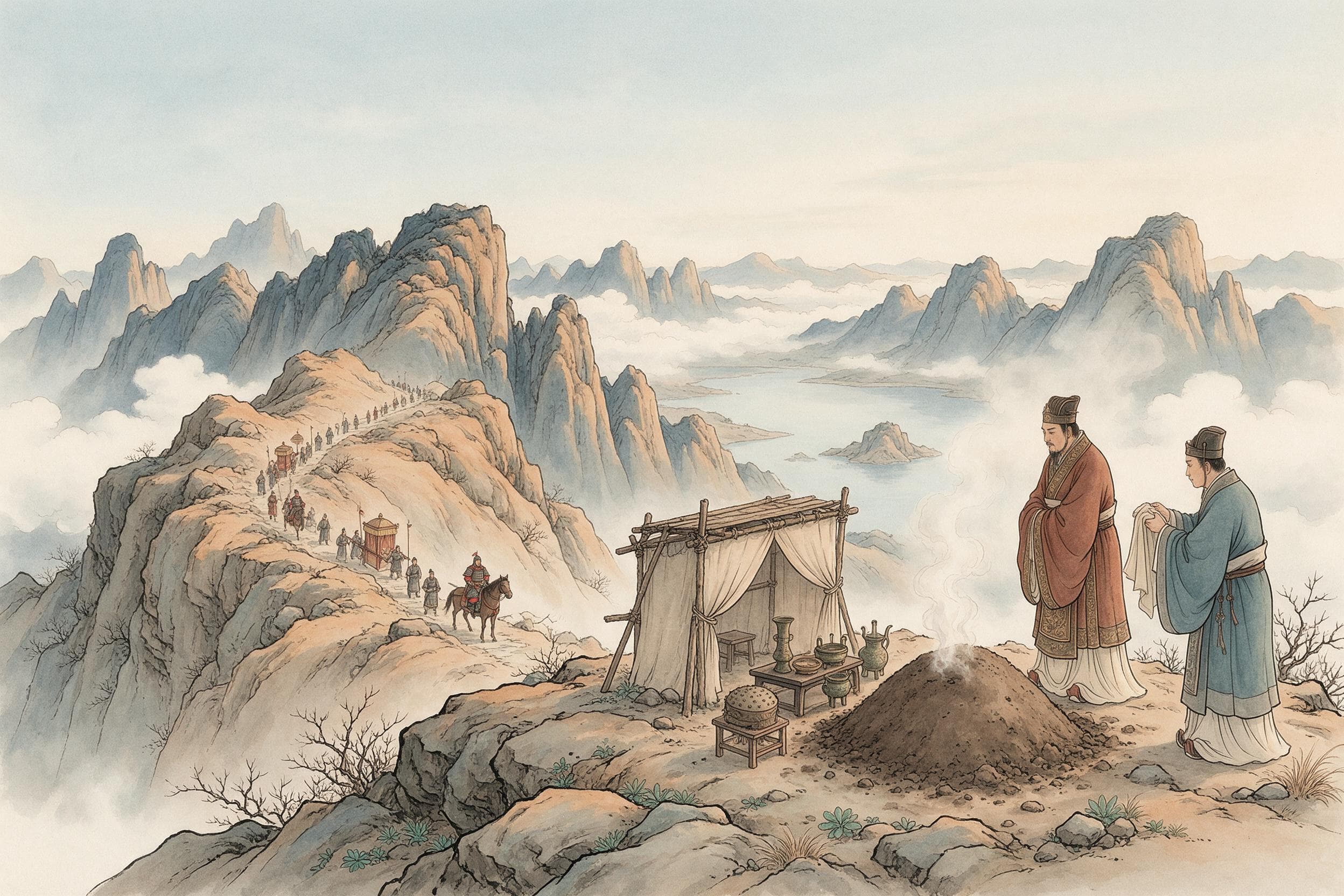
In the fourth month of Yuanfeng 1 the emperor's party came back to Fenggao, under Mount Tai. The grass and leaves on the mountain had still not come out. Attendants in plain caps shot an ox; east of the foot the emperor sealed a mound one zhang two chi across and nine chi high, 'in the manner of the suburban sacrifice to the Great Unity', with a jade tablet document beneath, the writing secret. Then he went up with one companion, the carriage attendant Zihou, and sealed the summit too. What was done there was forbidden to be told. The fullest account of the rite in either history has a hole at its centre.
Seventy-two houses, twelve names
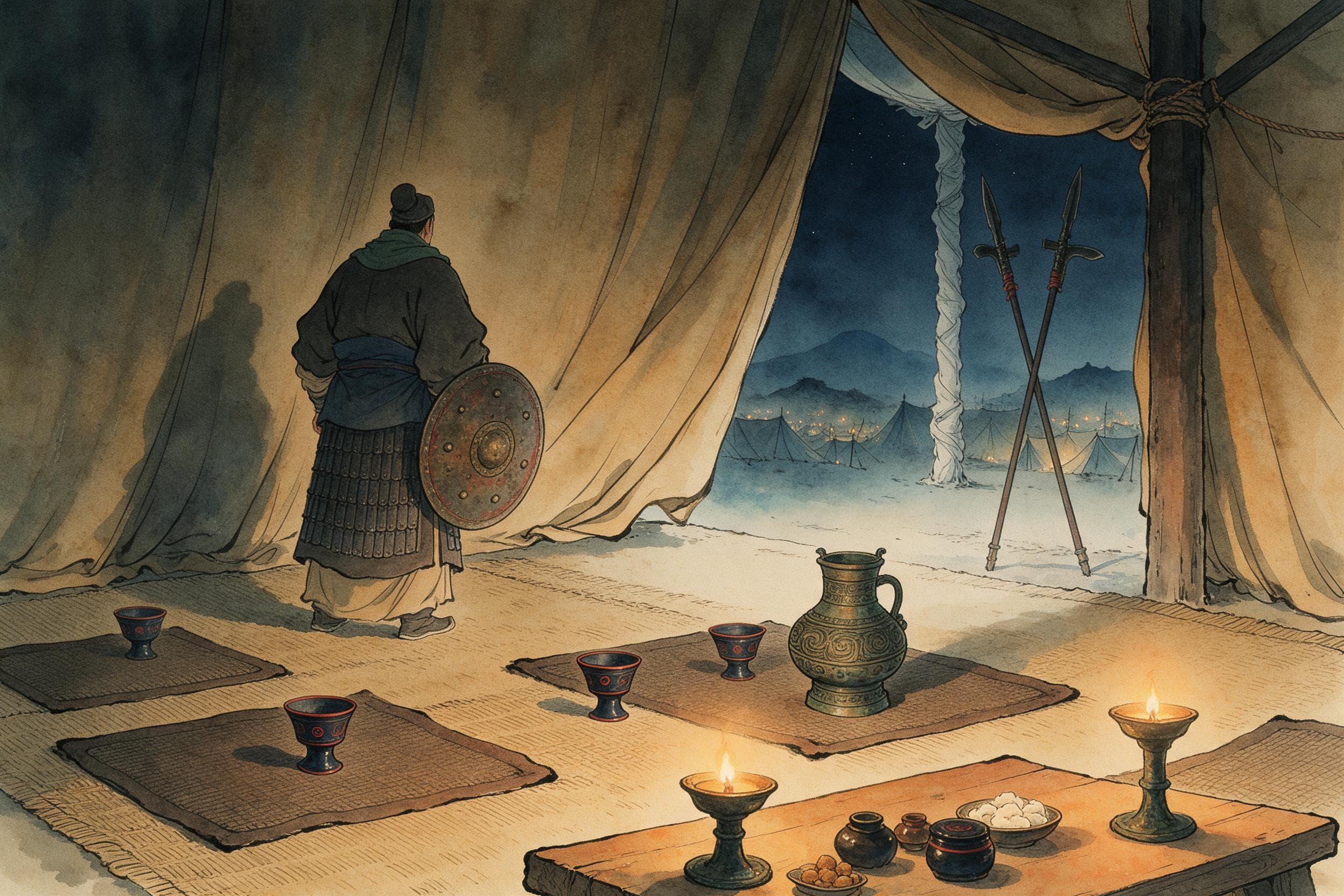
The Book of Feng and Shan concedes ignorance early: founders of dynasties sacrificed at Mount Tai, Sima Qian writes, but the rite had lapsed for a thousand years or a few hundred, 'so its regulations are blank and buried, and the details cannot be recorded or heard of.' What follows is an argument about a ceremony nobody could perform from memory. Duke Huan of Qi, then hegemon, met the lords at Kuiqiu and proposed to go up. Guan Zhong produced a list: seventy-two houses had sealed Mount Tai, twelve of which he could name, all only after receiving the mandate. The duke answered with his own tally of chariot meetings, so Guan Zhong set conditions instead: millet, a three-ribbed grass for a mat, fish and birds from far seas. 'Now the phoenix and qilin do not come, fine grain does not grow, and owls gather — and you would seal Mount Tai?' The duke gave it up.
Confucius is in the chapter for refusing to describe the thing. The tradition he inherited held that more than seventy kings had sealed Mount Tai and cleared Liangfu, 'but the vessels and offerings of their rite are not clear, and so it is hard to speak of them.' Asked about the di sacrifice he said he did not know; whoever did, he said, would see the world in his palm. The chapter carries two numbers and reconciles neither: seventy-two houses, seventy-odd kings.
The seventy scholars at the foot
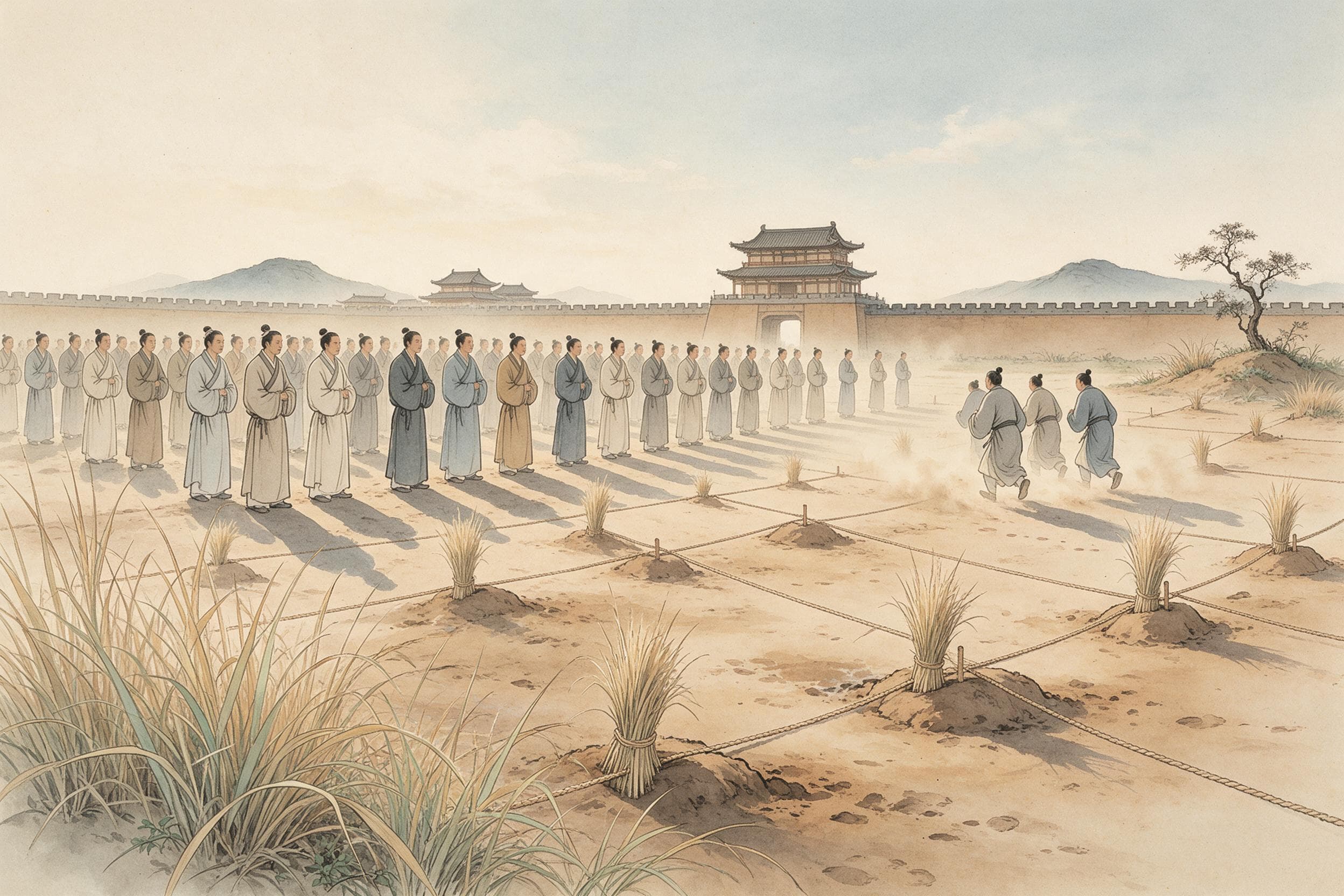
In the third year after he took the imperial title, the First Emperor toured east and summoned seventy scholars and erudites of Qi and Lu to the foot of Mount Tai. They could not agree: some said the rite used a cart with cattail-wrapped wheels, others that the ground was swept and the offering laid on a mat of woven stalks because that was easy to follow. The proposals were too various to use and he dismissed them. He cut a carriage road up the southern face, set up a stone inscription praising his own virtue, came down by the northern path and performed the shan at Liangfu, borrowing from what the grand invocator did at Yong. The sealed deposit was secret; the world was not allowed to record it.
On the way up, a violent storm caught him and he sheltered under a large tree. The scholars, dismissed and shut out of the ceremony, heard about the rain and mocked him. It is storytelling, not liturgy: it records what people thought, not how it was staged. After the Qin fell the story hardened into a verdict — that the First Emperor had been struck by the storm and 'had not succeeded in the feng.' Sima Qian repeats the saying and adds a line of his own: was this not a man performing the rite without the virtue for it? The sneer is his.
A rite nobody knew how to perform
Under the Han the project returned in stages. Gaozu, told that Qin had sacrificed to four Lords on High, supplied the fifth himself, 'waiting for me to complete it.' In Emperor Wu's first year two officials drafted the same programme and killed themselves under prosecution. Only after a cauldron came out of the fen did the debate turn practical, and the record is candid: 'the feng and shan had been rare and cut off, and no one knew its ritual.' Li Shaojun taught that sacrificing to the stove draws beings, beings turn cinnabar into gold, gold vessels lengthen life, and that 'to see the immortals and then perform the feng and shan is not to die — the Yellow Emperor did it.'
The scholars assembled a procedure from the 'Canon of Yao', the 'Officers of Zhou' and the 'Royal Regulations'. Ding Gong, a man of Qi of ninety-odd, offered the other version: the feng was 'the name for joining the undying'; the First Emperor had failed to get up; if the emperor climbed a little way without rain he would succeed. Gongsun Qing brought a book said to come from the Yellow Emperor: of the seventy-two kings only the Yellow Emperor got up. They practised the ox-shooting and drafted the forms for years. When the emperor showed them the vessels he had commissioned, they said they did not match antiquity, and he stopped employing scholars altogether.
One zhang two chi of earth
What the sources give for the day is a sequence of acts and very little explanation. He went on to Mount Tai, where the leaves were still not out, and had a stone set on the summit. In the fourth month he sacrificed to the Lord of the Earth at Liangfu and sealed: a mound one zhang two chi by nine chi, a jade tablet document beneath, one companion on the climb, the summit sealed too, the descent by the northern path, the shan at Suran in yellow robes with full music, a mat of three-ribbed grass. That night there seemed to be light; by day a white cloud rose from the sealed earth. The companion did not last: Zihou fell ill and died within a day.
The two accounts do not even agree on the date: yimao for the sealing and bingchen for the shan in the Feng and Shan chapter, guimao for the ascent in the Annals. The rewards differ too: an ox and ten shi of wine in one, cloth to the over-seventies in the other. What neither gives is what a reconstruction usually supplies: the prayer, the text on the jade tablet, the words on the summit, the shape of the altar. The chapter said at the start that these were lost. They are still lost, and this article does not draw them back in.
Once every five years
After the ascent the rite became a schedule. The emperor decreed that the Son of Heaven tours inspection every five years and sacrifices at Mount Tai, and that the lords build lodges at its foot; he repaired the sealing at five-year intervals, and the year took its name from the event — the cauldron year became Yuanding, this one Yuanfeng. The Annals list the later visits down to Zhenghe 4. The verdict is dry: after twelve years the emperor had been over the five peaks and four rivers, the men watching for immortals had produced nothing, and he had tired of their talk — 'yet he kept them on, hoping for the true thing. From then on there were more of them than ever, and their results may be seen.' Sima Qian had walked in that procession himself; he wrote as an usher, not a believer.
Related reading:Lowering the Coffin: The Day of the Burial · Fifty Get a Staff: Old Age in a Ritual Book and an Edict · At the Ancestral Sacrifice: Drums, Pipes, Chimes and the Wan Dance
Sources & further reading
- 司马迁《史记》卷二十八〈封禅书〉(维基文库本,未与点校本复核) — The chapter opens by admitting the rite's regulations are lost: 'its regulations are blank and buried, and the details cannot be recorded or heard of' (其儀闕然堙滅,其詳不可得而記聞). It carries the Guan Zhong and Duke Huan exchange (seventy-two houses, twelve named), Confucius on the seventy-odd kings, the First Emperor's seventy dismissed scholars and the storm on the middle slope, and the Han Wu day: 'the mound was one zhang two chi across and nine chi high, with a jade tablet document beneath, the writing secret' (封廣丈二尺,高九尺,其下則有玉牒書,書祕). It adds that the companion Zihou 'fell gravely ill and died within a day' (奉車子侯暴病,一日死), and closes with the dry verdict 'their results may be seen' (其效可睹矣).
- 班固《汉书》卷六〈武帝纪〉(维基文库本,未与点校本复核) — The annalistic account of the same ascent, dated 'in the fourth month of summer, on the guimao day, he returned and ascended to seal Mount Tai, then descended and sat in the Bright Hall' (夏四月癸卯,上還,登封泰山,降坐明堂). It records the cry of 'Ten thousand years' at Mount Song as heard by the officials (吏卒咸聞呼萬歲者三), three hundred households made a shrine town named Chonggao, and rewards worded differently from the Feng and Shan chapter: cloth to the orphaned and widowed over seventy, the poll tax remitted, a rank to every man, wine and beef to every hundred households of women.