The hardest sentence in the Book of Documents about drinking is an order: 'If people drink in groups, do not let them get away; seize them all and bring them back to Zhou, and I will put them to death.' Before anything else, ask who is speaking to whom. The speaker is the Duke of Zhou; the man addressed is Kang Shu, whom he has enfeoffed at Mei, in the old Shang heartland. This is a Zhou proclamation issued over a conquered country. It is not a Shang law, and no Shang statute on drink survives.
Drinking in groups: seize them, send them to Zhou
The order stands in the 'Announcement about Wine', and it continues with a second clause: 'But as for the many officials and craftsmen brought along by Yin, if they steep themselves in wine, there is no need to kill them; for the time being only teach them. Those who have this clear warrant and still do not use my words of instruction — if I, the one man, do not pity them, if their affairs are not purified, then they are equally to be killed.' Read the two clauses together and the policy is a scale, not a ban: seize the group drinker and kill him; teach the Yin official first, and kill only the man who persists. Note who is exempted: officials and craftsmen, the skilled men a new regime needed.
That scale is the interesting part. Mei was newly conquered ground, and the men being governed had served the previous dynasty. A proclamation that opens with execution and then supplies an exemption for Yin craftsmen is not a statement about how much Shang people drank. It is a statement about how a new regime sets terms in a place it has just taken. Of the enforcement — who informed, how often the exception was used — nothing is recorded.
When drinking was allowed
Yet the same chapter permits drinking. 'Do not drink constantly' is the general rule; then: 'throughout the various states, drink only at sacrifices, and let virtue carry you so that you are not drunk.' The sacrifice is a licence, and the phrase 'let virtue carry you' turns the licence into a test of bearing. What is forbidden is not wine but the wrong occasion — the group, the habit, the losing of oneself. The grammar is a permission with a condition, not a prohibition.
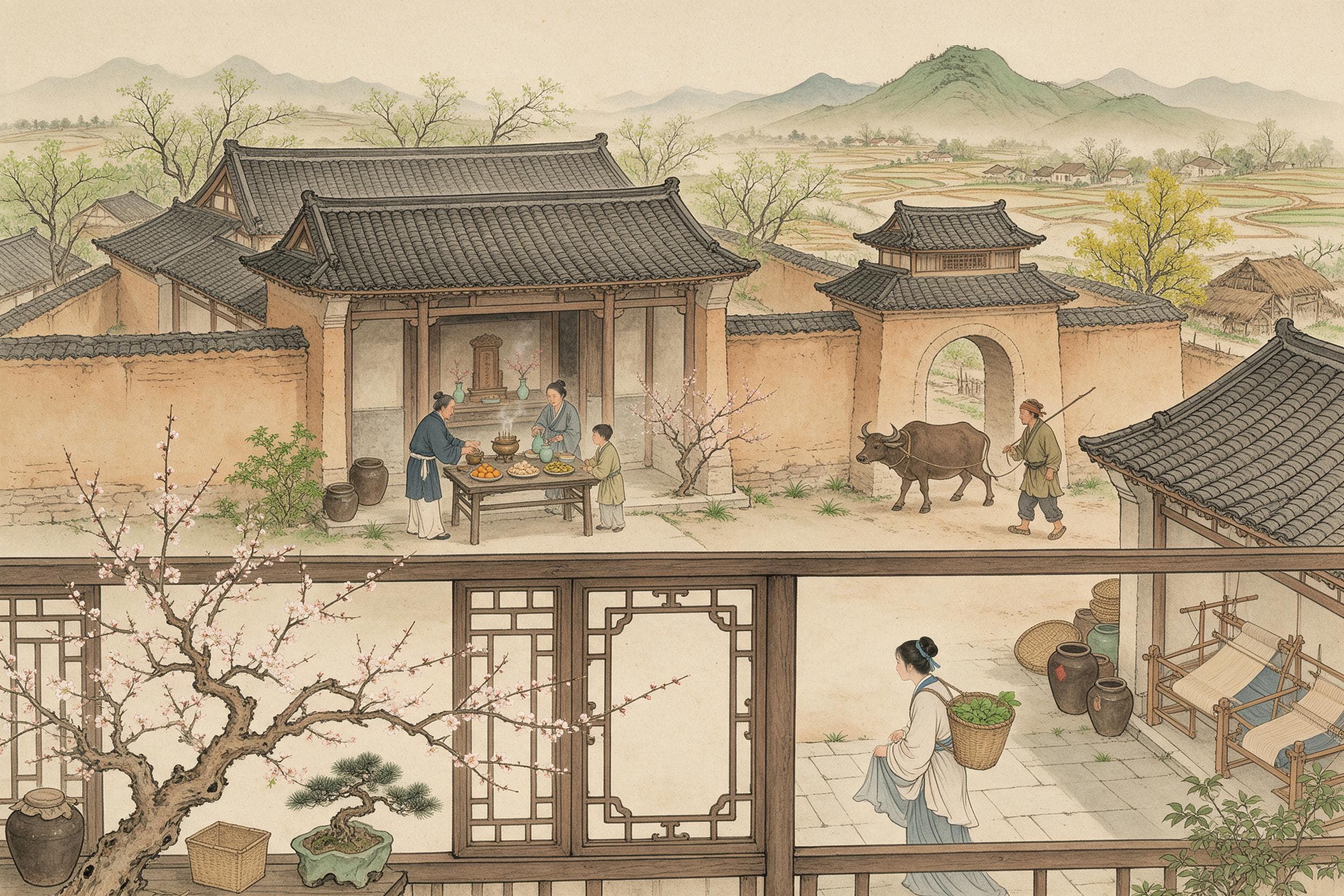
The most surprising allowance is for the people of Mei themselves: 'In Mei, continue your labours of arm and thigh; devote yourselves to planting millet; run about in the service of your fathers and elders. Then harness ox-cart and waggon, go far to trade, and support your parents. When your parents are glad, and you have washed the vessels and set out the good food, you may bring wine into use.' Work, trade, filial support — and then drink, at the parents' celebration. The order of the sentence is the rule: the cup comes last.
The Zhou explanation: rise and fall filed under drink
The same speech explains history. Of the early Shang kings: 'From Cheng Tang down through Di Yi ... they did not dare to steep themselves in wine — not only did they not dare, they had no leisure for it.' Of the last: 'The later successor king gave himself up to pleasure ... he was wholly abandoned to wine, without stopping, at his ease ... therefore Heaven sent down ruin upon Yin.' And of the Zhou themselves: 'Our western land ... could still use the teaching of King Wen and did not drink heavily. Therefore to this day we have received Yin's mandate.' Rise and fall, both filed under drink: this is a political explanation of the change of dynasty, not a record of consumption. The passage closes its explanation with a formula: 'Heaven was not cruel; the people brought the guilt on themselves.'
The Han painting
A thousand years later the Han historian Sima Qian gave the last Shang king a scene: 'He made a pool of wine and a forest of meat, let men and women chase each other naked among them, and held drinking bouts through the night.' The picture is famous, concrete and late. It comes from a Western Han writer retelling the fall of a dynasty, and it should be read with that date attached; the more vivid it is, the more it is a Han painting of the Shang court rather than a Shang record. The same paragraph gives him a queen and a soundtrack: he loved wine and pleasure, doted on Da Ji and followed her words, and had Shi Juan compose new licentious music, the dances of the north ward, the songs that sap the will.
In the same passage the king is said to have raised taxes to fill the Lu Terrace with money and the Ju Bridge with grain. Those are separate charges, set beside the wine, not causes joined to it; the text does not argue that one produced the other.
Three layers of evidence, two of them here
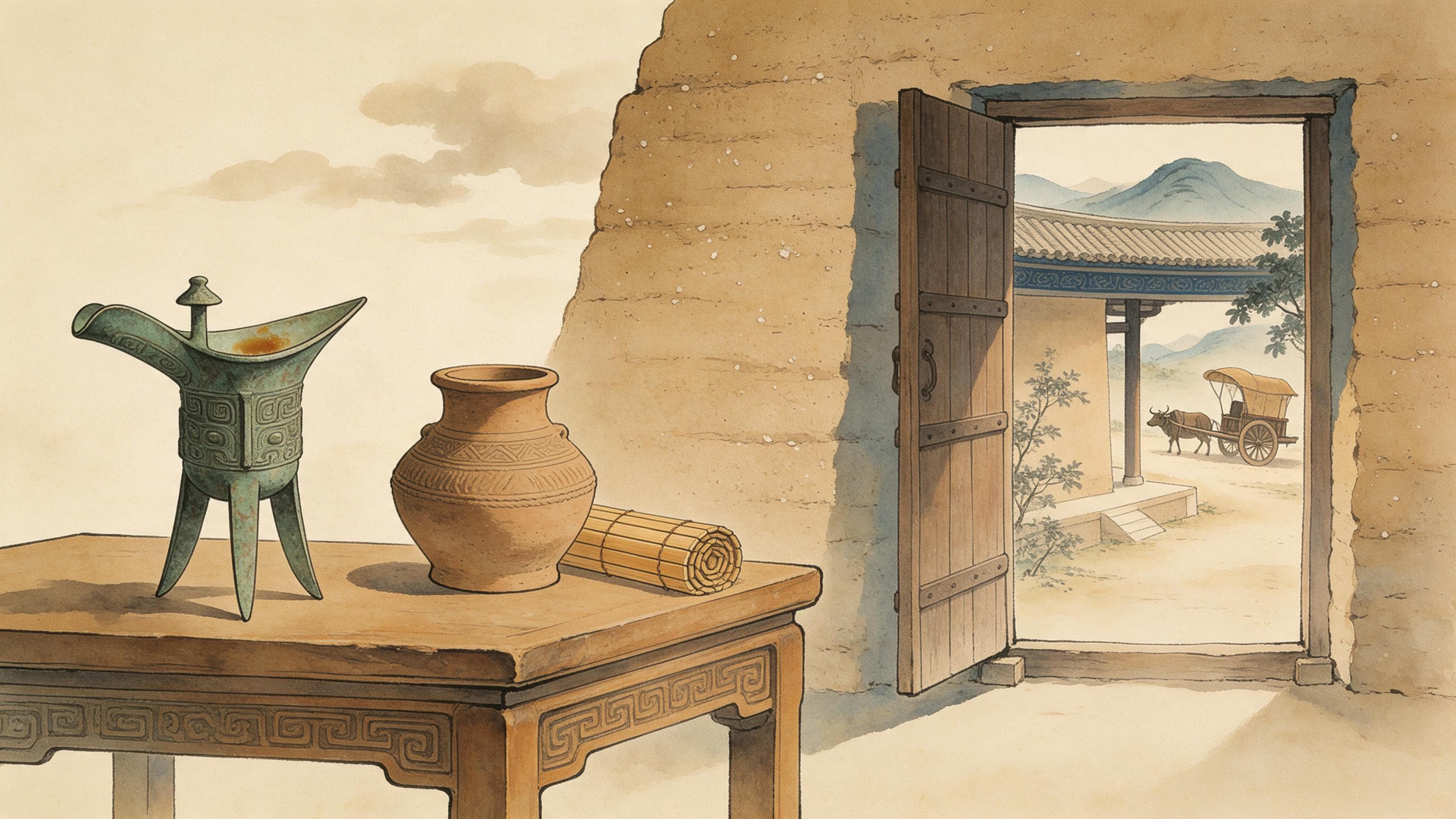
Three kinds of evidence would normally be assembled for a question like this: a Shang record of its own, a later literary tradition, and the material remains — the bronze cups and jars that archaeology recovers. What this piece has is the middle layer only: a Zhou proclamation and a Western Han retrospective, neither of them a Shang document. The Shang layer of its own, and the archaeological layer, are both missing. So nothing here counts how much anyone drank: no prices, no volumes, no numbers of drinkers. Which is precisely why the missing third layer matters: bronze cups from tombs would tell us about vessel types and burial, not about how much was drunk, and this piece does not use them as evidence of consumption.
The limits follow. This is not evidence that Shang people drank more than anyone else; it is evidence that Zhou people said so, and legislated on it. The fall of Shang is given as a Zhou explanation, not a verdict. 'A pool of wine and a forest of meat' is a literary image, not a site. And the group-drinking order belongs to the Zhou, not to a Shang statute book.
Read end to end, the 'Announcement about Wine' is not a tract on taste. It is a governor's document: rules for a conquered province, an exemption for its skilled men, a licence for sacrifice and for a parent's feast, and a theory of why Heaven changed sides. That is what survives. What the Shang themselves said about drinking is not in the material used here, and this piece does not supply it. The voice of the chapter is a founder speaking to a governor of a conquered province, and that is the voice a reader should hear.
Sources & further reading
- 《尚书·酒诰》(西周初,周公诰康叔;维基文库本) — A Zhou text, not a Shang one: the Duke of Zhou's proclamation to Kang Shu and the people of Mei. It orders that those who drink in groups be seized and brought to Zhou to be killed, while Yin officials and craftsmen who drink are first to be taught and killed only if they persist; it allows drinking at sacrifices 'with virtue, without drunkenness', and allows the people of Mei to drink when they honour their parents. The same speech explains Shang's fall by its last kings' drinking and Zhou's rise by its own abstention.
- 司马迁《史记》卷三·殷本纪(西汉;维基文库本) — A Western Han retrospective, about a millennium after the events: King Zhou 'made a pool of wine and a forest of meat, let men and women chase each other naked among them, and held drinking bouts through the night.' Used only as a Han picture of the Shang court, never as Shang-period evidence. The same passage separately mentions taxes filling the Lu Terrace and the Ju Bridge; the two charges are not joined as cause and effect.